From The Alpha and the Omega - Volume III
by Jim A. Cornwell, Copyright © July 20, 2002, all rights reserved
"Volume III - Gods/Goddesses of Ancient Egypt"
PTAH
(Peteh, Pteh)


    To return to the
Virgo Decan (the netjer of the second month Phaophi, Paophi, Paopi, Menchi, Coptic Baba, at Ramesseum: Ptah, Ptah-res-aneb-f, at Edfu: Ptah Menk),
Auriga Decan (star Capella is personified by Ptah),
Lupus Decan (Sekhmet, a lioness-goddess, wife of Ptah was worshipped in Memphis),
Denderah Decan 11-Grand Temple Decan 10 (possibly hieroglyph of pt-h as in Ptah),
Denderah Decan 24-Grand Temple Decan 33 (Sekhmet, a lioness-goddess, wife of Ptah was worshipped in Memphis),
Apis (sacred bull, ba of Ptah),
Nefertum (the son of Sekhmet and Ptah),
Tayet (wore the cloth used for the curtains of the tent purification that were embroidered by Ptah),
or List of Netjeru.
    Ptah was worshipped in predynastic Mennefer (Hikuptah, Gr. Memphis) the "Ineb-hedj" or the "White Walls" (Mennefer), was founded in the Early Dynastic Period.    His high priests were probably linked to the different crafts and was given the title "wer-kherep-hemu (wr khrp hmw [hemut])" "Greatest of the Controllers of Craftsmen," or "great leader of the craftsmen," which relates to him as the great sculptor of mankind and god of craftsmen, pottery, creation and rebirth.    The Egyptians believed that he was a god who created everything from artefacts to the world egg to the other deities themselves.    The Opening of the Mouth ceremony was believed to have been devised by him.
    The origin of Ptah's name is unclear, but may mean "opener" or "sculptor," but since he was a god of craftsmen, the later is probably correct.    He was a patron of the arts, protector of stonecutters, sculptors, blacksmiths, architects, boat builders, artists and craftsmen.
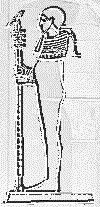
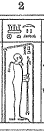
    Ptah was depicted in mummiform man, only his hands reaching forward out of his shroud, wearing a tight-fitting skull cap and carrying a combined waas scepter that incorporated the djed pillar, the ankh symbol.    A tassel hangs from the collar around his neck.    His beard is straight or curved.    He stands on a dais, suggesting connection to the primeval mound.
    As seen above on the upper section of the ESNE Plate 87 you can see an image of Ptah, where I have mistakenly titled two figures as Ptah, the one on the left is Ptah the one on the right is Khonsu.
    An image of Amset may be seen on ESNE Plate 79, but may be an image of Ptah.
    Ptah was married to either Bast, Sekhmet or Wadjet.    His union with Bast was thought to have produced a lion-headed god called Maahes, while Nefertem was his son by either Sekhmet or Wadjet.    Mennefer had a triad consisting of Ptah, Sekhmet and Nefertem.    The architect of the Saqqara Step Pyramid, Imhotep, after he became deified came to be regarded as the son of Ptah.    As father and creator of the gods, the deities he created first were Nun and Naunet and the nine gods of the Ennead.    The nine were Tem, Shu, Tefnut, Geb, Nut, Osiris, Isis, Set, and Nephthys who were considered to be both the teeth and lips of the mouth of Ptah and the semen and the hands of Tem.
    His temple Hwt-Ka-Ptaw, "Mansion of the Spirit of Ptah" was in Mennefer, leading to the Greek name Aigoptos, for Egypt.    He was also "Lord of Ankh-Tawy," "That Which Binds the Two Lands," where Upper and Lower merged.    He was also found at the Serapeum at Saqqara.
    Mennefer was located at the spot where Upper and Lower Egypt merged.    It is here that Ptah acquires several of his titles:     In "The Dawn of Astronomy" a study of the temple-worship and mythology of the Ancient Egyptians by J. Norman Lockyer, New York, The McMillian Company 1897, as seen on page 317-318, "We are driven, then, to the conclusion that the star Capella is personified by Ptah, and that as Capella was worshipped setting, Ptah is represented as a mummy ... the temples both at Annu and Memphis were dedicated to Ptah."
    The Greeks and Romans saw Ptah as Hephaistos and Vulcan.
    Ptah was the god discredited by the tenth plague of Egypt regarding death of the firstborn.    Ptah was a creator god, the third highest god in Egypt.    Ptah was only overshadowed by the sun god Ra, and the hidden god Amen.    He fashioned the universe through words of power and by thought, as well as creating different parts by hand.    He was an ancient god who the Egyptians worshiped through their long history.
    What other sources state about Ptah.
    It was believed that Ptah invented masonry and that it was he who crafted the boats that the dead used to travel to the Duat.    The Book of the Dead describes him as: ..."a master architect, and framer of everything in the universe"...
-- Egypt - Myths and Legends, Lewis Spence
    It was believed that Ptah created the heavens and the earth while Khnum fashioned the animals and people on his pottery wheel.    Ptah created the giant metal plate that was believed to be the floor of heaven and the roof of the sky, he also created the struts that upheld it.    He created the universe by speaking words through his Tongue (linked to the god Thoth and the goddess Tefnut) and by thoughts coming from his Heart (linked to Horus the Elder).    "There came into being as the heart and there came into being as the tongue ... in the form of Atem.    The mighty Great One is Ptah, who transmitted [life to all gods], as well as (to) their kas... (Thus) it happened that the heart and tongue gained control over [every] (other) member of the body, by teaching that he [i.e., Ptah] is in every body and in every mouth of all gods, all men, [all] cattle, all creeping things, and (every thing) that lives, by thinking and commanding everything that he wishes... Thus all the gods were formed and his Ennead was completed.    Indeed, all the divine order really came into being through what the heart thought and the tongue commanded.    Thus the ka-spirits were made... by this speech... Thus were made all work and all crafts, the action of the arms, the movement of the legs, and the activity of every member, in conformance with (this) command which the heart thought, which came forth through the tongue, and which gives value to everything".
-- Primal Myths, Barbara C. Sproul
    Not only was Ptah a god of creation, but he was involved with the soul's rebirth in the afterlife.    He was related to the dead since Old Kingdom times, where he was believed to have invented the Opening of the Mouth ritual to allow the spirit to be able to see, hear, speak and eat as a living being.    "The Osiris Ani [whose word is truth, saith]:- I eat bread. I drink ale.    I gird up my garments.    I fly like a hawk.    I cackle like the Smen goose.    I alight upon that place hard by the Sepulchre on the festival of the Great God.    That which is abominable, that which is abominable I will not eat.    [An abominable thing] is filth, I will not eat thereof.    That which is an abomination unto my ka shall not enter my body.    I will live upon that whereon live the gods and the Spirit-souls.    I shall live, and I shall be master of their cakes.    I am master of them, and I shall eat them under the trees of the dweller in the House of Hathor, my Lady.    I will make an offering.    My cakes are in Tetu, my offerings are in Anu.    I gird about myself the robe which is woven for me by the goddess Tait.    I shall stand up and sit down in whatsoever place it pleaseth me to do so.    My head is like unto that of Ra.    I am gathered together like Atem.
    Here offer the four cakes of Ra, and the offerings of the earth.    I shall come forth.    My tongue is like that of Ptah, and my throat is like unto that of Hathor, and I remember the words of Atem, of my father, with my mouth.    He forced the woman, the wife of Geb, breaking the heads near him; therefore was the fear of him there.    [His] praises are repeated with vigour.    I am decreed to be the Heir, the Lord of the Earth of Geb.    I have union with women.    Geb hath refreshed me, and he hath caused me to ascend his throne.    Those who dwell in Anu bow their heads to me.    I am [their] Bull, I am stronger than [the Lord] of the hour.    I unite with women.    I am master for millions of years
."
-- The Chapter of Making the Transformation into Ptah, The Book of the Dead
    Ptah was also a miracle worker.    It was believed that Ptah saved the town of Pelusium from Assyrian invaders with an army of rats.    Ptah ordered the rats to sneak into the camp of the Assyrians and gnaw through the bowstrings and shield handles of the enemy.    Without weaponry or defence, the Assyrian army fled.    It was also said that he stopped a fight between Horus and Set: "He judged between Horus and Set; he ended their quarrel.    He made Set the king of Upper Egypt in the land of Upper Egypt, up to the place in which he was born, which is Su.    And Geb made Horus King of Lower Egypt in the land of Lower Egypt, up to the place in which his father was drowned which is 'Division-of-the-Two-Lands.'    Thus Horus stood over one region, and Set stood over one region.    They made peace over the Two Lands at Ayan.    That was the division of the Two Lands."
-- The Shabaka Stone


    This file was created on June 18, 2005 and updated on May 30. 2006.

Return to the Table of Contents or the Zodiac of Denderah