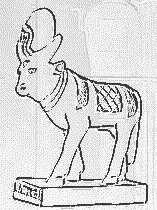
Apis a fertility symbol, developed into a sacred bull, or the "Ba" of the creator god Ptah at the cult center of MenNefer/Memphis, actually in the town of Zau (Sais) and Hut-Heryib (Athribis), whom also was the son of Ptah.
According to the Palermo Stone, the worship goes back to shortly after 3,000 B.C., and Manetho claims it in the Second Dynasty.
In the 22nd Dynasty (945-715 B.C.) on, the Apis bull was depicted on private coffins and regarded as a protector of the deceased.
During the Greek Period, the bull's mother was said to be Isis (as a heifer), who was said to have conceived him through a flash of lightning (Ptah in the form of fire).
By the means of oracles the Apis bull helped humans communicate with the creator god Ptah, and was a manifestation of the king, as symbols for strength and fertility.
This animal was chosen as being divine incarnation, and was black with a small white triangular mark in his forehead, and on his back there was a pattern like the wings of the vulture (or eagle).
Its image has a sun disc between its horns and a uraeus (coiled cobra) coming out of its head.
In 1851, Mariette discovered an underground gallery of tombs, which had been cut out for the bulls burials around 650 B.C. in tombs on the plateau of Saqqara, overlooking Men-Nefer (Memphis), as they were mummified, all had been plundered, and today the area is known as the Serapeum.
At the death of the Apis bull he was assimilated into the god Wesir (Osiris); Wesir-Apis which in the early Ptolemaic period became hellenized and called Serapis and combined with other Greek deities.