From The Alpha and the Omega - Volume III
by Jim A. Cornwell, Copyright © July 20, 2002, all rights reserved
"Volume III - Gods/Goddesses of Ancient Egypt"
BAT


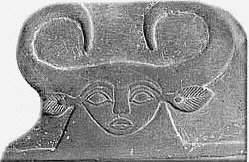
Bat as seen on the upper left hand corner
of the Narmer's Palette

    To return to the
Venus Decan (goddess Bat as similar to),
or List of Netjeru.
    Narmer's Palette as seen on page,
"http://www.mazzaroth.com/ChapterFour/NarmersPaletteObverse.htm" and
"http://www.mazzaroth.com/ChapterFour/NarmersPaletteReverse.htm" as seen below
UPPER REGISTER: REVERSE
Upper Register - Reverse Side

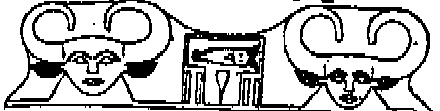
    Above we see the two man-faced Bull emblems with his name in the cartouche between the Bull-heads is pictured the King wearing the crown of Lower Egypt in procession.
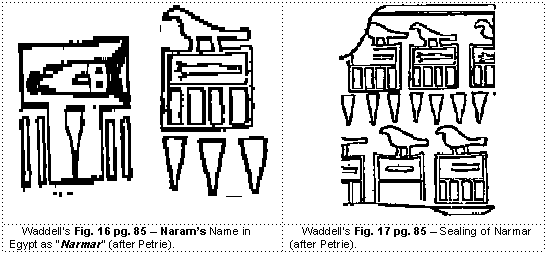
Serekh of Naram's Name


    Bat is a primeval deity, one of the cow goddesses from the 7th Upper Egyptian Nome, depicted on the Narmer Palette (ca 3100) with cow's horns and two faces.    Without inscriptional evidence it is still of caution, but it does seem likely, on stylistic grounds, that she was represented on the top corners of the Narmer Palette, rather than Hathor, making her a very old Egyptian deity.    In the New Kingdom she was assimilated with Hathor.
    She is rarely depicted in Egyptian art, except as a jewelery-amulet.    Her head is human but she shows bovine/cow's ears and horns coming out from her temples.    Her whole body forms a necklace counterpose.
    Bat's main cult center is Upper Egypt, the 7th nome, in fact, the whole iconography suggests the sacred rattle or sistrum, which is fittingly since her cult center is the district of Upper Egypt known as the "Mansion of the Sistrum."
    There has been discussions about the goddess image on top of the Narmer palette being Bat or Het-Hert.    Since textual evidence is lacking, only the image is there to suggest that it might be Bat than Het-Hert (G. Hart).    The earliest written sign of Bat is from the Pyramid Texts where it says: the King is Bat "with her two faces."    This might mean the front and back of her sistrum as carved on the Narmer palette.
    There is an earlier image of a goddess depicted on a palette on which it shows stars at the tip of her horns, indicating that, like most Egyptian cow deities, she has celestial connections, but it is still unsure if this is Bat.
    On the Denderah Zodiac in front of Pisces and behind Aquarius, Venus is seen as a male figure with the Egyptian waas-scepter.    It is unusual in that this figure has two faces, the one to the left seems to be a normal human face and looking backwards and the one on the right has a lion-like face and looking forward.
    Also Hathor has a reference as sometimes being called the "female soul with two faces."
    As seen above on the lower section of ESNE Plate 87, we see a figure which appears to have two faces similar to the one on the Denderah Zodiac for Venus.

    Other sources claim it is possible that Bat has a presence that maintains the unity of Egypt, both north with south and the Nile Valley with the deserts.    In addition to her pre-eminent position on the Narmer Palette, she is represented in the center of a pectoral of the 12th Dynasty flanked by the two protagonists in the struggle for the Egyptian throne, Horus and Seth, in a state of reconciliation.    However, her similarity to Hathor, the cow goddess worshipped in the neighboring southern district, was so close that Bat's personal identity was not strong enough to survive being totally assimilated by the New Kingdom.


    This file was created on June 18, 2005.

Return to the Table of Contents or the Zodiac of Denderah