From The Alpha and the Omega - Volume III
by Jim A. Cornwell, Copyright © July 20, 2002, all rights reserved
"Volume III - Gods/Goddesses of Ancient Egypt"
SEPDET
(Septet, Sopdet,
dog star: Sirius, Gr. Sothis
)


    To return to the
Denderah Decan Zero Or 37 - Grand Temple Decan 37 (Soped or known as the child of Sirius, Egyptian Sepdet or Septet),
Soped (son of Sah and Sepdet),
Hathor (identified with Sept, Sothis, Sirius, Venus-Aphrodite),
Isis (Isis sometimes appears as the star Sopdet, Sirius, Gr. Sothis),
or List of Netjeru.
    Sepdet (Egyptian name "Sopdet" from which came the Greek Sothis) was the goddess personifying the "dog-star" Sirius, the bright appearance of which in the July dawn sky announced the annual flooding of the Nile (7th day of Thuti - 25th of July).    This star was the most important of the stars to the ancient Egyptians, and the heliacal rising of this star came at the time of inundation and the start of the Egyptian New Year.
    As a goddess of the inundation, she was a goddess of fertility to both the living and the dead.    By the Middle Kingdom, she was believed to be a mother goddess, and a nurse goddess, changing her from a goddess of agriculture to a goddess of motherhood.    This probably was due to her strong connection with the mother-goddess Isis.    She also was linked to the pharaoh and believed to cleanse him on his journey in the afterlife.    It is interesting to note that the embalming of the dead took seventy days, the same amount of time that Sirius was not seen in the sky, before it's yearly rising.
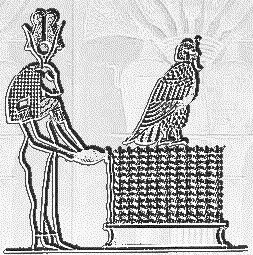
    She is portrayed as a lady with a star on top of her headdress.    Another image of her shows a woman with a cows head, with two hathor style horns with a sun disc between them, and two tall pumes, holding an object against an altar, that has a hawk figure (Ka - ka bird) perched upon it.    One source claims she can be seen as a seated cow with a plant between her horns as depicted on an ivory tablet of King Djer.    The plant may have been symbolic of the year, and thus linking her to the yearly rising of Sirius and the New Year.    She was very occasionally depicted as a large dog, or in Roman times, as the goddess Isis-Sopdet, she was shown riding side-saddle on a large dog.
    As early as the First Dynasty, Sothis was called "the bringer of the new year and the Nile flood."    The agricultural calendar started when Sirius appeared in the sky each year, the Nile generally started to flood and bring fertility to the land.
    The ancient Egyptians connected the two events, and so Sopdet took on the aspects of a goddess of not only the star and of the inundation, but of the fertility that came to the land of Egypt with the flood.    The flood and the rising of Sirius also marked the ancient Egyptian New Year, and so she also was thought of as a goddess of the New Year.
    Sirius was both the most important star of ancient Egyptian astronomy, and one of the Decans, star groups into which the night sky was divided, with each group appearing for ten days annually.    The heliacal rising, the first night that Sirius is seen, just before dawn, was noticed every year during July, and the Egyptians used this to mark the start of the New Year (wp rnpt, Wep Renpet "The Opening of the Year").    It was celebrated with a festival known as "The Coming of Sopdet."
    The time period between Sothic risings is called the Sothic Cycle and it is one of the tools Egyptologists use to create a chronology of Egyptian history.
    She was worshipped at Per-sopdu/Soped/Saft el-Hinna, in the 20th Nome of Lower Egypt.    She was the personification of the most important star of ancient Egypt, so important was she that her worship lasted through Egyptian history, from predynastic times, through to the Graeco-Roman period.
    In the Pyramid Texts, she is the goddess who prepares yearly sustenance for the pharaoh, "in this her name of 'Year'."    She is also thought to be a guide in the afterlife for the pharaoh, letting him fly into the sky to join the gods, showing him "goodly roads" in the Field of Reeds (or Field of Rushes) and helping him become one of the imperishable stars.    She was thought to be living on the horizon, encircled by the Duat.
    In the Pyramid texts, parallelling the story of Osiris and Isis, the pharaoh (king) was believed to have had a child (the morning star) with his sister Sopdet: "Your sister Isis comes to you rejoicing for love of you.    You have placed her on your phallus and your seed issues into her, she being ready as Sopdet, and Horus-Soped has come forth from you as Horus who is in Sopdet." -- Sopdet in the Pyramid Texts

    Gradually Sothis became linked with the constellation of Orion, because of the prosperity which resulted from the fertile silt left by the receding waters of the river.
    As seen that Grand Temple Decan 37 is called Soped or known as the child of Sirius, (Egyptian Sepdet or Septet) we see
a tall triangular figure or sign, which is unknown to me.    Although here it is represented as Sepd,
and since next is the bread loaf, Egypt. t,
and then it ends in a star, ‘gate.’
    We therefore see [Sepd-t], possibly the stars Sirius and Mirzam in Canis Major.
    As seen on "http://www.egyptologyonoline.com/ astronomy.html" a claim is made that "The god Sah (Orion on Denderah Decan 21 - Grand Temple Decan 36) was the personification of the constellation later known as Orion.    Sah was described as 'the glorious soul of Osiris' and formed a divine triad with the dog star Sopdet (Sepdet or Sirius on Denderah Decan 22 - Grand Temple Decan 35) and their son Soped (Soped, Sepd on Denderah Decan 37 - Grand Temple Decan 37), god of the 'eastern border'."
    Sopdet was believed to be wife of Sah (the star Orion) and the mother of Soped (Sopdu).    She was also thought to give birth to the Morning Star (Venus), the pharaoh being described as the father in the Pyramid Texts.    She was linked closely with Isis, just as Sah and Soped were linked with Osiris and Horus.    In "The Lamentations of Isis and Nephthys for Osiris," Isis calls herself Sopdet, saying that she will follow Osiris in the heaven.    Sopdet was also connected to the goddess Satet at Abu (Elephantine).    Sirius happens to travel the sky just ahead of the large constellation of Orion.    His belt of three stars serves as an easy pointer towards Sirius, the unmistakable bright star that is one of the few visible even in city lights' glare.    Orion was identified with the dying-and-resurrected god Osiris, in Egyptian mythology, who was one of the most well-known gods of the pantheon.    His wife and sister Isis was Lady of Magic, who brought her husband back to life, and the bright star his constellation followed naturally came to be associated with her.
-- Inventing the Solar System: Early Greek Scientists Struggle to Explain How the Heavens Move, Ellen N. Brundige
    She was also given a masculine aspect, and linked with Horus as Sopdet-Horus during the Middle Kingdom.    She was also linked with Anubis during Greek Times as Sopdet-Anubis, probably because of the iconography of her as a god, or riding on the back of a dog.    She was also linked with other goddesses such as Hathor, Bast and Anqet.


    This file was created on June 18, 2005.

Return to the Table of Contents or the Zodiac of Denderah