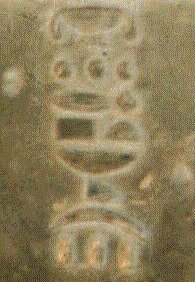
I became interested in this subject recently because an acquaintance informed me that in the crypts of Denderah in the entrance there is a symbol that has the key to the answer of what the Zodiac of Denderah is all about. I searched all my images for anything that had the hieroglyphs seen in the image below above the bulb-like figure on the right. I could not find anything in the standard monuments from the Napoleonic mission. The reason I could not find it is that it was in the crypts, which they never discovered.
There were a couple of websites promoting this subject with images regarding the above reference, as you will see in the following information I highlighted some of their work and used some of the images, and inserted my reference material to allow comparison. I have researched what has been presented but still have not determined an answer for any key. But then maybe it just has not hit me in the face as of yet.
Where are the crypts?
The finest examples of crypts are to be seen at the Denderah Temple dedicated to HATHOR (Athyr, Het-Her, Het-heru, Het-Hert, Hwt-Hert, Hethara, Hat-hor), where there is a total of three crypts, one each in the east, the south and the west outer edges of the main temple building. There are actually ten crypts, seven of which are located about ten meters beneath the temple within the foundations of its Eastern wall. The crypt described above is the only one now open to visitors, whose mysterious images appear in at least two other crypts in the complex, as well as in an upper register, just below the ceiling of room #7, at the rear of the temple.
The photograph displayed above is from the southern crypt, the only one currently open to the general public. Access to the crypt is through a once secret opening a wooden trap door in the floor behind the sanctuary, down a few steps of ladder to a very low gap in the stonework below ground level through which one must crawl on hands and knees. After this, a narrow passage leads into the equally narrow long rectangular crypt. Here you can see glimpses of the high relief contours of inscriptions and images of life-sized figures lining the walls.
What is the dating of the Temple and Crypts?
The Denderah temple is claimed to have been built between 54 B.C. and 60 A.D., since it has reliefs on its rear external wall depicting Cleopatra VII and her son Caesarion, which dates during the Ptolemaic and Roman periods.
The temples at Denderah were constructed upon the foundations of older ones, and that important data were reincorporated into the new building to preserve knowledge of Egypt's historic past. The temple's necropolis even includes tombs from the earliest dynastic times (3100-2890 B.C.). Thus proposing the temple has a deep enough connection with the past to make it a mystery.
Although the crypt complex does contain Old Kingdom texts and reliefs of King Pepi II (6th dynasty, c. 2175 B.C.). And there is evidence that Khufu (Old Kingdom 4th dynasty c. 2675 B.C.) and Thothmose III (18th dynasty, c. 1480 B.C.), also built there. By the Late Period crypts were included in the architectural design of most temples.
What were the Crypts used for?
Egyptian temple crypts were used for storing archives and equipment such as cult statues, which were probably, made of gold, while others contained magical emblems for the temple's protection and also a place of refuge for external threats. The Denderah crypts are decorated throughout with religious imagery and inscriptions that include a description of the festivals that were held there. They also state that their entrance and place are hidden, so it is assumed the crypts were of a cultic nature, and not for storage.
The cult-statues were considered to be "life-less" and the "body" of the deity now rested as a "corpse" in the underworld. The "corpse," once brought out of the crypt had to be brought back to life through rituals. Certain statues were "processed" to live again through the "Opening of the Mouth" ceremony, which was practiced in the Gold House situated close to the crypt.
The wall reliefs of the well-worn staircases leading from the main temple to the roof, where chapels, rooms, ramps and staircases can be observed, depict the rituals which were held at different times of the year for the statues of different deities.
Egypt's deities in history.
If we check the identities and references of the entities involved on the image.
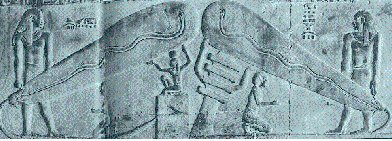
Two of the oldest cults in Egypt are the frog goddess HEKET (Heqet, Hehet, Hauhet), ("He" rooted in "heh," eons of time and eternity; the hieroglyph for "qet" the pointed knife, "qualities, dispositions, abilities, virtues) can be seen on the far right, where she holds two knifes to cut the umbilical cords of the newborn. She was a cohort with the ram-headed, KHNUM (Khenmew, Khnemu, Khenmu, Chnum), seen as the parallel companion to the left. Both were part of the first gods who built men and made the gods. Heqet gave the spark of life into the embryo of the unborn and Khnum, fashioned them on his potter's wheel, and also created the pharaoh's "KA" (etheric double) prior to birth.
On source claims that the hieroglyphs before Heqet means "uniter of attributes."
Above the large snake-containing bulbs the inscription reads, "Gold Ka." Referring to Horus the divine solar hawk because he is magnificently etched on the wall, off to the right. In the cosmologies of Heliopolis and Hermopolis are crypt scenes: The "Island of Flames" (birthplace of the sun) which at the center of the sacred "Lake of the Two Knives" (associated with Heqet). At the center of this island was the sacred lotus containing the cosmic egg. The world became manifest at the beginning of time when the sacred lotus opened and the cosmic egg within it hatched the luminous god. Inscriptions in the Temple show the king performing the "Offering the Lotus" to Horus.
"I offer thee the flower, which was in the beginning, the glorious lotus of the great water. Thou camest forth from the midst of its petals . . . and did lighten the Earth, which was still wrapped in darkness." This was also said of Re, who is not the sun himself, but the principle of light that causes the solar radiance. One of his epithets is Nekhbu-ur Re ("Re, the Great Lotus"), which I cannot confirm that association with Re. He also is referred to as "That great god who is within the lotus bud of gold." And that is what the hieroglyphs directly above the lotus bulbs read, "Gold Ka."
Another source claims the reliefs in the southern crypt depict Harsomtu (or Harsomtus), a variation of the child god Ihy, son of Hathor and Horus, with priests assisting the birth and extracting the waters of inundation, which were said to issue from his mouth. Hathor was said to be the mother of the pharaoh, and is often depicted in a nurturing role, suckling the pharaoh when he was a child. Other than the pharaoh - a living god - she was believed to have a son with Horus-Behdety, a form of Horus the Elder, known as Ihy (Ahy, Horus-Sematawy, Harsomtus), who was shown as a falcon-god, a child-god of music and dancing who carried a sistrum, and as a serpent. Harsomtu or Horsematawi is the Greek form of the Egyptian Hr-smA-tA.wj, "he who unites the two lands." The three were worshiped at Iunet. "My majesty precedes me as Ihy, the son of Hathor."
The snakes coming from the lotus symbolize fertility. The snake was the first animal to rise from the primeval waters in the same way as Harsomtu, like the sun-god Re, burst from the lotus. Harsomtu originated from, and was venerated as, a serpent at a town called Khadi on the east bank of the Nile, where the deity was connected to an agricultural fertility cult. His principal function appears to have been in restoring the inundation. This particular crypt is situated in the southeastern angle of the temple, which may give a connection between the rising of the sun and its brilliance when in the south. So the assumption that the unusual balloon-like shapes surrounding the snakes, is a hieroglyph (alerti or jtr.t.y in Ptolemaic hieroglyphs) representing the "north and south" or the double shrines of Lower and Upper Egypt. The hieroglyph is used in The Decree of Canopus (Wallis Budge).
Hieroglyphs above the right bulb.
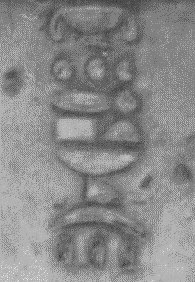
A negative of the image to the left.
The issue of the mysterious light bulbs of the serpent crypts.
Conclusions about the "serpent crypts" at Denderah varies among researchers, where some claim the images show a type of ancient energy technology as if it is an electronic light device system. Speculation is that the large bulb-like objects being early electron tubes or archaic light bulbs. The long cables attached to the bulbs have been interpreted as bundles of conducting electrical wires. The pillar with the four cross-struts (an Egyptian "Djed") has been seen as some kind of high voltage insulator.
Usually the underworld serpent was everyone's worst nightmare, threatening world order by scheming to prevent the sun from rising, the Egyptians regarded the glorious solar serpent as the symbol of elemental fire, and portrayed draped over the sun disk, or rearing up as the fire-spitting Uraeus serpent that graced the king's forehead as his living diadem. But as the radiant core of its own fire element the solar serpent resided vertically within the solar disk as the resplendent center of the center, it's essence-the Ka of the Sun.
As if that were not convincing enough, Rundle Clark writes, "Hence, what rises from the opening flower is the world soul which is the light, [and] life ...of the sun" and that the pictorial symbolism the lotus "opens to reveal the head of the emerging soul, the Divine Child." The Pharaoh was traditionally portrayed as a young child within the lotus flower. And in later times, lay people too, aspired to the same ideal.
The god who personifies attributes of the newly born sun is NEFERTUM (Nefer-Tem, Nefertem, Nefertemu, Nefer-Temu, Iphtimis). He wears the long-stemmed lotus upon his head. So, too, are the heads of most mummy sarcophagi guilded with a golden lotus.
Although three lotus bulbs are displayed in the crypt reliefs, the tableau is actually a representation of the One archetypal lotus of creation in three separate phases of embryonic development.
On the left is Atum-Ra (Tum, Tem)) (creative principle of heaven and Earth) supporting the lotus from below.
On the right is the next growth phase where the bulb is being supported by the Djed (symbol of stability), whose upraised arms form the ideogram "Ka," thus emphasizing the contents of the bud as the solar "Ka."
At the far right of the crypt the third-phase bud is supported by everyone, Atum-Ra, the Djed, the two-seated figures, plus an unidentified female.
Confirming this view, one set of hieroglyph reads, roughly, "Golden Lord of the Sky, exalted (raised up?), three lunar months."
The other set of hieroglyphs specify "four lunar months." It does not say how old the third bud is.
The two large figures behind the lotus buds each stand upon a rectangular block (symbolizing a body of water out of which the lotus grows). There are slight differences between the size and height of each body of water, suggesting separate stages of the divine bud's development.
Since the lotus is a flower that opens up towards the light at dawn it is likely that the fully mature lotus bud is depicted in its mature vertical attribute in one of the other crypts. One researcher has in fact referred to two additional panels showing the lotus bulb containing the serpent in an independent upright position, minus the supporting attendant figures and connecting "cable" (i.e., stem), but identified no location.
In connection to the lotus as to the Zodiac of Denderah see the following link for more on this subject HARPOCRATES (Heru-Pa-Khret, Harpakhrad).
So is the crypt debunked?
Are the huge bulb-shaped objects lotus bulbs (a source of radiance) and not electron tubes?
Are the serpents within the bulbs the Ka of Horus (with its own radiation) and not an electron beam or electric current?
Are the bud bulbs the long graceful stems of the lotus that are rooted in mud below the water level of marshes, rivers, or the mythic primeval waters? Do the stems connect to rectangular blocks ("bodies of water"), not power generator boxes?
Is the Djed pillar supporting the lotus bulb a symbol of "stability," not a high-voltage insulator?
And beneath the lotus bud, two of the figures use their heads as supports, easing the burden by means of a circular pad. They are not receiving energy rays from the bulb through their heads.
The following link is a highlight of a critical analysis of those who promote the "electric light bulb" theory by Frank Dörnenburg as seen on his site at http://www.world-mysteries.com/sar_lights_fd1.htm, titled "Electric Lights in Egypt?"
Sources:
http://www.atlantisrising.com/issue17/denderahserpentcrypts.html - "NEW LIGHT ON DENDERAH'S "SERPENT CRYPTS" Challenges the 'Electric Bulb' Theories by Moira Timms, author of "Beyond Prophecies & Predictions" is an "archaic-futurist" and researcher whose work encompasses a deep understanding of ancient Egyptian sacred science, (its symbolism, mythology, and mysteries) Jungian psychology, and prophecy.
http://users.iafrica.com/g/gr/grenvill/denderah.htm - Denderah Temple Crypt by Keith Grenville. Sources: Cauville, Sylvie. 1990. Le Temple de Dendera: Guide Archéologique. Bibliothèque générale 12. Cairo, Institut français d'archeologie Orientale du Caire. P. 58. W. Waitkus, Die Texte in den unteren Krypten des Hathortempels von Dendera, MÄS 47, Mainz, 1997.
Conclusion.
I will continue to search for the answer and update this page as I find anything substantial.
This file was created on September 19, 2007, and updated on August 10, 2009.