From The Alpha and the Omega - Volume III
by Jim A. Cornwell, Copyright © July 20, 2002, all rights reserved
"Volume III - Gods/Goddesses of Ancient Egypt"
HEKET
(Heqet, Hehet, Hauhet)


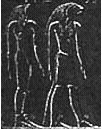
Heh and Hauhet
    To return to the
Denderah Decan Zero Or 37 - Grand Temple Decan 37
(One of the eight primordial deities - Ogdoad),
Heka (Heket's consort),
Ogdoad (eight primordial deities),
Denderah Serpent Crypts (Heket's associaton),
or List of Netjeru.
    Hauhet the feminine side of the god Heh, was a much more obscure goddess than her husband, more of a representation of duality than an actual goddess.    She was a snake-headed woman who ruled over infinity with her husband.    Her name was the same as her husband's, except with a feminine ending.
    Heh and Hauhet are the active and passive infinity, mostly conceived in relation to time, and is consequently equivalent to, and often described by the Greek Aion, as infinity of form it resembles Eros.    The first act of a creation is the formation of an egg, which rises upon the hands of Heh and Hauhet out of the primeval matter.    Out of the egg arises the god of light, Ra, the immediate cause of life in this world.
    The hieroglyph for a frog is .

    As to any connection with Hauhet in regard to Heket.
    Heqet (Heket) (Greek Hecate or Hekate) was a woman with the head of a frog or a frog headed goddess of childbirth, creation and grain germination, a water deity with a papyrus shape on her scepter.    As a water goddess, she was also a goddess of fertility (reproduction) associated with the later stages of labour and resurrection.    In this way, the title of "Servants of Heqet" may have been a title applied to her priestesses who were trained as midwives.    And she helped Osiris to rise from the dead.
    The ancient Egyptians saw thousands of frogs appear all along the Nile at certain times of the year.    This appearance of the amphibian came to symbolise fruitfulness and coming life.
    Often called the wife of Khnum the god who created men on his potter's wheel, and she gave the newly created being the breath of life before the child was placed to grow in the mother's womb.    She was also regarded as the wife of Horus the Elder in the myths of Osiris, she was represented at the funeral as a frog, symbolic of life and fertility after death.
    Heqet was worshipped at Gesy/Apollonopolis/Parra/Qus, in a Ptolemaic temple, of which only a pylon remains.    She was also known as "Lady of Her-wer" (Antinoe): A tomb at Tuna el-Gebel has text speaks about a procession in her honour where she asks that the temple of Heqet at Her-wer be restored and protected from inundation, but this temple has not been found, yet.
    She was one of the gods discredited by the Biblical second plague of Egypt regarding frogs.
    In Egypt she was a goddess of creation, birth and the germination of corn.    A midwife, assisting at the daily birth of the sun, where some say that Shu (who married Tefnut) was her husband.
    Hecate or Hekate in Greek Mythology was an ancient fertility goddess who later became associated with Persephone as queen of Hades and protector of witches.
    Other sources claim in the story of the triplets who would be pharaohs, she was the goddess of magically "hastens the birth," in an unspecified manner.
    In Hatshepsut's (1473-1458 B.C.) birth colonnade, it was Heqet, with Khnum, who led Ahmose to the birthing room.    She also was depicted as the goddess who held the ankh sign of life to Hatshepsut and her ka, fulfilling her job as the giver of life to the newly created child.
    She originally appears in the pyramid texts where she helps the pharaoh ascend into the sky (Pyramid Text 1312).    She is also connected with the Osiris myth in the "Funeral of Osiris" at Iunet (Dendera): Osiris, ithyphallic and bearded, in mummied form, lying upon his bier; over his feet and his body hover the hawks.    At the head kneels Hathor, "Mistress of Amenty, who weepeth for her brother," and at the foot is a frog symbol of the goddess Heqet, beneath the bier are an ibis-headed god holding the Wedjat (Eye of Horus or Ra), two serpents, and the god Bes.
    Amulets of Heqet were worn by women to protect them while they gave birth.    These amulets were usually of her as a frog.    During the Middle Kingdom ritual ivory knives and clappers, a type of percussional musical instrument, bore her name or image as protection for inside the home.    She was also sometimes shown on the ivory "magic wands," which were also linked to the childbirth-related deities Bes and Taweret, and probably used to ward off evil.


    This file was created on June 18, 2005, and updated on September 19, 2007.

Return to the Table of Contents or the Zodiac of Denderah