"Volume III - Denderah Serpent Crypts Critical Analysis"
The Crypts of the Denderah Temple.
My comments
This page is a continuation of my investigation of the crypts of the Denderah Temple, although it is a critical analysis of its mysteries.
But first I present some of the information in the following article about who the main deities seen in the crypt are:
Heh or HEKA (Heq, Heh, Huh) was a frog or human headed god, one of the original eight gods of the Ogdoad of Khmunu (Hermopolis), the god of infinity and time, the god of long life and eternity, in his hand he is shown holding one or two palm fronds of "A Million Years" in his hands, the Egyptian sign of long life. Sometimes he was shown wearing a palm frond on his head, as a headdress.
As a god of infinity, his name was linked to numbers, and his determinative was an image with his arms raised, used for "one million." It seems that "million" was a number for eternity as in the "Barque of a Million Years" was the name of the boat that the sun god Ra travelled in during the day, which the Egyptians believed would happen until the end of time, when chaos took over the land once more.
Other sources claim a centerpiece of a princess' necklace is composed around the throne name of King Senwosret II found among the jewelry of Princess Sithathoryunet (sit-hathor-you-net) in a special niche of her underground tomb beside the pyramid of Senwosret II at Lahun. The hieroglyphic signs might be read as a text saying, "The god of the rising sun grants life and dominion over all that the sun encircles for one million one hundred thousand years [i.e., eternity] to King Khakheperre [Senwosret II]." The cartouche rests on the bent tops of palm fronds (signs for "year") that are held by a kneeling Heh, god of eternity and sign for "one million," then a tadpole, sign for "one hundred thousand" dangles from the god's right elbow.
Heka is one of the three creative powers of the sun god Ra, which are necessary for Creation to come about. Thus the divine energy or the life force, the Sia - divine knowledge.
Heka was a man standing in front of naus where the sun-god is seen, in the sunboat, holding different ritual objects. The word heka means "magic" or "life force in action."
Another source shows Neheh (Heh) as a squatting man wearing a curved reed on his head and carrying symbols of life, like the crux ansata, like the one that Atum (Tum, Tem) carries.
The hieroglyph for a snake is .
Heh and Hauhet came to symbolise infinity and limitless time, and long life.
As well as being a god of time and infinity, he was also an air god, identified with Shu, Heh was a god of the wind who was linked to the four pillars that held up the sky. Like Shu, he was sometimes shown with his arms raised to help hold up the sky. As seen on the Coffin Text, Spell 76, "O you eight chaos gods, keepers of the chambers of the sky, whom Shu made from the efflux of his limbs, who bound together the ladder of Atum...The bnbn [phoenix] of Ra was that from which Atum came to be as Heh... I am the one who begot the chaos gods again, as Heh, Nun, Amen, Kek. I am Shu who begot the gods."
Heh was also eight different gods, like Hathor and the seven Hathors who were believed to support the great celestial cow in the heavens. He, like Nun, was also believed to hold up the solar barque of Ra, and to lift it up into the sky at the end of its voyage through the land of the dead.
Some believe that Heh was a representation of fire at one point, though it seemed that he was regarded as representing different things over time. While being a god of fire, he was shown as a snake headed god.
HEKET (Heqet, Hehet, Hauhet), ("He" rooted in "heh," eons of time and eternity; the hieroglyph for "qet" the pointed knife, "qualities, dispositions, abilities, virtues) can be seen on the far right, where she holds two knifes to cut the umbilical cords of the newborn. Heqet gave the spark of life into the embryo of the unborn. On source claims that the hieroglyphs before Heqet means "uniter of attributes."
Hauhet, as a goddess personifying fire, was shown with the head of a cat.
She was a cohort with the ram-headed, KHNUM (Khenmew, Khnemu, Khenmu, Chnum), seen as the parallel companion to the left. Both were part of the first gods who built men and made the gods and Khnum, fashioned them on his potter's wheel, and also created the pharaoh's "KA" (etheric double) prior to birth.
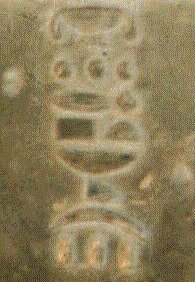
Above the large snake-containing bulbs the inscription seen below reads, "Gold Ka," referring to:
Horus the divine solar hawk because he is magnificently etched on the wall, off to the right. In the cosmologies of Heliopolis and Hermopolis are crypt scenes: The "Island of Flames" (birthplace of the sun) which at the center of the sacred "Lake of the Two Knives" (associated with Heqet).
At the center of this island was the sacred lotus containing the cosmic egg. The world became manifest at the beginning of time when the sacred lotus opened and the cosmic egg within it hatched the luminous god. Inscriptions in the Temple show the king performing the "Offering the Lotus" to Horus.
"I offer thee the flower, which was in the beginning, the glorious lotus of the great water. Thou camest forth from the midst of its petals . . . and did lighten the Earth, which was still wrapped in darkness."
This was also said of Re, who is not the sun himself, but the principle of light that causes the solar radiance. One of his epithets is Nekhbu-ur Re ("Re, the Great Lotus"), which I cannot confirm that association with Re. He also is referred to as "That great god who is within the lotus bud of gold."
Hieroglyphs above the right bulb.
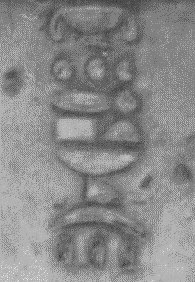
A negative of the image to the left.
And that is what the hieroglyphs directly above the lotus bulbs read, "Gold Ka."
Another source claims the reliefs in the southern crypt depict Harsomtu (or Harsomtus), a variation of the child god Ihy, son of Hathor and Horus, with priests assisting the birth and extracting the waters of inundation, which were said to issue from his mouth.
Hathor was said to be the mother of the pharaoh, and is often depicted in a nurturing role, suckling the pharaoh when he was a child. Other than the pharaoh - a living god - she was believed to have a son with Horus-Behdety, a form of Horus the Elder, known as Ihy (Ahy, Horus-Sematawy, Harsomtus), who was shown as a falcon-god, a child-god of music and dancing who carried a sistrum, and as a serpent.
Harsomtu or Horsematawi is the Greek form of the Egyptian Hr-smA-tA.wj, "he who unites the two lands."
The three were worshiped at Iunet. "My majesty precedes me as Ihy, the son of Hathor."
The snakes coming from the lotus symbolize fertility. The snake was the first animal to rise from the primeval waters in the same way as Harsomtu, like the sun-god Re, burst from the lotus. Harsomtu originated from, and was venerated as, a serpent at a town called Khadi on the east bank of the Nile, where the deity was connected to an agricultural fertility cult. His principal function appears to have been in restoring the inundation.
This particular crypt is situated in the southeastern angle of the temple, which may give a connection between the rising of the sun and its brilliance when in the south.
So the assumption that the unusual balloon-like shapes surrounding the snakes, is a hieroglyph (alerti or jtr.t.y in Ptolemaic hieroglyphs) representing the "north and south" or the double shrines of Lower and Upper Egypt. The hieroglyph is used in The Decree of Canopus (Wallis Budge).
The issue of the mysterious light bulbs of the serpent crypts.
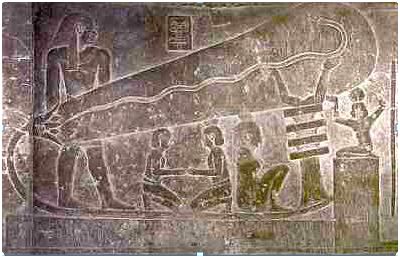
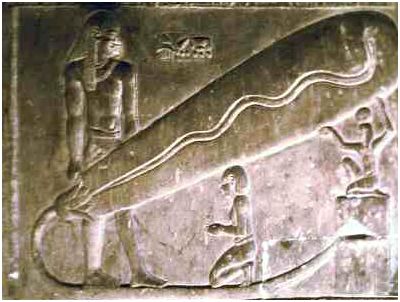
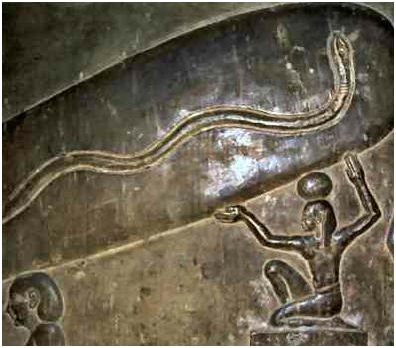
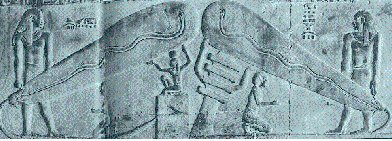
Conclusions about the "serpent crypts" at Denderah varies among researchers, where some claim the images show a type of ancient energy technology as if it is an electronic light device system. Speculation is that the large bulb-like objects being early electron tubes or archaic light bulbs.
The long cables attached to the bulbs have been interpreted as bundles of conducting electrical wires.
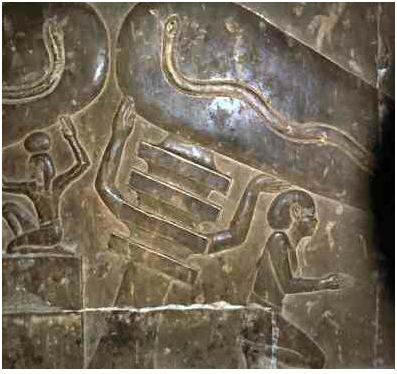
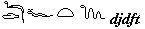
The pillar with the four cross-struts (an Egyptian "Djed") has been seen as some kind of high voltage insulator.
Usually the underworld serpent was everyone's worst nightmare, threatening world order by scheming to prevent the sun from rising, the Egyptians regarded the glorious solar serpent as the symbol of elemental fire, and portrayed draped over the sun disk, or rearing up as the fire-spitting Uraeus serpent that graced the king's forehead as his living diadem. But as the radiant core of its own fire element the solar serpent resided vertically within the solar disk as the resplendent center of the center, it's essence-the Ka of the Sun.
As if that were not convincing enough, Rundle Clark writes, "Hence, what rises from the opening flower is the world soul which is the light, [and] life ...of the sun" and that the pictorial symbolism the lotus "opens to reveal the head of the emerging soul, the Divine Child." The Pharaoh was traditionally portrayed as a young child within the lotus flower. And in later times, lay people too, aspired to the same ideal.
The god who personifies attributes of the newly born sun is NEFERTUM (Nefer-Tem, Nefertem, Nefertemu, Nefer-Temu, Iphtimis). He wears the long-stemmed lotus upon his head. So, too, are the heads of most mummy sarcophagi guilded with a golden lotus.
Although three lotus bulbs are displayed in the crypt reliefs, the tableau is actually a representation of the One archetypal lotus of creation in three separate phases of embryonic development.
On the left is Atum-Ra (Tum, Tem)) (creative principle of heaven and Earth) supporting the lotus from below.
On the right is the next growth phase where the bulb is being supported by the Djed (symbol of stability), whose upraised arms form the ideogram "Ka," thus emphasizing the contents of the bud as the solar "Ka."
At the far right of the crypt the third-phase bud is supported by everyone, Atum-Ra, the Djed, the two-seated figures, plus an unidentified female.
Confirming this view, one set of hieroglyph reads, roughly, "Golden Lord of the Sky, exalted (raised up?), three lunar months."
The other set of hieroglyphs specify "four lunar months." It does not say how old the third bud is.
The two large figures behind the lotus buds each stand upon a rectangular block (symbolizing a body of water out of which the lotus grows). There are slight differences between the size and height of each body of water, suggesting separate stages of the divine bud's development.
Since the lotus is a flower that opens up towards the light at dawn it is likely that the fully mature lotus bud is depicted in its mature vertical attribute in one of the other crypts. One researcher has in fact referred to two additional panels showing the lotus bulb containing the serpent in an independent upright position, minus the supporting attendant figures and connecting "cable" (i.e., stem), but identified no location.
In connection to the lotus as to the Zodiac of Denderah see the following link for more on this subject HARPOCRATES (Heru-Pa-Khret, Harpakhrad).
And now for the critical analysis by Frank Dornenburg, who made a valid attempt to debunk many of the speculation on the images of the crypts of Denderah.
In the temple of Hathor at Dendera, several dozens of kilometers north of Luxor, there are reliefs interpreted by some "experts" as lamps.
The theory that electricity was known and used in antiquity seems to be based on pots found a few hundred kilometers east of Egypt in 1936, in today's Iraq, which contained watertight copper cylinders, glued into the opening with asphalt. In the middle of the cylinder was an iron rod, held in place also with asphalt, and was stated as a galvanic element, a primitive battery, which did indeed show that it was possible to create electricity with it.
A key element for the electro-thesis is actually something that is missing, which is soot, in many thousands of subterranean tombs and pyramid shafts, where they are full of often colorful paintings. The primitive light sources the Egyptians knew (candles, oil lamps etc.) are always leaving soot and are using oxygen. So how DID the Egyptians get their light? Some rationalists are arguing with mirrors, but the quality of the copper plates the Egyptians used as mirrors were not good enough for that.
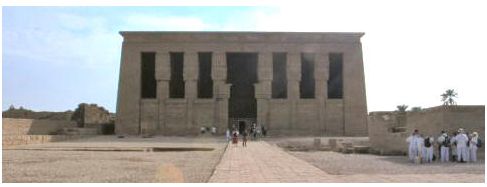
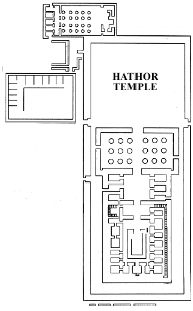
Temple of Hathor in Dendera
In the temple in Dendera, several dozens of kilometers north of Luxor, a Norwegian electrical engineer noticed that the object shown on the relief on top of this page could work as a lamp. An Austrian colleague was able to construct a working model, and two well known authors in the AAS, Peter Krassa and Rainer Habeck, worked out a real theory based on it. What we see is without question a form of bulb, with two arms reaching into it near its thick end, and a sort of cable at the other end, from where a snake is leaping out to touch the arms on the other side. The whole ensemble really looks like a lamp.
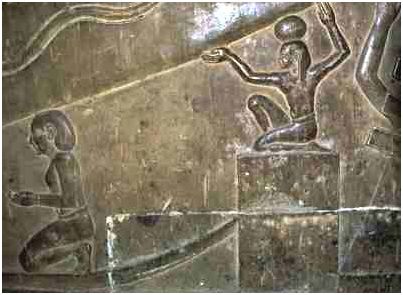
Another picture from the crypts of Dendera:
Eastern relief on south wall
Is this the proof? Did the Egyptians know and use electric lights? If so, where did they get the principle from? Was it from their own invention, or did they have help?
Soot and Lamps
I will examine some of the circumstantial evidence, several authors use to prepare the "light mystery" are in contrast to what I have seen personally. Here are two of many quotes:
"Krassa and Habeck are telling us, that torches, oil lamps or candles are emitting soot on a large scale, which must be detectable on walls and ceilings. But that is not the case." [ Däniken, Erich von; Die Augen der Sphinx, Ullstein 1989, P. 215]
or
"In the Roman and Greek world torches and oil lamps were used to light the buildings. Wherever places are left where such devices were positioned, we can find traces of soot on the walls and ceilings. But in ancient Egypt ... we can find these combustion traces nowhere." [Ercivan, Erdogan; Das Sternentor der Pyramiden, Bettendorf 1997, P. 83]
This chamber is completely above ground, built by Snofru, father of the builder of the Great Pyramid, Khufu. The soot seems to be millimeters thick, and if one goes through the pyramid passages in Egypt a look at the ceiling is enough to find soot in abundance.
The oldest comment known to me about soot in the Great Pyramid is from John Greaves, in a book from 1638!! [Explained in: Lauer, Jean-Phillipe; Das Geheimnis der Pyramiden, Herbig 1980, P. 37 f ]
The passages and chambers in Egyptian pyramids were built with a few exceptions in open ditches like the example of Abu Roasch. A large dugout was furnished with several layers of floor- and wall blocks, the sarcophagus was lowered into the open chamber, ornamented wall parts, finished outside, were lifted down and put in place, the roof was positioned, and then the ditch was refilled. The whole construction process took place in broad daylight.
The great chambers of the red pyramid, and the passages in the great Pyramid, also were built in full daylight. The whole time, until the last ceiling block was positioned years after the chamber was begun, all tasks like polishing and furnishing the walls and roof beams could be done in daylight. Why should there be soot in such constructions? In the pyramid age only very few construction projects needed artificial light, like the Djoser-labyrinth and the underground passage and chamber in Khufu's pyramid.
It's the same with the decorated chambers of the pyramids of the 5th and 6th dynasty. All decorations could be put to the wall blocks in broad daylight which were then covered afterwards. Even most of the private mastaba tombs could be finished with no artificial light. So missing soot in all these constructions would be no mystery at all.
In all these buildings which did not need any artificial lighting, soot can be found. Even the walls of the crypts where those supposed light bulb reliefs were found are covered with soot, as this picture shows:
Dendera - Soot on lamp relief
The original white color of the lime stone can be seen on the edges of the re-set block...
The book quotes from above have now been falsified twice. For one, many of the passages needed no artificial lighting, and second they also contain lots of soot.
The source of the soot is pretty clear: almost all buildings have been opened in antiquity and were tourist attractions through the centuries, even millennia. For example: Greek writings were found in the subterran chamber of the Great Pyramid.
There were thousands of visitors in them, and every single one of them, until the beginning of the 20th century, had to use oil lamps, candles or open flame torches to get light. And all those people spent a much larger amount of time in those buildings than the original builders.
TECHNICAL ISSUES
The "Lamp"
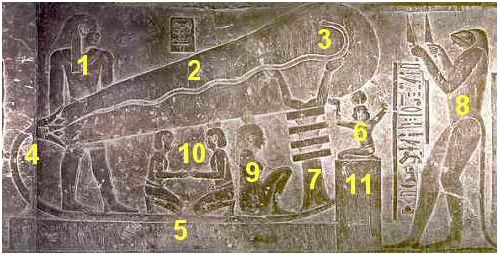
The author critiqued the book "Lights of the Pharaohs" by the Austrian authors Krassa & Habeck, as the representatives of the electro thesis interpret the famous Dendera picture. [The numbers are equal to the ones in the sketch in Krassa/Habeck; Das Licht der Pharaonen, Herbig 1992, p. 231] Krassa/Habeck are giving the following explanations. [ibd.]
1. Priest –
2. ionised fumes
3. electric discharge (snake)
4. Lamp socket (Lotos)
5. Cable (Lotos stem)
6. Air god
7. Isolator (Djed-Pillar)
8. Light bringer Thot with knifes
9. Symbol for "current"
10. Inverse polarity (Haarpolarität +)
11. Energy storage (electrostatic Generator?)
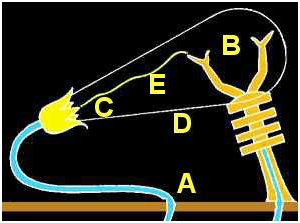
On the basis of this picture engineer W. Garn constructed a working device which indeed gave some light. In the book of Krassa/Habeck we find he following sketch and description:
"If we evacuate a glass bulb with two metal parts reaching into it (B), (C), we can see a discharge at much lower levels, depending on the size of the glass balloon (D). At a pressure of about 40 t (tonnes) (40 mm of mercury) a snakelike light filament meanders from one metal part to the other (E). If we evacuate further, the light filament grows wider until it fills the whole glass balloon. This is exactly what we see in on the pictures in the subterranean chambers of the Hathor sanctuary." [ibd. p. 239, emphasize by me]
This is the basis of the technical interpretation. Sounds logical, sounds comprehensible – but it doesn't work! The critical view based on the word "two" in Garns comment, in that every "normal" lamp needs two electrodes to produce light, a simple light bulb or the Garn-construction. The problem is, that the "working" lamp picture in Dendera is only one of six. And from all six pictures this is the ONLY one where something reaches "into" the "bulb"!
The pictures of the objects can be seen three times in the subterranean crypts and three times in an associated "cult room." I will discuss later. The "working" lamp is once shown in the crypt. Three times pictures like this, with the air god Heh carrying the "lamp" are shown (one in the crypt, two in the cult room):
and two times this way with a djed pillar outside of the "lamp" (once in the crypt and once in the cult room):
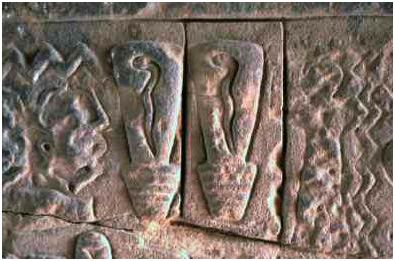
These objects could never have been lamps. Neither a Garn-type nor a "normal" light bulb. Even other pictures of similar objects in the chapels around the temple are seen without Djed, lotus or generator:
Dendera - Snake Stella
This is a picture with so-called snake stones, which Krassa and Habeck make fun of as "silly explanations of Egyptologists." Thus the "lamp explanation" works only for one of six large pictures, and for none of the uncountable snake stones in this temple and in all of Egypt.
The explanation was: "The Egyptians saw the whole thing just a short moment, so they couldn't remember how the thing really looked like." The core of the lamp-story is, that the Egyptians used those things centuries, even millennia, to routinely light out their pyramids and tombs, but they could not remember how their daily tool looked like?
Even the "reduced model" was that only priests had this magical instrument and showed it a few times a year to the astonished masses, fails, because they had to have the objects at hand and could have copied them.
But there are more problems demolishing even the basic idea that those things could be light bulbs of any kind. Krassa/Habeck seem to believe that the objects on the pictures are shown in their natural proportions with regard to the "priest" behind the lamp (although they are wondering, that some other people are shown smaller than the priest). [ibd. p. 97] If we use the priest as scale, the objects on the relief must be around 2.5 m long with a largest diameter of one meter, and a smallest diameter of 50 centimeter! The construction used, the bulb had to have a near vacuum inside - can you imagine the air pressure resting on such a device?
To calculate it, with a length of 2.5 meters, a largest thickness of one meter and a smallest thickness of 50 centimeters we can calculate the volume roughly as a truncated cone of approximately 2 m length (Volume = Pi * h /3 * (r12 + r1 * r2 + r22) and a hemisphere of one meter diameter (Volume 2/3 Pi r3). The combined volume is around 1.12 cubic meters, the surface of the object amounts to approximately 6.3 square meters. If the object is evacuated, a pressure of about 63 t (tonnes) would rest on a Dendera object. To withstand such an immense pressure, the object would have to be quite thick-walled, at least two to three centimeters thick. The weight of this bulb would be then approximately 750 kilograms. And this monster would be nevertheless a ticking time bomb: a small crack in the glass by uneven cooling with the manufacturing, and the Dendera lamp implodes with the force of a bomb. The fragmentation effect might be deadly in the periphery of several meters! This cannot be done by modern manufacturing, and the Egyptians had no technical industry at all.
One source claimed they could fill it with a noble gas, which grows on date palms, but it would still require a real industrial technology to get those gasses, which did not exist before the 20th century. The Dendera lamp would have to contain enough gas to fill at least 713000 halogen lamps with a lighting performance of together 14 million Watts.
Glass became a prestigious high price product around 1,500 B.C.E. - more than 1,000 years after the great pyramids were built.
The Garn-lamp uses the snake to suddenly become a symbol for the electric current! Then not only the snake, but all of the objects on the relief suddenly become symbols.
The two facing persons below the bulb are transforming to a "symbol for alternating current", the woman before them becomes a "symbol for electric current", the ape with the two knifes (identified only a few pages earlier correctly as protection god Upu [Krassa/Habeck p. 213], but with a crazy interpretation) mutates within a few pages later [ibd. P. 231] from a "symbol for high voltage" to "Thot, bringer of light" - a "symbol for light."
The time scale
To look at Dendera and its connection to Pharaonic Egypt and support an influence of the Dendera-"technology" on ancient Egypt the temple must be old, as claimed by Krassa/Habeck in their book. Not only old, but prehistoric, too. It is true that the location of the temple was used since old times, at least back to Khufu's reign. But this temple was torn down completely after Alexander the Great conquered Egypt in 332 B.C.E.:
"Remnants of the former temples are ... not known, because all earlier structures were torn down in the later Ptolemaic epoch to make room for the new, today visible temple." [Arnold, Dieter; Die Tempel Ägyptens, Artemis 1992, p. 165 ff]
The reliefs could be older, and are located in underground chambers, maybe they weren't removed? The reliefs are worked in high relief which cannot be altered afterwards. And on the reliefs we can find the name of the builder of the temple. Krassa/Habeck were about 4 hours inside the rooms and photographed any square centimeter of the reliefs and inscriptions [Krassa, Habeck p. 100 & 106]. So they must have stumbled over the "visiting card" of the owner, its name cartouche. It can even be seen in their book on table 24: Ptolemeius XII. And he lived - around 50 B.C.E.! That was it with prehistoric. If one looks up what Thomas Schneider has written in his Lexikon der Pharaonen (Dictionary of the Pharaohs) about Ptolemeius XII, we find:
"The outstanding event of the building and religion policy P.s ' XII. is the inauguration of the Edfu temple on 7 February 70. In Dendera he begun in the year 54 B.C. with the construction work of the Hathor temple ......" [Schneider, Thomas; Lexikon der Pharaonen, Artemis 1994, p. 224 f]
The temple was built in an era long after the end of dynastic Egypt, about 300 years after the reign of the last Egyptian pharaoh. No temple before Dendera shows symbols like these, leaving no connection between these symbols and Pharaonic Egypt. The idea of electricity in ancient Egypt has died with this building date.
Egyptologic issues
So let's look now what Egyptology has to say about these reliefs. Would you be astonished if I say that these are pictures of "cult objects?" "Cult" is a definitive bad word in alternative archaeology, because in the opinion of many alternative authors "cult" is always used by school science when they cannot explain the real meaning of an object. But ancient man, so they argue, was much more intelligent than school science accepts, and had no need for useless cults, since our ancestors were too intelligent for cults; on the other hand they were too stupid to stack more than two stones without the help of "gods."
There are some buildings called "churches" around, which can be seen as "cult centers," where we celebrate communions, christenings, church service connected with cult objects, crosses, tabernacles, altars. As well as temples, mosques and synagogues from many different religions around the world, then crystal healing, UFO cults like Raelians, earth powers, Feng Schui, horoscopes, ghosts and the full specter of esoteric beliefs.
So with billions of cultists around we can assume, that cults in ancient times played at least the same role as they do today. So how would future persons interpret remains of our cult buildings? Church towers and minarets as "lost memory of space ships?"
Some authors have tried to pull details out of the context and molding them together to create a new reality to produce spectacular results, but no reliable ones. Egyptian reliefs are usually found in temples or graves, unlike churches, Egyptian temples normally served special purposes, as in the Dendera temple, whether it served a light God, or perhaps even a "unknown instructor from the stars" this would be a good sign.
The temple serves no star god. The Dendera temple and its crypt, the mysterious figures serve exclusive one purpose: The yearly cycle of the sun, the New Year and its celebrations, which it is dedicated to this topic. The crypt also functioned as a storage for the statues shown on the reliefs for the celebrations, which were gotten out to the ceremonies. The texts in the crypts, which are translated "hidden place of the smn pictures." In the texts can be found which purpose what statue had, how big they were, what materials they consisted of and what was done with them during New Year's Eve.
The meaning of the reliefs
The text, which belongs to the relief, explains all its parts showing only the New Year topics shown above. The main theme is the sun having its last day in the old year and its first morning in the New Year. As it read this clearly: "Resomtus alive with gloss in the sky (and) lives at the day of the New Year celebration."
The oval which contains the snake is according to some authors a light bulb and the snake a light filament. Apart from the fact that snakes in Egypt never represented "light." The oval had in Egypt a define meaning: It was a symbol of the morning sky, in ancient Egypt "Duat"!
The snake represents, as in many other pictures, the god of the morning sun, Harsomtus. The reason is Egyptians noticed that snakes shed their hide and were believed to renew with each shedding. Almost as the morning sun, which comes up every morning renewed. And the sun moves like the snake without visible outer organs.
Especially in Greek-Roman times from 300 B.C. on Harsomtus is always depicted as snake. Therefore Harsomtus appears in Dendera in all cases as newborn sun, and not as a filament - it would be widely out of the context.
The Djed pillar
A substantial point in the light bulb argumentation is the Djed column, which is unknown what it represents, some assume it to be an electrical insulator and integrated into the light bulb thesis. The positioning of the arms from the Djed pillar inside the "bulb," not at all in others and sometimes outside the bulb, making it suspect to be an insulator - because glass itself is one of the best insulators known.
We do not know the origin of the Djed form. It could have been many different things. But the hieroglyphic, the sign which used the Djed pillar as a word, was used exclusively for the word "lasting" or "stability" - at all times of the 3,500 year long history. The occasional use of the symbol as "support of the sky" supports this meaning additionally. In the bulb representation the Djed supports the morning sky, which corresponds accurately with the conventions. So we can translate ",i>Djed" in many cases just directly with "column".
Further relief elements
The "light bulb" of Dendera has on the foot something like a socket, into which a "cable" runs, which is connected on the other side with a "generator." But the cable is no cable, as in the texts describing the scene, a symbolic sun barge, a boat in which the sun floated across the sky.
In many symbolic barge representations the boat only consists of a string like object which forms a bow and a stern. And on the horizontal platform between we find normally gods and objects connected with the sun or the sunrise. One of these objects connected with the sun barge, and normally located at its stern, is the lotus flower, which as seen in Dendera, too, the so called "lamp socket"!!
The ancient Egyptians believed that the sun originally came out of the first hill coming out of the flood of creation (the crypts in Dendera were accurately under this place, so was believed). One version of this was that the sun child (usually Nefertem) climbed out from a lotus flower - the same thing Harsomtus does in form of a snake in the Dendera pictures. A lotus flower is no lamp socket, nor does it look like one, and the inscriptions explaining the pictures simply state it’s a lotus flower. The lotus flower was used e.g. for the production of ointments. The God Nefertem, the Memphitic version of the sun god, was even called "The Large Lotus Flower," who emerges as the first thing from the receding waters and started creation.
The figure in the center is called Ka, and the connection of the texts on the north wall suggests that it is the Ka of Harsomtus. Ka is a type of physical soul and no "priest handling a device" as some authors propose.
The God on the "box" is Heh, the carrier of the sky, which supports the rising sun, a scene thousand-fold to be found in Egypt. Heh is like Djed a symbol for eternity - it defines however the cyclic eternity, contrary to Djed, which is for the "continuing" eternity. All this has something to do with the way the old Egyptians saw "time." There were objects which lasted forever - the sky, the sun, the earth. The sun returned from the kingdom of the dead every morning! This was guaranteed by the cyclic eternity, represented by Heh. The pictures in the east represent the sunrise, whereas the pictures in the western spaces D and E show the sunset.
In the first picture Djed carries the Harsomtus to make it eternal, and Heh the morning sky to let it come again in all eternity.
In the second picture supports Djed the sky to make it eternal.
In the third one Heh to let it come again for all eternity.
The Djed, the Duat, the Barge, Harsomtus, the Ka, the snake, Heh, etc. are foundations for whole theologies during all of ancient Egypt. All of these are well understood and give no room for misunderstood technique. For example, the Djed became since oldest time in combination with anch (life) and Uas (welfare) a luck symbol. No place for insulators.
THE TRANSLATION OF THE TEXTS
The following is the translations of the texts of the crypts made by Egyptologist Wolfgang Waitkus. After reading these see if you can grasp how someone could come to the conclusion of any "technical data or electrical hypothesis," found in the texts.
Complete text of the south wall:
Bandeau de la frise: Resomtus is alive with gloss in the sky (and) lives at the day of the New Year celebration. He lights up in its house in the night of the child in his nest, by donating the light to the country from the birth bricks. The sky is jubilant, the earth is pleased and the God chapels is glad, when he appears in his chamber in his procession barge at his beautiful celebration of the New Year.
The God with his disk has come to see him. Nehebkau gives him reputation, and the goddess with her disk, with godly body, rejuvenates him in his sanctuary. Tchnt tpjt jnr (probably the goddess Thoeeris, a birth goddess) is content because of her majesty. She praises Re because of him with praise for his Ka, with wine from schfjt (wine area) and meat bits on the altar before him.
The "land-of-Atum" (= Dendera) is prepared with his most distinguished plan, as Hu and Sia are subordinated to him. He may protect the son of Re (empty king cartouche), forever.
Title of the south wall:
Bringing of the amuletts (Pektoral) made of gold.
Speak: To speak words: This is the protection of your majesty for the celebration, in ktmt gold. Ihi: Words to speak of Ihi, the great, the son of the Hathor, the noble child with shining plait: I please your heart with glories for your person, and I drive rage out with spells. King: The king of upper and lower Egypt (cartouche with the name of Ptolemaeus XII), the son of Re (cartouche with another name of the same king).
Royal edge line
I came to you, to your place (destroyed section). Beautiful one, whose looks are perfect. I have the Amulet of gold (destroyed section) attached with live on the day of the celebration (destroyed section) of your body. Isis: Words to speak of Isis, the great, the gods mother, lady of jat dj, who stays in Dendera, the beginning with whose arrival the earth began, turquoise skin and lapislazuli like head. Harsomtus: Words to speak of Harsomtus, the great god who stays in Dendera. Gold, height: 4 hands. Made of metal the Day barge, the lotos flower from gold (this section is about the statues kept here, which were brought upward (room G)). Harsomtus: Words to speak of Harsomtus, the great God, who stays in Dendera, the multicolored-feathered who is on the Serech. Gold. Height: 1 cubit. (the falcon on the relief is meant) Ihi: Words to speak of Ihi, the great, the son of the Hathor, Re in its shape of the great God, who appears with the diadem as a king of jztj (Egypt) and as a master of the Sed festival: You reign Dendera millionfold from the nhh eternity to the completion of the Djed eternity. Gold. Height: 1 cubit. Harsomtus: Words to speak of Harsomtus, the great, who stays in Dendera, the living Ba in the Lotus flower of the day barge, whose perfection the two arms of the Djed pillar carry as its seschemw picture, while the Ka's on its knees are with bent arms. Gold. All precious stones, height: 3 hands. Harsomtus: Words to speak of Harsomtus, the great, who stays in Dendera, who is in the arms of the princes in the night barge, the noble snake, whose chntj statue carries Heh, whose crew carries his perfection in holyness, because of whose Ba the appearing (Hathor) in the sky appeared, whose shape is admired by admirers, who comes as unique, enveloped by his head serpents, with numerous names at the point of chw.n=sn (Gods with relationship with the Hathor), the sechm-picture of Re in the "Land-Of-Atum" (= Dendera), the father of the Gods, who created everything. Gold, metal, height: 4 hands. Isis: Words to speak of Isis, the great, mother of the Gods, lady of jat dj, who stays in Dendera, the queen of the rchjt people, with pointed horns.
Edge line of the Gods
Come in peace, servant of his Lord, as the chw djeser priests are subordinated to you, and you protect my throat with your trusty behavior. I have myself pleased about the freshness of your character. Gold. Height: 1 cubit.
Final remarks:
As the text proves and describe the pictures as representations of statues, which were kept in these rooms. They give detailed descriptions of their extents and even the used material. A bulb made from gold, which light would not shine through it. There is not the smallest suggestion which could justify an interpretation as light bulb in the texts. The function of these rooms was to keep the cult statues which were necessary for the celebrations mentioned.
Light of the pharaohs...
In German speaking countries the idea of "electric lighting" was brought to a greater public by two Austrian authors, Reinhard Habeck and Peter Krasa. I could not find any reference to them on any English website, so I believe that they play no role outside Austria/Germany/Swiss. They even seem to have occupied the idea from a Scandinavian author.
Their book uses some tricks to make the Hathor temple mysterious.
Age and inscription
To make the Hathor temple mysterious enough it must be old. Very old, prehistoric if possible. The "lamp authors" declare the temple to be old. Their first piece of evidence: The "Zodiac of Dendera," located on top of the temple, is prehistoric! The zodiac is a kind of a small orrery, hewn into a rock, with a diameter of about 3 meters. When the orrery is prehistoric, the temple beneath must be much more prehistoric. The ozodiac shows the constellations of the stars and the planets and is prehistoric, because the represented constellations do not correspond with those of our time. But: Analyses of the zodiac made for example by the mathematical-astronomical section at the Goetheanum showed, that the zodiac does not represent an astronomically possible constellation, since for example Venus and Mercury are to each other in an astronomically impossible angle. It is therefore no real representation, but a symbolic overview of all planets and constellations which could be seen during the years!
He claims the zodiac cannot be prehistoric - it can be at its oldest from 332 B.C. Why? Because it shows the constellations in their Greek forms! Therefore it cannot be older than the year the Hellens conquered Egypt - 332 B.C.!
But the zodiac is not the only thing to be re-dated for the "higher purpose." To be old, the writings must be old, too, therefore we can read in Krassa/Habecks book:
"It remained reserved for the French archaeologist Augusts Mariette to find in the middle of the 19th century in the crypts of Dendera [...] in yet completely unknown relief figures. Additionally they contained a hieroglyphic writing, which had only little in common with the well-known hieroglyphs on the Rosetta stone. Hieroglyphics from an older epoch of old Egypt, which could not be dated exactly yet, whose decoding has now begun."
Anybody with even rudimentary knowledge of Hieroglyphics will now protest. Fact is: The old Egyptian writing consisted mostly of syllables. A hieroglyphic usually represents one consonant, which forms a syllable with a not represented vowel. The old writing got along therefore with relatively few characters. Beyond that there was a number of symbols, which contained several syllables (consonants), as well as a collection of "real" picture symbols and determinatives which should suggest, how a word is to be interpreted. All in all approximately 750 characters. At the beginning of Egypt history. All these characters are well-known and their interpretation undisputed.
Much later, more than thousand years after the end of the pyramid era, Egypt was attacked, annexed and ruled by other countries now and then. And all were fascinated by hieroglyphics and began to add own characters. At the time when Egypt was a Roman province, about the 8,000 hieroglyphic symbols were used, some of them were found only in one or two reliefs or writings - to guess their meaning is very hard and often cause of great debate. The fact that the Dendera inscriptions are to be translated with difficulty, is therefore a sign for a relatively young age of the Dendera crypts!
 .
.