From The Alpha and the Omega - Volume III
by Jim A. Cornwell, Copyright © July 20, 2002, all rights reserved
"Volume III - Pisces and its Decan Constellations"

Pisces and its Decan Constellations.

Decan 33-34


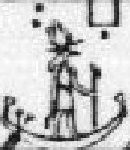
    Decan 33 is seen below Luna as a young male figure holding up in front of him with both hands an object, which is lyre shaped, on top of this object to the right is a small duck or goose.    Below this object are five stars in a u-shaped pattern.
    Since Decan 33 is seen as a netjeru in human form, therefore it represents a spiritual understanding.

    The hieroglyphs below are
either
    a sun disk or a lunar disk, probably the Egyptian sign for h (kh),
    or r3 (ra, Ra),
next the child sign, Egypt. ms,
and ends with a star.
    Thus [kh-ms] or [ra-ms].
    This could be seen as
"The child of the sun."


    From www.siloam.net/denderah it claims that (Denderah Decan 32-33) represents the "Great Square" entitled "Law Giver," showing a "four headed ram which sits upon an altar where a 'law giver' stands (i.e. this is Denderah Decan 32).    "In other words, the subliminal has been raised to the supraliminal, and a rational person has been formed."


    If compared to Denderah Decan 33, no connection can be seen except for the duck/goose on the lyre and the goose sign in the Decan name.


    Grand Temple Decan 24 is a male figure with an Ibis bird head wearing a Atef crown (Osiris' white crown of Upper Egypt and the red feathers of Busiris) seen also in Grand Temple Decan 20, 24, 29 and 35.    It has three stars, whereas above the crown are two stars and above his scepter is one star.

    Thoth (Egyptian Tahuti), the god of wisdom, his consort is Ma’at, and is usually seen as a man with the head of an Ibis bird, who carries a pen and scrolls to record with.    In Theban tradition he created the 8 primordial deities, which can be seen in Grand Temple Decan 37.
    Denderah Decan 1, which is seen below also has the Ibis bird head figure as seen above in Grand Temple Decan 24.


    On the Grand Temple image seen below, these first two deities are between Aries and Luna (in Pisces) and located above Decan 26, and it is possible that the figure to the right may be Cetus, although it is wearing an Atef crown as seen on the figures on Grand Temple Decan 20, 24, 29 and 35.
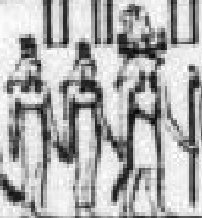
 

    The Decan 24 is called     Baba, Bawey, or Tepi-a Bawey
a goose sign, Egypt. b3, (ba) is doubled here.
    The hieroglyphs on Denderah Decan 12 and 13 possibly have this sign.
    The deity on Grand Temple Decan 2, is called Ba or Isis, but it shows a long horned ram sign with two stars.
    The figure by Orion’s hind foot is called by the Egyptian name of Ba-Bird, Jabiru, Sumerian Habur, and Egyptian Sahu.
    Of interest is that the second month (Phaophi - Virgo) of the calendar of the Christian coptes is called Baba, which is the opposite of Pisces.    Baba was a predynastic baboon god.

    Also mentioned on "http://home.main.rr.com/ imyunnut/Den.Round.html" by Joanne Conman, seems to connect the Denderah Decan 31 (Grand Temple Decan 26) with the name "Bawey," claiming it means "The Two Ba-Spirits."    As seen here in Denderah Decan 33 (Grand Temple Decan 24) she calls it by the name "Tepi-a Bawey," and claims it means "The One Preceding the Two Ba-Spirits."
    Could the one preceding the two Ba-Spirits be Denderah Decan 33 "The child of the Sun?"
    The question here is: 'Who are the Ba spirits?'
    Are they the hour deities on the Grand Temple square zodiac?
    Or are they the Denderah Decans of the round zodiac?
    See Banebdjedet a ram deity, whom represents the four first rulers of the world, in four forms the Ba-spirits.


    Its deity is called     Douamoutef (Tuamutef), Qebehsenouef (Qebhsennof) sons of Horus.


    Associated with PISCES,
it has stars
in Aries as [10] Hamal and Sheratan,
and Perseus as Algol.


Select one of the following to open it.
Each of these are connected to the constellation Pisces,
Luna, Andromeda, Cetus, Cepheus.
Decan 31, Decan 32, Decan 33, Decan 34.

    This file last updated on February 21, 2004, and also on June 18, 2005.

Return to the Table of Contents or the Zodiac of Denderah