Capricornus and its Decan Constellations.
|
Decan 1 -2 
|
The crown on Decan 1 is not an Atef crown, but more like a (Hedjet) white crown of Upper Egypt with horns extended. Although the male figure with two stars aligned vertically under his left hand, does have an Ibis bird head. The hieroglyphs in front of his head and below Capricornus' front leg, may coincide with the name Seret seen in the Grand Temple Decan 20, which reads    Decan 1 is Thoth (Egyptian Tahuti), the god of wisdom, his consort is Ma’at, and is usually seen as a man with the head of an Ibis bird, who carries a pen and scrolls to record with. 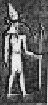 As seen above on ESNE plate 87, upper section, first figure on the bottom right, is a male figure with an Ibis bird head, wearing the (Hedjet) white crown of Upper Egypt. This is similar to Denderah Decan 1 showing a male figure with an Ibis bird head wearing the white crown of Upper Egypt.
From www.siloam.net it states "Thoth, the ruler of nine, is the rational wisdom which comes when humility overtakes arrogant self esteem." Under Pisces "The ninth life of Bastet is certainty of wisdom." |
Compare to Denderah Decan 1, a major connection in the crown.  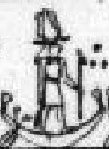 Grand Temple Decan 20 is a male hawk head with Atef crown (Osiris' white crown of Upper Egypt with red feathers of Busiris), in Decan 20, and 29 that is similar to that in Grand Temple Decan 24 and 35, which are both Ibis head figures, in front of the scepter is three stars, above his crown is one star. As seen in the Grand Temple Decan 24 and Grand Temple Decan 35 in the following images.  
Decan 20 is named
As seen on "http://home.main.rr.com/ imyunnut/Den.Round.html" by Joanne Conman, "Above Aquarius is the figure of a man (Perseus), about to slit the throat of a gazelle, while just below him is a headless human figure (Pegasus) on all fours. The headless being is above Capricorn as well as above Aquarius. The man is the god Anti. Anti was accused of beheading Hathor in the Jumilhac papyrus. His punishment was to be skinned alive and he became associated with the flayed skin or 'imyut' fetish, a symbol of the god Anubis. Egyptian gods' flesh was gold and their bones were silver. Having no flesh, Anti was associated with silver. On this ceiling, he is positioned over the decan Seret (Denderah Decan 1 and Grand Temple Decan 20), which is the only decan whose metal is silver. Just below him is what looks like a headless animal, but which has human hands and feet. It may possible be Anti's skin. Brugsh believed the Egyptians called the sign of Capricorn, 'Skin'."
Its deity for Grand Temple Decan 20 is Isis (Ast), see notes on Denderah Decan 17 (Grand Temple Decan 6).
Associated with PERSEUS, |
 Seret or Sert (sr.t), meaning "Sheep" or "Ewe," (sr "Ram") where we see