Capricornus and its Decan Constellations.
|
Decan 1 -2
|
Decan 2 is seen a small goat or Ram with horns and with a short tail, and one star is seen above the sun disk crowned head. Not a lot of connection here with Grand Temple Decan 19 except for the one star.
The hieroglyphs here are very similar to the deity seen on Grand Temple Decan 18, which is named   
Denderah Decan 2 is the Humble Ram, representing Humility. As www.siloam.net states, "At the head of the Humble Ram is the arrow which was pointed through the breast of Tauret (Draco), the right foot of the jackal at the center of the composition through Jupiter, the planet of dominion, and to the star between the horns of the Hathor cow. This is the symbol of Seshat (Sheshat also Bootes) being given to the Humble Ram as a magic wand to rule the earth as a Humble Shepherd." Also see Denderah Decan 3 and Denderah Decan 26 for more on Sheshat. From www.siloam.net/denderah it claims that Denderah Decan 1, 2, and 3 represented as Thoth-Aries-Seshat are entitled as "Humble Alignment." "The great rational being, signified by the large strutting ram (see Denderah Decan 35), is brought down in size by the wisdom of Thoth (Denderah Decan 1), and becomes a Humble Ram (Denderah Decan 2)." "Beyond the Humble Ram is the wife of Thoth, Seshat (Denderah Decan 3)." Thoth has a bird's head (Ibis), who is considered as the written message, and rational wisdom. Seshat has a serpent's head, and considered as conception, inspiration, and intuitive wisdom. |
Compared to Denderah Decan 2, we see no connection except for the one star.  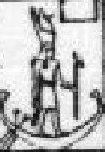 Grand Temple Decan 19 is a male figure with either a normal or a lion or baboon like face, and is wearing the Double Crown (Pshent, unification of the white and red crown) or Horus combination of upper and lower crown with the curly item on his head, which also seen on Grand Temple Decan 18 and 19. In front of his staff is one star.
Its name is seen as
The deity for this is Hapy (Hapi).
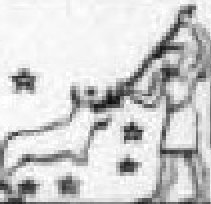 On the image above on the Grand Temple located above Decan 16, it shows possibly Hercules using Sagitta the arrow or spear to pierce Ursa Major.
Associated with CYGNUS, |

 Hor,
Hor, Tep a semdet, Tepi a semdet, Tep a-Semt, Tepa-Semt or Tepi-a-Semed, Tepi-a Smd, meaning "Precedes Semed (Full Moon Festival see