From The Alpha and the Omega - Volume III
by Jim A. Cornwell, Copyright © July 20, 2002, all rights reserved
"Volume III - Gods/Goddesses of Ancient Egypt"
ANUBIS
(Inpew, Yinepu, Anpu,
Djehuty, Ano-Oobist
)


    To return to the
Ursa Minor Decan (jackal-seven stars),
Centaurus Decan (small jackal),
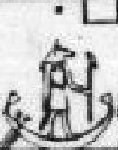
Perseus Decan (imyut fetish),
Pegasus Decan (imyut fetish),
Denderah Decan 34 - Grand Temple Decan 23 (jackal-headed diety, Akhouy).
Denderah Decan 01 - Grand Temple Decan 20 (imyut fetish),
Wesir (assumed the role of Yinepu as protector of this process of mummification),
Wepuat (is associated with Anubis),
List of Netjeru.
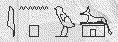
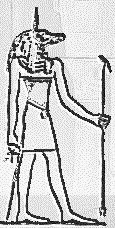
    Anubis a jackal or dog-headed god, mostly represented as a crouching dog, pointed ears and a long, hanging tail, as can be seen on many banners.    He is also depicted in human form with a jackal's head.
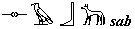
    The hieroglyph for a jackal is .    Anubis was often identified by the word sab, "jackal" rather than "dog, iwiw.    To the Egyptians there was not much difference between the two canines, so there is some confusion over which animal Anubis actually was, and is referred to as the "Anubis animal."
    What speaks against this being a jackal, is that the black color of the coat is not typical for jackals.    Others claim Anubis was painted black to further link him with the deceased, as a body that has been embalmed became a pitch black color.    Black is symbolic of the purification of the deceased, as well as the black soil which was the basis of the fertility of the Nile valley.    Others claim the Egyptians noticed the jackals prowling around the graveyards, and linked the animal with the dead.    Archaeologists usually follow the jackal trails to find Egyptian tombs.
    Since Predynastic times he is known as protector of the deceased and of the necropolis, and overseer of the mummification process, who guided and protected the spirits of the dead.
    In myth he is sometimes called the son of Nebt-Het (Nephtys) and Re.    He may also have had a daughter Kebehwet (Kebechet, Kabechet, Kebechet, Kebehut, Kebhut), depicted as a celestial serpent/snake or ostrich carrying water.    She was the goddess of freshness and purification through water who washed the entrails of the deceased and brought the sacred water to Anubis for his tasks.    She was thought to give water to the spirits of the dead while they waited for the mummification process to be complete.    She was probably related to mummification where she would fortify the body against corruption, so it would stay fresh for reanimation by the deceased's ka.    According to the Pyramid Texts of Pepi I, Kebechet finds Pepi, and she goes to meet him with the four nemset vases.    She refreshes the breast of the Great God on the day of his watch, and she refreshes the breast of Pepi with life.    She washes Pepi, she censes Pepi.
    The goddess Anput (Input, Inpewt, Yineput) was depicted as a woman wearing the jackal standard of her nome or a woman with the head of a jackal, and believed to have been the wife of Anubis, and possibly the mother of Kebechet.
    Anubis' main center of worship was at Zawty/Lycopolis/Asyut, another source calls this the city of Hardai, Cynopolis (modern El Kes) where a vast number of dog mummies were buried at dog cemeteries.    To the east of Saqqara there was a place known as Anubeion, one of Anubis' cult centres.

    Also see the information on Imiut (Imyut, Imy-Ut).

    Some of his epithets are:

    In the image above of Denderah Decan 34 seen below Luna is a male figure with a black wolf or jackal head, no crown and with one star under its left hand.    This is definitely Anubis.
 
    As compared to Denderah Decan 34, we definitely can see a major connection, with the jackal head and the one star on the above images of Grand Temple Decan 23 which is a male figure with a wolf or jackal head, no crown and with one star above its head.

    Other sources claim Anubis, was believed to be the one who invented the process of mummification.    Anubis helped Isis bring her husband back to life again after Set had killed him.    He embalmed the body of the god, swathed it in the linen cloths that had been woven by the twin goddesses, Isis and Nephthys, making sure that the body would never decay or rot.
    The wakening of the dead was also thought to be a function of Anubis.    He would appear by the mummy, and awaken the soul.    The mummy was removed from the sarcophagus when it arrived at the door of the tomb and was placed upright against the wall by a priest wearing the mask of Anubis, thought to have become the god himself.    The "Opening of the Mouth" ceremony was then performed.    It consisted of a number of rituals that would turn the mummy (or a statue of the dead) into an inhabitable vessel for the deceased's ka.    The ceremonies involved purification, censing and anointing of the mummy along with incantations.    The mummy was touched by ritual objects on various body parts to restore the senses - the spirit would then be able to see, hear, speak and eat as a living being.    Some of the tools for this ritual have been found in predynastic Amratian graves, so it is probable that at least some of the rituals involved in the "Opening of the Mouth" had evolved from this early time.
    After the deceased had been placed into the tomb and sealed up, it was thought that Anubis would lead the deceased to the afterlife, along with another god, Wepwawet (Upuaut).    The two are very similar, though Wepwawet was also another ancient jackal or wolf god, appearing on the Narmer palette.    He was not just a god of the dead, but he was a warrior god who opened the way to victory for the pharaoh.    The "Opener of the Ways" helped Anubis to guide the dead to the Halls of Ma'ati.    It was here that Anubis, as "He Who Counts the Hearts," watched over of the weighing of the heart and the judging of the deceased.    Here it was his duty to see that the beam of the scales was in its proper place, and that the weighing was done correctly.    He would then pass judgement on the deceased and Thoth would record the pronouncement.    Anubis would protect the innocent from the jaws of Ammut, but would give the guilty to her to meet the final death.    According to E.A. Wallis Budge in The Gods of the Egyptians Anubis shared the duty of guiding the dead through the afterlife with another jackal-headed god ... ("Opener of the Ways").    These two gods both "opened the ways", although Anubis was the opener of the roads of the North and Wapwawet the opener of the roads to the South.    Budge goes on to say that Anubis was the personification of the summer solstice, and Wapwawet of the winter solstice.


    This file was created on June 18, 2005.

Return to the Table of Contents or the Zodiac of Denderah