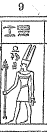
Aries and its Decan Constellations.
Aries
On the Denderah Zodiac, Aries is known by one source as Coptic Tametouris Ammon, the reign or rule of Ammon. The Hebrew word is Hamown, but the Ram in Hebrew is Taleh. No halo is noticeable above the figure of a male lamb or ram (with a long tail), and if you look close you can see its horns curling along its jaw bone to its mouth and it is seen lying down, and looking back towards Pisces or the Utchat (Eye) or Udjat the round eye of Horus, symbol of healing and protection.
Cyril Fagan comments, "Aries, the pictograph of a ram seems to have been used by the Egyptians as a sort of zodiacal road sign to indicated something significant. In the later period such were used as the places 'from whence the winds blew' or to mark where the zodiacal constellations commenced. In the Pyramidic period, the culmination of the sr Ram and sr.t Ewe pentades, which in the aggregate constituted the constellation Aries, herald the rising of Sirius, the Star of Egypt. So these sheep stars constituted a very useful zodiacal traffic signal for them." |
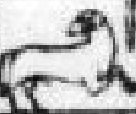 As seen in the image above, Aries on the Grand Temple is located above Decan 27, and as you can see it has no horns in compliance to what is seen on the Denderah Zodiac. Although it is in a running posture instead of lying down. 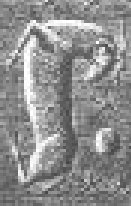 As seen above on ESNE Plate 79, Aries which has horns, is lying down, glancing backward and has a circular object above its back. This object may be the Utchat (Eye) or Udjat. 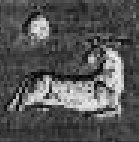 As seen above in the upper section of ESNE Plate 87, Aries is shown with horns, lying down, looking back and has a circular object above it. This circular objects may be images of the Utchat (Eye) or Udjat.
In "The Witness of the Stars," by E.W. Bullinger, page 105 "In the Denderah Zodiac its (Aries) name is Tametouris Ammon, which means the reign, dominion, or government of Ammon. The lamb’s head is without horns, and is crowned with a circle."
From www.siloam.net it claims Aries, "Before the wall in the stars, Aries (I am, an image of Amun) attempts to leap over it, but becomes the sacrificial lamb (See Perseus for more information)." |
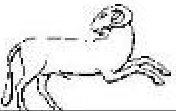

The hieroglyphic origin is seen as an Animal skin, see more on Pegasus and Perseus regard animal skins as in the flayed skin or 'imyut' fetish.

Demotic

Aries Sign
The above heiroglyph is a hide, dhr (deher), which exhibits a long tail. The Greeks identified Aries with the Golden Fleece, which was suspended in the grove of Ares (Mars) in Colchis and was guarded day and night by a dragon (Cetus) until it was captured by Jason.
|
In the season Shemu I (Shomu, Ete) - Harvest, Harvests, the Summer.
The month of Aries, as seen on Calendar Dates the month dates as: The star is in b Arietis.
On the Grand Temple the image seen below shows these deities which are located between Taurus and before Aries - Cassiopeia (Triangulum) and located above Decan 29-30. It is very possible that the figure to the right holding the staff is Monoceros, which is positioned within the Taurus group. 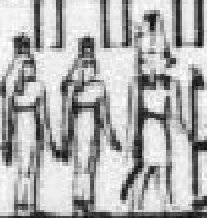 On the Grand Temple the two deities in the image below are between Aries and Cassiopeia (Triangulum) and located above Grand Temple Decan 28. Notice the figure on the right is a male with an animal on his head, similar to the figure seen on Grand Temple Decan 25, which is in the Pisces section and connects with Andromeda (Triangulum). It is also possible that this figure may be Eridanus. It is very possible that the figure to the left may be the Utchat (Eye). 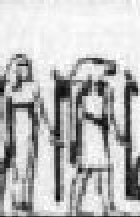
Cyril Fagan comments, "Aries rose acronycally during the month Athyr (Sun in Libra). This was the month of the autumnal equinox when the inundation was at its highest. Associated with Aries is Cetus, the Sea Monster. The waters of the Nile were now so high that crocodiles and hippopotami swam over the erstwhile pastures. In the pastures that remained dry, the ewes were separated from the rams. |