|
Decan 31-32

|
Decan 32 seen below Pisces is a strange figure with wavy horns and a sun disk crown on top of a torso with four ram’s heads; two each side integrated into its body with its base sitting on a semi-circular object, or either the upper shape of an altar. All of this is on top of an altar with one star in front of it. See notes on Khnum.
Since Decan 32 is seen as a netjeru in a multiple animal form, therefore it represents a multiple force of nature.
Some claim that the rams heads has two looking toward the past and two looking to the future. Therefore representing the Law of the past, and the Law of the future, as in Aries (a time of Moses) moving to Pisces (the time of the one to come, the Christ).
The hieroglyphs are seen
first as Egyptian head sign for Tep,
then either
the lower arm sign, Egypt. a,
or bent lower arm sign, Egypt. rm,
next three ducks or goose signs, Egypt. s3,
which is sasasa,
and ends with a star.
This could read like this
[Tep a Sa-sa-sa] or [Tep-rem a Sa-sa-sa].
As to Denderah Decan 32 it has one source claiming that this image represents "Rational Material Laws."
From www.siloam.net/denderah it claims that (Denderah Decan 32-33) represents the "Great Square" entitled "Law Giver," showing a "four headed ram which sits upon an altar where a 'law giver' stands (i.e. this is Denderah Decan 33). "In other words, the subliminal has been raised to the supraliminal, and a rational person has been formed."
Of interest as seen on Denderah Decan 28 below, which is called Spiritual Elements, "The altar of the four serpents became the altar of four rams."

Therefore the above image of the four serpents could represent the past Cancer, Gemini, Taurus and Aries, as four ages of time that the serpent ruled, but now is moving into a time when it looses.
|
As compared to Denderah Decan 32, the only connection is the ram heads and the animal on his head, and one star.
 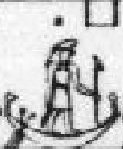
Grand Temple Decan 25 is a male figure with a hawk head with an animal on his head, and one star above it.
There seems to be a connection here with the Grand Temple deities between Aries and Cassiopeia (Triangulum) located above Decan 28, the figure seen below on the right is a male figure with an animal on his head (i.e. Set), similar to the one here in Grand Temple Decan 25. It is also possible that the figure to the right may be Eridanus and the figure to the left may be the Utchat.
Decan 25 is named  Khent heriou, Khentu heriyew, Khent Herou, or Khent-heru, Khent heriou, Khentu heriyew, Khent Herou, or Khent-heru,
the Egyptian sign for khent,
then the face sign, Egypt. hr,
next the mouth sign, Egypt. r,
and the quail chick sign, Egypt. ou,
followed by a star.
Thus we find [Khent Hr-r-ou].
Khent is seen on Grand Temple Decan 10, 11, 12, 13, 25, 26 and 27.
Herou is seen on Grand Temple Decan 25 and 32.
Heri is seen on Grand Temple Decan 15, 25 and 26. Heri, Hery and Heru mean "Upper."
As seen on "http://home.main.rr.com/imyunnut/Den.Round.html" by Joanne Conman, "Khentu heriyew," which means "The Upper Khentu." See Denderah Decan 30 (Grand Temple Decan 27) for information on "The Lower Khentu."
As seen on "http://home.main.rr.com/imyunnut/Den.Round.html" by Joanne Conman, "Khentu," which means "to travel southward or upstream (masculine)," or "The (male) Southern Traveler."
It's deity is called  Amset, Mestha, Hapy (Hapi). Amset, Mestha, Hapy (Hapi).
Associated with ANDROMEDA (TRIANGULUM),
it has stars
in Auriga as Capella,
which is also mentioned on Denderah Decan 29 - Grand Temple Decan 28 associated with Eridanus.
Also note that LUNA, Egyptian ich (iah) = the moon is relevant here.
|