|
Decan 27-28

|
Decan 28 is seen below the front foot of Eridanus and one source claims this is Spiritual Elements, "The altar of the four serpents became the altar of four rams." We actually see a tall altar with four cobra-like serpents each with a human-like head, and there are no stars, unless the three stars above the serpents are not part of the hieroglyphs.
Since Decan 28 is seen as a netjeru in four animals with human heads, it represents four forces of nature.
The hieroglyphs seen here are below the front foot of Eridanus, with the first
the duck sign, Egypt. s3,
then we see either
the bread loaf, Egypt. t,
or the sandy slope, Egypt. k,
or the Egypt. q,
it ends with one star,
and then below it are three stars.
This would read as this [sa-t] or [sa-k] or [sa-q].
This has some similarities to Grand Temple Decan 29 for the name Sasaqed, Sasaqet, Sasa qet, Sawy Qed, or Sawey Qed.
In Denderah Decan 28 we can clearly see the four serpents on the altar.
From www.siloam.net/denderah it claims that (Denderah Decan 28) represents the "Great Square" entitled "Subliminal Esteem," showing an altar with "four uraeus serpents upon it. These four subliminal beings represent the four elements of the ancient metaphysics called earth, water, air, and fire, and standing for material, physical, mental, and spiritual creation."
As seen in the image below of Denderah Decan 32 we can see the altar of four rams, which some sources claim represents Rational Material Laws.

|
If comparing to Denderah Decan 28, we find no connection except possibly in it's Decan name.
 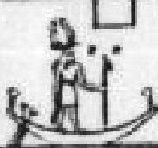
Grand Temple Decan 29 is a male figure with the Atef crown on his head, a crown emblem seen also in Grand Temple Decan 20, 24, 29 and 35, above his scepter are two stars. Notice Grand Temple Decan 29 similarity to the images below.
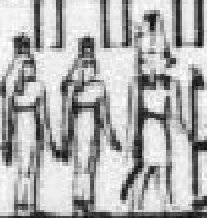
On the Grand Temple the image seen below shows these deities which are located between Taurus and before Aries - Cassiopeia (Triangulum) and located above Decan 29-30. It is very possible that the figure to the right holding the staff is Monoceros, which is positioned within the Taurus group. This figure is wearing the Atef crown on his head.
Decan 29 is named  Sasaqed, Sasaqet, Sasa qet, Sawy Qed, or Sawey Qed, Sasaqed, Sasaqet, Sasa qet, Sawy Qed, or Sawey Qed,
the first two are the duck sign, Egypt. s3, SaSa
then the next three signs mean Qed
stilt sign, Egypt. q
hand sign, Egypt. d
a jar sign, Egypt. determinative,
which then ends with two stars,
then with three stars.
Therefore seen as [sa-sa-qd].
Sasa is also seen on Grand Temple Decan 21 and 29. Sasa probably means "The Two Sons."
Qed is also seen on Grand Temple Decan 28 and 29.
As seen on "http://home.main.rr.com/
imyunnut/Den.Round.html" by Joanne Conman, "Sawey Qed" means "The Two Sons of Qed." She also claims that "Qed" (also mentioned on Denderah Decan 29) means "to go around, like the potter's wheel." "Neugebauer and Parker say this is the four uraei on a support, but in both their and in Daressy's illustrations, these figures look like four human-headed serpents to me."
On "http://www.creatures-kbc.com/ae_senmut_sah.htm" by Ken Bakeman promotes that the hieroglyphs on Senmuts' Tomb after the 'front facing' stars are followed by the hieroglyphs for the "twin pot makers"  and in sequence by the imagery of the pottery wheel of the Qed ('builder') twins. In this case we can see first "Qed" and then "Sasa Qed," as seen on Grand Temple Decan 28 and 29 Perhaps this was envisioned as turning or revolving the attention of Herf-haf to the celestial events which took place before the Sah-related group of decans. and in sequence by the imagery of the pottery wheel of the Qed ('builder') twins. In this case we can see first "Qed" and then "Sasa Qed," as seen on Grand Temple Decan 28 and 29 Perhaps this was envisioned as turning or revolving the attention of Herf-haf to the celestial events which took place before the Sah-related group of decans.
This deity is called  Kha semsou
khe en mou. Kha semsou
khe en mou.
Note the Aquarius signs, or the Egyptian water sign.
Associated with CASSIOPEIA (Triangulum),
but it has stars
in Cetus as Menkar
and unsure on Hasseleh.
Based on the images above this may also be associated with MONOCEROS.
|