|
Decan 27-28

|
Decan 27 is seen behind and below the rear foot of Eridanus as a figure with a long stiff neck positioned on top of a serpent. On the neck is a head of a Ram, with horns curling along its jaw to its mouth like Aries, but on its head are the wavy horns and a sun disk crown. In front of it are three stars aligned vertically. It is possible that the star in front of its sun disk applies here.
Since Decan 27 is seen as a netjeru in a partial animal form, it represents a partial force of nature.
The hieroglyphs seen here are below the rear foot of Eridanus, which are very hard to see, and I cannot determine them. Some sources claim Eridanus in the Aries section may be known as Peh-ta-t, the mouth of the river.
Then the hieroglyphs for this if it is would be
a mouse sign, Egypt. peh,
then either
the Egypt sign for ta,
or the reed leaf sign, Egypt. \\, i, double ii or y,
next is either
the bread loaf sign, Egypt. t,
or another unknown sign,
followed by either one star or two stars.
It may be [Peh-ta-t] or [Peh-i-t].
See Denderah Decan 16 for a comparison with its connection to Grand Temple Decan 5 which reads [Peh-ouy dj-t].
 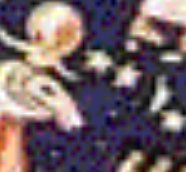 
One source calls Denderah Decan 27 the "Stiff-necked ram" (Rationalist). [Break in Stone] "Mother Nature ... broke the Denderah monument at the knees of the acquiescent mother and the barque of the stiff-necked ram." "The east side break in the Denderah stone separated the throne of tyranny from an Age of a Great Man at the south side, as it passed through the Age of Aries into the Age of Pisces. The restoration of the path beyond the break occurred at the location symbolic of the end of the Age of Pisces."
As seen on Decan 9-10  where Decan 9 is a head of a ram with wavy horns and a sun disk crown, which seems to be placed on an altar or pedestal, which may have hieroglyphic markings on it. where Decan 9 is a head of a ram with wavy horns and a sun disk crown, which seems to be placed on an altar or pedestal, which may have hieroglyphic markings on it.
Note that Denderah Decan 27 is similar as seen below is called the "Stiff-necked Ram."
This image is located under Taurus,
which is the known opposite of Scorpius.
|
Compared to Denderah Decan 27, there are no major connections.
 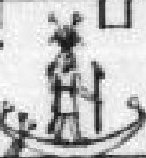
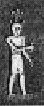
Grand Temple Decan 30 is a male figure with a flowery crown, and no stars.
As seen below in the image to the left, on the upper section of ESNE Plate 87, the third figure from the bottom right is a male figure wearing the flowery crown and holding up a vial in his right hand.
In the image below to the right, as seen on the Grand Temple above Decan 22, Aquarius is seen wearing this same type of plumed or flowery crown.
 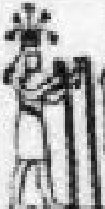
This Decan is called by 
the name of Aret or Art,
and is seeen as
the lower arm sign, Egypt. a,
then the mouth sign, Egypt. r,
and the bread loaf sign, Egypt. t,
which is followed by two smaller stars.
This would be seen as [a-r-t].
As seen on "http://home.main.rr.com/
imyunnut/Den.Round.html" by Joanne Conman, "Aret" means "To Rise Up or Ascend" or possibly "Jaw." "It is connected to the Uraeus."
As seen on "http://www.creatures-kbc.com/ae_senmut_sah.htm" by Ken Bakeman poses that the hieroglyphs on Senmuts' Tomb for aret seb,  , also called the "Gate" or "lintel" star is seen hieroglyphically as: , also called the "Gate" or "lintel" star is seen hieroglyphically as:
the lower arm sign, Egypt. a; then the mouth sign, Egypt. r; and the bread loaf sign, Egypt. t; which is followed by one star.
This would be seen as [a-r-t], Aret.
It is claimed that it appears on the horizon as Betelgeuse (Alpha Orionis). Also its divinity is in reference to the Eye of Horus. Also see Denderah Decan 24 which correlates to Grand Temple Decan 33 for a connection to Orion's star Betelgeuse.
Its deity is called  Amset (Mestha), Qebehsenouef (Qebhsennuf), Douamoutef (Tuamutef), and Hapy (Hapi). Amset (Mestha), Qebehsenouef (Qebhsennuf), Douamoutef (Tuamutef), and Hapy (Hapi).
Associated with TAURUS,
it has stars
in Taurus as Al Heka
and Eridanus as Rana.
|