|
Decan 16-17

|
Decan 16 seen below the feet of Crater is a male figure with a hawk head and is wearing the (Hedjet) white crown of Upper Egypt; below his left hand are three stars (in an upward pointing triangle). The connection to Grand Temple Decan 5 is a male figure wearing the (Hedjet) white crown of Upper Egypt, and three stars above his crown.
Since Decan 16 is seen as a netjeru in human form, therefore it represents a spiritual understanding.
The hieroglyphics below Crater’s feet and in front of his face are hard to see, assuming that they could be
the mouse sign, Egypt. Peh,
then the reed leaf, \\, i, double ii or y,
then we have the fire sign, d3, da, or dj,
then the bread loaf, Egypt. t,
and it ends with a star.
Thus we may see the [Peh-ouy dj-t].
See Denderah Decan 27 and Eridanus for a comparison to [Peh-ta-t] or [Peh-i-t].
These may be the same as that seen on the Grand Temple Decan 5 and named  Pehouy djat. Pehouy djat.
Horus is usually depicted as wearing the Double Crown (Pshent, the unified white and red crown) or combination of the upper and lower crown headdress with the little curly item coming from it. He is also hawk-headed and carries a spear in his left hand. Also see him in Denderah Decan 29 as a child.
|
If comparing to Denderah Decan 16, this is another major connection, as we see a male figure, with the white crown of Upper Egypt and the three stars.
 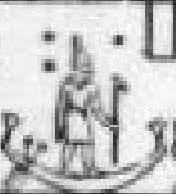
Grand Temple Decan 5 is a male figure with a lion’s head, wearing the (Hedjet) white crown of Upper Egypt with a scepter, and three stars above his crown.
This was called Pehouy djat, Pehui-Tchat, or Pahwey djat, and we see
the mouse sign, Egypt. Peh,
then the reed leaf, \\, i, double ii or y,
then we have the fire sign, d3, da, or dj,
then the bread loaf, Egypt. t,
and ends with a star, ‘gate.’
Thus we see [Peh-ouy dj-t].
Djat is also seen on Grand Temple Decan 4 and 5.
As mentioned on "http://home.main.rr.com/
imyunnut/Den.Round.html" by Joanne Conman, "Djat, the meaning of djat is uncertain. It may be 'to ferry' or 'to cross by ferry' or it may be connected to the crane, a migratory bird."
As if the ferry refers to Argo Navis (boat) or the crane/bird to Corvus the crone/raven.
Pahwey is similar to Pehwey, which is seen on Grand Temple Decan 36 (Denderah Decan 21).
As mentioned on "http://home.main.rr.com/
imyunnut/Den.Round.html" by Joanne Conman, "Pehwey-djat," means "The End or Later Part of Djat."
This alludes to a reference to the end or back of Argo Navis a boat (ferry). See Denderah Decan 17 for the front.
Its deity is  Nebet tep Ahet, Nebt-tep-ahet (the children of Horus, ou les enfants d'Horus) of interest is Nephthys (Nebt-het) who is the sister and wife of Set, sister of Isis and Osiris, mother of Anubis, who protected Hapi. Nebet tep Ahet, Nebt-tep-ahet (the children of Horus, ou les enfants d'Horus) of interest is Nephthys (Nebt-het) who is the sister and wife of Set, sister of Isis and Osiris, mother of Anubis, who protected Hapi.
Associated with CENTAURUS
and possibly COMA BERENICES,
but it has stars
in Coma Berenices as Vindemiatrix,
and Argo Navis as Canopus.
|