From The Alpha and the Omega - Volume III
by Jim A. Cornwell, Copyright © July 20, 2002, all rights reserved
"Volume III - The Seventh Month - Constellation Names for Libra"
 LIBRA
LIBRA
Libra, the Scales, the Balance.
The constellation name for Libra:
Viewpoint that Libra was known as the MOUND or ALTAR
before or after 3000 B.C.
- Some Scholars claim that the Akkadian Tul-ku, for Libra is the seventh month (lunar month of the autumn equinox, September-October) means "The Sacred (Holy) Mound" or "The Holy Altar." The following shows that argument.
- Sumerian reads (dul(6), mound, sanctuary + kù, sacred, holy), in lieu of tul-ku.
- Sumerian dul(6), du6: mound, heap; sanctuary; ruins, 'tell'.
- Sumerian ú-tul: (cf., udul).
- Sumerian kug, kù: n., noble metal; silver; money; v., to cleanse; adj., bright, pure; sacred, holy.
- In "The Witness of the Stars," by E.W. Bullinger, page 47 "Libra is called in the Akkadian Tulku. Tul, means mound (like dhul and dul), and ku, means sacred. Thus the sacred mound or the holy altar."
- In "The Witness of the Stars," Appendix by E.W. Bullinger:
- Pages 199-200 "The ancient Akkadian name for the seventh month, which was the month when the sun was in the Sign now called LIBRA, was Tulku, which means the sacred mound or altar. The Akkadian name for the Sign was Bir, which means the Light, hence, the Lamp with its light, or the Altar with its fire." "Its most ancient form was circular altar."
- Page 200 "The next stage of the corruption is shown in the Akkadian name of Scorpio (the Scorpion) - the Sign immediately to the left of the Altar. It was called Gir-tab, which means the Seizer and Stinger, seen below is Figure (2) from "The Witness of the Stars," page 200
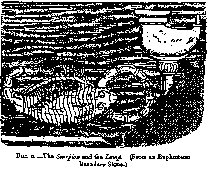 ,
taken from an Euphratean boundary stone, both shows the two Signs combined, for the Scorpion is stretching out its claws in order to seize the Lamp or Altar."
,
taken from an Euphratean boundary stone, both shows the two Signs combined, for the Scorpion is stretching out its claws in order to seize the Lamp or Altar."
The above is similar to both images seen on "http://www.mazzaroth.com/ChapterThree/SumerianInfoOfAnnunaki-Anakim.htm" below for the images of the Scorpion and the Nunska Lamp


Guardians Of Four World Quarters Symbols Of The Babylonian Gods.
- Page 201 "A seal on a contract, nearly 700 B.C., shows this Circular Altar actually in the grasp of the Scorpion, as seen in Figure 3 below.
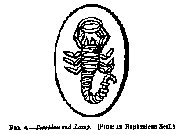 FIG. 3 "The Witness of the Stars," page 201 is a picture of this Euphratean Seal, preserved on a contract made on the eighth day of the month Tisri, i.e., this same seventh month!"
- Note that the seventh Hebrew month was originally called Ethanim, but is now called Tishri, or the Akkadian Tashritu. Note that this initially applied to the concept of dedicating, as shown earlier for this month in the Libra Introduction.
- Page 202 "Greek name for the Sign was Chelai, which means the Claws. This led to the mistake of Servius, that 'the Chaldean Zodiac consisted of but eleven constellations.'"
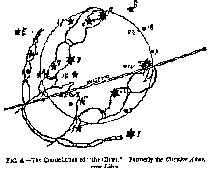 FIG. 4 "The Witness of the Stars," page 202
- Page 203-204 "This is how the stars formerly in the Sign of the (Circular) ALTAR, came to be reckoned in the Claws of the Scorpion; and this is how the circular scales of LIBRA came to be substituted for the ancient Circular ALTAR."
- Note that as seen in Aries, The Ram was also called the Lamb, but in the First Month - constellation name for Aries: After 3000 B.C., we see the following:
- Akkadians called (Aries) it Baraziggar, which means "The Altar (Sacrifice) of Making Right."
- Akkadian nissanu is the first month of the year. One source claims that it is the same as the Sumerian BAR.ZAG.GAR. Sumerian BAR, means "month," so as seen in the Sumerian UR.BAR.RA, "the seed of heavenly plow."
- In "The Witness of the Stars," by E.W. Bullinger, page 105 "Akkadian name was Baraziggar." "Bar means altar, or sacrifice, ziggar, right making, the sacrifice of righteousness."
- The Altar.
- Hebrew mizbeach, miz-bay'-akh, from Heb. zabach, zaw-bakh', a primary root to slaughter an animal (usually in sacrifice), kill, offer, sacrifice, slay, thus an altar, or place of slaughter, Gr. bomos, is in Acts only, thysiasterion.
From Starnames by Richard H. Allen:
Brown thinks that its present symbol (for Libra), generally considered a representation of the beam of the Balance, shows the top of the archaic Euphratean Altar, located in the zodiac next preceding Scorpio [Ara, the altar is below Scorpio], and figured on gems, tablets, and boundary stones, alone or in a pair. Miss Clerke recalls the association of the 7th month, Tashritu, with this 7th sign and with the Holy Mound, Tul Ku, designating the biblical Tower of Babel, surmounted by an altar, — the stars in this constellation, alpha, mu, xi, delta, beta, chi, zeta, and nu, well showing a circular altar. Sometimes this Euphratean figure was varied to that of a Censer, and frequently to a Lamp; Strassmaier confirming this by his translation of an inscription as die Lampe als Nuru, the Solar Lamp, synonymous with Bir, the Light, also found for the sky figure. In this connection it will be remembered that another of the names for our Ara, a reduplication of the zodiacal Altar, was Pharus, or Pharos, the Great Lamp, or Lighthouse, of Alexandria, one of the seven wonders of the world. This Lamp also has been found shown on boundary stones as held in the Scorpion's claws, and we see the same idea even as late as the Farnese globe and the Hyginus of 1488, where the Scales have taken the place of the Lamp. When the Altar, Censer, and Lamp were in the course of time forgotten, or removed to the South, the Claws were left behind, and perhaps extended, till they in turn were replaced by Libra. Miss Clerke additionally writes:
The 8th sign is frequently doubled, and it is difficult to avoid seeing in the pair of zodiacal scorpions, carved on Assyrian cylinders, the prototype of the Greek Scorpion and Claws. Both Libra and the sign it eventually superseded thus owned a Chaldaean birthplace.
The early Greeks did not associate its stars with a Balance, so that many have thought it substituted in comparatively recent times for the Chelae, the Claws of the Scorpion (Scorpio), that previously had been known as a distinct portion of the double sign; Hyginus characterizing it as dimidia pars Scorpionis, and Ptolemy counting eight components in the two divisions of his Khelai (claws), — Boreios and notios with nine amorphotoi. Aratos also knew it under that title, writing of it as a dim sign, — phaeon epiduees, — though a great one, — megalas khelas. Eratosthenes included the stars of the Claws with those of our Scorpio, and called the whole Skorpios, but alluded to the Khelai; as did Hipparchos, although with him the latter also were Zugon, or zugos, these words becoming common for our Libra, and turned by codices of the 9th century into Zichos. They were the equivalents of the Latin Jugum, the Yoke, or Beam, of the Balance, first used as a stellar title by Geminos, who, with Varro, mentioned it as the sign of the autumnal equinox. Ptolemy wrote these two Greek titles indiscriminately, and so did the Latin poets the three, — Chelae, Jugum, Libra, — although the scientific writers of Rome all adhered to Libra, and such has been its usual title from their day. The ancient name was persistent, however, for the Latin Almagest of 1551 gave a star as in jugo sive chelis, and Flamsteed used it in his description of Libra's stars.
The Romans claimed that it was added by them to the original eleven signs, which is doubtless correct in so far as they were concerned in its modern revival as a distinct constellation, for it first appears as Libra in classical times in the Julian calendar which Caesar as pontifex maximus took upon himself to form, 46 B.C., aided by Flavius, the Roman scribe, and Sosigenes, the astronomer from Alexandria. Some have associated Andrew Marvell's line, Outshining Virgo or the Julian star.
Viewpoint that Libra was known as the Scales, the Balance
before or after 3000 B.C.
- Sumerian ZI.BA.AN.NA, one source claims that Libra in the Sumerian Zib-ba an-na, means "Balance of Heaven" or "Heavenly Weighing Scales,"
which is somehow derived from this (zi, to divide, cut + ba, portion, nominative + an, heaven + na, that one, nominative)
or possibly it could be rephrased as a "dividing/cutting of a portion of the heavens."
- Sumerian zi: breathing; breath (of life); throat; soul (cf., zid, zìg).
- Sumerian zí: stench; bile; bitter.
- Sumerian zì: (cf., zíd).
- Sumerian zìg, zi: n., wall, partition; v., to stand up, rise; to rise up from (with -ta- or -ra-); to go out or make go out; to tear out, uproot; to take out, extract; to spend or credit; to approach (zi-zi in marû); adj., high.
- Sumerian zil; zi; zé: to undress; to peel off; to pare, cut; to shell.
- Sumerian sila, sil(2), zil; si-il: to cut into; to divide.
- Sumerian sìla, šál: measure of capacity - 0.842 liter in the Neo-Sumerian period; measuring pot (si14, 'a small pot', + lá, 'to weigh'; but cp. also, sal, 'uterus').
- Sumerian lal, lá: v., to be high; to hold; to lift; to carry; to hang (from) (with -ta-); to weigh; to pay; to deduce; to strap, harness (with -ši-); to dress oneself; to place, set; to bind (a reed pillar); to stretch, extend, reach; to load; to lessen, be few, diminish; to accuse, denounce; to fall back, retreat (cf. also, lá); adj., light, deficient; minus (cf. also, lá).
- Sumerian ki-lal: weight ('place' + 'to weigh').
- Sumerian lá-ìa[NI]: remainder of debt left over, difference, arrears ('to weigh; minus'; cf., lalla).
- Sumerian érin, rín: balance scale (cf., erim).
- Sumerian ba: n., share, portion; rations, wages; v., to give; to divide, apportion; to pay; modal prefix, used when there is no transitive subject.
- Sumerian (ku6)ba: a shelled creature (such as a turtle or a snail).
- Sumerian bà: liver; omen.
- Sumerian ba7: (cf., bar).
- Sumerian -ba (nominative).
- Sumerian an: n., sky, heaven; the god An; grain ear/date cluster; v., to be high; adj., high.
- Sumerian an-ki: universe ('sky' + 'earth').
- Sumerian an-na: tin ('sky' + 'stone').
- Sumerian an-pa: zenith ('sky' + 'branch' of sun dial ?).
- Sumerian an-ta: above ('heaven' + 'from').
- Sumerian an-ta-gál: high, superior ('sky; high' + 'from' + 'to be').
- Sumerian an-ta...gi4: to meet ('heaven' + 'from' + 'to return').
- Sumerian an-ta-sur-ra: a stone ('heaven' + 'from' + 'boundary marker' + a,'the').
- Sumerian an-úr: horizon ('sky' + 'base, floor').
- Sumerian an-za-kàr: tower ('heaven' + 'stone' + 'round, high thing').
- Sumerian na; ni: he, she; that one.
- Sumerian ní: self; body.
- Sumerian ní; ne4: fear; respect; frightfulness; awe.
- Sumerian nì: (cf., ní ).
- Sumerian ne: this (one).
- From www.lexiline.com, "The Scales (ZI.BA.AN.NA), the 'horn' of the scorpion, Akkadian zibanitum, described as MUL d.Shamash d.UD 'constellation of the sun,' and applied to the star a Librae in Libra which in Arabic is UZ Zubana, Zubenelgenubi." "Sumerian ZI.BA.AN.NA could also mean 'like lightning, sharp, prong, claw, fork."
- Note some of the other names for Libra: Al Zuban'ah (14th manzil), Al Zubanatain. Allen states: Arabian astronomers, following Ptolemy, knew these stars as Al Zubana, the Claws, or, in the dual, Al Zubanatain, degenerating in Western use to the Azubene of the 1515 Almagest; but later on, when influenced by Rome, they became Al Kiffatan, the Trays of the Balance.
- Arabic #16 Zubânayn, Azubene, Al Jubana, "Claws," or "The Claws."
- Hebrew zeban (Chaldean), zeb-an', corresponding to Heb. Zebiyna, zeb-ee-naw', from an unused root (meaning to purchase), gainfulness, Zebina, thus to acquire by purchase, gain.
- Latin Libra, the Scales, the Balance.
- Rolleston claims it as "weighing, Vulgate Isaiah 40:12."
- Some state that the symbol for Libra
 looks like the top of an altar, than a pair of balances.
- Akkadian Zibanitu, "The Scales," for Libra.
- Babylonian Ziba (lacuna) in Libra means "the claws."
- The Scales of Libra, was the autumnal Equinox when the Sun stood still in the time of Old Babylonia. It represented the tipping of the balance between summer and winter, and since it was associated with autumn it was associated with judgment and reaping.
- Hebrew word known as Mozanaim, which means "The Scales Weighing," associated with a form of redemption.
- Balance the English word is from the Latin bilanx and means, "having two scales." It is used to translate three Hebrew words: mo'znayim, kaneh, and peles.
- The Hebrew word for balance is mo'zen, mo-zane', from Heb. 'azan, aw-zan', a primary root for weight, (only in the dual) a pair of scales: -- balances.
- Rolleston states the Hebrew as Moznaim.
- Richard H. Allen comments: The Hebrews are said to have known it as Moznayim, a Scale-beam, Riccioli's Miznaim, inscribing it, some thought, on the banners of Asher, although others claimed Sagittarius for this tribe, asserting that Libra was unknown to the Jews and that its place was indicated by their letter Tau, while still others claimed Virgo for Asher, and Sagittarius for Joseph.
- Syriac Mazatho, "scales," according to Rolleston and Seiss.
- Richard H. Allen comments: The Syrians called it Masa’tha, which Riccioli gave as Masathre; and the Persians, Terazu or Tarazuk, all signifying Libra; the Persian sphere showing a human figure lifting the Scales in one hand and grasping a lamb in the other, this being the usual form of a weight for a balance in the early East.
- Egyptian/Coptic:
- Libra was originally part of Scorpius, in Roman times part of it was changed to the constellation of Libra.
- Libra was originally called Chelae (Latin for "claw"), when connected to Scorpius. Apparently becoming a separate constellation with the Romans who called it Libra, the Scales.
- AP Petavius, Uranologian, 168, "The claws called by the Egyptians, Zugon," i.e. the yoke that joins any two things together.
- Rolleston and Seiss both commented on "Zugas, Greek Septuagint Isa. 40:12; Revelation 6:5."
- Allen commented: Brown also says that the Euphratean Sugi, the Chariot Yoke, which he identifies with alpha and beta of this constellation, remind us by sound and signification of the Zugon and Jugum of Greece and Rome respectively, and that astrology adds evidence in favor of a Chaldaean origin, for it has always claimed Libra — the Northern Scale at least — as a fruitful sign, taking this from the very foundations of astrology in the Chaldaean belief that "when the Sugi stars were clear the crops were good." In modern astrology, however, the reverse of this held in the case of the Southern Scale.
- The Egyptians here began the pattern of the Divine Child, Osiris, next to his mother Isis (Virgo).
- On the Denderah Zodiac, Libra is seen as a what appears to be a female image dressed in white, but some show this as a young male with long hair, holding his left hand up to his lips, with the same posture as seen in the Grand Temple Decan 27.
- This scene is enclosed in a circle, or sun disk, which is balanced or is supporting a scale figure. The Grand Temple image shows the enclosed circle seated in the hieroglyph sign for the sun rising between the mountains.
- Richard H. Allen states: Manetho and Achilles Tatios said that Libra originated in Egypt; it plainly appears on the Denderah planisphere and elsewhere simply as a Scale-beam, a symbol of the Nilometer. Kircher gave its Coptic-Egyptian title as Lambadia, Statio Propitiationis (meaning station of propitation).
- In his work “BABYLONIAN STAR-LORE: An Illustrated Guide to the Star-lore and Constellations of Ancient Babylonia,” by Gavin White gives this image of Libra which is seen on page 46 shown here as
 and comments, "The constellation of the Scales, which was formed from the Scorpion's Claws long ago, is held to be particularly sacred to the sun god Shamash. In the first place, the Scales symbolize the autumn equinox, when the watches of day and night are held to be of equal duration and sun rises due east and sets due west. And secondly, the Scales symbolize the idea of judicial prudence, as in the phrase 'weigning up the evidence', which is particularly appropriate to the sun god as his principle role within the Babylonian pantheon was to act as the arbitrator of truth and justice. For these reasons the Scales are thought to be the special station of the sun in Babylonian cosmology, where they are purposefully set opposite to the moon's station in the Star Cluster (the Pleiades)."
As you can see for yourself the image for Libra above has some correlation with the Round Denderah image  and the Square Denderah image
 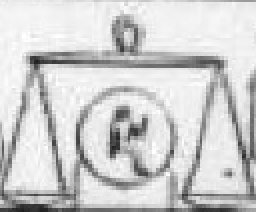 and the hierogyphic image
 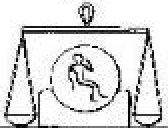 , but see the Denderah Decan information for more detail.
- Other names for Libra: Midsa'non, Al Zuban'ah (14th manzil), Al Zubanatain, Afr (a, b, g), Almi'zen, Azuben'e, Al Kiffatan (Arab).
- Allen states: Arabian astronomers, following Ptolemy, knew these stars as Al Zubana, the Claws, or, in the dual, Al Zubanatain, degenerating in Western use to the Azubene of the 1515 Almagest; but later on, when influenced by Rome, they became Al Kiffatan, the Trays of the Balance, and Al Mizan, the Scale-beam, Bayer attributing the latter to the Hebrews. This appeared in the Alfonsine Tables and elsewhere as Almisan, Almizen, Mizin; Schickard writing it Midsanon. Kircher, however, said that Wazn, Weight, is the word that should be used instead of Zubana; Riccioli adopting this in his Vazneschemali and Vazneganubi, or Vaznegenubi, respectively applied to the Northern and Southern Scale as well as to their lucidae.
- The sacred books of India mention it as Tula, the Tamil Tulam or Tolam, a Balance; and on the zodiac of that country it is a man bending on one knee and holding a pair of scales; but Varaha Mihira gave it as Juga or Juka, from Zugon, and so a reflex of Greek astronomy, which we know came into India early in our era; but he also called it Fire, perhaps a recollection of its early Altar form, mentioned further on.
- Seen as the Italian Libra and Bilancia, the French Balance, the German Wage, — Bayer's Wag and Bode's Waage, — but the Anglo-Saxons said Wæge and Pund, and the Anglo-Normans, Peise, all meaning the Scales, or a Weight.
One of the twelve simple Hebrew Letters is Lamed (KJV Lamed, law'-med, Ps 119:89), the English letter l which has a numerical value equal to 12, and an esoteric meaning of "Ox {cattle} Goad," note from below the Hebrew lamad, law-mad', a primary root. Also of interest is the original name LÚ.HUN.GÁ, "The Hired Man," "Hired Laborer," or farm worker, in Aries, which was the name of this constellation prior to 3000 B.C., before it was changed to a Ram. The image was shown holding a goad, which he prodded the celestial Bull, Taurus with.
- Goad.
- Hebrew malmad, mal-mawd', from Heb. lamad, law-mad', a primary root properly to goad, i.e. (by implication) to teach (the rod being an Oriental incentive), expert, instruct, learn, skillful, teach, thus a goad for oxen, goad.
- Hebrew dorbown, dor-bone' [also dor-bawn'] of uncertain derivation, a goad.
- Ox.
- Hebrew showr, shore, from Heb. shuwr, shoor, a primary root properly to turn, i.e. travel about (as a harlot or a merchant), a bullock (as a traveller), bull(-ock), cow, ox.
- Hebrew te'ow, teh-o', and tow' (the original form), toh, from Heb. ta'ah, taw-aw', a primary root to mark off, i.e. designate, point out, a species of antelope (probably from the white stripe on the cheek), wild bull (ox).
- Hebrew baqar, baw-kaw', from Heb. baqar, baw-kar', a primary root to plough, thus a beeve or animal of the ox kind of either gender (as used for ploughing), a herd, beeve, heifer, kine, ox.
- Sumerian áma, am: wild ox or cow (aurochs).
- Sumerian gud, gu4: domestic ox, bull (regularly followed by rá; cf., gur(4)).
- Sumerian gud-am; gu4-dam: a mythological entity ('bull' + 'wild ox').
- Sumerian gud-dun-a: subordinate ox ('bull, ox' + 'subordinate' + nominative).
- Sumerian gud-gal-gal: full-grown ox ('bull, ox' + reduplicated 'great').
- Sumerian gud-giš: work ox ('bull, ox' + 'tool').
- Cattle.
- Hebrew behemah, be-hay-maw', from an unused root (probably meaning to be mute), properly a dumb beast, large quadruped animal, beast, cattle.
- Hebrew miqneh, mik-neh', livestock.
- Hebrew seh, seh, or sey, say, grazing cattle.
- Sumerian a-lu: adjective for small cattle.
- Sumerian lú-u18-um: name of a breed of small cattle (possible Semitic loanword).
Continue to Star Names of Libra or return to Introduction of Libra.
This file updated on July 15, 2008, and March 30, 2010.
Return to the Table of Contents or the Zodiac of Denderah