From The Alpha and the Omega - Volume III
by Jim A. Cornwell, Copyright © July 20, 2002, all rights reserved
"Volume III - Gods/Goddesses of Ancient Egypt"
MA'AT
(Maae't)


    To return to the
Leo Decan (The hieroglyphic origin of Leo is a feather, as in the Feather of Maat),
Denderah Decan 21-Grand Temple Decan 36 (Maat Hor),
Denderah Decan 22-Grand Temple Decan 35 (Maat Heru),
Nun (has no surface, stretching into infinity, not subject to cosmic order of Ma'at),
Ra (was accompanied by his Vizier Thoth and his daughter Ma'at),
Thoth (Ma'at was a consort of Thoth),
or List of Netjeru.
    Ma'at the most important deity of them all was a personification of the basic laws of existence, representing the concept of truth, justice, order, morality and balance, a status for a pharaoh to uphold.    Unlike Hathor and Nephthys, she is not a goddess or netjeru, but a principle of cosmic harmony, without her the universe would become chaos as Nun would reclaim the universe.    Egyptian universe and the world around them, was sacred in the ancient view and would be nothing without Ma'at, a reality that made the Sun rise, the stars shine, the river flood and mankind think.    The Egyptians believed that the universe was an ordered and rational place, with predictability and regularity, a universe that remained constant and in perfect balance.
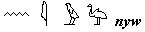
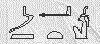
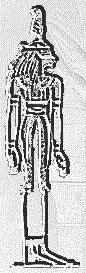
    Shown as a lady, who wears an ostrich feather on her head, a hieroglyph like the one seen as the symbol for Leo Decan.    The hierogylphs of her name represent the primeval mound upon which the creator god emerged.
    When seen as a winged goddess (like Nephthys), she is essential to the deceased reaching paradise as a judge at the Egyptian underworld.    In the Hall of the Double Truths (Ma'ati), the heart of the deceased is weighed in balance by Ma'at herself, against an image of the goddess or by the Feather of Ma'at, her symbol that she wore on her head was an ostrich feather.
    The hieroglyph for a ostrich is .
    Thoth weighed the heart, to see if the deceased had followed the concept of ma'at during his life, or sinned against ma'at, which then his heart was devoured by a demon, called Ammut, "Devouress of the Dead," to die the final death.    If the heart weighed the same as Ma'at, the deceased was allowed to go on to the afterlife.
    In the southern sector of the precinct of Montu at Karnak, is a small ruined temple to Ma'at.    This temple was dedicated by Hatshepsut (1473-1458 B.C.) to Ma'at at Ipet-Isut (Karnak), the smallest of three enclosures and seems to have been built by Hatshepsut, then reconstructed by Thothmose III.

    Other sources claim that Ma'at, was similar to what the Greeks called the underlying order of the universe logos, meaning, order, pattern, as seen in John 1:1, "In the beginning was the Word (logos), and the Word was with God and the Word was God."     Logos was the "Word," another name for Jesus.
    "Ethics" is an issue of human will and human permission.    It is a function of the human world of duality.    What is 'ethical' for one group is sin for another.    But Ma'at, the reality that made all groups what they are is transcendent of ethics, just as a rock or a flower is amoral, a-ethical, without 'truth' or falsehood."    How can a flower be "false" or "ethical."    It just is.    How can the universe be "ethical or moral, right or wrong?"    It simply is.    That is Ma'at. -- Walk Like An Egyptian: A Modern Guide To The Religion and Philosophy Of Ancient Egypt, Ramona Louise Wheeler
    In life, it was the pharaohs' duty to uphold ma'at.    "I have done Ma'at" has been spoken by several pharaohs, as well as being called "beloved of Ma'at".    The ruler who forcibly emphasizes his adherence to Ma'at on his monuments in Akhenaten - the very king whom later pharaohs considered to have deviated immensely from her laws. -- Ma'at/Maae't, Nebet Mirjam
    Ma'at, as would be logical, was also was the justice meeted out in ancient Egyptial law courts.    It is likely that a "Priest of Ma'at" referred to people who were involved in the justice system, as well as being priests of the goddess herself.
    Ma'at did not exist until Ra rose from the waters of Nun (the water where Nun and various other gods and goddesses of Chaos lived).    She was known as a Neter goddess, and as such, was described as a daughter of Ra.    She was also thought to be the wife of Thoth, moon god and god of the wisdom.


    This file was created on June 18, 2005.

Return to the Table of Contents or the Zodiac of Denderah