From The Alpha and the Omega - Volume III
by Jim A. Cornwell, Copyright © July 20, 2002, all rights reserved
"Volume III - Virgo and its Decan Constellations"

Virgo and its Decan Constellations.

Decan 14-15

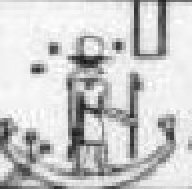
    Decan 14 seen below the back leg of the chair that Corvus sits in is a male figure with a hawk head and with wavy ram horns and a sun disk crown.    He has six stars in two rows of three (in a horizontal rectangular position) below his left hand.
    Since Decan 14 is seen as a netjeru in human form, therefore it represents a spiritual understanding.

    This connects well with Grand Temple Decan 7 a male hawk head with wavy horns under its sun disk crown.    It is unsure whether the name Tjemat kheret and its hieroglyphs match the hieroglyphs in front of Denderah Decan 14’s head, which are located inside the throne or chair of Corvus, known as Her-ua in some sources.

    The hieroglyphs seem to be
the bread loaf sign, Egypt. t,
then a leg sign, Egypt. b,
    with options open for two smaller signs not readable,
and then followed by a star.
    This is [t-b-?-?].


    Of interest is that Denderah Decan 9 has a statue animal image with wavy horns and a sun disk crown on its head as seen below in the figure to the left, which is similar to the one here in Denderah Decan 14.


    Cyril Fagan commented on the Grand Temple Decan 6 and 7 name of Tjemat or Themat seen in the column to the right, "Most appropriately, tm3.t (Themat) the 'river,' is one of several pentades that tally with the constellation Aquarius."

    Compared to Denderah Decan 14, we see a major connection, in that it is a male figure with a hawk head and a horned sun disk crown.


    Grand Temple Decan 7 is a male figure with a hawk head with wavy horns under its sun disk crown, and three stars above it.

    It is called     Tjemat kheret, Themat-Khert, Themaf-Khert or Tjemat Kherijet, which begins with
the tether rope sign, Egypt. tj,
then the Egyptian sign for m3, (ma),
and the bread loaf sign, Egypt. t,
then follows the Egyptian sign for kh,
next the mouth sign, Egypt. r,
then the bread loaf sign, Egypt. t,
followed by a star.
    Thus we read [Tj-ma-t kh-r-t].
    Kheret is also seen on Grand Temple Decan 7 and 12.    Kher seems to mean "lower."
    Tjemat is on Grand Temple Decan 6 and 7.    As seen on "http://home.main.rr.com/ imyunnut/Den.Round.html" by Joanne Conman, "Tjemat," possibly means "The Mat."
    Thus possibly "The Lower Mat."    This is not to be confused with Ma'at.


    Its deity is called     Qebehsenouef, Qebhsenuef (Kabexnuf, Qebsneuef), also seen as Qebh-Sennuf or Tuamutef, son of Horus, seen as a mummified man with a head of a falcon.    Protector of intestines and protected by the goddess Serket.


    Associated with the planet SATURN
and possibly part of DRACO continuation through the heavens,
but it may have stars in
Corona Borealis as Alphecca,
a possible reference to Ipedjes.


Select one of the following to open it.
Each of these are connected to the constellation Virgo,
Bootes, Coma Berenices, Centaurus.
Decan 14, Decan 15.

    This file last updated on February 21, 2004, and also June 18, 2005.

Return to the Table of Contents or the Zodiac of Denderah