Sagittarius and its Decan Constellations.
|
Decan 7-8
|
Decan 7 is under the forefeet of Sagittarius and the stinger of Scorpius and seen as a male figure with a hawk head and two stars aligned vertically under his left hand. It can be compared to Grand Temple Decan 14 as a male figure with a hawk head, with no crown, with three stars (one star above his head, and two stars above his scepter).
The hieroglyphs here are varied on the Denderah Zodiac, we can only speculate that this is the proposed name for Sagittarius, Pi-maere,   
Denderah Decan 18 has the same image
Another source shows the right image as the
From www.siloam.net Denderah Decan 7 is stated as meaning, "Male Intuition, Perception."
From www.siloam.net/denderah it claims that Denderah Decan 5, 6, and 7 represented as Wisdom are entitled as "Rational Feelings." "The enlightened one is transformed into a knowledgeable man who wears the atef crown of rational understanding and walks behind the man with a bare head of a serpent." |
If compared to Denderah Decan 7, a major connection is seen here as a male figure with a hawk head with no crown.  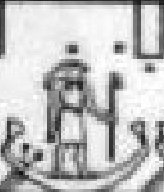 Grand Temple Decan 14 is a male figure with a hawk head, with no crown, with three stars (one star above his head, and two stars above his scepter). Compare this Decan to the Denderah image of Mars.
This Decan is named
The deity is called
Associated with SAGITTARIUS, |

 (i.e. the bar with the two legs) as seen above in the middle picture.
 Soped or known as Sirius, (Egyptian Sepdet) we see
 Sapet khenou, Sa pet khenou, Sapty Khenwey or Sapt-Khennu, the first is