Sagittarius and its Decan Constellations.

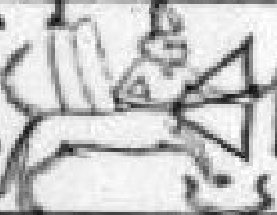
On the Denderah Zodiac, the name of Sagittarius is seen as the Coptic Pi-maere, which means "graciousness," possibly gracious one, or "the going forth," or "shoot." As seen in the Hebrew Naim, the gracious one, and also because of the serpent under it may be known as the same name as Hydra, Knem, "He conquers," but it is actually Draco and called Her-fent, "the serpent accursed."
Also of interest is that Sagittarius is a male figure, wearing the Atef crown (Osiris' white crown of Upper Egypt with the red feathers of Busiris), although upon a closer look one might see female breast or large male breast on the chest, and from the waist up connected to a horse as in being a centaur with wings, and drawing back upon its bow and arrow. Sagittarius - [Centaurus is under Virgo] one source states, "the joining of the Centaur and the Archer in Sagittarius is a metaphor for the union of matter and inspiration." |
Sagittarius as seen above on the Grand Temple with Draco under it's forefeet is located above Decan 14.
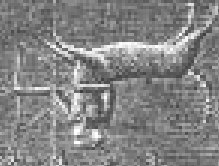
On ESNE Plate 79, we see Sagittarius, upside down and without wings.
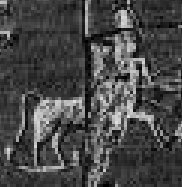
On the lower section of ESNE Plate 87, we can find Sagittarius with Draco below his hind feet.
One source claims that Sagittarius is the Mesopotamian god Pabilsag, as a double-headed (front face is human and rear face is a lion) winged centaur, wearing the atef crown without horns of Egypt, holding a bow and arrow, and having his front hooves in a small bark. |
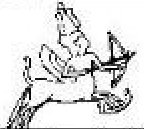 
The hieroglyphic origin is seen as the Arrow 
Demotic 
Sagittarius Sign
 On the Denderah Zodiac, Hercules is seen with a spear (possibly an arrow) in his left hand. |
In the season Peret I (Pert, also Printemps) - seed time, whereas others call it Proyet, meaning "Emergence." So besides a time to sow seeds, it also is when they sent the sheep and horses to pasture.
The month of Sagittarius, as seen on Calendar Dates the month dates as: 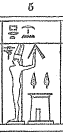 The star is in Lyra (Vega).
On the Grand Temple this deity is between Sagitta (in Capricornus) and Sagittarius located above Decan 15. 
Denderah Decan 4 has a hieroglyph above its head and below the hind feet of Sagittarius, which is not quite readable. Although it looks to begin with the water sign and ends with a star. It may be similar to the name of Grand Temple Decan 17 which is called Ken Mou,
Note that many claim this to be the characters "under the hind foot read Knem, which means He conquers."
In the Zodiac of Denderah, Draco is the serpent under the forefeet of Sagittarius and called Her-fent, "the serpent accursed." Fent means serpent.
In "The Witness of the Stars," by E.W. Bullinger, page 63-64 "Coptic Pimaere, the graciousness or beauty of the coming forth. Hebrew Naim, the gracious one." |