From The Alpha and the Omega - Volume III
by Jim A. Cornwell, Copyright © July 20, 2002, all rights reserved
"Volume III - The Ninth Month - Constellation Names for Sagittarius"
 SAGITTARIUS
Sagittarius, the Archer.
The constellation name for Sagittarius:
- Sumerian PA.BIL.SAG, Sagittarius, one source calls it Papilsak, "Winged Fire-Head."
This alludes to the Sumerian (pa, 'wing' + bil, 'burn, roast' + sag, 'head'), which would mean "winged burning head," making the Archer-centaur, the eternal guardian of fire.
- Sumerian (giš)pa: leaf, bud, sprout; branch; wing; feather.
- Sumerian pana, pan, ban: bow (pa, 'branch', + na4, 'pebble, stone').
- Sumerian pa4,5,6: irrigation ditch, small canal.
- Sumerian pà: (cf., pàd).
- Sumerian pa...è; pa-è...ak: to show; to make appear; to make resplendent (often with -ni- or bi-) ('bud, sprout' + 'to send forth' + 'to make').
- One source claims an Egyptian-Sumerian connection: PA-RIN of the (Sun-)Hawk; Bah, Pah verses Bak, Pak, Rin (Sumerian ring, enclosure, dwelling place), the symbol looks like a square. Note: PA, (or XU) Hawk, The (Sun-)Hawk (line), of the (Sun-)Hawk race.
- Sumerian bil: to burn; to roast.
- Sumerian bìl: sprout, shoot.
- Sumerian gir4-bil: furnaceman, stoker ('kiln' + 'to burn').
- Sumerian i-bí[BIL]: smoke ('to go out, rise' + 'to burn').
- Sumerian gíbil: to burn; burning (gu7, 'to consume', + bil, 'to burn').
- Sumerian sag: head; point; present, gift; slave; human, individual; adj., first, prime; prep., in front.
- Sumerian ság: scattered.
- Sumerian sa-gaz; sag-gaz: highway robber ('head' + 'to smash').
- Sumerian sa-gaz...ak: to rob (someone: dative infix) ('robber' + 'to do').
- Sumerian sag-gaz...ak: to slay ('head' + 'smash' + 'to do'; cf., sa-gaz).
- As one source calims as the Egyptian-Sumerian connection: SAG, The Seer, or Diviner, The Lofty Kad, the tablet (seal) of the One Lord, The Gut (Goth)," Sagara in its fuller form.
- Assyrian-Babylonian Mythology calls it Pabilsag - god of the antediluvian city Larak, and identified with names associated with Ninurta (nin.ur.ta, "foremost warrior").
- In his work “BABYLONIAN STAR-LORE: An Illustrated Guide to the Star-lore and Constellations of Ancient Babylonia,” by Gavin White he claims on page 47, "The base of the Milky Way we find Pabilsag, the Babylonian prototype of our Sagittarius, whose name means the 'Fore-Father' or 'Chief-Ancestor. His function within the stellar calendar was to drive discarnate souls from the environs of the earth up into the heavens."
Other sources have this image 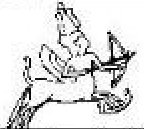 as the hieroglyhic origin of the arrow where White's image seen here
 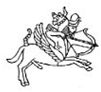 correlates and can be compared to the Grand Temple's square image
 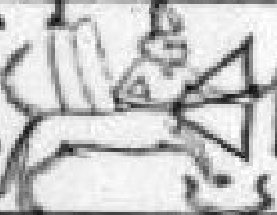 but is not comparable to the round Denderah image
  where he claims on his exerts, "Apart from the Egyptian headdress, the depiction of Sagittarius is almost identical to its Babylonian prototype even down to its two heads and two tails. What is more, below his front feet is a small figure of a boat – this can only be an image of the Babylonian Cargo-boat, which is said to be located beneath the figure of Pabilsag, the Babylonian name for our familiar Sagittarius."
My comment here: I can only see one tail on the round Denderah image, and the The Cargo-Boat is also called MA.GUR8, Ma.gurch and most likely represents Argo Navis or a variation of Draco.
- In Gemini Star Names under Gemini: Akkadian Manzât, is called "The Rainbow," and also under Canis Major: the star name e Adhara, has the following connected words.
- Bow.
- Hebrew qesheth, keh'-sheth, from Heb. qashah, kaw-shaw', a primary root properly to be dense, i.e. tough or severe, thus in the original sense of (Heb. qowsh, koshe, a prim. root to bend) of bending, a bow, for shooting (hence fig. strength) or the iris, arch (-er), bow.
- Rainbow.
- Greek iris, ee'-ris, perhaps from Gr. ereo, er-eh'-o, probably a fuller form of Gr. rheo, hreh'-o, an alternative for Gr. epo, ep'-o, a prime verb, in certain tenses, to utter, i.e. speak or say, call, tell, thus (as a symbol of the female messenger of the pagan deities), a rainbow ("iris"), rainbow.
- Winged Fire-head seen under Sagittarius, and also Hebrew Qashot in Sirius.
- From www.lexiline.com, "The star behind them: The Fire-Arrow-Sagittarian (PA.BIL.SAG), the horse's head of Sagittarius contains the brightest stars, the galactic center."
- From www.lexiline.com it claims, "On the 15th of Kislimu, the Leopard UD.KA.DUCH.A (Cepheus), the eagle TI8.MUSHEN and the fire-arrow-Sagittarius PA.BIL.SAG are visible."
- Sumerian ban, pana, pan: bow (pa, 'branch', + na4, 'pebble, stone').
- Also the Kish.
- Hebrew Qiysh, keesh, from the Heb. qowsh, a bow, Kish.
- From www.lexiline.com, "The Bow (BAN), the Elamite d.Ishtar, the daughter of d.Enlil," same as Sumerian BAN, "bow."
- Akkadian name for the constellation is called Nunki or Nun-ki, "The Prince of the Earth."
- The star name in Sagittarius, s (sigma) Nunki, is an untranslated ancient Babylon proper name, as a heavenly counterpart to their city Ridu (Eridu), sacred to the god Ea.
- Hebrew Naim for Nunki, means "The Gracious (One)," per some sources.
- But actually the Hebrew na'iym, naw-eem', from Heb. na'em, naw-ame', a primary root to be agreeable (lit. or fig.), pass in beauty, be delight, be pleasant, be sweet, thus delightful (obj. or subj., lit. or fig.), pleasant (-ure), sweet.
- Note that Naim, Na'iym is found in the Arabic lunar names.
- The Arabic Al Naim, means "the Gracious, pleasant."
- Rolleston states the Hebrew Naim, the Gracious, the delighted, from Psalm 27:4.
- One source claims the Hebrew channun (i.e. kan nun ki), which means "the gracious one," as in Psalm 45:2.
- Hebrew chen, khane, from Heb. chanan, khaw-nan', a primary root properly to bend or stoop in kindness to an inferior, to favor, show mercy, thus graciousness, i.e. subj. (kindness, favor) or objective (beauty), favor, grace (-ious), pleasant, precious.
- Egyptian/Coptic:
- On Denderah Zodiac, the name of Sagittarius is seen as the Coptic Pi-maere, which means "graciousness," possibly gracious one, or "the going forth," or "shoot." As seen in the Hebrew Naim, the gracious one, and also because of the serpent under it may be known as the same name as Hydra, Knem, "He conquers," but it is actually Draco and called Her-fent, "the serpent accursed."
- Also of interest is that Sagittarius is male figure, wearing the triple crown or Atef, although upon a closer look one might see female breast or large male breast on the chest, and from the waist up connected to a horse as in being a centaur with wings, and drawing back upon its bow and arrow.
- In "The Witness of the Stars," by E.W. Bullinger, page 63-64 "Coptic Pimaere, the graciousness or beauty of the coming forth. Hebrew Naim, the gracious one."
- "In the ancient Zodiac of Denderah he (Sagittarius) is called (as in the Coptic) Pi-maere, i.e. graciousness, beauty of the appearing or coming forth. The characters under the hind foot read Knem, which means He conquers."
- In the Zodiac of Denderah, Draco is the serpent under the forefeet of Sagittarius and called Her-fent, "the serpent accursed." Fent means serpent.
- Sagittarius has been associated with Nergal, the arrow-shooting god of 2 Kings 17:30.
- Nergal (nur'-gal).
- Hebrew Nergal, nare-gal', of foreign origin, Nergal, a Cuthite deity, other sources claim the Heb. nereghal, a Babylonian deity of destruction and disaster, associated with the planet Mars, thus personified as the Assyrian-Babylonian Mars.
- A cylinder seal from Larsa, an ancient Sumerian city, c. 2360-2180 B.C., shows the god Nergal standing with one foot upon the body of an enemy.
- Jewish writers claim that this idol (i.e. of Nergal) is usually in the form of a cock, which is often associated with a priest on the Assyrian monuments.
- Sumerian nir-gál: noble ('raised high' + 'to be').
- Cuneiform inscriptions designate Sagittarius as the Strong One, the Giant King of War, and as the Illuminator of the Great City, personifying the archer god of war, Nergal or Nerigal, or under his guardianship, as the Great Lord [Allen notes: This may be seen in the Mandaeans' name to-day — Nerig — for the planet Mars]. This divinity is mentioned in the Second Book of Kings, xvii, 30.
- Nimrod (nim'-rod).
- Hebrew Nimrowd, nim-rode', or Nimrod, probably of foreign origin, the assumption is that it means "rebel," a son of Cush, Genesis 10:8-10, presents a mighty hunter (his royal character), and the first king in the earth, ruler of the land of Shinar.
- He was responsible for building the city of Babel (Babylon) and his name has been connected to the Sumerian Nin-Maradda, "Lord of Marad," a town southwest of the city of Kish.
- He also has a possible reference to Ninus.
- He founded Nineveh (nin'-e-veh).
- Hebrew Niyneveh, nee-nev-ay, of foreign origin, Nineveh, the capital of Assyria.
- Allen claims: ... but the conception of Nimrod as "the mighty Hunter before the Lord," at least in the ordinary sense of that word, is erroneous, for the original, according to universal Eastern tradition, signifies a Lurking Enemy, or a Hunter of men rather than of beasts.
- As noted under Auriga as mentioned in "Hamlet's Mill" by Giorgio de Santillana and Hertha von Dechend, Gambit Inc. 1969 it states on page 438, "... chariot (narkabtu) at Ningirsu. MES.LAM.TA.E3.A, the oldest name know of the god Nergal, 'who comes forth from MES.LAM'."
- Latin Sagittarius, the Archer, or "who sends forth the arrow."
- Rolleston and in "The Witness of the Stars," by E.W. Bullinger, page 63 "The Hebrew and Syriac name of this sign is Kesith, which means the Archer (Gen. 21:20). The Arabic name is Al Kaus, the arrow. In Coptic it is Primaere, the graciousness, or beauty of the coming forth. In the Greek it is Toxotes, the archer, and in Latin Sagittarius."
- Richard H. Allen states: Toxeutes, the Archer, and Rutor toxon, the Bow-stretcher, with Aratos; Toxeuter with other Greeks; and Toxetes with Eratosthenes, Hipparchos, Plutarch, and Ptolemy. The Belokrator cited by Hyde, though not a lexicon word, probably signifies the Drawer of the Arrow.
- He also comments: It was the Persian Kaman and Nimasp; the Turkish Yai; the Syriac Keshta and the Hebrew Kesheth; Riccioli's Kertko, "from the Chaldaeans"; all signifying a Bow, whence some early maps illustrated Sagittarius simply as a Bow and Arrow. This was an idea especially prevalent in Asiatic astronomy.
- One source claims that Rolleston states that the Hebrew Terebellum, means "sent forth swiftly," and Greek Croton, the purchaser, (referring to Libra).
- RIchard H. Allen states: Columella called it Crotos, and Hyginus, Croton, the Herdsman; but how these names are applicable does not appear, as to the mythological satyr Crotos.
- Other names for Sagittarius: Alkauus'o, Elkaus'u, Al Kaus', Udhi'yy al Na'am.
- French Sagittaire, the Italian Sagittario, and the German Schutze, — Bayer's Schutz.
- In regard to the Bow, Elkausu or Elkusu, Schickard's Alkauuso, from the Arabic Al Kaus.
Other sources claim that Sagittarius is:
- Sumerian ùz, ud5, ut5: she-goat.
- Sumerian us, uz: domestic goose or duck (Semitic loanword).
- Sumerian ús: n., side, edge; distance; in geometry: length; height; vertical; perpendicular; v., to follow; to drive; to come near to, reach; to let reach; to join; to be next to; to moor; to lean against; uz: (cf., us).
- Sumerian us5, u8: mother ewe, adult female sheep.
- Under Lyra we find the Sumerian ÙZ , Akkadian Enzu, "The She-Goat."
- Also in Lyra, see the star named a Capella (Latin "little she-goat") in Auriga.
- Akkad Nedu, "Soldier" or "Archer."
- Assyrian Yumu nahri, "Day-of-Dawn" or "Dawn of Day."
- Akkadian Utacagaba, "Light-of-the-White-Face," (derived by Sayce).
- Richard H. Allen claims: An inscription, on a fragment of a planisphere, transcribed by Sayce as Utucagaba, the Light of the White Face, and by Pinches as Udgudua, the Flowing (?) Day, or the Smiting Sun Face, is supposed to be an allusion to this constellation; while on this fragment also appear the words Nibat Anu, which accord with an astrolabe of Sennacherib, and were considered by George Smith as the name of its chief star.
- Akkadian claims Udguda, "Smiting-Sun-Face," as claimed by Brown.
- Udguda was subdivided into three parts:
- 1) "The Dusky Part."
- 2) Akkadian Ega, Assyrian Agu "Crown", Uzza "Glory," possibly the stars l (Lambda) and m (Mu) (6 & 3 Capricornus) the bright upper part of the figure.
- The star name l Kaus Borealis, "northern [star] of the bow," marks the top of the domed lid of the teapot,
- m Sagittarii (no name), nor translations.
- 3) Sugab, "The Left Hand" (the hand that holds the bow, the stars g (Gamma) and d (Delta) (1 & 4 Capricornus) at the upper part of the bow.
- The star name for g (Gamma) Alnasl which is Arabic for "the point" and refers to the tip of the arrow,
- d (Delta) Kaus Media or Kaus Meridionalis word for "bow" (kaus) and the Latin for "middle," is part of the body of the teapot.
- Richard H. Allen claims cuneiform inscriptions call Sagittarius "Strong One," "Giant King of War," and "Illuminator of the Great City," personifying the archer god of war, Nergal or Nerigal, or under his guardianship, as the Great Lord, which may be seen in the Mandaeans' name to-day — Nerig — for the planet Mars. This divinity is mentioned in the Second Book of Kings, xvii, 30.
An incomplete Babylonian fragment is thought to read Kakkab Kastu (Akkadian Ban), "The Constellation of the Bow."
- Richard H. Allen states: Another inscribed tablet, although somewhat imperfect, is thought to read Kakkab Kastu, the Constellation, or Star, of the Bow, — in Akkadian Ban, — indicating one or more of the bow stars of the Archer. This will account for the Toxon of Aratos and the Arcus of the Latins, Sayce agreeing with this in his rendering Mulban, the Star of the Bow.
- See note in Gemini under Canis Major, Sumerian Ban (Gish.Ban), Akkadian Qashtu, "The Bow."
- Sumerian ti...ra: to shoot an arrow ('arrow' + 'to stab').
One of the twelve simple Hebrew Letters is Samekh (KJV, Samech, Ps 119:113, Çamek, saw'-mek), s which has a numerical value equal to 15, and an esoteric meaning of "a Support."
- Support.
- Hebrew samak, saw-mak', a primary root, to properly (lit. or fig.), reflex, to lean upon or take hold of.
- Hebrew aman, aw-man', a primary root to build up or support.
- Foundation.
- Hebrew maççad, mas-sad', or muwçad, moo-sawd', from Heb. yaçad, yaw-sad', a primary root, to set, to found, a foundation.
Continue to Star Names of Sagittarius or return to the Introduction of Sagittarius.
This page updated on March 14, 2005, July 15, 2008, and March 30, 2010.
Return to the Table of Contents or the Zodiac of Denderah