To return to the Sagittarius Decan (Min was netjer of the fifth month named Tybi), Reshef (Qadesh, goddess of love, an aspect of Hathor, stands on a lion flanked by Min and Resheph),
or List of Netjeru.
Min one of the Egyptian gods worshiped from predynastic times and had the earliest form of a fetish resembling a barbed arrow, a belemnite fossil or a thunderbolt. The strange arrow, over time, became the first hieroglyph, the one above the standard, in his name. A Gerzean palette known as the El Amrah Palette (near Abtu (Abydos)) also had a second name, the Min Palette, because it had the symbol of the fertility god on it. Unlike in the hieroglyph, this looks more like a double-ended arrow (on a hook). Another piece from El Amrah was an ivory statuette of a man that stood with his legs together, his arms at his sides and an erect penis. This, too, was probably another early representation of the god.
He was also a god of the Eastern Desert, and as seen in the Pyramid Texts, "the one who raises his arm in the east," is probably Min, where he offered protection to travellers and traders on the caravan route through Gebtu and headed out east to the Red Sea. At Wadi Hammamat, on the trade route, prayers and thanks to the god Min were found.
Worshipped at Gebtu/Koptos/Qift and Ipu/Khemmis/Panopolis/Akhmin. Gebtu (Koptos) was Min's cult centre from the earliest times. Later, he was associated with Khent-Min (Panopolis, Akhmim). The predynastic ruler, the Scorpion King, was believed to have worshiped both Min and Set. Min was worshiped right through Egyptian predynastic times up to Roman times, a deity whose temples were built and rebuilt through Egypt's entire history. Min was another form of Amun worshipped at Coptos (trading) and Panopolis (white bull at the games of the Greeks). During New Kingdom times he was sometimes shown as a white bull, an animal sacred to the fertility god.
In the Hymn to Min, "Min, Bull of the Great Phallus, ... You are the Great Male, the owner of all females. The Bull who is united with those of the sweet love, of beautiful face and of painted eyes, Victorious sovereign among the Gods who inspires fear in the Ennead.... The goddesses are glad, seeing your perfection."
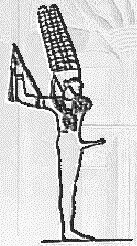
The netjer of the fifth month of Sagittarius (Tybi, Shefdbet, Coptic Toba) was Min, at Ramesseum: Min, at Edfu: Set-but, note Shefdbet mentioned above. As seen in the month of Tybi, Min was the ithypallic god of Panopolis and Koptos, depicted as a human male naked and with an erect penis, crowned with lofty plumes of Amon, and holding a flagellem in the act of striking. He was an Egyptian god of procreation or always a god of fertility and sexuality.
In Egyptian times, he was usually an ithyphallic bearded mummiform man, standing with both legs together, an arm raised holding his symbol or a flail and wearing the same low crown with twin plumes as Amen (Amon). The flail was often used to show the pharaoh's supremacy over his enemies, and was therefore linked to both power and destruction. The way he holds his flail might be symbolic of intercourse, since the flail forms the V while his upraised forearm seems to thrust inside the V. The Egyptian paintings and reliefs on tomb walls and temples did not show Min's other arm, but the statues of the god show him with his left hand encircling the base of his penis. Min was also a lunar deity associated with moisture and thus of fertility, given the title "Protector of the Moon," therefore related to the lunar month, and the day was known as "The Exit of Min."
He was a god for animals or a god of vegetation. He was celebrated at the "festival of the staircase" when he was presented the first ear of corn from the new harvest.
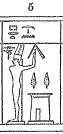
Other sources claim he was associated with the Egyptian long-leaf lettuce - an aphrodisiac to the ancient Egyptians because the lettuce was tall, straight and secreted a milky substance when pressed! This was also a favourite food of Set. Min was often shown standing before offering tables, covered with heads of lettuce.
The fertility god was associated both with Horus the Elder (Min-Horus) in the Middle Kingdom and with Amen (Amen-Min) in New Kingdom times to show the creative force of both gods. At times, even some goddesses have been shown with the body of Min!
The goddess Sekhmet as the Eye of Ra, for instance, showing that Min also has a destructive side, rather than just creative. She was shown with the body of an ithyphallic Min and the head of a lioness. There are some indications that there was a ritual in the Egyptian military for ensuring the subjugation of prisoners - as in the story of Set and Horus - it involved "impregnating" (and so emasculating) the prisoner, and so the erect state of the penis could relate to victory over the enemy.
There was also a composite deity called "Mut-Isis-Nekhbet, the Great Mother and Lady" who was shown as a winged goddess with leonine feet, an erect penis and three heads - a lion head wearing Min's headdress, a woman's head wearing the double crown of Egypt and a vulture's head wearing the red crown of Lower Egypt. Min wasn't just a fertility god, such as Hapi or Osiris, who only presided over the fields - he was also a god of male fertility who could give the pharaoh (and other men) the power to father a child.
He also presided over the sed (jubilee) festival of the pharaoh (where the pharaoh had to run around a course set by the priests, carrying different objects), symbolically rejuvenating the pharaoh to give him long life... and the fertility of his youth. In representations of one of the important Min festivals, the Pharaoh was shown hoeing the ground and watering the fields while Min looked on. At the Min festival held at the beginning of the harvest season, the Pharaoh was seen ceremonially reaping the grain ... When he begot his heir (ritually at the same festival) the Pharaoh was again identified with Min.
As with Osiris, Min was an agricultural god - at Medinet Habu, Ramses III is shown scything a sheaf of wheat for the Festival of Min. There are also scenes of pharaohs ceremonially hoeing the ground and watering the fields under the supervision of Min. It is interesting to note that a virgin was poetically referred to as an "unplowed field."
Depictions of men climbing poles at the Feistval of Min used to be thought of as an activity Egyptologists called "Climbing for Min." It is now known that this was a very important part of the Festival - the erection of a large festival tent. It was so important that the only depiction of the Festival of Min was the scene showing the men climbing the poles of the tent! Min was also worshiped by the men who worked the mines and the men who quarried the stone at Hammamat. At this particular Wadi, Min was given the title "Min, the Male of the Mountain," a title with the word "male" being similar to the hieroglyph for "foremost." Montuhotep IV set out on an expedition to Hammamat: Year Two, second month of the inundation, day 15 of the reign of Horus, lord of the two lands, two ladies lord of two lands, divine of gold, the king of Upper and Lower Egypt Nebtawyra, son of Ra, Montuhotep, living forever.
His majesty decreed the erecting of this decree for his father Min - Lord of the Foreign Lands, in this Mountain, the Noble One, the Primeval God Foremost of Place in the Land of the Horizon Dwellers, the Palace of the God, to Endow with Life the Divine Nest of Horus with which this God (Min) is Content, his Pure Place of Enjoyment which has Authority over the Uplands and God's Lan - in order that his ka be content.
"My majesty caused the Prince - the Overseer of the City, the Vizier, the Overseer of the Royal Constructions - his Trustee Amenemnhat, to go forth with an army of 10,000 men from the southern nomes of Upper Egypt, the foremost ones of the Theban nomes, to bring me excellent rich pure blocks, which are in this mountain whose excellence Min made, to be a sarcophagus, a remembrance of eternity and to be monuments in the temple of Upper Egypt, being one whom the king who is upon the Two Lands sent to bring him his wishes from the hill countries of his father Min."
He made it as his monuments for his father Min of Gebtu, Lord of the Hill Countries, who is upon the Chieftain of the Bowmen, so that he might achieve of "state of given life." He who lives like Ra, eternally.
Gebtu was a cult centre for both Min and Isis, and in this city, Min became the husband of Isis and father of Horus because of his powers of fertility. In later periods he was possibly placed in a triad to the Syrian love goddess Qedeshet (Kadesh, Qadesh, Qetesh, Qudshu) and the Syrian god of war and thunder, Reshef (Reshep, Reshpu). It was likely that Min was placed with these two deities from the east of Egypt because he was both god of the Eastern Desert and Lord of Foreign Lands. He was also thought to be the son-husband of the goddess of the east, Iabet, again through his position of god of the Eastern Desert. Min, Lord of the Processions,
God of the High Plumes,
Son of Osiris and Isis,
Venerated in Ipu,
Gebtu's Horus of the Strong Arm.
-- Hymn to Min
This file was created on June 18, 2005, and updated on May 30, 2006.