From The Alpha and the Omega - Volume III
by Jim A. Cornwell, Copyright © July 20, 2002, all rights reserved
"Volume III - Gods/Goddesses of Ancient Egypt"
SESHAT
(Sesheta, Sashet)


    To return to the
Argo Navis Decan (flower with seven petals an early reference to Seshat, consort of Thoth),
Denderah Decan 3 (Seshat and the ceremony of the stretching of the cord, her magic wand with its seven pointed star),
Denderah Decan 26 (Seshat and seven stars of intuition, mistress of measure),
List of Netjeru.
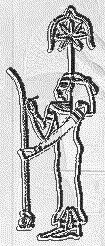
    Seshat, meaning "she who is foremost in the house of books," or "female scribe," was a goddess of writing and measure of time, mathematics, calculated sidereal moment, historical records, royal accounts, audits, measurement and architecture to the ancient Egyptians.    She helped the Pharaoh with a measuring cord to lay ground plans of a new temple.
    She is shown as a woman wearing a panther skin robe (the garb of the funerary stm priests), holding a pen, a palette and a tally-stick.    Her headdress that was also her hieroglyph which may represent either a stylised flower or a seven (or nine) pointed star on a standard that is beneath a set of down-turned horns or surmounted by either a bow or a cresent moon with two falcons feathers.    The horns may have originally been a crescent, linking Seshat to the moon and hence to her spouse, the moon god of writing and knowledge, Thoth (Djehuty).
    Other sources claim she was also identified with Isis.    Safekh-Aubi (Sefekh-Aubi) is a title that came from Seshat's headdress, that may have become an aspect of Seshat or an actual goddess.    Safekh-Aubi means "She Who Wears the Two Horns" and relates to the horns that appear above Seshat's standard.

seven petalled flower enlarged
    The flower above has seven petals, and is probably an early reference to the goddess of conception, Seshat as seen on Argo Navis Decan.
    During New Kingdom times, she was shown to have been involved in the sed (jubilee) festival of the pharaohs, holding a palm rib (palm leaf) in her hand to show the passage of time.    She kept track of each pharaoh and the period for which he ruled and the speeches made during the crowning rituals.    She was also shown writing down the inventory of foreign captives and captured goods from campaigns.
    On Denderah Decan 3, Seshat is seen as Female Intuition, and "origin of the wisdom of Thoth, the essence of cosmic intuition, and the mistress of measure.    The Egyptian priests enacted a ceremony for her at the creation of the cosmos by the ceremony of the stretching of the cord.    Her magic wand (seven pointed star seen at Bootes) is a symbol of creative ideas."
    Seshat has no temples that have been found, though she did have a priesthood in early times.    Along with her priestess', there were a few priests in the order, the Slab Stela of Prince Wep-em-nefret, from the Fourth Dynasty, gives him the title of Overseer of the Royal Scribes, Priest of Seshat.    It was at a later time that the priests of Thoth took over the priesthood of Seshat.
    She was associated with the pharaoh at the "stretching the cord" foundation ritual, where she assisted the pharaoh with the measuring process, which was called Pedj Shes, a ceremony used to work out correct alignment for building temples and pyramids, by using the constellations of Orion and Ursa Major (the great bear).
    In "The Dawn of Astronomy" a study of the temple-worship and mythology of the Ancient Egyptians by J. Norman Lockyer, New York, The McMillian Company 1897, as seen on page 173, "Amongst these ceremonies, one especially refers to the fixing of the temple-axis; it is called, technically, 'the stretching of the cord,' and is not only illustrated by inscriptions on the walls of the temples of Karnak, Denderah, and Edfu ..
    Another part of the ceremony consisted in the king proceeding to the site where the temple was to be built, accompanied mythically by the goddess Sesheta, who is styled 'the mistress of the laying of the foundation-stone.'
    Each was armed with a stake.    The two stakes were connected by a cord.    Next the cord was aligned toward the sun or star.    As the case might be; when the alignment was perfect the two stakes were driven into the ground by means of a wooden mallet
."
    He continues on page 174-175, "Egyptian word which expresses the idea of founding or laying the foundation-stone of the temple is Senti - a word which still exists in Coptic.    But in the old language another word, Put-ser, which no longer remains in Coptic, has been traced.    It has been established that put means 'to stretch,' and ser means 'cord'."
    Cyril Fagan, in his work Zodiacs Old and New (1951), stated "One of the most important ceremonies in the foundation of Egyptian temples was known as Pedjeshes (Pedj--'to stretch,' Shes--'a cord') and it forms the subject of one of the chief monumental ornaments in the temples of Abtu (Abydos), Iunu (On, Heliopolis), Iunet (Dendera), and Djeba (Utes-Hor, Behde, Edfu).    The reigning pharaoh and a priestess personifying Seshat, the goddess of writing, proceeded to the site, each armed with a golden mallet and a PEG connected by a cord to another PEG.    Seshat having driven her peg home at the previously prepared spot, the king directed his gaze to the constellation of the Bull's Foreleg (this constellation is identical with Ursa Major, 'Great Bear,' and the 'hoof' star is Benetnasch, Eta Ursae majoris).    Having aligned the cord to the 'hoof' and Spica as seen through the visor formed by Seshat's curious headdress, he raised his mallet and drove the peg home, thus marking the position of the axis of the future temple."

    As can be seen on Denderah Decan 26 the image above which is seen below the forefeet of Taurus as a female figure with a lion’s head, with three cobra-like serpents on her head (Uraeus, the cobra is an emblem of Lower Egypt, associated with a kingdom of Lower Egypt, and as a symbol worn on the crown or headdress of royalty).    She is on her knees, with her hands on her thighs, and in front of her abdomen are seven stars in a u-shaped pattern.

    What other sources state about Seshat.
    She was believed to appear to assist the pharaoh at various times, and who kept a record of his life: It was she who recorded the time allotted to him by the gods for his stay on earth.
    Seti I, at Abtu, dedicated part of his temple to the goddess: The staircase of the temple ... bears an address in 43 columns of the goddess Seshat to the king (KRI I, 186-188).    The text displays a rigid scheme which deals with the temple itself and its two groups of occupants (the king and the gods) and in which pseudo-verbal/ temporal aspects and non-verbal sentences/ a-temporal aspects alternate.    The author demonstrates that the three main elements, temple, gods and king, have each their proper place in the sophisticated and complicated structure of the text.    The address consists of three parts.
    The Egyptians believed that Seshat invented writing, while Thoth taught writing to mankind.    She was known as "Mistress of the House of Books," indicating that she also took care of Thoth's library of spells and scrolls.    It was as "Mistress of the House of Architects" that she helped the pharaoh set the foundations of temples with indication that she set the axis by the aid of the stars.
    Pharaoh Hatshepsut (1473-1458 BC) depicted both Seshat and Thoth as those who made the inventory of treasures brought back from Punt: Thoth made a note of the quantity and Seshat verified the figures.
    Seshat was the only female that has been found (so far) actually writing.    Other women have been found holding a scribe's writing brush and palette - showing that they could read and write - but these women were never shown in the act of writing itself.    She was a rather important goddess, even from earlier times in the Pyramid texts.    She was the first and foremost female scribe - accountant, historian and architect to both the pharaoh and the gods.    She was the female goddess of positions belonging mostly to men.    Yet she did not have a personal name, only a title - Seshat, the Female Scribe.


    This file was created on June 18, 2005.

Return to the Table of Contents or the Zodiac of Denderah