|
Decan 9-10

|
Decan 9 is seen below Scorpius as a head of a ram with wavy horns and a sun disk crown, which seems to be placed on an altar or pedestal, which may have hieroglyphic markings on it. It is also noticeable that Denderah Decan 27 seen below is similar to Denderah Decan 9 as seen as the "Stiff-necked Ram."
Since Decan 9 is seen as a netjeru in animal/object form (altar of animal instincts), therefore it is a variation of a force of nature.

This is located under Taurus, which is the opposite of Scorpius.
There are no hieroglyphs seen above Denderah Decan 9, but as seen in the images below it may contain some inside the body of the image itself.
 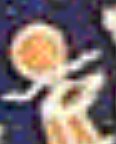 
Note that on the  Grand Temple Decan 7 the figure has a male hawk head with a circle and horns (sun disk crown) similar to those on Denderah Decan 9. Grand Temple Decan 7 the figure has a male hawk head with a circle and horns (sun disk crown) similar to those on Denderah Decan 9.
From www.siloam.net/denderah it claims that Denderah Decan 8, 9, and 10 represented as Thoth-Osiris are entitled as "Primordial Instincts." "This process is the beginning of the whole cycle represented by the baboon of Thoth (see Denderah Decan 8), at the altar of animal instincts (see Denderah Decan 9), we see the man of Osiris (see Denderah Decan 10)."
|
Comparing to Denderah Decan 9, there is no connection seen.
 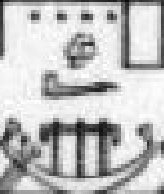
Grand Temple Decan 12 is seen with four stars,
then the Egyptian sign for Tep,
and the lower arm sign, Egypt. a,
then a fence with three post, as seen on Orion, in Egyptian hieroglyphs this is seen as a fence with three posts (or a backbone with three bones). It is the only image like this in the Grand Temple procession.
This Decan is named  Khentet kheret, Khentet-Khert, or Khentet Kherijet, Khentet kheret, Khentet-Khert, or Khentet Kherijet,
the first three signs are the Egyptian Khentet, also seen on Grand Temple Decan 10-13,
then followed by the Egyptian sign for kh,
next the mouth sign, Egypt. r,
then the bread loaf sign, Egypt. t,
followed by a star.
Thus we read [Khentet kh-r-t].
As seen on "http://home.main.rr.com/imyunnut/Den.Round.html" by Joanne Conman, Khentet means "to travel southward" or "upstream."
Cyril Fagan comments, "Preceding Khonoy (Pisces) are a group of pentades falling in the constellation Aquarius and having the ideogram of three jars in a stand. This is a syllable for knt.t (Khentet) which means 'he who is in front.' This refers to the Full Moon in Aquarius which occurred at the inauguration of the Sothic Cycle and which led the planetary reading from west to east."
The name Sebshesen is the closest that may connect to this Decan, and its meaning is uncertain. As can be seen on Denderah Decan 13 the sequence of stars are the names Sebshesan (Libra), Ipedjes, and Weshaty-Bekaty.
Khent is seen on Grand Temple Decan 10, 11, 12, 13, 25, 26 and 27.
Kheret is seen on Grand Temple Decan 7 and 12 also.
Kher is seen on Grand Temple Decan 3, 22, 27 and 34.
The deity is called  Set, the god of evil. Set, the god of evil.
Associated with URSA MINOR,
but has stars in Ophiuchus/Serpens as Sabik and Ras Al Hague.
|