From The Alpha and the Omega - Volume III
by Jim A. Cornwell, Copyright © July 20, 2002, all rights reserved
"Volume III - The Ninth Month - Star Names for Lyra"
In the Ninth Month of Sagittarius
Star Names of Lyra
a Vega which means, "eagle" or "vulture" in Arabic, (al nasr) al waqi', the falling (vulture).
- Falling.
- Hebrew nabel, naw-bale', a primary root to wilt, gen. to fall away, fail, faint, fig. to be foolish, fall (down), falling, make vile, wither, which is connected to the Hebrew word for Lyre as seen in the next star name.
- Vulture: noted in the Arabic al waqi'.
- One source claims Ve'ga, means "the swooping (eagle)," and Arabic Al-Waqi', "the stooping" eagle.
- Sumerian te8: bearded vulture.
- Hebrew 'ayah, ah-yaw', perhaps from Heb. 'iy, ee, short. form Heb. 'owy, o'ee, alas!, woe, thus the screamer, i.e. a hawk, kite, vulture.
- Hebrew dayah, dah-yaw', intens. from Heb. da'ah, daw-aw', a primary root to dart, i.e. fly rapidly, fly, thus the kite (from its rapid flight), vulture, a falcon (from its rapid flight), vulture.
- Hebrew ra'ah, raw-aw', a primary root to see, thus a bird of prey (probably the vulture, from its sharp sight), glede.
- Sumerian anzud(2), anzu(2)-(d)[dIM.MI/DUGUDmušen]: a mythical giant bird; vulture, eagle.
- Eagle: noted in the Arabic, (al nasr).
- Sumerian urin, ùri: eagle; standard, emblem, banner; blood.
- Sumerian Á.MUSHEN, Akkadian Erû, "The Eagle," in Aquila; which is seen in the Sumerian (á, arm, wing, strength + mušen, bird), "The Strong Bird," not specifically an eagle.
- Hebrew neshar (Chald.), nesh-ar', corresponds to Heb. nesher, neh'-sher, from an unused root meaning to lacerate, the eagle (or other large bird of prey), thus an eagle.
- Hebrew racham, raw-khawm', or (fem.) rachamah, raw-khaw-maw', from Heb. racham, raw-kham', a primary root to fondle, to love, thus a kind of vulture (supposed to be tender towards its young), gier-eagle.
- In "The Witness of the Stars," by E.W. Bullinger, page 67 "In the Denderah Zodiac this constellation (Lyra) is figured as a hawk or an eagle (the enemy of the serpent) in triumph."
- Another meaning for Vega is "He Shall Be Exalted," from Psalm 99:5, 9 and Phil. 2:9-11. Whereas another source claims "Vega, He shall be exalted (Psalm 65:1)."
- Exalt.
- Hebrew ruwm, room, a prim root, to be high, bring up, exalt, extol, from Psalm 99:5, 9.
- Greek huperupsoo, hoop-er-oop-so-o, to elevate above others, raise to the highest position, highly exalt, from Phil 2:9.
- Rolleston claims the "Hebrew Vega, he shall be exalted (triumph - Exodus 15:1)."
- Triumphed.
- Hebrew ga'ah, gaw-aw', a prim. root, to mount up, hence to rise, be majestic, gloriously, grow up, increase, be risen, triumph, from Exodus 15:1, 21.
- Sumerian dLAMMA, which is associated with the star named a Vega, Arabic for "eagle," or "vulture," in Lyrae.
- Sumerian dlamma, lama: a female spirit of good fortune; tutelary genius (lam, 'to make grow luxuriantly', + a, nominative suffix).
- In his work “BABYLONIAN STAR-LORE: An Illustrated Guide to the Star-lore and Constellations of Ancient Babylonia,” by Gavin White gives this image of a Lamma-goddess with an overflowing vase seen on page 59 shown here as
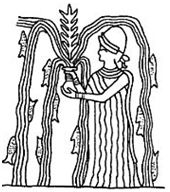 where he connects it to the Star of Abundance in Bootes, but I show as a reference to Sumerian HÉ.GÁL-a-a, Akkadian kakkab nushi, "Star of Abundance," as part of Coma Berenices (?), as part of Virgo.
- Other names for Vega: We'ga, Fidis, Harp Star, Ve'ka, Vue'gg, Wa'ghi.
b Sheliak, which is Arabic for "harp," an eclipsing variable star sometimes called Beta Struve (after Otto Struve).
- The harp was first used by Jubal in Genesis 4:21.
- According to Josephus the harp was played with the fingers and had twelve strings, in contrast to ten strings of the lyre, which was played with a plectrum.
- David is represented as a skillful performer on the lyre in 1 Sam. 16:14-23.
- The harp is mentioned in the Book of Psalms and also in Amos 5:23.
- A lyre was found in:
- a grave at Ur, (c. 2500 B.C.).
- on wall paintings from the Theban tomb of Djeserkarseneb, time of Thutmose IV (c. 1421-1413 B.C.).
- a limestone relief from the tomb of Paatenemheb, near Saqqara, Egypt (c. 1350 B.C.).
- Harp or Lyre.
- Hebrew kinnowr, kin-nore', also kinnor from an unused root meaning to twang, a harp, harp.
- Hebrew nebel, neh'-bel, or nebel, nay'-bel, also nebbel, from Heb. nabel, naw-bale', a primary root to wilt, gen. to fall away, fail, faint, fig. to be foolish, fall (down), falling, thus a skin bag for liquids, a vase, also a lyre (as having a body of like form).
- Sumerian balag: lyre (?); drum (?); funeral song.
- Sumerian balag-íl: harp or lyre carrier ('harp' + 'to lift').
- Other sources call this Shel'iak or Shel'yak, which means "tortoise," (lyre made from a shell).
- In "The Witness of the Stars," by E.W. Bullinger, page 67 "There may be some confusion between the Hebrew Nesher, an eagle, and Gnasor, a harp," (Assumption of the eagle soaring up with a harp).
- My comments: Of course I find no word for gnasor in the Hebrew.
- In "The Witness of the Stars," by E.W. Bullinger, page 67 "b is called Shelyuk, which means an eagle (as does the Arabic, Al Nesr)."
- Rolleston "Arabic Al Nesr, the eagle, Lev. 11:13 (coming straight - 1 Sam. 6:12)."
- Straight.
- Hebrew yashar, yaw-shaar', a primary root to be straight or even, fig. to be (causat. to make) right, pleasant, prosperous, direct, fit, seem good, please, be right, bring straight (way), be upright (-ly).
- Rolleston claims "Hebrew Shelyuk, the fishing eagle, Lev. 11:17 (sent forth to smite)."
- Other names for Sheliak: Shil'iak.
g Sulaphat or Sulafat', which is Arabic for "tortoise."
- Also seen as the Arabic As-Sulahfah, "The Tortoise."
- Rolleston and in "The Witness of the Stars," by E.W. Bullinger, page 67 "g is called Sulaphat, springing up, or ascending, as praise," (groweth, Psalm 129:6).
- Groweth.
- Hebrew shalaph, shaw-laf', a prim. root, to pull out, up or off, draw, (oof), grow up, pluck off, from Psalm 129:6.
- Under the constellation of Cancer the crab, some viewed it as a tortoise, turtle.
- Turtle.
- Sumerian (ku6)ba: a shelled creature (such as a turtle or a snail); found in a word like sig4-ba: turtle shell (?) ('brick; wall' + 'turtle').
- Another word to consider is the Sumerian kúšu: turtle (cf., ŠIM×KÚŠU, where 'whale' must be meant) (ku6, 'fish', + šú, 'to cover'). ŠIM×KÚŠU: ambergris ('aromatic substance' + 'turtle; whale ?'), a waxy substance secreted by whales, used in perfumes.
- Hebrew towr, tore, or tor, probably succession, a string, order, border, row, turn, thus a ring-dove, often (fig.) as a term of endearment, (turtle) dove.
- One sources claims that the Phoenicians called the stars of Lyra by Xelus, "Tortoise," as a musical instrument made from the shell of a tortoise.
- It was Hermes who made the kithara from a tortoise shell.
- Other names for Sulaphat: Sulahfat'.
d Lyrae (no names) one and two are both a double star.
e Lyrae (no name) is famous for being a double star.
h Aladtar.
m Al Athtar.
RR Lyrae, far to the north-east and very close to the Cygnus border is this prototype of a class star used for distance measurement, found by a line drawn through the star g and h.
Other stars not shown here are k, z, and q round out the 10 to 11 stars of Lyrae.
The famous Ring Nebula, catalouged as M57 (NGC 6720) is located along the line g to b.
Return to Constellation Names of Lyra.
This file was updated on April 4, 2010.
Return to the Table of Contents or the Zodiac of Denderah