From The Alpha and the Omega - Volume III
by Jim A. Cornwell, Copyright © July 20, 2002, all rights reserved
"Volume III - The Twelfth Month - Constellation Names for Pisces"
 PISCES
Pisces, the Fishes, the Bands.
The constellation name for Pisces:
- This constellation depicts two fish, with a band or string fastened or tied to their tails meeting in a knot marked by the brightest star of the constellation.
- The most eastern star of the constellation is a Al Rischa (Babylonian Risku [Pisces] "The Cord"), which is the knot of the cord and aligns with 210 B.C. the beginning of the Age of Pisces.
- Richard H. Allen comments: The 26th nakshatra, Revati, Abundant or Wealthy, lay here in the thirty-two stars from zeta northwards, figured as a Drum or Tabor. But the manzil (Moon Mansion), Batn al Hut, the Fish's Belly, or Al Risha’, the Cord, and the corresponding sieu, Koei, or Kwei, Striding Legs, were formed by sixteen stars ... from psi Piscium to nu Andromeda, and mainly lay in this constellation, although beta and zeta, in Andromeda seem to have been their determinant points. All of these stations, however, may have been even more extended, for there certainly is "a perplexing disagreement in detail among the three systems."
- One fish is represented with its head pointing upward towards the North Polar Star, the other is shown at right angles swimming along the line of the ecliptic or path of the sun.
- Sumerian SIM.MAH, as the western fish of Pisces, which derives from the following form (sim, to strain, filter + mah, great), "Great Sifting," or better defined "The Swallow."
- Sumerian sim, sín: to strain, filter; to sift (flour); to see through.
- Sumerian šim, šem: herb; aromatic wood; resin; spice; fragrance, perfume.
- Sumerian mah: v., to be or make large; adj., high, exalted, great, lofty, sublime.
- Sumerian dub-sar-mah: chief scribe ('scribe' + 'high').
- Sumerian ezen-mah: great festival ('feast' + 'great').
- Sumerian sukkal-mah: vizier ('minister' + 'grand').
- O'Neil has the Sumerian as Zi-me (similar to the above sim-mah), which is associated with the Akkadian Zibbati, "Tails," which derives from (zi, life, wall, went out, rise up + me, function, area of power), as if "Deity of Life," or possibly "(Deity) Ruler - of the Wall/Went out or Rose Up from."
- Under Pisces and in Andromeda in the Egyptian/Coptic section in reference to the Wall of the Ruler on the Denderah Zodiac:
- One-source states this about Andromeda, "Above the wall ('Wall of the Ruler') Andromeda is bound to a stone and a Tree of Life. Below the wall in the stars, the material soul of the past life is placed at the roots of the same tree. That message is an essential message behind the Osiris-Seker neter and the constellation of the Sculptor at the bottom of the Cosmos."
- Sculptor is below Cetus and Aquarius to the left of Fomalhaut in Piscis Austrinus. It is a modern constellation.
- Sumerian zi: breathing; breath (of life); throat; soul (cf., zid, zìg).
- Sumerian zìg, zi: n., wall, partition; v., to stand up, rise; to rise up from (with -ta- or -ra-); to go out or make go out; to tear out, uproot; to take out, extract; to spend or credit; to approach (zi-zi in marû); adj., high.
- Sumerian zí: stench; bile; bitter.
- Sumerian zì: (cf., zíd).
- Sumerian zil; zi; zé: to undress; to peel off; to pare, cut; to shell.
- Sumerian ku6kun-zi: fish-pond fish ('canal tail; reservoir' + 'life').
- Sumerian kun: tail; outlet, reservoir (of a canal); grasp.
- Sumerian me, ge: n., ideal norm; office, responsibility, function; the phenomenal area of a deity's power; divine decree, oracle; v., to be; to say, tell; poss. suffix, our.
- Sumerian me3,6,7,9: battle.
- Sumerian me6: to act, behave.
- Sumerian dumu-me-KA.UD: a cult servant ('child' + 'function' + ?).
- Sumerian me-lám: splendor, light (myth.) ('area of power' + 'awe-inspiring quality').
- Sumerian me-te: fitting thing; unique; ornament ('function' + 'to meet').
- Akkadian shinunutu, "The Swallow," is the western fish of Pisces, or the circlet of stars located under Pegasus.
- From www.lexiline.com, "The star at the Great Square: The Swan (shi-nu-nu-tum)."
- The star name e (epsilon) Albali is the most western star in Aquarius and an Arabic word for "swallower."
- Swallow, Swallowed.
- Hebrew bela', beh'-lah, from Heb. bala, baw-lah', a primary root to make away with (specially by swallowing), general to destroy, cover, destroy, devour, eat up, swallow down (up), thus a gulp, fig. destruction, devouring, that which he hath swallowed up.
- Sumerian gu7, kú: n., food, sustenance; v., to eat, swallow, consume; to eat up, finish off; to feed, nurse, benefit (with -ni-).
- The sign picturing a loop of cord, in Egyptian "loop, circle, ring," and secondarily through its sense of enclosure "great multitude."
- This is possibly the Sumerian sign Hap (the source of the English "Heap").
- Its Akkadian value of Shinu may be the source of the Egyptian name and phonetic value of Shenu for the cartouche or surround for royal names.
- In his work “BABYLONIAN STAR-LORE: An Illustrated Guide to the Star-lore and Constellations of Ancient Babylonia,” by Gavin White gives this information about Anunitum on page 56-58, "The origins of our modern-day Pisces can be found in the Babylonian constellations known as Anunitum and the Swallow. A variety of 1st millennium sources indicates that Anunitum was envisioned as a fish - seal designs show Anunitum and the Swallow joined by the familiar cord still retained in modern depictions of Pisces; and late texts speak of a star entitled the 'fin of Anunitum'.
Anunitum probably represents one of the oldest of several fish symbols found among the constellations. The essential mythical meaning of the fish is revealed in the story of the Syrian goddess where it rescues a golden egg (a symbol of the sun) from the watery depths of the Euphrates and sets it on its ascending course.
There is every reason to believe that Anunitum was somewhat larger than its modern-day Piscean counterpart - extending northwards into the central regions of Andromeda. The best evidence for this is found in Arabic astronomy where 3 distinct images of the northern fish are found associated with Andromeda.
MUL A NU NI TUM or Anunitum is translated 'the star of the goddess of Heaven,' and 'nu-ni a form of the word for fish - nunu has a parallel formulation in the name of the Swallow, spelled in syllabic fashion as Shinunutu.
Anunitum, the 'goddess of heaven', is essentially an Akkadian translation of 'Inanna', the 'Lady of heaven' - the multifaceted great goddess of the ancient Near East."
- In "The Witness of the Stars," by E.W. Bullinger, seen on page 96, "Indeed, this Sign of Pisces has always been interpreted of Israel. Both Jews and Gentiles have agreed in this. ABARBANEL, a Jewish commentator, writing on Daniel, affirms that the Sign PISCES always refers to the people of Israel. He gives five reasons for this belief, and also confirms that a conjunction of the planets Jupiter and Saturn always betokens a crisis in the affairs of Israel. Because such a conjunction took place in his day (about 1480 A.D.) he looked for the coming of Messiah."
- The Fishes:
- Sumerian ku6, kua: fish (kú, 'food', + a, 'water').
- Sumerian *ha: fish (not the usual word for fish, but the fish sign may get its syllabic reading of HA from *h 'many' + a 'water' = 'fish', an alternative to the usual ku6, kua).
- Sumerian há, hi-a: numerous; diverse; assorted; mixed.
- Sumerian hà, hù, a6, u: ten (usually written: u).
- From www.lexiline.com, it claims that "The Fish (KU6) d.Ea, is the lead star of the stars of Ea." See notes in Piscis Austrinus also.
- Babylonian Risku [Pisces] "The Cord".
- Sumerian gu7, kú: n., food, sustenance; v., to eat, swallow, consume; to eat up, finish off; to feed, nurse, benefit (with -ni-).
- One source claims that in Akkad the month of the fishes was Se-kesil, "The-Sowing-of-Seed," associated with fruitfulness and productivity.
- Feburary-March usually represent Pisces, also the Purim or Feast of Ester.
- Akkadian adaru or Addaru, a month of the Akkadian calendar.
- Hebrew or (Chaldean) 'Adar, ad-awr', probably of foreign derivation, perhaps meaning fire; Adar; Heb. 'Addar, ad-dawr', intens. from Heb. 'adar, aw-dar', a primary root to expand, i.e. be great or (fig.) magnificent, (become) glorious, honourable, thus ample, Addar, a place in Palestine (southern border of Judah, Josh. 15:3), and a name of an Israelite (Heb. 'addar, threshing floor, son of Bela, grandson of Benjamin, 1 Chron. 8:3, called Ard in Gen. 46:21 and Num. 26:40).
- According to Richard H. Allen: Miss Clerke thinks that the dual form of this constellation recalls the additional month which every six years was inserted into the Babylonian calendar of 360 days; and Sayce, agreeing in this opinion, translates the early title for these stars as the Fishes of Hea or Ia.
- Hebrew word Dagim, which means "The Fishes" referring to or closely connected to a multitude. Rolleston also promotes this in her work.
- Fishes.
- Hebrew dag, dawg, or da'g, from Heb. dagah, daw-gaw', to move rapidly, a fish (as prolific), or from Heb. da'ag, daw-ag', be anxious (as timid), in the sense of squirming, moving in the vibratory action of the tail of a fish, fish.
- Fisher, as in "Fishers of Men."
- Hebrew dayag, dah-yawg', from Heb. diyg, deeg, from Heb. dag, dawg, or da'g, action of the tail of a fish, thus to fish, fish, thus a fisherman, fisher.
- Dagon.
- Hebrew Dagown, daw-gohn, from Heb. dag, dawg, from Heb. dagah, daw-gaw', (probably fish) was a Canaanite and Philistine fish god from Dab, "fish," or a god of agriculture, from Dagan, "grain." Found in 1 Sam. 5:2 "the house of Dagon," who was represented under a monstrous combination of human head, breast, and arms, joined to the belly and tail of a fish. Dagon (grain god) was the offspring of El (Baal, Hadad, Ramman, Rimmon) and Asherah.
- Allen states: Al Biruni asserted that "the name of the sign in all languages signifies only one fish," and it is probable that the original asterism was such, for, according to Eratosthenes, it symbolized the great Syrian goddess Derke or Derketo, and so, later, was named Dea Syria, Dercis, Dercetis, Dercete, Proles Dercia, and Phacetis. The Greeks called this Atargatis [Allen notes: Allusion was made to this Atargatis in the apocryphal 2nd Book of Maccabees, xii, 26; and gems now in the British Museum show the fish-god with a star or other astronomical symbol.] and from a supposed derivation of this word from Adir and Dag (Great and' Fish) it was drawn with a woman's head upon a huge fish's body. In this manner it was connected with the Syrian Dagon and the Jews' Dagaim, their title for the Two Fishes, — Riccioli's Dagiotho. Avienus called the constellation Bombycii Hierapolitani; Grotius correcting the error in orthography to Bambycii, as Derke was worshiped at Bambyce, — the Mabog of Mesopotamia, or Hierapolis, — on the borders of Syria. Thus, too, it was Dii Syrii.
- In his work “BABYLONIAN STAR-LORE: An Illustrated Guide to the Star-lore and Constellations of Ancient Babylonia,” by Gavin White gives this image of Pisces which is seen on page 37 shown here as
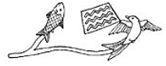 and comments, "The same theme of solar rebirth is expressed in a somewhat different form in the adjacent constellations known as Anunitum, the Swallow and the Field. These star figures together constitute a vivid depiction of the 'myth of the Syrian goddess', which can be thought of as the master-myth of this season. The myth runs as follows - two fish found an enormous egg floating in the depths of the river Euphrates, the fish guided the egg up from the watery depths of the river and rolled itonto dry land, where a dove appeared and started to brood it. In due time the Syrian goddess was born from the egg. On account of this myth fish and birds were held to be particularly sacred to the Syrian goddess.
The star-map indicates that the setting of this myth and its participants are not, in fact, of this earth, but are to be found in the heavens. What is of pivital significance is the identity of the 'river Euphrates.' Apart from the earthly river, the 'Euphrates' can also be found on the star-map where it is closely associated with the watery outflow joined to the Swallow. This heavenly river actually runs parallel to the course of the ecliptic and now that this fact is established, the action of the fish can be better understood - they escort the sun (the mythical egg) from its lowest point at the solstice and guide it onto its ascending path that leads towards the spring. The myth as a whole can now be understood as an image of time that has guided us from the darkness of winter to the beginning of spring."
As you can see for yourself the image for Pisces above has some correlation with the Round Denderah image  and the Square Denderah image
 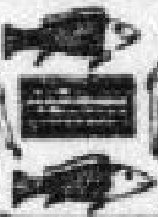 and the hieroglyphic image
 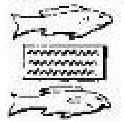 .
.
- Egyptian/Coptic:
- On the Denderah Zodiac and to the ancient Egyptians/Coptic, they called this constellation Pi-Cot Orion or Pisces Hori, "The Fish of Him Who Comes."
- Some believe that "The Fish of Him Who Comes," is the fishes that belong to that One who is coming, or fishes that belong to Christ. The fishes are symbolic of swarms or multitudes.
- Rolleston as well as in "The Witness of the Stars," by E.W. Bullinger, and seen on page 93, "The ancient Egyptian name, as shown on the Denderah Zodiac, is Pi-cot Orion, or Pisces Hori, which means the fishes (that is to say, swarms or multitudes) of Him that cometh."
- In the "Gospel of the Stars," by Joseph Seiss, page 82 "Coptic Pi-cot Orion, the Fish, congregation, or company of the coming Prince."
- Richard H. Allen comments: while Kircher cited, from Coptic Egypt, Pikotorion, Piscis Hori, which Brown translates "Protection," but claims for a Coptic lunar asterism formed by beta and gamma Arietis.
- Babylonians called these stars Nunu, "fish," seen also in the Babylonian lunar mansion as kullat-nûnu.
- Sumerian word agargaraku6 [NUNtenû]: a fish.
- According to Brown in the Euphrates tablets this was Nuni, the Fishes.
- Syriac it was called Nuno, means "fish."
- In the "Gospel of the Stars," by Joseph Seiss, page 82 "Syriac Nuno, the Fish prolonged."
- Rolleston as well as in "The Witness of the Stars," by E.W. Bullinger, and seen on page 93, "Syriac Nuno, means the fish, as lengthened out (that is to say, in (as) posterity)."
- Persian name for these stars Amhik, "fish."
- Allen claims the Persians called it Mahik.
- Turkish name for these stars were Balik, means "fish."
- Graeco-Babylonian astronomy calls it, Zib from a Turko-Tartar root meaning "water" and/or "shining."
- Allen claims: It has also been found on Euphratean remains as Nuni, the Fishes, a supposed equivalent of its other title, Zib, of the later Graeco-Babylonian astronomy; although this last word may mean "Boundary" as being at the end of the zodiac. Another signification is the Water, which we have already seen with Aratos for this part of the sky; this also is the meaning of the word Atl, the Aztecs' name for Pisces.
- Greek Ichthus, an acrostic Iesous Christos Theou Uios Soter, used for "fish," to represent "Jesus Christ, the son of God, the Saviour."
- Rolleston claims that the Greek Ichthues, means "fish, as the one seen in Septuagint Ezek. 47:9 (Heb. dagah)."
- Allen states: The Alfonsine Tables of 1521 had Pesces, and the Almagest of 1515 Echiguen, Bayer's Ichiguen, a word that has defied commentators unless Caesius has explained it as being a corruption of Greek Ichthues.
- Latin Pisces, "The Fish," plural of piscis, "fish."
- Rolleston claims that the Latin Pisces as "fish, multiplying, in Vulgate Ezek. 47:9 (Heb. dagah)."
- Arabic Al Haut, or al Hut, "the fish."
- Allen states: With the Arabians it was Al Samakah, — Chilmead's Alsemcha, — or, in the dual, Al Samakatain; and al Hut, the Fish, referring to the southern one, the Vernal Fish, as marking that equinox; the northern being confounded with Andromeda's stars and so not associated with the zodiac. From these came Sameh, Haut, El Haut, and Elhautine in Bayer's Uranometria.
- From www.louisville.edu, it claims "Anunitu equals Pisces, 'The Lady of the Heavens,' (Babylonian) Ishtar and the Canaanite Ashtoreth."
- From www.lexiline.com, it claims "The star behind the Great Square: Anunitum appears to be the star Andromeda, daughter of Anu."
- Other names for Pisces, the Fish: Al sem'cha (Chilmead), El Haut', Elhaut'ine, Haut, Al Sam'akah, Al Sam'akatain, Sam'eh.
- Allen states: With the Arabians it was Al Samakah, — Chilmead's Alsemcha, — or, in the dual, Al Samakatain; and Al Hut, the Fish, referring to the southern one, the Vernal Fish, as marking that equinox; the northern being confounded with Andromeda's stars and so not associated with the zodiac. From these came Sameh, Haut, El Haut, and Elhautine in Bayer's Uranometria.
- Seen as the German Fische, the Italian Pesci, the French Poissons, the Anglo-Norman Peisun, and the Anglo-Saxon Fixas.
- The Bands That Connect The Two Fishes
- The Bands, is not a constellation it is part of Pisces, as a band or bridle which connects these two fishes.
- Is the Band a constellation? This just is not possible. That would be like stating that the two fish or the tablet/lake shown were separate constellations or that Pleiades was a separate constellation from Taurus.
- In "The Witness of the Stars," by E.W. Bullinger, page 100, "The band that unites these two fishes has always formed a separate constellation."
- Rolleston believed the Band was a Decan.
- Egyptian/Coptic (Bands):
- On the Denderah Zodiac and to the ancient Egyptians, Pisces is known as Pi-Cot Orion, or Pisces Hori, the Fish of Him Who Comes. Denderah clearly shows it as two fish with a cord attached to their tails, and between them is a rectangular figure (tablet-like) with three hieroglyphic seen as Egyptian water signs, nnn, on it.
- The cord is connected to a figure, which seems to be Cetus.
- This intersection is made at the back of the head of Cetus, The Sea Monster, who is tied to it.
- The foreleg of Aries, The Ram (or Lamb) has his paw placed on the Band tied to the Sea Monster, as if protecting the Fish that moves toward the Pole star (Polaris).
- This intersection is located at the star named a Alrisha or Alrescha which is Arabic for "the knot," so-called because it ties the two fish together.
- Rolleston and in "The Witness of the Stars," by E.W. Bullinger, page 100 "Its Arabic name is Al Risha, the band, or bridle."
- Babylonian Risku [Pisces] "The Cord".
- This star aligns exactly with the year 210 B.C., the beginning of the Age of Pisces.
- Some sources claim that the Band has an Egyptian name of U-or, which means He Cometh or He cometh binding them together, as seen in Hosea 11:4.
- In "The Witness of the Stars," by E.W. Bullinger, page 100, referring to The Band, "Its ancient Egyptian name was U-or, which means He Cometh." Thus binding them together (Hosea 11:4) and breaking the band which binds them to their old enemy Cetus.
- The other Fish travels along the ecliptic, seen as the circlet of stars, representing the action that will occur in this age.
- Cord, Cords.
- Hebrew chebel, kheh'-bel or khay'-bel, from Heb. chabal, khaw-bal, wind tightly (as a rope), to bind, thus a rope (as twisted).
- Hebrew chuwt, khoot, from an unused root meaning to sew, a string, measuring tape, cord.
- Hebrew yether, yeh'-ther, from Heb. yathar, yaw-thar', to jut over or exceed, properly an overhanging, also a small rope (as hanging free).
- Hebrew meythar, may-thawr', from Heb. yathar, yaw-thar', thus a cord (of a tent) or string (of a bow).
- Bands.
- Hebrew mowshekah, mo-shek-aw', active particle feminine of Heb. mashak, maw-shak', to draw, thus something drawing, i.e. (fig.) a cord, band.
- Hebrew mowser, mo-sare', also (in plural) feminine mowserah, mo-say-raw', or moserah, mo-ser-aw', from Heb. yasar, yaw-sar', to chastise, properly chastisement, a halter, restraint, band, bond.
- Hebrew 'aboth, ab-oth', to intertwine, band, cord, chain.
- Bound.
- Hebrew 'asar, aw-sar', to yoke, or put in bonds, tie.
- Hebrew 'aqad, aw-kad', to tie with thongs, bind.
- Chain.
- Hebrew rabiyd, raw-beed', from Heb. rabad, raw-bad', to spread, a collar, chain.
- Hebrew 'anaq, aw-nawk', chain.
- Greek the word halysis, found in Mark 5:3-4, Luke 8:29 chains are used to bind a demoniac. And also used as an angel binds Satan with a chain.
- Sumerian kešda, kešdr?, kéš-(d): n., knot (ki, 'place', + šita4, 'to bind'); v., to bind, wrap, tie; to join; to fasten; to harness; to snatch.
- Sumerian kéš-de6: a fish measure ('to join, tie' + 'to carry').
- Sumerian kad4,5: to tie, bind together.
- Sumerian šita(4); šid3,4,5: n., band; bond, tie; v., to bind; to be together; to join, link with; to couple; adj., bound, intact.
- One source called the Bands, by the Sumerian Du-nu-nu, or Akkadian Rikis numi, meaning "Fishcord."
- Sumerian du: to walk; to go; to come (sing. marû, cf., gin, re7, súb).
- Sumerian dú: (cf., tud).
- Sumerian dù('): n., work; totality; v., to build, make; to mould, cast; to erect something on the ground; to plant; to fasten, apply (dù-e in marû).
- Sumerian du6: (cf., dul(6)).
- Sumerian du7: to be finished, complete; to be suitable, fitting; to butt, gore, toss (reduplication class?) (regularly followed by rá).
- Sumerian du8: (cf., duh).
- Sumerian du9: (cf., dun5).
- Sumerian du10: (cf., dùg).
- Sumerian du11: (cf., dug4).
- Sumerian du12: (cf., tuku).
- Sumerian du14: quarrel, struggle, fight.
- Sumerian nu: n., image, likeness, picture, figurine, statue; adj. & adv., no, not; without; negative; used here as reduplication , "do not."
- Another name for the bands - Al H'ait al Kattani'yy, meaning "The Flaxen Thread uniting Pisces."
One of the twelve simple Hebrew Letters is Qoph (KJV Koph, kofe, Ps 119:145; Heb. qowph, kofe, or qoph, probably of foreign origin, a monkey, ape), the English q which has a numerical value equal to 19, and an esoteric meaning of "Back of the Head," or possibly "Needle Eye."
See note under Virgo (Hebrew kaph, kaf, from Heb. kaphaph, kaw-faf', a primary root to curve, bow down (self), thus the hollow hand or palm (paw of an animal, sole, bowl, handle, leaves; fig. power, branch.).
- The band of Pisces is connected or attached to the back of the head of Cetus, the Sea Monster, a whole other story in itself. Of note is the Sumerian si-šuš-nu: a sea creature ('antennae' + 'to sit down' + 'do not').
- Crown of the head.
- Hebrew qodqod, kod-kode', from Heb. qadad, kaw-dad', a primary root to shrivel up, i.e. contract or bend the body (or neck) in deference, bow (down) (the) head, stoop; thus the crown of the head (as the part most bowed), crown (of the head), pate, scalp, top of the head.
- Sumerian gú: neck; back of neck = a load = a talent in weight; river bank; edge; front; land; chick pea (cf., gúnu).
- Sumerian ugu: n., skull; top of the head; top side; upper part (ù, 'after it', + gú, 'neck'); adj., physical, bodily; prep., upon, over, on top.
- Head.
- Hebrew ro'sh, roshe, from an unused root apparently meaning to shake, the head (as most easily shaken), whether lit. or fig. (in many applications, of place, time, rank, etc.): band, beginning, in front, captain, chief, head.
- Sumerian sag: head; point; present, gift; slave; human, individual; adj., first, prime; prep., in front.
- Sumerian sag...bala: to shake the head ('head' + 'to turn').
- Sumerian sag-sig... gar: to bend the head (before someone/something: -ši-) ('head' + 'small, weak' + 'to place').
- Needle Eye (Matt 19:24; Mark 10:25; Luke 18:25, "to go through a needle's eye," from the Greek rhaphis, hraf-ece', from a primary Gr. rhapto (to sew, perhaps rather akin to the base of Gr. rhapizo, hrap-id'-zo, from a derivative of a primary Gr. rhepo (to let fall, "rap"), to slap, smite (with the palm of the hand), thus through the idea of puncturing), a needle.
- Sumerian dálla, dála: needle (da, 'with', + lá, 'to pierce').
- Sumerian gu: thread; wool yarn; flax; hemp; net; orig. word for needle.
- Sumerian bulug: needle; awl; boundary post; border.
- Cord.
- Hebrew chuwt, khoot, from an unused root meaning to sew, a string, measuring tape, cord.
Continue to Star Names of Pisces or return to the Introduction of Pisces.
This file was updated on July 15, 2008, and March 30, 2010.
Return to the Table of Contents or the Zodiac of Denderah