From The Alpha and the Omega - Volume III
by Jim A. Cornwell, Copyright © July 20, 2002, all rights reserved
"Volume III - The Sixth Month - Constellation Names for Virgo"
 VIRGO
VIRGO
Virgo, the Virgin, the Maiden.
The constellation name for Virgo:
- Sumerian AB.SÍN, "The Furrow," the star a Spica (Latin spica, ear of wheat (grain), ancient meaning "The Branch") is one of the brightest stars in the sky and the brightest in the constellation of Virgo.
- Sumerian ab-sín: furrow ('niche' + 'to sift').
- Sumerian absin(3): (seeded) furrow (ab, 'niche', + sín, 'to sift').
- Sumerian ab: window; niche (cf., aba).
- Sumerian áb: domestic cow.
- Sumerian ab-(ba): (cf., aba).
- Sumerian aba, ab: lake; sea.
- Sumerian ab-ba: father; elder; ancestor (Akk. loanword).
- Sumerian ab-ba-uru: city elder ('elder' + 'city').
- Sumerian sín, sim: to strain, filter; to sift (flour); to see through.
- Furrow - is a narrow groove made in the ground by a plow.
- Hebrew telem, teh'-lem, from an unused root meaning to accumulate, a bank or terrace, furrow, ridge.
- Hebrew ma'anah, mah-an-aw', from Heb. 'anah, aw-naw', a primary root to depress, thus in the sense of depression or tilling, a furrow.
- Hebrew geduwd, ghed-ood', or (fem.) gedudah, ghed-oo-daw', from Heb. gadad, gaw-dad', a primary root to crowd, to gash, thus a furrow (as cut).
- This may connect to the Hebrew gad, gawd, from Heb. guwd, goode, a primary root to crowd upon, (in the sense of disturbing), fortune, also troop, thus Baal of Fortune, a place in Syria, and also a Babylonian deity.
- One source claims that the Mesopotamian lunar mansions list only Se-makh, "Seed-great," which refers to the bright star Spica, (pidnu sa samê, Ab-sin, Absinnu) "furrow-of-heaven." This seed in the furrow, represents growth, fertility and dependence upon divine beneficence.
- From www.lexiline.com, "The Seed-Furrow (AB.SIN), d.Shala (with the) sheaf of grain." "AB.SIN rises 10 days after SHU.PA, which rises 60 days after KAK.SI.SA, thus it can only be the star SPICA (seed furrow, also refers to vulva.)."
- Shala equates to Virgo, "The Woman," the Bright star. Later named Spica, which as Ab-Sin (Sumerian) meaning "the furrow," and some call this Inanna's vulva. Shala was also called Ishtar AB.SIN.
- Abundance.
- Hebrew shaluah, shal-vaw', from Heb. shalah, shaw-law'.
- This is in reference to the Sumerian HÉ.GÁL-a-a, Akkadian kakkab nushi, "Star of Abundance," seen later in Coma Berenices, as part of the Virgo.
- In Assyro-Babylonian Myth, one of the many names that Anshar gave to Marduk after defeating Tiamat was Hegal.
- Sumerian hé-gál: abundance ('abundance' + 'to be available').
- Also seen on Coma Berenices is the reference to www.lexiline.com, "Erua and Chegalaju."
- Coma Berenices references this under possible stars/constellations as the Sumerian A.EDIN, Akkadian Erua, g Comae Berenices and the Sumerian HÉ.GÁL-a-a, Akkadian kakkab nushi, "Star of Abundance," a part of Coma Berenices.
- In his work “BABYLONIAN STAR-LORE: An Illustrated Guide to the Star-lore and Constellations of Ancient Babylonia,” by Gavin White he claims in his exerts, "Similarly, the figure of Virgo from the Dendera Zodiac is much closer, in terms of its size and orientation, to its Babylonian prototype than it is to its Greek counterpart."
Actual round, square and hieroglyphic Denderah images are  ,
,  ,
, 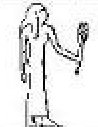 and compared to this image
 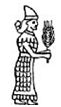 of White's as seen on his page 44 with statement "The constellation of the Furrow depicts the goddess known as Shala with her ear of barley. She represents the autumn seeding season when farmers use the seed plough to plant seed in the newly prepared fields.."
- Of note as seen earlier in reference to the Virgo Introduction section for Hebrew Baal and the word Dominion.
- Hebrew memshalah, mem-shaw-law', feminine of Heb. mimshal, mim-shawl', from Heb. mashal, maw-shal', thus a ruler or (abstr.) rule, dominion, that ruled, thus rule, also (concr. in plural) a realm or a ruler, dominion, government, power, to rule.
- Babylonian-Assyrians had Babylonian Ishtar, the goddess of love, fertility, and war.
- Canaanite Ashtoreth.
- Richard H. Allen claims: This Istar, or Ishtar, the Queen of the Stars, was the Ashtoreth of the 1st Book of the Kings, xi, 5, 33, the original of the Aphrodite of Greece and the Venus of Rome; perhaps equivalent to Athyr, Athor, or Hathor of the Nile, and the Astarte of Syria, the last philologically akin to our Esther and Star, the Greek Aster. Astarte, too, was identified by the Venerable Bede with the Saxon goddess of spring, Eostre, at whose festival, our Easter, the stars of Virgo shine so brightly in the eastern evening sky; and the Sumerians of southern Babylonia assigned this constellation to their sixth month as the Errand, or Message, of Istar.
- Sumerian Inanna.
- Allen states: In Assyria Virgo represented Baaltis, Belat, Belit, and Beltis, Bel's wife; while some thought her the Mylitta of Herodotus. But this was a very different divinity, the Babylonian Molatta, the Moon, the Mother, or Queen, of Heaven, against whose worship the Jews were warned in the Book of the Prophet Jeremiah, xliv, 17, 19, and should not be confounded with Ashtoreth, the goddess of the Zidonians, that our figure symbolized.
- Egyptians had Isis as the ancient goddess of fertility or nature, the sister and wife of Osiris, who holds a child in her lap.
- Allen states: In Egypt Virgo was drawn on the zodiacs of Denderah and Thebes, much disproportioned and without wings, holding an object said to be a distaff marked by the stars of Coma Berenices; while Eratosthenes and Avienus identified her with Isis, the thousand-named goddess, with the wheat ears in her hand that she afterwards dropped to form the Milky Way, or clasping in her arms the young Horus, the infant Southern sun-god, the last of the divine kings.
- Early Anatolians: Greek Cybele (Roman Kybele) was the Phrygian goddess of nature and of Earth (and caverns) of ancient Asia Minor. In Greece she was identified as Rhea.
- Allen comments: Classical Latin writers occasionally called her Ano, Atargatis, and Derceto, the Syrorum Dea transferred here from Pisces; Cybele drawn by lions, for our Leo immediately precedes her; Diana; Minerva; Panda and Pantica; and even Medusa. Posidippus, 289 B.C., gave Thesbia or Thespia, daughter of Thespius, or of the Theban Asopus; and some said that one of the Muses, even Urania herself, was placed here in the sky by Apollo.
- Nordic people called her Nerthus a goddess of the earth.
- One source claims the following for Virgo:
- Pharonic QA'A equates to Spica (Virgo).
- Qebhu equates to Bi-nechis.
- KI is the 20th of Euphratean ecliptic constellations.
- Allen comments: It appears as Ki, the 20th in the Euphratean cycle of ecliptic constellations, and considered equivalent to Asru, a Place, i.e. the moon station that Spica marked; but Jensen thinks that the original should be Siru, or Shiru, perhaps meaning the "Ear of Corn"; much of this also is individually applied to Spica.
- Chinese Kio, Keok or as She Sang Neu, the Frigid Maiden; but before their Jesuit days it was Shun Wei, which Miss Clerke translates the Serpent, but Williams, the Quail's Tail, a part of the early stellar figure otherwise known as the Red Bird, Pheasant, or Phoenix.
- Persian Kho-Sha, Khu-sak.
- Allen states: In Persia it was Khosha, or Khusak, the Ear of Wheat, and Secdeidos de Darzama, this last often translated the "Virgin in Maiden Neatness"; but Ideler, doubting this, cited Beigel's conjecture that it was a Persian rendering of Stachys, one of the Greek titles of Virgo's star Spica. Bayer had it Seclenidos de Darzama.
- Vedic Ka-nya, Kau-ni.
- Allen again: In India Virgo was Kanya, the Tamil Kauni, or Maiden, — in Hyde's transcription, Kannae, — mother of the great Krishna, figured as a Goddess sitting before a fire, or as a Gul; and in the Cingalese zodiac as a Woman in a Ship, with a stalk of wheat in her hand. Al Biruni thought this ship marked by the line of stars beta (Zavijava), eta (Zaniah), gamma (Porrima), delta (Auva), and epsilon (Vindemiatrix), like a ship's keel. Varaha Mihira borrowed the Greek name, turning it into Parthena, Partina, or Pathona.
- Babylonian Emuku Tin-tir-ki equates to Spica.
- Virgo is always portrayed holding a spike of wheat in one hand and either a staff, a caduceus, in the other or when seen as the goddess of justice, she is the Scale of Libra.
- Virgo the goddess of agriculture, harvest, justice and her different aspects, is seen as:
- Greek Demeter, associated with Artemis.
- Roman Ceres, associated with Diana.
- Egyptian/Coptic: On the Denderah Zodiac, Virgo is seen as a female figure in a long robe, holding in her left hand what appears to be a sprig of wheat.
- Are the Nile Lotus and the wig of Hathor both symbols of the object held in the hand of the constellation Virgo? Or is it a sprig of wheat, an ear of corn, or a flower? One source claims she is Isis to the Egyptians, holding a child in her lap. The Greeks saw her as the grain goddess, Demeter.
- In "The Witness of the Stars," by E.W. Bullinger, page 33 "Her (Virgo) name is called Aspolia, which means ears of corn, or the seed."
- Rolleston claims the "Coptic Aspolia, means station of the desired, the branch (Zech. 4:12)."
- Allen shows: Aspolia is from Kircher, who in turn took it from the Coptic Egyptians, the Statio amoris, quem in incremento Nili du ostendebant. This, however, is singularly like H Polias, designating Minerva as guardian of citadels and the State, already seen as a title for this constellation; and there was a Coptic Asphulia in Leo as a moon station.
- As seen on Leo star names, the Coptic Mansion of the moon according to Kircher is asphulia, station of Love, associated with Alzarpha, tail of Leo or Mansion of Love, Latin statio Amoris, connection to Al Sarfah, The Changer of Weather (Azarfa).
- Arabic Sunbula, who bears (carry, Isa. 46:4).
- Carry.
- Hebrew çabal, saw-bal', a primary root to carry, be burdensome, bear.
- Rolleston and in "The Witness of the Stars," by E.W. Bullinger, page 33 "Other names of stars in the sign, not identified, are -" "Subilah, who carries (Isa. 46:4)."
- Allen claims: Their later astronomers, however, adopted the Greek figure, and called it Al 'Adhra' al Nathifah, the Innocent Maiden, remains of which are found in the mediaeval titles Eladari, Eleadari, Adrendesa, and in the Adrenedesa of Albumasar. But as they would not draw the human form, they showed the stars as a sheaf of wheat, Al Sunbulah, or as some stalks with the ripened ears of the same, from the Roman Spica, its brightest star. Kazwini gave both of these Arabian names, the last degenerating into Sunbala, found in Bayer, and Sumbela, still occasionally seen. The Almagest of 1515 says Virgo est Spica.
- Sunbul, ear of corn (Job 24:24).
- Ear.
- Hebrew shibbol, shib-bole', or (feminine) Hebrew shibboleth, shib-bo'-leth, from the same as Heb. shobel, show'-bel, to flow, a stream, also an ear of grain (as growing out), by analogy a branch, ear (of corn).
- Rolleston claims "Aziman, the two ears of corn (ears, Isa. 17:5)."
- Rolleston also references a "Al Zimon, the desired."
- Rolleston and in "The Witness of the Stars," by E.W. Bullinger, page 33 "Other names of stars in the sign, not identified, are -" "Al Azal, the Branch (Isa. 18:5)." "Subilon, a spike of corn (or the ears) (Isa. 17:5)."
- Virgo's sign is the emphasis upon her fertility (her motherhood) because she holds in her right hand a branch (a staff, caduceus, or the scales of Libra; also a title applied to the Messiah as the offspring of David), and in her left hand some sheaves of corn, or seeds of wheat (or ear of grain, spike of wheat (Spica)). This is the origin of the English word "spike."
- Branch.
- Hebrew tsemach, tseh'-makh, from Heb. tsamach, tsaw-makh', a primary root to sprout, thus meaning a sprout (usually concr.), lit. or fig.; branch, bud, that which grew, spring.
- This is remarkable in that later we will see the Arabic lunar mansions, specifically number 14 which is called Simak, Azimech, Al Simak, meaning "Unarmed," or simply without weapons.
- One source claims this to be the Egyptian Sechem (Sekhem).
- As seen earlier in this section one source claims that the Mesopotamian lunar mansions list only Se-makh, "Seed-great," which refers to the bright star Spica, (pidnu sa samê, Ab-sin, Absinnu) "furrow-of-heaven." This seed in the furrow, represents growth, fertility and dependence upon divine beneficence.
- Allen commented in his Corvus section: The Raven of Rome and Greece became Al Ghurab in Arabia; but in earlier days four of its stars were Al ‘Arsh al Simak al Azal, the Throne of the Unarmed One, referring to the star Spica.
- Greek klema, klay'-mah, from Gr. klao, klah'-o, a primary verb to break (spec. of brad), a limb or shoot (as if broken off), branch.
- Rolleston claims "Virga, branch in Vulgate Isa. 11:1."
- Virgo, called "The Maiden" has an ancient meaning of "The Branch," a title applied to the Messiah as the offspring of David in Scripture.
- Noted as the Branch of David, seen in Zech. 3:8 and 6:12.
- Although the Hebrew word for Virgo would be Bethulah which means "virgin."
- Virgin.
- Hebrew bethuwlah, beth-oo-law', fem. pass. part. of an unused root meaning to separate, a virgin (from her privacy); sometimes bride, basically an unmarried, virgin girl, also fig. a city or state.
- Rolleston claims "Hebrew Bethulah, a virgin, Arabic branch (Genesis 24:16)."
- Syriac Bethulto, or Bethulta as Bethulah.
- Sumerian ki-sikil: young girl; virgin ('place' + 'pure').
- Sumerian sikil: v., to be/make clean, pure (siki, 'hair' ?, + ul, 'to shine'; cf., suku5, 'to shine brightly', sig7, 'to create; to make beautiful'); adj., clean, fresh, pure, virgin.
- Hebrew 'almah, al-maw', fem. of Heb. 'elem, lad, thus a lass (as veiled or private), damsel, maid, virgin, basically a young woman of marriageable age.
- Rolleston claims "Greek Parthenos, the virgin, Septuagint Isa. 7:14."
- Maiden.
- Hebrew na'arah, nah-ar-aw', fem. of Heb. 'na'ar, lad, thus a girl (from infancy to adolescence): damsel, maiden, young.
- Hebrew har'arah, girl, maiden, as seen in Exodus and Ruth.
- Allen comments: Thus she was known in the Attic dialect as Kore, the Maiden, representing Persephone, the Roman Proserpina, daughter of Demeter, the Roman Ceres; while in the Ionic dialect Nonnus, of our 5th century, called her stakhuodes Koure (Stachyodes Koure), the Wheat-bearing Maiden, spicifera Virgo Cereris, the Virgo spicea munera gestans of Manilius. When regarded as Proserpina, she was being abducted by Pluto in his Chariot, the stars of adjacent Libra; and the constellation also was Demeter herself, the Ceres spicifera dea, changed by the astrologers to Arista, Harvest, of which Ceres was goddess. Caesius had it Arista Puellae, that would seem more correct as Aristae Puella, the Maiden of the Harvest.
- One of the twelve simple Hebrew Letters is Yod (KJV Jod, yode, Ps 119:73), seen as the English letter y which has a numerical value equal to 10, and an esoteric meaning of "Hand."
- Hand.
- Hebrew yad, yawd, a primary word a hand (the open one [indicating power, means, direction, etc.], in distinction from Heb. kaph, kaf, from Heb. kaphaph, kaw-faf', a primary root to curve, bow down (self), thus the hollow hand or palm (paw of an animal, sole, bowl, handle, leaves; fig. power, branch, thus the closed one), used (as noun, adv., etc.) in a great variety of applications.
- Other names for Virgo: Adrentdesa, Andren'edesa, 'Adhra'al Nathifah, Alaraph', Elada'ri, Eleada'r, Al Bard (Arabic group), Sum'bela, Al Sun'bulah.
- As to Adrentdesa and Andren'edesa seen above and under Coma Berenices we find Adrenosa, the virgin who carries (carry, Gen. 46:5).
- Allen states: Their later astronomers, however, adopted the Greek figure, and called it Al 'Adhra' al Nathifah, the Innocent Maiden, remains of which are found in the mediaeval titles Eladari, Eleadari, Adrendesa, and in the Adrenedesa of Albumasar. But as they would not draw the human form, they showed the stars as a sheaf of wheat, Al Sunbulah, or as some stalks with the ripened ears of the same, from the Roman Spica, its brightest star. Kazwini gave both of these Arabian names, the last degenerating into Sunbala, found in Bayer, and Sumbela, still occasionally seen. The Almagest of 1515 says Virgo est Spica.
- Seen as the Anglo-Saxon Maeden, the Anglo-Norman Pulcele, the French Vierge, the Italian Virgine, Bayer's Junckfraw, and the present German Jungfrau, — in fact a universal title, — generally has been figured with the palm branch in her right hand and the spica, or ear of wheat, in her left.
Continue to Star Names of Virgo or return to Introduction of Virgo.
This file updated on July 15, 2008, and March 30, 2010.
Return to the Table of Contents or the Zodiac of Denderah