Fausset's Bible Dictionary: Cainan in Luke 3:36-37, second Cainan is introduced in the genealogy of Shem after the flood, a transcriber seems to have inserted it from the margin, where it was noted down from the Septuagint version of Genesis 10:24; Genesis 11:12;
Smiths Bible Dictionary: Cainan means "possessor" son of Arphaxad, and father of Sala, according to Lu 3:36,37 and usually called the second Cainan. He is nowhere named in the Hebrew MSS. It seems certain that his name was introduced into the genealogies of the Greek Old Testament in order to bring them into harmony with the genealogy of Christ in St. Luke's Gospel.
Bible Encyclopedia – ISBE: Cainan - ka'-nan, ka-i'-nan (Kainan): Greek form of Kenan (Lk 3:37): also the King James Version form in Old Testament (except 1 Ch 1:2). A son of Arphaxad (Lk 3:36) omitted in Gen 10:24; 11:12.
In The Patriarchal Age: or, the History and Religion of Mankind (1854), George Smith writes: "It is remarkable that, notwithstanding the omission of the name of Cainan from the Hebrew text, and the consequent general rejection of him by historians, there are more traditions preserved of him than of his son Salah. 'The Alexandrine Chronicle derives the Samaritans from Cainan (What the Latin Alexandrine Chronicle actually says is that "those who live east of the Sarmatians" were derived from Cainan); Eustachius Antiochenus, the Saggodians; George Syncellus, the Gaspheni; Epiphanius the Cajani. Besides the particulars already mentioned, it is said Cainan was the first after the flood who invented astronomy, and that his sons made a god of him, and worshiped his image after his death. The founding of the city of Harran in Mesopotamia is also attributed to him; which, it is pretended, is so called from a son he had of that name.' -Anc. Univ. Hist., vol. i, p. 96, note."
As found on The Universal Magazine, Vol. IV by John Hinton, 1749. Pg. 305, "He was born two years after the flood, begat Salah in the 34th year of his age, and died at the age of 438 years, according to the Mosaic chronology. But a certain author (Bolduc. De Eccl. Ant. Legem, 1. 2. c. 2.) makes him one of the Rephaim, or believers, who, he supposes were sent by Noah, to recall mankind to the worship of God. He also makes him the same as Cainan, and founder of the empire of China; and adds that the sect of the Bronzei was introduced into Japan by him, or by his disciples; and the Brachmans took their rife in Chaldea, soon after the arrival of that patriarch in the country of Etham, into which he was sent with a colony by Noah, about the year 68 after the flood, the chief of which colony was called Yarcha, which, in Hebrew, is Rapha, i.e. The healer."
"S. Who was that Canaan you mentioned above?
T. According to the Septuagint translation, he was the son of Arphaxad, and father of Salah. But the Hebrew and Samaritan bibles have no such name in their genealogy of Shem. And if this life be admitted into the succession of patriarchs from Noah to Abraham, it will make the difference 130 years in the chronology, that being the age at which Cainan, according to the Septuagint, begot his son; which however is justly suspected of error, because it is not found in the ancient chronologies, taken from the Septuagint, by Africanus and Eusebius; and therefore supposed to have been inferred in Christ’s genealogy in St. Luke, from some erroneous copy of the Septuagint. Nethertheless, the existence of such a one in the patriarchal line has been so generally acknowledged amongst Christians, that he has been celebrated as the founder of the Sarmatians, Saggodians, the Gaspheni, and the Cajani; and Salianus thinks the river Caina in India takes its name from him. Besides, he is said to have first invented astronomy after the flood; and to have founded a city in Mesopotamia, and called it by the name of his son Harran; and finally to be deified and worshipped by his children after his death."
Sarmatians
Sarmatians were an Iranian people of Classical Antiquity, flourishing from about the 5th century B.C. to the
Sources claim they are the place where the lost tribes went after they took council in the Book of Esdras and decided not to go back to their home land. They went through the head waters of the Euphrates River and just east of that area is Russia the modern day descendents of Esau but that is another story.
Their territory was known as Sarmatia to Greco-Roman ethnographers, corresponding to the western part of greater Scythia (modern Southern Russia, Ukraine, and the eastern Balkans). At their greatest reported extent, around 100 B.C., these tribes ranged from the Vistula River to the mouth of the Danube and eastward to the Volga, bordering the shores of the Black and Caspian seas as well as the Caucasus to the south.
The Sarmatians declined in the fourth century with the incursions connected to the Migration period (Huns, Goths, Turks). The descendents of the Sarmatians become known as the Alans during the Early Middle Ages, and ultimately give rise to the modern Ossetic ethnic group.
The names of several Sarmatian tribes, such as Thisomatae, Iaxomatae and others, are characterized by the final -matae, apparently meaning something like "tribe, people, men," compared by Malte-Brun (1829) to Madai, the name of the Medes. The first element of the name is compared to Avestan zar-, "old" by Alexander Lubotsky. Sarmatae is in origin probably just one of several tribal names of the Sarmatians which came to be applied to the entire group as an exonym in Greco-Roman ethnography. Strabo in the 1st century names as the main tribes of the Sarmatians the Iazyges, the Roxolani, the Aorsi and the Siraces.
The Greek name Sarmatai was corrupted to the variant Sauromatai apparently by association with lizards (sauros). Suggestions for the reason the Sarmatians were associated with lizards include their reptile-like scale armour, their dragon standards, or their "small and lively eyes, compared [by the Greeks] to those of lizards" (Malte-Brun 1829, c.f. Herodotus 4.110-117).[Both Pliny the Elder (Natural History book iv) and Jordanes are aware that the names in Sar- and in Sauro- are interchangeable variants, referring to the same people.
Greek authors of the 4th century mention (Pseudo-Scylax, Eudoxus of Cnidus) mention Syrmatae as the name of a people living at the Don, perhaps reflecting the endonym as it was pronouned in the final phase of Sarmatian culture. The Avesta mentions Sairima as a region "in the west."
Go to the top of this page
Now I will continue to tell the story of the Sumerian creation story.
The oldest rocks on Earth, zircon crystals, have been dated to 4,200 million years. According to the texts, when it all started there were nine planets, or gods around 4.5 billion years ago in our solar system moving in a counterclockwise direction, around the Sun (Apsu). In this system there was one planet named Tiamat, which had ten satellites, with one of them named Kingu. The other planets were: Mercury (Mummu); Mars (Lahmu); Venus (Lahamu); Jupiter (Kishar); Saturn (Anshar); Pluto (Gaga); Uranus (Anu) and Neptune (Ea).
The myth continues that an incoming planet attracted by the gravitational pull of Neptune and Uranus entered the solar system named Marduk, almost the size of Jupiter or Saturn, in a clockwise direction and broke up into 4 satellites or "winds." As it neared Saturn and Jupiter, their massive gravitational pulls bent its orbit inward. One of these satellites pulled Kingu out from Tiamat as a new planet, which gave it a new planetary course or orbit (Tablet of Destiny). Marduk although continued to rip Tiamat and its satellites out of orbit, making them become the comets we see today. Marduk's new orbit forced it to become known as Nibiru, meaning the planet of crossing. Its orbit was one shar, a Nephilim year (3,600 Earth-years) according to the myth. Each orbit or sar around the sun, Marduk would influence Tiamat as it approached it. Over time Tiamat eventually split into two parts and one of them broke up to become the asteroid belt (Hammered Bracelet), with the claim that this was the Hebrew creation story, referring to the "firmament," or the heaven. The other half of Tiamat eventually ended up between Venus and Mars and became what we call the Earth (Ki), with the splitting influence giving it an axial spin. Kingu continued but was eventually pulled back into the Earth to orbit it and later was called the Moon. Neptune, Uranus and Pluto were jolted out of their regular orbits because of Nibiru's influence with Tiamat.
The Earth went through the following periods shown below after the above incident.
Precambrian Era: 3.5 billion- 600 million years.
Paleozoic Era: Cambrian Period - 600 million years; Ordovician Period - 500 million years; Silurian Period - 425 million years; Devonian Period - 405 million years; Carboniferous Period - 345 million years; and the Permian Period - 280 million years.
Apparently a continent called Pangea formed on Earth according to the creation epic as told by the Sumerians.
Mesozoic Era: Triassic period - 220 million-181 million years (What we call the age of Dinosaurs).
At 200 million years the myth claims the continent Pangea split into a northern continent named Laurasia and a southern one named Gondwana. This consisted of: Jurassic Period - 181 million years (Mammals appear) and also the Cretaceous Period - 135 million years.
At 65 million years - The two continents split into smaller ones as we see today, and Dinosaurs became extinct.
Cenozoic Era:
Tertiary Period: Paleocene Epoch - 65 million years; Eocene Epoch - 54 million years; Oligocene Epoch - 36 million years (Apes appear); Miocene Epoch - 25 million years (14 million years Hominids, or manlike apes appear as if a process of evolution) (At 11 million years was the first appearance of apes classified as Homo on Earth). In the Pliocene Epoch - 5 million to 1 million years we find the Australopithecus afarensis on Earth 3.75 million to 3 million years. In Laetoli, Tanzania and Hadar in Ethiopia, Africa (Lucy) the Australopithecus africanus appeared at 3 million to 2 million years. Then Homo habilis, Australopithecus boisei and rebustus appeared at 2 to 1.75 million years. Then Homo erectus appeared between 2 million to 40,000 years whom evolved from habilis and spread from Africa to Europe and Asia.
Quaternary Period:
Pleistocene Epoch - 1 million to 11,000 years.
Old Stone Age - 800,000 years; First Ice Age - 600,000 to 550,000 years; Second Ice Age - 480,000 to 430,000 years.
Go to the top of this page
I would like to mention the issue of a sar being 3,600 years, which you will read later why I promote it to be 3,600 days, and you will see this after each reference to a sar with a recalculated value in solar years and in parenthesis lunar years. These simplistic equations are as follows.
number of sars x 3,600 solar days / 365 days per year = recalulated years and (18.5 lunar years x number of sars = lunar years).
According to the Sumerian account at 450,000 years ago (448,000 B.C.) the planet Nibiru supposedly experienced deterioration of its atmosphere and increased disruption, forcing the kingship to colonize the Earth, which is the Anunnaki tradition or Sumerian reference to the Beginning. Warfare broke out, but led to a union between a male leader of the north to a female of the south, whose firstborn would lead the united Nibiru.
The period of events on Nibiru before the missions to Earth was called Prior Times.
The Nephilim were assumed to have arrived at Earth around 450,000 B.C., finding primitive life or humanoids already evolving. At 400,000 to 200,000 years ago (398,000 B.C. to 198,000 B.C.), it has been assumed that Homo erectus evolved into Homo sapiens who emerged on Earth.
Next I will list the kings of Nibiru.
AN (the Celestial One) was to rule Nibiru and was the first unity king on Nibiru. AN is also the name of the planet we call Uranus.
- AN.KI (By AN A Solid Foundation) followed next, the firstborn son of AN and AN.TU (the Leader Who Is AN's Spouse). AN.KI as the second ruler of Nibiru died without an heir.
- Nimul who was the mother of Ea/Enki by Anu; not being an official spouse and half sister, her son, though firstborn, lost the succession to Enlil, whose mother was Antu.
- Enuru was the third son of An and Antu and father of Nibiru's ruler Anu.
- Anu was still Nibiru's ruler when the Anunnaki came to Earth. Antu was the spouse of An/Anu and the early name of the planet we call Neptune.
- IB became the third dynastic king on Nibiru, and was given the royal title AN.IB (The One In The Middle, Who IS AN's Son), AN.KI's younger brother. By his spouse, NIN.IB (the Lady of IB) they beget AN.SHAR.GAL (AN's Prince Who Is Greatest Of Princes).
- AN.SHAR.GAL became the fourth ruler on Nibiru of the unified dynasty. AN.SHAR.GAL's spouse was KI.SHAR.GAL, whom beget AN.SHAR.
- AN.SHAR was the fifth ruler of Nibiru, also the planet we call Saturn, married KI.SHAR (the planet we call Saturn) and they had a son named EN.SHAR (Lordly Master Of The Shar).
- EN.SHAR's who became the sixth dynastic ruler on Niburu, his spouse was NIN.SHAR, and begets DU.URU (In The Dwelling Place Fashioned).
- DU.URU the seventh ruler on Nibiru, chose DA.URU (She Who Is By My Side) not of royal lineage, and did not bear a child, but took a foster child.
- LAHMA (Dryness) then gained the throne as the eighth dynastic king on Niburu, and his spouse was LAHAMA.
ANU appeared before a council of the Seven Who Judge declaring his kingship before ALALU. The Judges left ALALU to rule, but ANU would be allowed for his children to become future kings. After 9 shars (32,400 years or recalculated 89 years (167 years)) ANU overthrew ALALU, who was forced to escape and he went to KI (Earth), where he discovered gold, which could be used to repair the atmosphere on Nibiru. Apparently there was no gold on Nibiru or of short supply.
The period that began with the first landing on the Earth and ended with the Deluge was called Olden Times.
Supposedly at 445,000 B.C. (443,000 B.C.), ANU sent his son E.A (He Whose Home Is Water) / EN.KI with a group of fifty Nephilim to Earth to verify ALALU's claim of gold.
They landed and made a settlement of Eridu (E.RI.DU - Home In The Faraway, or Earth Station 1 as told by some sources). Eridu in the Hebrew is Eretz, Kurdish Ertz, Middle English Erthe, and German Erde; in the region they named Edin (Sumerian E.DIN - Home of the Righteous Ones) between the Tigris and Euphrates rivers, known as Mesopotamia.
The fifty Nephilim were called AN.UNNA.KI (Those Who From Heaven To Earth Came Down).
The twin peaks of the mountain Arrata / Ararat were landing guides of the Nephilim.
The Anunnaki used what they called Celestial chariots, for their interplanetary spacecraft to travel between worlds. Their aircraft for flying in Earth’s skies were called Skybirds. They also had Helicopter-like aerial vehicles called Whirlwinds. The aerial vehicle of Ninurta was called Black skybird and the aerial battlecraft was called Storm Bird.
The Anunnaki called their Spaceports Chariots' place. The Place of Celestial Chariots was a spaceport of the Anunnaki. Sippar was the spaceport city before the Deluge and commanded by Utu (Akkadian Shamash), which was his cult center after the Deluge. Mount Mashu was a Sinai spaceport and an instrument-equipped mount after the Deluge.
The platform for skyships and rocketships in the Cedar Mountains in present day Lebanon was called the Landing Place located in the Cedar forest.
The Anunnaki had various Mission Control Centers (Navel of the Earth, was an epithet for its location). The original one was in Nibru-ki (Akkadian Nippur), which was Enlil’s city in Shumer before the Deluge, and after the Deluge, it was on Mount Moriah (Mount of Showing the Way, which the Samaritan tradition identifies it with Mount Gerizim, and in Genesis 22:2 the place where Abraham was to sacrifice his son).
These spacecraft had pilots such as Abgal, the first commander of the Landing Place. Others were Alalgar, the second commander of Eridu, Anzu the first commander of the way station on Mars, and Nungal.
These spacecraft also had Lieutenants of Ea’s with the first landing party: Enbilulu, Engurst, Enkimdu, Enursag, Kulla, Guru, Mushdammu, Ningirsig, and Ulmash.
Another group of interest is the Igigi, which consisted of three hundred Anunnaki assigned to shuttlecraft and the way station on Mars. Many of them were frequent rebels and the leader of the Igigi; Shamgaz was the instigator of the abduction of Earthling females for wives.
The Egyptian name for the restricted zone of the spaceport in the Sinai was Duat.
Genesis 2:9 “And out of the ground made the LORD God to grow every tree that is pleasant to the sight, and good for food; the tree of life (sign and seal of immortal life) also in the midst of the garden, and the tree of knowledge of good and evil (test of obedience).”
As seen below is a very interesting Hebrew word that matches that word very well in relationship to Eden.
First I will mention the tree of life [(Final Mem Yod (Yod vowel) Cheth He Final Tzaddi Ayin Vau) tree - Heb. ‘ets, tree wood, Gr. dendron, tree, xylon, timber, wood, tree, a special tree in the garden of Eden I (Gen. 2:9; 3:22) and will appear again in Revelation 22:2 as a fruit-bearing tree with leaves. It will have healing in its leaves (22:2). The phrase “tree of life” in Proverbs (3:18; 11:30; 13:12; 15:4) is figurative for an exhilarating experience.]
Next it states {also} in the midst of the garden [(Final Nun Gimel He Final Caph (Vau vowel) Tau Beth) garden -Heb. gan, gannah, a covered or hidden place; Gr. kepos],
It continues with and the tree of knowledge [(Tau Ayin Daleth He Final Tzaddi Ayin Vau) Heb. da’ath, dah’-ath, from the primary root Heb. yada’, yaw-dah, to know; thus knowledge, cunning. Later God … “know(s)” in Gen. 3:5 is Ayin Daleth Yod; here in Gen. 2:9 it is seen as a special tree of knowledge - Heb. Daleth (Doh) Ayin Tau - possibly duat - or not shown here is science - Heb. madda’ seen in Dan. 1:4, Gr. gnosis 1 Tim. 6:20 “knowledge” is understanding knowledge or thought. At the site of Eridu, situated near what was considered to be the ancient shoreline, clay tablets have been found that tell of a garden in the neighborhood in which grew a sacred palm tree.]
Emphasis mine [From Zecharia Sitchin who stated that the Egyptian’s believed in the Duat, a magical “Abode for rising to the stars” or a magical land divided into twelve divisions, and was traversed in twelve hours. Hieroglyphically it is a star and a falcon or simply a star within a circle, denoting a celestial or heavenly association. The Duat was divided into twelve divisions, variably describe as fields, plains, walled circles, caverns or halls. Amen-Ta was called the “Hidden Place” which had two magical trees.]
{of} good and evil [(Ayin Resh Vau Beth (Vau vowel) Teth) evil or wicked, wickedness - Heb. ra’, rasha, Gr. poneros, poneria, kakos, moral evil or sin is any lack of conformity to the moral law of God; good - Heb. tobh, Gr. agathos, kalos].
ANU and his son EN.LIL came to Earth, the kingship had been lowered from heaven, to look at gold retrieval processes and they founded five cities.
1. E.RI.DU, given to Nufimmud, the leader.
2. BAD.TIBIRA, given to Nugig.
3. LA.RA.AK, he gave to Pabilsag.
4. SIP.PAR, given to Utu.
5. SHU.RUP.PAK, he gave to Sud (Ninlil).
ANU remained king of Nibiru and returned to it after assigning his two sons Enlil and Ea/Enki their duties.
These two half-brothers did not get along, and were always in a rivalry with each other to mine gold from deep mines in the Earth.
EN.LIL was given command of Eridu and Edin, the son of Anu and his sister-spouse Antu and thus the Foremost Son entitled to the succession to Nibiru's throne ahead of the firstborn Ea; as military commander and administrator, sent to Earth to organize wide-scale gold-obtainment operations.
E.A who became known as EN.KI (the Earth's Master) had found gold in Abzu and was assigned to oversee the mining of gold in the Abzu (the southern/lower/nether region), the region of southern Africa along the Zambezi River.
ALALU was left out and after a fight with ANU was sent to exile and eventually died on Mars, where his image is said to be on a tomb there.
Of interest is the biblical comments on gold in Eden as seen in Genesis 2:10 “And a river went out of Eden to water the garden; and from thence it was parted, and became into four heads.” Genesis 2:11 “The name of the first is Pison: that is it which compasseth the whole land of Havilah, where there is gold.”
Pison (Pishon) Heb. Piyshown, pee-shone', dispersive, Gr. Phison, which could be located Armenia or Mesopotamia, but is still uncertain. Others claim it is known as Ganges also Ganga a river of northern India (or Emlak) and Bangladesh rising in the Himalaya Mountains and flowing about 2,510 km (1,560 mi.) generally eastward through a vast plain to the Bay of Bengal. The river is sacred to Hindus. It flowed around the whole land of Havilah, Heb. Chaviylah, khav-ee-law', or hawilah, means circular or sand land.
The following is information on the genealogy of the two sons and their half-sister:
Enlil (Ilu), Lord of the Air and Lord of the Command (whose mother was Antu), which made him the continuation of the kingship line. What you will read as you continue is that Enlil was a more fearsome entity, who created Edin, opposed the fashioning of the Earthlings and was the one who drove the Biblical Adam and Eve out of Edin. It was Enlil, who was going to wipe out mankind when the Deluge came upon the Earth. Enlil seems to reign supreme, and it was he who set into effect the ‘confusion of tongues’ with the tower of Babel. Abram and his descendants served Enlil, as Jehovah.
Around 2,000 B.C. Enki’s humans and Enlil’s humans were in all out war, and authorized the use of nuclear weapons against Marduk, which led to the Sodom and Gomorrah destruction of the Sumerian civilization by Enlil’s sons Ninurta and Ningal. Enlil was the one who sent the Israelites into captivity in Babylon.
Some sources blame Inanna a granddaughter of Enki and her arch enemy Enki’s son Marduk (who took over during the Age of Aries) for the destruction of the Sumerian civilization, and afterward subjugated humans with politics and slavery, especially Enlil’s Hebrew descendants.
Here are a couple of Biblical verses that may reference to Enlil as Jehovah.
Psalm 82:1 “God (Heb. ‘elohiym, a deity or the Deity) standeth in the congregation of the mighty (Heb. ‘el, any deity or a multitude of deities); he judgeth among the gods (Heb. ‘elohiym, as a plural of deities),” or as other sources state it “Jehovah takes his stand at the Council of El to deliver judgment among the elohim.” Then in verse 6, “I have said, Ye are gods (Heb. ‘elohiym, as a plural of deities); and all of you are children of the most High (Heb. ‘elyown, el-yone, the Supreme),” or as seen elsewhere, “You too are gods, sons of El Elyon, all of you.”
The Anunnaki have also been equated with the “Watchers” (who are also mentioned in the books of Daniel and Jubilees), Daniel 4:13, “I saw in the visions of my head upon my bed, and, behold, a watcher (Heb. (Chaldean) ‘iyr, eer, a watcher, an angel , guardian) and an holy one (Heb. (Chaldean) qaddiysh, kad-deesh, holy (One), saint) came down from heaven,” or as other sources state it, “Behold a watcher and an holy one came down from heaven.”
The genealogy of Enlil:
- Ninlil (Sud, also the Hindu goddess Maya, Egyptian Ma'at, Roman Majesta, Russian Myesyats, and Chinese Tien-Mu) was espoused by Enlil after she forgave his date rape, and was the mother of Nannar and Ishkur. Sud was a nurse, which is the epithet-name for Ninlil before she became Enlil's spouse.
- Nannar (Nanna, Suen, known as the Bright One, may be equivalent with the Greek Hermes, Egyptian Thoth, and Mayan Quetzalcoatl) was the son of Enlil and Ninlil, the first Anunnaki leader to be born on Earth. He became the patron god of Urim (Ur) and Harran; associated with the Moon; known also as the Akkadian Sin; father of Utu and Inanna.
- Ningal was the spouse of Nannar (Sin), and the mother of Inanna and Utu. Nanna and his wife, Ningal, were the parents of Inanna and Utu.
- Inanna (Babylonian/Akkadian Ishtar, ir.ni.ni, the strong, sweet smelling lady, eqivalent to Hindu Lakshmi, Greek Aphrodite, Egyptian Hathor) was the daughter of Nannar and Ningal, and a twin sister of Utu; ferocious in war, lusty in lovemaking; mistress of Uruk and of the Third Region; associated with the planet we call Venus. Anunitu is known as an endearment name for the goddess Inanna.
- Dumu-zi the Shepherd King was married to Inanna (Dumuzi in the Semitic Old Testament book of Ezekiel 8:14 is called Tammuz, possibly the Greek Adonis, Egyptian Aten-Ra).
- Enlil married Eresh-kigal, the Queen of the Netherworld, the daughter of Nanna and Ningal (i.e. Inanna’s sister), and the mother of Lilith (who became handmaiden to Inanna, her maternal aunt). Lilith is also notorious as the first wife of Adam, but it was Lilith who rejected him (and thus incurred the wrath of every reject-worthy male on the planet).
- Utu (Akkadian Shamash) and his spouse was named Aya.
- Ishkur (Akkadian god Adad, also known as Dudu) was the youngest son of Enlil by his spouse Ninlil. Elamite god In-Shushinak (Iskur, Addad, Haddad, Rimmon, Rammon, Adonis, Baal in the Bible).
- Nin-khursag (Ninmah, Ninharsag, Mountain Queen, the Lady of Life, the Great Lady) was half-sister of Enki and Enlil, mother of Ninurta by Enlil. Ninharsag was the chief medical officer of the Anunnaki and helped Enki to genetically engineer the Primitive Worker. She was the peacemaker between the rival and warring Anunnaki clans. She was granted an abode in the Sinai Peninsula.
- Ninurta (Ningirsu), (nin.ur.ta, foremost warrior) the Mighty Hunter, and a reference to Nimrod. Enlil's Foremost son, mothered by Enlil's half-sister Nin-khursag (Ninmah), and his legal successor who battled with Anzu, who seized the Tablets of Destinies, and with Marduk; found the alternative sources for gold and established alternative space facilities in the Americas; patron-god of Lagash. Ishum was an epithet given to Ninurta after the nuclear holocaust, meaning "the Scorcher." Bau was the spouse of Ninurta, a healer.
E.A was the firstborn of Anu, whose mother was Nimul but not of royal lineage, which went to his half brother Enlil. Ea became known as EN.KI (the Earth's Master, Lord of the Earth and Waters, Prince of the Earth, God of Wisdom, Whose home is water, Lord Earth, Lord of Destiny, Lord of Truth, Master of Fate, Lord of the Abyss, equivalent to the Hindu Shiva, Greek Poseidon). He had found gold in Abzu and was assigned to oversee the mining of gold in the Abzu (the southern/lower/nether region), the region of southern Africa along the Zambezi River. Enki with help from his half-sister, Ninki (Nin-Khursag, also known as Nin-mah, created a man to be suited for Earth labor. That also gave him the title of the fashioner of Mankind and the epithets Nudimmud ("the Fashioner,” He Who Fashions Things), Egyptian Ptah ("the Developer" as in Opener, Sculptor or Engraver in Memphis, Egypt) which commemorates his deeds in raising the land from under the Flood's waters.
Enki (Ea) could be associated with what in the Bible is called Satan, the devil, since he was the one who taught Adam and Eve the way to spiritual freedom and to eat of the fruit of the Tree of Knowledge of Good and Evil, and guided them after their exile from Edin. It was Enki who provided the plan for Noah to build his Ark and the seed of other life. The Egyptians served Enki and prospered. Enki also took over during the Age of Pisces to guide mankind and was the prototype Aquarius.
Ea’s distinguishing feature was the horned headdress and in some cases was depicted as a goat with a fish’s tail (The zodiac image of Capricornus) or in human form with water gushing from his shoulders or from a vase he carried (The zodiac image of Aquarius) possibly the prototype of both signs.
Enki was the father of Marduk by his spouse Damkina and failed to have a son by his half sister Ninmah, but fathered five other sons by concubines and also children by Earthling females.
The genealogy of E.A/EN.KI:
- Ninki (Damkina) was Ea's spouse, when he was entitled Enki ("Lord of Earth"). Ninki was the daughter of Alalu.
- Marduk was the firstborn son and legal heir of Enki and Damkina, who was worshiped as Ra (Egyptian name for Marduk, meaning the Bright One). He was jealous of his brothers, and unsatisfied with Egypt alone as his domain, and after exiles and wars he finally attained supremacy on Earth from his city Babylon.
- Sarpanit was an Earthling, the spouse of Marduk, mother of Nabu.
- Nabu was the son of Marduk and Sarpanit, who organized human followers of Marduk.
- Satu was a son of Marduk and Sarpanit, the Egyptian god known as Seth.
- Duttur was a concubine of Enki, and was Dumuzi's mother
- Dumuzi was Enki's youngest son, who was in charge of shepherding in his Egyptian domain. Dumuzi's sister Geshtinanna eventually betrayed him.
- Gibil was a son of Enki, in charge of metallurgy, maker of magical artifacts. Some sources claim that Gibil was also called Nusku (Nunska) who was an Assyrian fire god as in one of the four elements. Nusku was also Enlil’s vizier and emissary. Also some sources claim that Gibil was called governor of gods and men, with the special task to sit in judgment over the souls of men who in their lives had been unjust judges.
- Nergal (arrow shooting god of II Kings 17:30) was a son of Enki, from his spouse Ereshkigal (possibly Gulu). Nergal (Erra or Irra an epithet of Nergal, meaning the Annihilator, after the nuclear holocaust) as the one who unleashed the nuclear weapons together with Ninurta. Another source claims another son of Enlil and Ninlil was Nergal (Meslamtaea), King of the Underworld. Nergal, appears to date back to Sumerian times, and in the Hebrew nereghal, a Babylonian deity of destruction and disaster, associated with the planet Mars (god of war and agriculture -- See also Hercules, Ares -son of Zeus, Zivis, Zio, Tiwas, Tiw). A cylinder seal from Larsa, an ancient Sumerian city, c. 2360-2,180 B.C. , shows the god Nergal standing with one foot upon the body of an enemy.
- Ereshkigal the granddaughter of Enlil, mistress of the Lower World (southern Africa) was the spouse of Nergal and sister of Inanna.
- Ninagal a son of Enki, appointed by him to navigate the boat of the hero of the Deluge.
- Ningishzidda a son of Enki, master of genetics and other sciences, was called Tehuti (Thoth) in ancient Egypt. Some sources claim he (Winged Serpent a epithet of Ningishzidda in the Americas) went with followers to the Americas after his brother Marduk deposed him.
According to the Sumerian account around 415,000 B.C. (413,000 B.C.), NIN.HUR.SAG (Sumerian mother goddess) comes to Earth, as the Chief Medical Officer, her mission to respond to medical complaints by the Anunnaki on Earth This would be considered the first 8 sars (28,000 years). If 3,600 days (18.5 years) is used to calculate the sar it would only total at 80 years (148 years).
Shuruppak became a medical center. The city of Nippur / Nibru-ki (the Bond Heaven-Earth) was established as a Mission Control Center. Sippar became a spaceport. Bad-Tibira became an industrial center for smelting and refining gold from the Abzu. Larsa and Lagash became beacon cities for incoming spacecraft.
At 300,000 years ago (298,000 B.C.) the Sumerian account claims that the fortieth shar (150,000 years) after the Nephilim came to Earth, the Anunnaki who had mined the gold in Abzu rebelled. If 3,600 days (18.5 years) is used to calculate the sar it would only total at 395 years (740 years).
I personally have trouble with these myths going back to hundreds of thousands of years ago. Also that there is a planet called Nibiru, with an orbit around our sun every 3,600 years, which would require some very complex interplanetary space travel, just to transport gold to it, to save their atmosphere. So be it that there is the possiblity that they came to the Earth in the 400,000 year ago range and performed their mining operation long before catastrophes that would come upon the Earth at later dates.
Homo sapiens-sapiens are called Cro-Magnon between 75,000 B.C. to 25,000 B.C. and still being used for the Anunnaki’s original purpose.
If there were such a landing of beings from another planet it would be more likely to have occurred as the book of Genesis states. The Anunnaki, Nephilim, Elohim, etc., came to the Earth during the last Ice Age, or after a global catastrophe and performed terrestrial restoration to make the planet to their liking to begin the industrial requirements anew. As you know I promote this occurring in the Age of Capricornus.
The Age of Capricornus started in 21,810 B.C. - Day One of Genesis. Wurm III Glaciation Period began. Light, daytime and nighttime occurred.
These beings may have attempted and achieved the above. Some believe that around 25,000 B.C. there was a tremendous seismic upheaval on the Earth's surface, and a possibility there was another one around 13,000 B.C. with huge tidal waves and shifting land masses, which may have caused massive loss of life to anything living on Earth. If they came in 21,810 B.C. minus 395 years (740 years) when the Anunnaki rebelled it would be around 21,415 B.C. (21,070 B.C.).
The Age of Sagittarius started in 19,650 B.C. - Day Two of Genesis. Torrential rains, oceans formed, atmosphere develops.
Then they terraformed the planet to restore what is mentioned above.
From 100,000 B.C. to 30,000 B.C. Homo sapiens neanderthalensis (Neanderthals) inhabited the Earth for a short time.
The Last Ice Age occurred between 120,000 to 12,000 B.C. and according to the Sumerian myth between 110,200 B.C. to 56,200 B.C., ADAPA, the Adama, or 'First Of A Kind' lived between the 93rd sar and 108th sar since the arrival of the Nephilim on Earth. If this was true then this was an evolutionary lifeform occurring before the Ice Age. If 3,600 days (18.5 years) is used to calculate the sar it would only total at 917 years (1,720 years) and 1,065 years (1,998 years).
Therefore we would subtract from 21,810 B.C. the values 917 years (1,720 years) and 1,065 years (1,998 years) putting this event around 20,893 B.C. (20,090 B.C.) and 20,745 B.C. (19,812 B.C.) for a restoration of animal-like man after the catastrophe.
Between 30,000 B.C. to 20,000 B.C. the generations of these lifeforms on Earth diverges into four racial groups from all the inter-breeding of the restoration of a wretched species that survived the Ice Age:
1. Caucasoids.
2. Mongoloids.
3. Australoids.
4. Negroid.
The Age of Scorpius started in 17,490 B.C. - Day Three of Genesis. Dry land emerged, grasses, plants and trees evolved. If ice was melting from the Ice Age, then water would have engulfed much of the known lands, and slowly would recede exposing land and allowing flora to grow.
The Age of Libra started in 15,330 B.C. - Day Four of Genesis. Stars, seasons, days, years, Sun and Moon became visible.
All around the world are landmarks of stone and earth, which have stood for thousands of years as symbols of great civilizations here long before our society of today. Examples are the Isle of Lewis, Avebury and the Glastonbury area in Britain, Carnac in Brittany, Easter Island in the Pacific, Tiahuanaco near Lake Titicaca in the high Andes of South America, the cyclopean monuments of the Deccan in India, the great pyramids of Egypt, the ziggurats of Babylon, in Japan the pyramids and dolmens around the Upper Yeneisi, all using technology that we would have trouble reproducing in today's world. The race that built all these megaliths also mined gold, and other metals including iron, and installed irrigation systems for their agriculture. One might assume that there was a central area that this race with that kind of technology came from and spread out in search for their purpose.
Some theorized that another planet in the solar system was captured by the earth and became its present satellite, our Moon, dating it to around 15,000 years ago. Such an event if it did happen would have caused faults to form, mountains to arise such as the Rocky Mountains, the Cascade Range and the Andes, in the Americas, together with the Himalayas in Asia and the Alps in Europe.
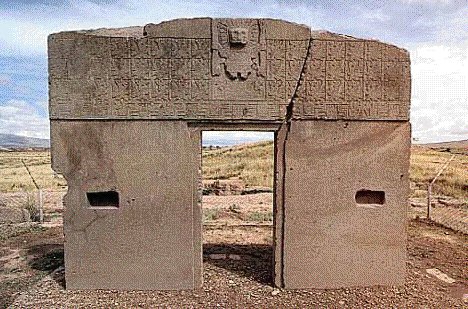
The deserted city of Tiahuanaco, also known as Tiwanaku, which is in the Bolivian Andes 12,500 feet above sea-level and located some 15 miles from the shores of Lake Titicaca. This lake contains shells and marine plants confirming that both were originally part of the sea. It has great monolithic structures of 200-ton stones which would have been impossible to carry the stones up to that city. Some have hypothesized that its modern name is a corruption of the Aymara term "taypikala", meaning "stone in the center."
Around the turn of the 20th century Bolivian scholar Arthur Broznansky began a fifty year study of the ruins of Tiahuanaco. Using astronomical information, he concluded that the city was constructed more than 17,000 years ago long before any civilization was supposed to have existed. He considered Tiahuanaco to be the 'Cradle of Civilization.'
It also contains the gigantic ruins called the Gateway of the Sun, seen in the image below, which turns out to be a extremely precise astronomical calendar that is based on a 290 day year, and was built between 12,000-15,000 years ago. So the question arises that the Earth may have had a different orbit year or it represents another planet such as Venus. This change could have been caused by the Moon's influence upon the Earth.
The Taoists in China had a mythology of the abode of "immortals of the west" and Shambhala, the planet Nibiru, the city of star-men. The mysterious Egyptian Zodiac of Denderah depicts the stars and constellations "upside-down" from what they are today, that is, North and South are reversed, which some propose that the North Pole was once located near the Ruins of Zimbabwe in southern Africa, due "south" of the Pyramids, suggesting that the heavens were reversed. A subject discussed by Dr. Immanuel Velikovsky in "Worlds In Collision."
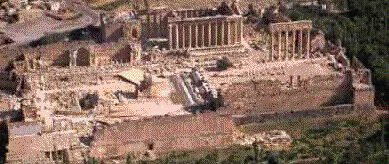
Another unfinished massive cyclopean ruins is found at Baalbeck, which lie at a height of 3,500 feet, to the northeast of Beirut, in the Bekaa Valley of modern-day Lebanon. Baalbeck's temples were built on an ancient tell that goes back at least to the end of the third millennium B.C., but there is evidence that in the course of the first millennium B.C. an enclosed court was built on the ancient tell. An altar was set in the center of this court in the tradition of the biblical Semitic high places.
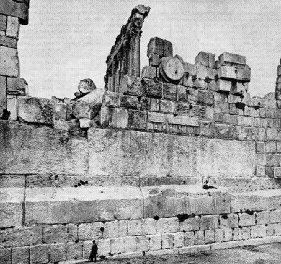

During the Hellenistic period (333-64 B.C.) the Greeks identified the god of Baalbeck with the sun god and the city was called Heliopolis or City of the Sun. Eventually over the ancient court the Romans placed the present Great Court of the Temple of Jupiter, one of the wonders of the ancient world and also the smaller Temple of Bacchus, and the much smaller Temple of Venus.
So it is likely that the orbit of the earth and the influence of the incoming Moon caused catastrophic events around 13,000 B.C.
A medical geneticist recently tested DNA of people in Britain and Ireland and discovered that the principal ancestors of that area today arrived from Spain about 16,000 years ago, which were related to a Basque speaking inhabitants. At that time the area was unpopulated because of glaciers which had been there for about 4,000 years forcing the inhabitants into Spain and Italy. When the glaciers retreated, people moved back north. Between 15,000 and 7,500 years ago, when rising sea levels split Britain and Ireland from each other, then the populations arrived there. The Neolithic Age began around 10,000 years ago.
Some theorize that around 9,500 B.C. Earth finally captured the Moon causing extreme tidal waves and movement of land masses, causing world wide flooding and in time the Earth's orbit went from 290 days to its present 365 1/4 days.

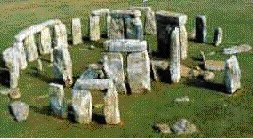
Gerald Hawkins, a Professor of Astronomy, concluded that Stonehenge was a sophisticated astronomical observatory designed to predict eclipses. He has discovered the 56-year cycle of eclipses by decoding Stonehenge, since mankind generally used the cycle of the moon as a unit of timekeeping. So Stonehenge may have been built in order to have a way to determine the length of the new year.
At the ruins of Stonehenge in England, this solstice sunrise appears on the horizon in direct alignment with the massive heel stone. This is the most outstanding feature of this ancient monument, which some claim it was built during the same era as the Great Pyramid of Egypt. There is little doubt that the builders of Stonehenge used it to mark this special day as the beginning of each year. By counting the number of days between these annual alignments, they could determine the length of the year. This could serve as a practical calendar to mark holidays and seasonal festivals and to ensure the timely planting and harvesting of crops.
Go to the top of this page
As you can see by the next two ages, that the Anunnaki genetically produced all forms of life in their labs.
The Age of Virgo started in 13,170 B.C. - Day Five of Genesis. Insects, amphibians, birds, fish and animals that swim and fly appeared.
So EN.KI and NIN.HUR.SAG decided to create a being to take over the mining labor. Apparently they had a genetic engineering and domestication facility set up called the Creation Chamber located on the Cedar Mountains. This House of Fashioning was a Genetic laboratory in the cedar forest for crops and livestock.
The Age of Leo started in 11,010 B.C. - Day Six of Genesis. Created every kind of animal, cattle and reptile (four-footed beast). A first creation of humans, the mystery of domain over animals. Various civilizations proposed that their beginnings were during this time. One source claims the sphinx was built in this age.
The ancient Egyptians and Peruvians had a connection across the Atlantic in that their calendars had eighteen months of twenty days with a five-day holiday at the end of the year, which shows a common source.
The first year of Zoroastrian chronology is 9,660 B.C. when "time began," showing a relevance to the date given by Egyptian priests to Solon for the doomsday of Atlantis, in 9,560 B.C. The ancient Egyptians calculated time in 1,460-year solar cycles (Sothis = 2.5 shars), where their last astronomical epoch came in A.D. 139, and by adding eight solar cycles this traces it to the year 11,542 B.C. The lunar calendar of Assyrians divided time in periods of 1,802 years, with the last one in 712 B.C., and adding six lunar cycles puts it at 11,542 B.C. Thus the solar calendar of Egypt and the lunar calendar system of Assyria coincided in the same year, possibly at the time they were created. The Brahmins measure time in rounds of 2,850 years from 3,102 B.C., and by adding three of these cycles, or 8,550 years, we get 11,652 B.C. The Mayan's calendar had long cycles of 2,760 years, where the beginning of one span is traced to the year 3,373 B.C., and adding three periods of 2,760 years, or 8,280 years, we get 11,653 B.C., which correlates with India.
One source claims the cycles of shars began in 1,588 B.C., 5,188 B.C., 8,788 B.C. and 12,388 B.C., promoting the destruction of Atlantis with one of the latter dates and the Flood of Noah in 5,188 B.C.
One source claims that the Vatican Codex A-3738 contains a significant chronology of the Aztecs according to which the first cycle continued for 4,008 years ending in a flood. The second of 4,010 years was destroyed by hurricanes. The third era of 4,801 years was closed by fires. In the fourth period which lasted 5,042 years, mankind suffered starvation. The present era is the fifth and it began in 751 B.C. The duration of all the four periods listed in this Codex is 17,861 years; and its beginning is traced to an incredibly distant date of 18,612 B.C.
Some of this is based on the theory that the planet Nibiru passed again between 762-687 B.C. Some claim that these calendars were trying to determine the correct length of a "shar," in order to warn future generations when it might happen again.
The Calendar of Denderah has the constellation Leo at the point of vernal equinox for a date between 10,950 to 8800 B.C., and may have been engraved to commemorate a distant event.
Then between 17,000 B.C. to 9,500 B.C. the domestication of animals occurred.
At 8,970 B.C. the First Pyramid War occurs with HORON challenging SATU avenging the death of his father ASAR.
At 8,670 B.C. the Second Pyramid War, DU.MUZI, the son of EN.KI falls in love with INANNA, daughter of NAN.NAR, and granddaughter of EN.LIL, which led to a war between the two, EN.LIL and EN.KI. In the end, the Nile valley was transferred to NIN.URTA, and the city of Heleopolis was established as a 'beacon city.'
They took the Life seed or Essence of Life, which is genetically encoded DNA extracted from semen and created a lullu (a genetically engineered hybrid Earthling or primitive worker, Lullu Amelu). This was called the Homo sapiens-sapiens (the Lullu, the 'one that is mixed'), probably a genetically altered Homo erectus, infusing the Nephilim/Anunnaki blood.
The result was called ADAMA (which text assumed is the Biblical Adam), which EN.KI named Adapa. Other sources claim that Adapa was a son of Enki by an Earthling female, which was the first Civilized Man. The term Dawn and Dusk is a reference to seven Earthling females (Musardu, Nimug, Ninbara, Ninguanna, Ninimma, Ninmada, Ninmug) who were impregnated by Enki, to become the mothers of first Earthlings.
They also created KHAWA or TI.TI, which the text assumes was known as Eve. Adapa and Titi were capable of reproduction.
Ilabrat was the vizier and emissary of Anu who fetched Adapa for the journey to Nibiru. The Nephilim, DU.MU.ZI and NINGISHZIDDA took ADAPA to Nibiru, to be shown to ANU. EN.KI wanted ADAPA to be restricted from eating Nibiru food to prevent a long life span. Inbu was the name of a fruit brought from Nibiru to Earth, which is claimed as the source of the Anunnaki's elixir, for their extremely long life spans.
ADAPA was returned to Earth, with seeds to cultivate grain and product for domesticating animals.
The Anunnaki males mated with female earthlings (note Genesis 6:4), "the sons of God came in unto the daughters of men." Some call these offspring Naphidem, or Watchers, others call them angels. Do the Anunnaki compare to the Genesis Anakim? The Naphidem, being partially descended from the Nephilim, began to assume superiority over the wholly earthling descended males, whom in the early texts are referred to as the Eljo. The friction that came to exist between the Nephidem and the Eljo eventually erupted into a war, in which the Eljo race was virtually exterminated.
The above situation does not mean that this was the Adam of Genesis as you may note in the following verses.
- The Elohim (i.e. gods) create their man in Genesis 1:26-28 and sent them into the world to conquer and survive.
- Genesis 1:26 "And God said, Let us make man in our mage, after our likeness: and let them have dominion over the fish of the sea, and over the fowl of the air, and over the cattle, and over all the earth, and over every creeping thing that creepeth upon the earth."
- Genesis 1:27 "So God created man in his own image, in the image of God created he him; male and female created he them."
- Yahweh (i.e. the LORD God) in Genesis 2:7-8 created His man and gave him a soul, and then made a Garden in Eden for him.
- Genesis 2:7 "And the LORD God formed man of the dust of the ground, and breathed into his nostrils the breath of life; and man became a living soul."
- Genesis 2:8 "And the LORD God planted a garden eastward in Eden; and there he put the man whom he had formed."
So an assumption was made that the EN.KI (and his cohorts the Elohim, Nephilim) creation of these primitive workers may just have been a mass production of the male and female shown in Genesis 1:26-28, which could be a genetically altered Homo erectus, infused with Nephilim/Anunnaki blood.
Therefore, the first creation of man was the genetically engineered ADAPA and KHAWA, who were busy begetting 60 children, 30 sons and 30 daughters according to the ancient myths. These sons and daughters multiplied and had dominion over the animal world on Earth. Their main purpose was workers in the process to mine gold and any other logistics required for that end.
The Age of Cancer started in 8,850 B.C. - Day Seven of Genesis. God rested from completing the heavens and earth. God then formed a man from the dust of the ground and breathed a soul into it. He then made a garden and placed the man in it.
As to Genesis 2:7-8, the second creation of man was by Yahweh, the LORD God, which is EN.LIL in the Sumerian story, made a decision to create a specific kind of human. He created a chemical-earth based man, and gave it a soul, which probably means an abstract thinking human, who can be taught to learn and perform tasks. EN.LIL (Assumed to be the Biblical Jehovah) may have decided to create his own specific man for the purpose of a bloodline.
He did this secretively, and placed the individual in a special facility containing food supplies, which was called Eden, which in Hebrew is gan, gannah, a covered or hidden place; Gr. kepos. He was given the name Adam, and his purpose was to tend to the garden and guard it.
Eventually the Lord created a helpmate for Adam, by taking tissue from him and created a female companion to keep him company, and named her Eve. In Eden there was a tree of knowledge, the Hebrew word is da’ath, dah’-ath, knowledge, which was forbidden to the humans.
The story goes that in time the first humans or EN.KI himself found out or came into Edin and taught Adam and Eve the way to spiritual freedom and to eat of the fruit of the Tree of Knowledge of Good and Evil. Of course when EN.LIL discovered what had occurred he evicted Adam and Eve out of Eden, and set their destiny with the first creation of humans.
For more on recent archeology finds posted in 2010 see the following subject regarding, Göbekli Tepe Temple, where a new discovery of this temple dates to 9,500 B.C., which was found in 1994 A.D. in modern Turkey buried in a hill of dirt. The image below is a reconstruction of what the temple may have looked like.
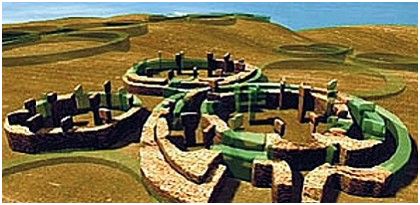
Go to the top of this page
The city Jericho is established; it was called in the Hebrew “Moon City,” and the earliest evidence of settlement was between 7,000-6,000 B.C., when a prepottery Neolithic town was built there. This correlated with the site Jarmo, in what is now Iraq around 8,000 B.C., a time when Adam and Eve were banished from Eden.
In the time before the Flood the Sumerian King Lists are texts that begin with the opening words: (Sumerian) nam.lugal meaning 'kingship' with lugal 'king’, the sign nam introduces an abstract noun in Sumerian (and later in Akkadian compound logograms), and composed many centuries after the times they refer to. Jacobsen was the first to study the list and published in 1939, and as learned, may have distorted the truth to serve the purpose of their own politics, as Kingship is seen as a divine institution, because it descended from heaven, as seen in the opening line, 'When kingship was lowered from heaven, the kingship was in Eridu.'
If the Flood occurred around 6,000 B.C. as I propose, then Adam who lived to be 930 years old, after the Fall at 7,656 B.C. representing either 1,307 years or 1,656 years or 2,242 years to the Flood depending on which version of Biblical sources used for dating. Adam had a son Seth at age 130 or at 230 years of age, between 7,426-7,526 B.C. His first and second son, Cain and Abel are out of the picture according to scripture, making Seth the progenitor, who lived to be 912 years old, and had a son Enos at age 105 or at 205 years of age, between 7,221-7,421 B.C.
Another source claims that the list starts with the 40th sar after Adam. This would be 390 years after Adam and projected as the 1266th year before the Flood. This would be relative to the year that the Flood began; I project it to have started in 6,000 B.C., with the Fall of Adam in 7,656 B.C., for 1,656 years. Also the argument is that the Sumerian determination of years in the sar, which was thought to be 3,600 years, may have really been 3,600 days. Berossus gives us a total period of 120 Sari for the ten antediluvian reigns, which involves a period of 432,000 years. If we allow the alternative value of the Saros as 18.5 years instead of 3600 years, this figure of 432,000 becomes 2,220 years. Bearing in mind that in the King List of Berossus we are concerned with reigns, not with total life spans as in Genesis, the figure still begins to approach a measure of concordance with the Genesis account. Berossus allows 222 years for the average reign; Genesis allows an average life span of 912 years. Sari are, with the Chaldeans, both a measure and a number, and according to the calculations of the Chaldeans, the saros contains 222 lunar months, which is equivalent to 18.5 years.
Thus, the 241,000 years would only represent a total of 670 years, using 3,600 days for each sar, and if a sar is equal to 18.5 years it could be 1,194 years and 147.5 days.
EN.LIL and his creation of a specific mankind for the purpose of a bloodline, who was the Biblical Adam and Eve, resulted after being ejected from Eden started that bloodline.
After Adam and Eve were put on the earth to survive around 7,656 B.C., they bore twin sons:
- QAYIN / KAIN (Biblical Cain, He Who In The Field Food Grows) instructed by NIN.UR.TA. Awan was the sister-wife of Ka-in (the biblical Cain). Land Beyond the Seas were the Americas; settled by Ka-in's descendants, as overseen by Ninurta.
- HEVEL / ABAEL (Biblical Abel, He Of The Watered Meadows) instructed by MARDUK on raising animals.
At the 95th sar (103,000 B.C.), the third son born to Adam at age 130 and Eve was SAT.NAAL / SATI/ SETH (He Who Life Binds Again), who took as his spouse AZURA. Here if we use the 3,600 days (18.5 years) to calculate the sar it would only total at 937 years (1,758 years) since the Nephilim came to earth, which is hard to believe, and which I date between 7,426-7,526 B.C.
Go to the top of this page
The following are the five cities in the Sumerian Kings List before the Deluge and my reference to the Biblical patriarchs before the Flood associated with each city. Whether there was a Sumerian tribe line of kings running along side of the biblical patriarchs or the patriarchs were the kings specified is undetermined. The list was claimed to start at the 40th sar - 390 years after Adam (7,656 B.C. minus 390 years is 7,266 B.C. and the reigns of the kings is 670 years through Ubardudu puts us at 6,596 B.C. Noah’s reign occurred before the flood and after he had his sons at age 500, the flood came in Noah’s 600th year, putting us around 6,000 B.C. as the range for the Deluge.
I have interfaced a concept presented in Brinsley Le Poer Trench’s book “The Sky People" Chapter III page 43, where he proposed a theory that there were two creations of man in Genesis, thus two lines - Adam-I Galactic Man, created by the Elohim, and Adam-II Earth-animal Man, the Jehovah creation. Though the concept of two creations is feasible in context with Genesis One creation of man by the Elohim and Genesis Two creation of man by Yahweh God and the placement in Eden. Although I am not sure as of yet which line is the Elohim or the Jehovah Line, but his concept mainly just shows the division between the two creations of mankind.
| Sumerian City Before The Flood |
Sumerian Kings Before The Flood |
Elohim Line - Genesis V (God - Heb. ‘elohim) Gen. 1:26-27 |
Sumerian Line EN.KI's creation |
Jehovah Line - Genesis IV JEHOVAH (EN.LIL) LINE (LORD God = IHVH or YHWH) Gen. 2:7-8 |
|---|---|---|---|---|
| . | . | Adam (I) of Gen. 5:1-3 Adam (Heb. 'adam, aw-dawm', from 'adam, aw-dam', to show blood, ruddy, a human being or species of mankind). Gen. 5:1 “This is the book of the generations of Adam. In the day that God (Heb. ‘elohim) created man, in the likeness of God made he him.” |
(Sum. Lullu, the 'one that is mixed'), ADAMA or Adapa. Sumerian Eve was called KHAWA or TI.TI. Gen. 5:2 “Male and female created he them; and blessed them, and called their name Adam, in the day when they were created.” |
Chemical Earth-animal Secondary creation Adam (II) Man (Heb. 'iysh, eesh, contraction of Heb. 'enowsh, en-oshe', a mortal, hence man, Gr. anthropos, also Gr. Adam, of the ground or taken out of the red earth) of Gen. 5:2. Eve (Heb. Chavvah, khav-vaw' or hawwah, life-giver, life, living) the first woman. |
| . | . | (1) Seth (Heb. Sheth, shayth, put, appointed, substituted.) Gen. 4:25; dating at 7,426-7,526 B.C. the third son born to Adam at age 130 and Eve. Gen. 5:3 “And Adam lived an hundred and thirty years, and begat a son in his own likeness, and after his image; and called his name Seth:” |
Sum. SAT.NAAL / SATI (He Who Life Binds Again). At the 95th sar (103,000 B.C.)SAT.NAAL took as his spouse AZURA and begat ENSHI. |
Gen. 4:15 “And the LORD said unto him, Therefore whosoever slayeth Cain, vengeance shall be taken on him sevenfold. And the LORD set a mark upon Cain, lest any finding him should kill him.” Gen. 4:25 “And Adam knew his wife again; and she bare a son, and called his name Seth: For God, said she, hath appointed me another seed instead of Abel, whom Cain slew.” |
| 1) Eridug (Eridu) is the first settlement on Earth, established by Ea; his everlasting center and abode in Shumer. E.RI.DU, was given to Nufimmud, the leader. Nudimmud is an epithet for Ea meaning He Who Fashions Things and also the planet Neptune. 2 kings for 64,800 years or 18 sar If 3,600 years for each sar, is actually 3,600 days, then the value could equal 180 years. If a sar were equal to 18.5 years, then it would be 333 years. |
First: ALULIM ("The man thousand of years before the flood") ruled for 28,800 years (8 sar x 3,600 years). (If each sar is actually 3,600 days, then the value would change to around 80 years ruled. If a sar were equal to 18.5 years, then it would be 148 years ruled) |
(2) Enos (Heb. 'Enowsh, en-ohsh', same as Heb. 'enowsh, en-oshe', mortal, Enosh, Gr. Enos) Gen. 4:26, 5:6 Seth at age 105 begat (Enosh) around 7,031-7,331 B.C., was the first to be taught rites and worship and was 90 years old when he begat Cainan. |
Sum. ENSHI (Master of Humanity) was the First king. At the 98th sar (92,200 B.C.) when his sister and wife NOAM begat KUNIN. |
---------- |
| . | Second: ALAGAR ("One Who Established Irrigation") for 38,000 years (10 sar x 3,600 years). If each sar is actually 3,600 days, then the value would change to around 100 years ruled. If a sar were equal to 18.5 years, then it would be 185 years ruled). |
(3) Cainan (Heb. Qeynan, kay-nawn', from the Heb. qen, kane, nest, erect, thus fixed, Ka-i’nan, Kenan) Gen. 5:9 also known as the Biblical Kenan dates between 6,696-7,196 B.C.and at age of 70 begat Mahalaleel. |
Sum. KUNIN (He Of The Kilns), or the art of smelting and refining gold ore, and was the Second king. At the 99th sar (88,600 B.C.) KUNIN and his wife, half sister, MUALIT, begat MALALU. | Cain, in Sumerian QAYIN / KAIN. Gen. 4:16 “And Cain went out from the presence of the LORD, and dwelt in the land of Nod, on the east of Eden.” Nod - Heb. nodh, wandering, east of Eden. |
| 2) Bad-tibira: Ninurta's city of smelting and refining gold. BAD.TIBIRA, was given to Nugig. 3 kings for 108,000 years or 30 sar. (If each sar is actually 3,600 days, then the value would change to around 300 years ruled. If a sar were equal to 18.5 years, then it would be 540 years and 330 days ruled. |
Third: ENMENLUANNA ("Lord of Heaven") ruled for 43,200 years (12 sar x 3,600 years). (If each sar, is actually 3,600 days, then the value would change to around 120 years ruled. If a sar were equal to 18.5 years, then it would be 222 years ruled.) |
(4) Mahalel, Mahaleel, Mahalaleel (Heb. Mahalal'el, mah-hal-al-ale', mahalal’el, praise of God) of Gen. 5:15, occurring between 6,696-7,196 B.C., at age 65 begat Jared. | Sum. MALALU (He Who Plays) the third king at the 100th sar (85,000 B.C.), and spouse DUNNA, begat IRID. | Enoch (initiated, or “the Initiator”). Gen. 4:17 “And Cain knew his wife; and she conceived, and bare Enoch: and he builded a city, and called the name of the city, after the name of his son, Enoch.” |
| . | Fourth: ENMENGALANNA ("Great Lord of Heaven") ruled for 28,800 years (8 sar x 3,600 years). (If each sar is actually 3,600 days, then the value would change to around 80 years ruled. If a sar were equal to 18.5 years, then it would be 148 years ruled.) |
(5) Jared (Yered, yeh'-red, a descent, bring down, Jered) Gen. 5:16, between 6,534-7,134 B.C., was 162 years old when he begat Enoch. | Sum. IRID (He Of The Sweet Waters) was the Fourth king. At the 102nd sar (77,800 B.C.), IRID when his spouse BARAKA, the daughter of his mother's brother, begat ENKI.ME. |
Irad (Heb. ‘iradh). Gen. 4:18 “And unto Enoch was born Irad:" |
| . | Fifth: DUMUZI-SIB ("The Faithful Son Rose Up From") ruled for 36,000 years (10 sar x 3,600 years). (If each sar is actually 3,600 days, then the value would change to around 100 years ruled. If a sar were equal to 18.5 years, then it would be 185 years ruled.) |
(6) Enoch (Heb. Chanowk, khan-oke', from Heb. chanak, khaw-nak' to narrow, initiate or discipline, or hanokh, consecrated, Gr. Henoch) Gen. 5:18, between 6,360-7,069 B.C. at age 65 he begat the Hebrew Methuselah, and then was taken heavenward at age 365 and granted much knowledge. | Sum. ENKI.ME (By ENKI ME Understanding) the Fifth king. EN.KI taught ENKI.ME all about their science, and history. ME were miniature objects encoded with information about Nephilim science and knowledge. ENKI.ME was also the father of Sarpanit, Marduk's spouse. At the 104th sar (70,600 B.C.), ENKI.ME at age 65 and his half-sister spouse, EDINNI gave birth to three sons: MATUSHAL, also RAGIM and his youngest GAIDAD. |
Mehujael (Heb. mehuya’el). Gen. 4:18 "... and Irad begat Mehujael:" |
| 3) Larag (Larak), Laarsa, Larsa, Ellaser: One of the Anunnaki's pre-Diluvian cities; reestablished after the Deluge. LA.RA.AK, he gave to Pabilsag. 1 king for 28,000 years (8 sar). (If each sar is actually 3,600 days, then the value would change to around 80 years ruled. If a sar were equal to 18.5 years, then it would be 148 years ruled). |
Sixth: ENSIBZIANNA ("The Shepherd Lord Rose Up From Heaven") for 28,000 years (8 sar x 3,600 years). (If each sar is actually 3,600 days, then the value would change to around 80 years ruled. If a sar were equal to 18.5 years, then it would be 148 years ruled). |
(7) Methuselah (Heb. Methuwshelach, meth-oo-sheh'-lakh, methu-shelah, man of the javelin (man of a dart)) Gen. 5:21, dates between 6,202-7,002 B.C., at age 187 begat Lamech. | Sum. MATUSHAL (Who By The Bright Waters Raised) was the Sixth king, and his spouse EDNAT had LU.MACH sometimes referred to as Ubartutu. | Methusael (Methu Shael). Gen. 4:18 "... and Mehujael begat Methusael:" |
| 4) Zimbir (Sippar): The spaceport city in pre-Diluvian times commanded by Utu; his cult center after the Deluge. SIP.PAR, was given to Utu for knowledge of justice. 1 king for 21,000 years (5 sar 5 ner x 3,600 years). (If each sar is actually 3,600 days, then the value would change to around 58 years and 120 days ruled. If a sar were equal to 18.5 years, then it would be 92.5 years ruled. |
Seventh: ENMENDURANNA ('The Lord of Heaven Bonds") for 21,000 years (5 sar 5 ner x 3,600 years). (If each sar is actually 3,600 days, then the value would change to around 58 years and 120 days ruled. If a sar were equal to 18.5 years, then it would be 92.5 years ruled. |
(8) Lamech (Heb. Lemek, leh'-mekh, lemekh, uncertain meaning) Gen. 5:25, lived between 6,014-6,600 B.C., and at age 182 begat Noah according to the Biblical account. | Sum. LU.MACH (Mighty Man) | Lamech. Gen. 4:18 "... and Methusael begat Lamech.” Gen. 4:19 Lamech had 2 wives: Gen. 4:20 Adah (Heb. ‘adhah, ornament) who borne Jabal (Heb. yaval) and in Gen. 4:21 she borne Jubal (Heb. yuval). Gen. 4:22 Zillah (Heb. tsillah, shadow) borne Tubalcain and a daughter named Naamah (Heb. na’amah, pleasant). |
| 5) Curuppag (Shuruppak), Shurubak: Healing center of Ninmah from before the Deluge and reestablished thereafter. SHU.RUP.PAK, he gave to Sud, who was a nurse; also the epithet-name for Ninlil before she became Enlil's spouse. Around 77,000 B.C. the city of Shuruppak was governed by Ubartutu (Ubar-Tutu, Friend of the god Tutu). 1 king for 18,600 years (5 sar and 1 ner). If each sar is actually 3,600 days, then the value would change to around 51 years and 240 days ruled. If a sar were equal to 18.5 years, then it would be around 80 years ruled. This king reigned before and after the Flood for 64,000 years or 18 sars, which if recalculated is 180 or 333 years. |
Eighth: UBARDUDU ("The One Who Came To Protect") for 18,600 years (51 years-240 days) or 5 sar and 1 ner. 1 king for 18,600 years ruled (5 sar and 1 ner x 3,600 years). If each sar is actually 3,600 days, then the value would change to around 51 years and 240 days ruled. If a sar were equal to 18.5 years, then it would be around 80 years ruled. This king reigned before and after the Flood for 64,000 years or 18 sars, which if recalculated is 180 or 333 years. |
(9) Noah (Heb. Noach, no'-akh, rest) Gen. 5:28-29, who lived to be 950 years old, and had 3 sons; one of them was Shem at age 500, between 5,514-6,100 B.C., the other two were Ham and Japheth. | In 49,000 B.C. ZIUSUDRA / UTNAPISHTIM is born, from EN.KI's relationship with an earthling, Batanash, the niece of Lu-Mach, but kept it a secret and the son was named Ziusudra (He Of Long Bright Lifedays or "Life of long days"), and the Akkadian Utnapishtim (Respite) or Utnapištim (Utnapishtim "he has found (everlasting) life") to bring a respite from suffering and last also called Atrahasïs ('exceedingly wise'). ZIUSUDRA married EMZARA who had the same three sons as listed for Noah. |
This line ends with the Flood, unless the children of Cain married with the children of Noah. |
| Total of 5 cities - with 8 kings for 241,200 years or around 67 sar. This would only represent a total of 670 years, using 3,600 days for each sar. If a sar is equal to 18.5 years it could be 1,194 years and 147.5 days. Some claim the list starts with the 40th sar after Adam, and the list begins 390 years after Adam and as the 1266th year before the Flood. |
. | The Eighth king reigned 18,000 years (5 sar and 1 ner - 51 years and 240 days) before the Flood and 46,000 years (est. 12.8 sar - 129 years) after the Flood for a total of 64,000 years or 18 sars, which if recalculated is 180 or 333 years. The Flood occurred at Noah's 600th years of age. | . | . |
Genesis 6:4 "There were giants in the earth in those days; and also after that, when the sons of God came in unto the daughters of men, and they bare children to them, the same became mighty men which were of old, men of renown." 6:5 "And God saw that the wickedness of man was great in the earth, and that every imagination of the thoughts of his heart was only evil continually." 6:6 "And it repented the LORD that he had made man on the earth, and it grieved him at his heart."
According to the Sumerian account around 38,000 B.C., EN.LIL, EN.KI and NIN.HUR.SAG and the Anunnaki / Nephilim found that they were aging faster on Earth, and decided to leave, but ANU denied this, sealing their fate on this planet. The LORD God of Genesis did not like what he was seeing from the first creation of humans. They had gotten way out of control.
In this case the Flood was about to occur, and Noah would continue to rule. So from Adam having Seth at age 130 to Noah having Shem at 500, the total of the time to maturity for the patriarchs totals 1,556 years.
So we have five cities with 8 kings for 241,000 years or around 67 sar, where some claim the list starts with the 40th sar after Adam, and the list begins 390 years after Adam and as the 1266th year before the Flood. Since Noah beget his three sons before the Deluge, if we start at 6,000 B.C. and add the 1,266 years (based on each sar equal to 18.5 years), we get 7,266 B.C., which is in the range for the Biblical Enos (Enosh) beginning around 7,031-7,331 B.C.
The Age of Gemini started in 6,690 B.C. - Day Eight of Genesis. The Deluge. Noah and descendants survive the Flood. The Golden Age occurs, Nimrod comes on the scene, Babylon and the fall of the tower; Noah’s descendant to tribes of Abram abounds through to the Age of Taurus.
According to the Sumerian account at 13,000 B.C. ANU warned that the next time Nibiru passed Earth it would cause a Deluge. This resulted in a mass evacuation of the Anunnaki from the Earth during the event. EN.KI did not want to see his creation destroyed so he put in a plan to save a few humans. So he assisted Ziusudra / Noah to survive it. EN.LIL was enraged that not all life was destroyed. Nibiru's passing caused the atmosphere to weaken.
Noah made the ark in Gen. 6:14, which took 125 years and collected the animals in Gen. 7:9, seven days before the rain started. The flood started in the second month, 17th day in Noah’s 600th year, which I date at 6,000 B.C., the total time till Noah left the ark was 371-376 days in the biblical years.
According to the Sumerian account around 12,000 B.C. the Deluge sweeps over the Earth. This flood resulted in such disruption of atmospheric conditions as to change the entire climate of the globe, removing the perpetual thin overcast, and creating the present conditions of thin atmosphere and extensive desert regions.
I briefly cover the Flood Account in Sumerian and Babylonian Tradition in “The Alpha and Omega, Volume I” on my Chapter Two page 128-130, “The oldest version of the Flood is Sumerian, recorded on the fragment of a tablet discovered at ancient Nippur, between Kish and Shuruppak in north central Babylonia. The dating is probably before 2,000 B.C. and inscribed on both sides with three columns to the side. The Babylon version of the Deluge constitutes the eleventh book of the famous Assyrian-Babylonian Epic of Gilgamesh. From the library of the Assyrian king Ashurbanipal (669-626 B.C.), but it was transcribed from much older originals. The Flood tablets were unearthed at Kuyunjik (Nineveh) by Hormuzd Rassam in 1853, but not identified until 1872 when George Smith, first recognized them.”
| Shem (Heb. shem, Gr. Sem, name, fame) The Semitic people (Hebrew and Arab) |
Ham (Heb. ham, perhaps hot) The Hamitic people. |
Japeth (Heb. yepheth, God will enlarge) Asia Minor - Europe. |
|---|---|---|
| Genesis 10:22 “The children of Shem; Elam (Elamites), and Asshur (Assyria), and Arphaxad (Hebrew, Saudia Arabia, Moab and Jordan), and Lud (Lydians), and Aram (Aramean or Syrian).” |
Gen. 10:6 “And the sons of Ham; Cush (Nimrod, Babel, Erech, Accad, Calneh, Persia, Tarshish-England, USA, Canada, Australia), and Mizraim (Egypt, Ludim, Philistines), and Phut (Put =Africa, Libya, Algeria, Tunisia, Morocco), and Canaan (Jesubites, Amorites, Girghites, Hivites, Arkites, Sinites, Arvadites, Zemarites, Hamathites).” |
Gen. 10:2 “The sons of Japheth; Gomer (Slovak tribes, East Germany, Poland, East Russia, Armenia), and Magog (Russia), and Madai (?), and Javan (Cyprus), and Tubal (Turkey), and Meshech (Turkey), and Tiras (?).” |
Go to the top of this page
By the Sumerian account at 10,500 B.C. (that is 1,500 years or 0.42 sar if recalculated this would be 4.1 years (7.8 years)) the Deluge ends, Ziusudra and his group survive and land on Aratta.
When the Anunnaki returned to the Earth after the Deluge, EN.LIL divides the earth into four regions in which the Earthlings’ own unique form of civilization could, through the nurturing guidance of the Anunnaki, grow and blossom.
These four regions are listed as follows:
- The First Region was to encompass the lands where the Edin had existed before the Deluge (i.e. the valley of the Tigris and Euphrates Rivers - later known by the names of Ki-Engi or Shumer ("Land of Lofty Watchers,” Sumer) and of course Mesopotamia). EN.LIL and his sons were appointed to shepherd the Earthlings there.
- EN.LIL and his children, and Ziusudra's sons, Shem and Japheth will dwell in the valley in the Tigris and Euphrates rivers (Iraq today).
- Arrata was the land and mountains of Ararat, whose peaks were called the Mount of Salvation, where the ark rested after the Deluge.
- The area in northern Mesopotamia where the descendants of Arpakad dwelt was called the Upper Plain.
- The Mediterranean Sea was called the Great Sea or Upper Sea.
- The body of water now called the Persian Gulf was called the Lower Sea.
- The location of the Anunnaki's first settlements was called Edin, the biblical Eden, in southern Mesopotamia, which later was the area of Shumer. This is also the area where Marduk built a launch tower in Babylon for the purpose of reaching the Gateway to heaven. In Genesis 11:4-5 we see the beginning of “the tower, which the children of men builded.”
- The Second Region was to encompass the Land of the Two Narrows (i.e. the lands along the Nile Valley - later known by the names of Egypt (ancient name was Hem-Ta) and Nubia (ancient name was Meluhha)).
- EN.KI and MAR.DUK and descendants, along with Ham were to shepherd the Earthlings there from the west in the valley of the Nile River to Africa.
- The Anunnaki also built a new site here called 'Place of the Chariots' known later as Egypt. Apparently they constructed two four sided pyramids, designed by NINGISHZIDDA; one was named Ekur (House Which Like A Mountain Is), which contained chambers to store the Gug Stone, beam emitting crystals used for beacons. These Beacon peaks, were possibly the two Great Pyramids of Giza; afterward, Mount Mashu in the Sinai. Between the two pyramids, NINGISHZIDDA built a monument fashioned in the image of a beast during the Age of the Lion, but the head an image of himself. This would be what we call the Sphinx now.
- Annu was a sacred city in Egypt, the biblical On or Heliopolis in Greek.
- MAR.DUK takes on the name RA, and divides Egypt between his sons:
- ASAR (Egyptian Osiris). ASAR's sister-wife was ASTA (Egypt. Isis). ASAR stayed in Egypt. The Golden Age of the Osirises occurred between 6,000 B.C. to 4,000 B.C., and some speculate that the Great Pyramids were built between 8,144 B.C. to 3,434 B.C.
- SATU (Egyptian Seth, Set). SATU's sister-wife was NEBAT (Egypt. Nephtys). SATU went back to the Tigris/Euphrates area.
- Asta and Nebat were both daughters of SHAMGAZ, the leader of the Igigi (those Nephilim who made their home at the way station on Lahmu/Mars for transporting gold from Earth to Nibiru).
- The rest of the story follows with the usual myth of Osiris's death by Set, and resurrection to have a son HORON (Egypt. Horus). Neteru is the Egyptian word for gods meaning Guardian Watchers.
- The Third Region was to encompass the lands to the east of the First Region (i.e. the Indus Valley). INANNA was to shepherd the Earthlings there. This area was called Aratta (Wooded Realm) and also Zamush or Zamash, the Land of Sixty Precious Stones.
- The Fourth Region was to encompass the lands on the peninsula known as the Place of the Chariots (i.e. the region which would later receive the name of the Sinai Peninsula, location of the post-Diluvian spaceport).
- This Fourth Region would be reserved for the Anunnaki.
- NIN.HUR.SAG was given the land named Tilmun or Dilmun (Land Of The Missiles), the area of Saudi Arabia now.
- One source claims that the Akkadian Shamash, Sumerian Utu (“The Bright One”) was in charge, of a place where man could find immortality.
- Magan is the Sinai Peninsula, which some believe is where Tilmun was located.
Abzu was Enki's gold-mining domain in southeast Africa. The southern tip of Africa, called the Lower Abzu, was the domain of Nergal and Ereshkigal. Africa was also called the Dark-hued land, and the Black land, the African domain of the god Dumuzi. Ennugi was the commander of the Anunnaki assigned to the gold mines in the Abzu.
The continent of Antarctica Great was called the Great Below, the Whiteland, and Snow-hued place. The Antarctic Ocean was called the Great Deep.
From 7,000 to 5,000 B.C. is the Neolithic Period as we see the beginning of what we know as our pre-history of civilization. In this period crude stone tools are replaced by polished stone tools with specific functions. The proliferation of pottery appeared widespread in 7,000 B.C., and the domestication of grains, such as wheat and barley, developed as a major source of food. Certain metals, such as copper and gold, begin to be discovered and refined in parts of present-day Europe and the Near East. Sheep has been domesticated as early as 9,500 in the Zagros mountain region of Mesopotamia, but to the southwest, in the Levantine, encompassed by the present-day countries of Syria, Jordan and Lebanon, the animal to be domesticated initially is the gazelle, which is followed by the goat by 7,000 B.C. Pigs are domesticated at this time in the region encompassed at the present time by Turkey. Cattle are domesticated in the Aegean region by 6,000 B.C.
The earliest evidence of civilization in Sumer dated to 3,800 B.C. found at the site of Eridu in 1,920 A.D.
Some claim that the Anunnaki reestablished Eridu and Nibru-Ki (Nippur) as ANU comes to Earth once more, and his children have aged more quickly than other Nibiruians. So in the First Region during 5,000-4,500 B.C., in the area of Sumer we find the Ubaid I and Eridu ware as well as the early temples at Eridu.
The first in the Second Region of Egypt were the Fayum around 5,000-4,500 B.C. Other sources date this at 6,000-4,000 B.C., a hunter/farmer culture with flint arrowheads and stone tools, sickle blades of wood and stone, and crude pottery without decoration.
The Chalcolithic period occurred around 4,500-3,500 B.C.
The Age of Taurus started in 4,530 B.C. - Day Nine of Genesis. Covenants with the tribe of Abram and to Abraham, the bull-worshiping Pharoahs of Egypt emerged, Melchizedek appeared, and the destruction of Sodom and Gomorrah came toward the end of this age.
In Egypt around 4,500-4,000 B.C. the second in were the El Tasi (Tasian) had "trumpet" jars used for perfumed oil and the third was the Badari culture who had simple clay figures and thin pottery, and the first cosmetic palettes. In Sumer we see the Ubaid II period.
The fourth in Egypt were the Merimda around 4,000-3,800 B.C., others date the Mirimde culture at 5,000-4,200 B.C., who lived in circular huts and their pottery was not decorated. In Sumer we see the Ubaid III period. Also we find pottery in eastern Arabian sites.
I have proposed that Abram was a tribe of people, the Abramu, who endured from 5,000 B.C. to 2,000 B.C., where Abraham (the last of the tribe of Abram) came into the picture. Other sources such as the Septuagint, equate to 1,093 years from the Flood till Terah begat Abram. I promote that the Flood occurred in 6,000 B.C. and if deducting 1,093 years this would set the first Abram’s birth at the end of the Age of Gemini around 4,907 B.C.
Go to the top of this page
The following are the Sumerian cities after the Flood according to the Sumerian Kings List.
1) Kic (Kish, Kishi): (Scepter City) The First City of Men in Shumer where kingship began. Shumer was called the Land of the Watchers, the First Region of post-Diluvian civilization; Sumer. It had 23 Sumerian kings for 24,510 years. Kings of Kish were of another race or tribe developing along side of the Biblical patriarchs.
I am projecting these 23 kings to have started around 6,000 B.C. as an offshoot of Noah, and this cities reign closed around 4,000 B.C.
One source claims that between the first and second king that for 960 years the Nephilim queen named NIDABA (GULLA.NIDABA.ANNAPAD) reigned in Kish.
Of interest to this dynasty is the recent archeological digs in 2005 of the Volume III - Sumerian city of Hamoukar and its meaning, “Men without ears.” The Hassuna Culture (6,000 B.C. - 5,250 B.C.) were a people who had moved into the foothills of northernmost Mesopotamia. The Samarran Culture which dated back to 5,500 B.C. to 4,800 B.C. was the first finding of a significant irrigation, suggesting there was more investment in the land as far as farming for crops. PreHistoric Tell Sawwan was a 6th millennium B.C. site of the Samarran Culture on the Tigris River north of Baghdad in Iraq.
Shem’s son was the Sumerian Arbakad, which is the same as the biblical Arpakhshad (Arpaxad, Arphashad), which I date at 5,965 B.C. According to some sources Arbakad was the father of Cainan a missing generation in Genesis, which is mentioned in Luke 3:36, and I date between 5,965-5,935 B.C. It is my assumption that a tribe line occurred here which led to the lineage of such entities as Nimrod, Sharru-Kin - Sargon the Great, Ishakka,and King Scorpion somewhere between 5,935-3,000 B.C. This may be the reason why the Hebrew text omitted it because it was not the bloodline required.
Sharru-Kin - Sargon the Great, as Kin (Sharru-Kin, Qenites, Qain, smiths, stemmed from Sumerian KIN, fashioner). The Kenites (Heb. Qeyniy, kay-nee', or Qiyniy, kee-nee' as in 1 Chron. 2:55, a patron of Heb. Qayin, kah'-yin, from Heb. quwn, koon, a primary root to strike fast in the original sense of fixity, a lance or spear, with a play upon the affinity to Heb. qanah, kaw-naw', as to a member of the tribe of Kajin, possibly Cain or Kain (as to Heb. kayin, smith, and Heb. Tuwbal Qayin, too-bal' kay'-yin, offspring of Cain, Tubal-Kajin, Tubal-cain, but specified as one of the ten cities in Josh. 15:57), thus leading to a Kenite), one source calls them by Heb. ha-qeni, smith) perhaps the same as those doomed by the prophecy of Balaam (Num. 24:21-22).
Sargon (SAHR gawn, Heb. sargon, the constituted or declared king) has an unknown history before 3,000 B.C. in some circles and no less than 2,300 B.C. in other circles. It is known for sure that he ruled for 61 years. As to the claim of Menes the first king of united Egypt (Dyn.1; 3,200-3,000 B.C.) was the eldest son of Sargon is suspect. Although if he was his father, then he would have existed before 3,100 B.C. in the middle of the Age of Taurus.
Arphashad would then have given the bloodline to his son Selah (Shelah, Sala, Salah) dating at 5,935 B.C.
Then we continued with the genealogy of Eber (Heber, Ibru) 5,901 B.C., then Peleg (Paliga, Phaleg) 5,871 B.C., Reu (Ragau) 5,839 B.C., Serug (Assyrian Sarugi) 5,809 B.C., and Nahor (Mahor) 5,780 B.C.
In Genesis 10:25, Peleg, the son of Eber, is noted that “in his day the earth was divided.” This division of the earth into different nations of various languages and dialects is recounted in Chapter 11, and chronologically is to be placed before the distribution of the nations.
Nahor begat the Sumerian name of Tirhu (Turakhi, the biblical Terah) born in Ur of Chaldees, who was an Oracle priest in Nippur, Ur, and Harran, around 5,710 B.C., who was the father of Abram, Nahor, and Haran. Nippur is the Akkadian name of Nibru-ki, where the Sumerian account claims the calendar of Earth years was begun in 3,760 B.C. It was also the birthplace of Ibru-Um (Abram). This is interesting since the Hebrew promote creation to be at 3,760 B.C.
In Genesis 11:31, the place “Ur of the Chaldees [Chaldean]” was not what it seems to be. The scribes in 1,000 B.C. knew the race of the Chaldeans as the Neo-Babylonian or Chaldean Empire of their time, which the Hebrew scribes defined the then incomprehensible foreign name in Hebrew K(ah)Sh(uh)D(ee)M, Kasdite; K(ah)S(uh)D(ee), Kasdiy, Kas-dee’, with a possible connection to Kesed, a relative of Abram. So the real name was “Ur of Kasdim.”
As to the heavens, the Anunnaki called the 72-year period for 1 ° zodiacal shift due to Precession the Celestial portions. The twelve houses of the zodiacal constellations was called the Celestial stations. Celestial Time was measured by the precessional shifts of zodiacal constellations.
See the following link regarding information on MUL.APIN:
Way of Anu: The central band of the celestial sphere containing the zodiacal constellations; on Earth, the central band between the northern Way of Enlil and the southern Way of Enki.
Way of Enki: The celestial sphere below the 30th parallel south.
Way of Enlil: The celestial sphere above the 30th parallel north.
EN.LIL was warned by the prophet GALZU that in three celestial portions the Ram of MAR.DUK as supreme Anunnaki / god would replace his children and spread war on the Earth. EN.LIL chooses an Earthling to preserve his seed. This was Tirhu an oracle priest, and descendant of Arbakad, thus bringing a connection to Sharru-Kin or Sargon. EN.LIL had his son NAN.NAR to build the city of Haran, which Tirhu was the Priest-Prince.
Note that this gives a clue to Sargon and his descendant being associated with Terah's family line and my assertion that led to King Scorpion.
In Genesis 11:26-29, Terah begat Abram, Nahor and Haran at age 70 in Ur of the Chal’dees. Haran had a son Lot and a daughter name Iscah, who became Sarai (princess) and the wife of Abram. Sarai was barren in Gen. 11:30. Terah took Abram, Lot and Sarai to Haran in 11:31 on the way to the land of Canaan, but died in Gen. 11:32 at 205 years old.
The Abram tribe was in process from 5,635 B.C.-2,500 B.C. representing Genesis 11-15 to Abraham 2,400-2,000 B.C. of Genesis 16-20 came in vogue (Also see Abram's Sumerian Influence for more information).
The Sumerian tribe line continued along this time line as mentioned in the following cities.
ANU decided to pass the kingship off to the Earthlings. The calendar was developed for Earth time. The kingship was transferred to Earthlings at Kishi (Scepter City) in 3,760 B.C. and from 3,500 B.C. to 2,500 B.C. Sumerian city-states flourished in 12 cities.
The Early Bronze Age I came at 3,500-2,850 B.C.
The Pre-dynastic Period of Egyptian history began from 3,400-3,100 B.C.
The fifth in Egypt were the Naqada I culture (Amaratian) around 3,800-3,600 B.C. and its pottery had very elaborate designs decorated on them.
The sixth in Egypt were the Ma’adi around 3,600-3,400 B.C., which includes the establishment of Hierakonpolis and also pottery is found in Bahrain.
Cush [Heb. Kuwsh, koosh, kush, probably of foreign origin, Cush (or Ethiopia), was first connected with Babylonia (Gen. 10:8-12) and later with Egyptian Kosh or Nubia. The Babylonian connection is sought in the ancient city-kingdom of Kish in lower Mesopotamia, resurrected by modern Archaeology. The home of the original Cushites was on the lower Tigris and Euphrates, where Nimrod raised them to great power. They spread into the southern peninsula of Arabia and crossed the Red Sea, colonized African Nubia and Abyssinia.
In Genesis 10:8, “And Cush begat Nimrod: he began to be a mighty one in the earth.” Nimrod [Heb. Nimrowd, nim-rode’, nimrodh or Nimrod, probably of foreign origin (rebel against God). In Gen. 10:6-10, “And the sons of Ham: Cush…and Cush begat Nimrod; he began to be a mighty one in the earth. He was a mighty hunter (his royal character) before Jehovah (Yahweh)…And the beginning of his kingdom was Babel, Erech, and Accad, and Calneh, in the land of Shinar.” He portrays the character in which earthly imperial power first appears in human history, but Nimrod stands out clearly as an individual man and a very interesting character. Nimrod was the founder of the kingdom of Babylon (Gen. 10:8, 9) as the evil system. The name Nimrod with the following comparison (Heb. marad, maw-rad', to rebel and Heb. marah, maw-raw', to be bitter, (be) rebel (against, -lious) has been plausibly explained as Sumerian (early non-Semitic Babylonian) Nin-Maradda, “Lord of Marad,” a town southwest of Kish. If the Babylonian Cush is to be traced to the city of Kish, founded about 3,200-3,000 B.C. from where the Babylonian emperors of the third millennium B.C. took their royal titles as kings of the world.
In Assyro-Babylonian Mythology, Ninurta (shares some characteristics with Ningirsu) and also gained one of many names, as one being Lugal-Marada, a patron god of Marad.
Some believe that the biblical Nimrod is the Babylonian Ninus.
MAR.DUK and his son NABU established the city Bab-Ili (Babylon, the Gateway of the Gods), and resulted in the construction of a tower high enough to 'reach the heavens', to better communicate with Nibiru. Esagil was the name of the temple of Marduk in Babylon. In Genesis 11:4-5 we see the beginning of “the tower, which the children of men builded.”
EN.LIL confounded the Earthling's language in 3,450 B.C. to halt MAR.DUK's endeavor. In Genesis 11:7-9 “They confound their language”; “scattered them abroad”; “and called it Babel.”
MAR.DUK, who took on the name RA (the Bright One), and EN.KI as to his father was called PTAH (the Developer). The Anunnaki came to be known in Egypt as the Neteru or Guardian Watchers. RA built a scepter city named Mena-Nefer (Mena's Beauty), which is Memphis.
The seventh in Egypt were the Naqada II culture (Gerzean) who made images in stone and a time when Hierakonpolis flourished and the eighth Naqada III around 3,400-3,200 B.C.
It was at this point that the influence of the son of Arbakad, Cainan influenced Egypt as its bloodline came in to begin the Dynasty Zero. Thus a Sumerian influence entered Egypt.
The ninth in Egypt was Iry-Hor, the grandfather of Sargon, and Ro his father around 3,200 B.C.
The tenth in Egypt was Scorpion, Ka-Ap, which was Sargon or King Scorpion at 3,200 B.C.
The eleventh in Egypt was Ka’a, King Ka (Kad), King Ap or Ap-uat, 3,200-3,100 B.C.
It is assumed that around 2,090 B.C. at age 70, which I place around 3,200-3,100 B.C. the present Abram of the Abramu tribe in Genesis 12:1-5 is called by the LORD God (EN.LIL), whom he calls Jehovah (Yahweh) to leave Ur and travel to Haran, with his bother, Nahor's family.
In Genesis 12:6-7, Abram was asked by God to cross the Euphrates River and southward into Canaan (the region south of Syria on the Mediterranean Sea). Then Abram was commanded to leave with only his wife, Sarai, and his nephew, Lot and go to the valley of Moreh (Si’chem, Shechem to Mount Ebal and Gerizim), where God gave him a promise that his seed would one day possess those lands. Abram built an altar at this location. In Gen. 12:8, Abram went to a mountain between Bethel and Ha’ion (Ai), which dates before 2,300 B.C. and built another altar, at least that’s what the Hebrew text states.
The Sumerian texts claim that EN.LIL called upon Ibru-Um, the eldest son of Tirhu to travel to Canaan to protect the sacred sites at the Place of the Celestial Chariots on the Sinai Peninsula, in order that the Anunnaki chariots might have a safe landing site.
In Genesis 12:9-10 because of a famine Abram went to the Negev, a desert region south of the Dead Sea and between the Mediterranean Sea.
Abram, Sarai and Lot then traveled to Egypt (Mizraim, a son of Ham) as seen in Gen. 12:11-20 during this time in regard to the story of Sarai being his sister, and the Pharaoh issue. Sumerian and Akkadian texts reveal a standard practice of the Nephilim / Anunnaki was for a man to mate with his half-sister. The Pharaoh eventually realized who Abram was and returned Sarai and gave him much wealth on his trip back to Canaan. I believe this was a time before the Union of Upper and Lower Egypt in 3,100 B.C.
In Genesis 13:1-4 Abram left Egypt very rich and went back to the Negev. Then he returned to Canaan where he had built the altars and called on the name of the LORD (Yahweh). In Gen. 13:5-7 the massive tribe of Lot, and Abram’s tribe had such large herds of animals, along with the Canaanites and the Perizzites that they split up. A Canaanite temple at Megiddo has been found dating to at least 2,500 B.C. and Canaanite temples in Beth Shan have revealed civilizations going back to 3,500 B.C.
In Gen. 13:8-13, Abram and Lot chose and went their own ways. Lot went to the plain of Jordan, south of the Sea of Galilee, and the cities of the plain of Sodom, and Abram remained in the land of Canaan.
Genesis 13:14-17, God appeared to Abram and made another promise of a great number of descendants, and he left and moved to the plain (by the oaks) of Mamre, in Hebron and built an altar to the LORD (Yahweh).
The Early Period (Protodynastic) period of Egyptian history was between 3,100-2,700 B.C.
At 3,100 B.C. Menes unites Egypt, as MENA was an offspring of the Neteru and an earthling, who was the first king of the First Dynasty of Egypt. Then King: Two - Hor-Aha, Narmer; Three - Djer or Zer, Zer-Ta, Khent at 3,100-3,000 B.C., Four - Djet or Uadji, Zet-Ata, Teha or Tcha; Fifth - Den or Udima, Den-Setul, Ten or Semti, Usphaid-os; Sixth - Enezib or Anedjib, Azab-Merpaba, Atab, Miebidos; Seventh - Semerkhet, Semerkhet-shemshu, Hu (?); and the Eighth - Ka’a, Qa-Sen, Qa or Sen, Qebhu (?).
Second Dynasty 2,850 B.C. : First - Hotepsekhemui; Second - Raneb; Third - Nynetjer; Fourth - Sekhemehet; and Fifth - Khasekhem.
At 3,000 B.C. to 2,750 B.C. - The Early Bronze Age II-III dates at 2,850-2,350 B.C., and the Bronze Age flourishes in Palestine. But the area never flourished because INANNA neglected it. So Unug-Ki lost its kingship, and the hero, Gilgamesh, starts his journey. Names such as BANDA, ENMERKAR, NINSUN show up.
In Genesis 14:1, the Four Kings invaded Canaan (Palestine). They were: Amraphel (Heb. ‘amraphel), an unidentified king of Shinar; Arioch (Eri-aku), king of Ellasar, which is the ancient Babylonian Larsa; Chedorlaomer (Kedorlaomer), king of Elam (Sumerian Numma, high mountain people, Akkadian Elamtu) in present day Iran, and the last was Tidal (Heb. tidh’al) which is an unidentified king of the nations. In Genesis 14:2-4, these four kings waged war with Bera, the king of Sodom, Birsha, king of Gomorrah, Shinab, king of Admah, Shemeber, the king of Zeboiim, and last Bela, which was spared later because of Lot, is also called Zoar. The war occurred in the valley of Siddim, and in Genesis 14:4-6 states 14 years later the Four Kings won, including the giant races, which lived in Canaan before Abram, who were like the Anakim (Sumerian Anunnaki), the Rephaim, Zuzim, Emim, and Horites.
They continued attacking in Gen. 14:7, and conquered: En-mishpat; the Amalekites; and the Amorites, who Amraphel of Shinar was their king. In Gen. 14:8-12 the four kings had conquered all and the kings of Sodom and Gomorrah fled to the mountains, and even Lot had been captured.
In Genesis 14:13-17, Abram the Hebrew a new reference to the tribe of Abram, was told about the capture of his brother’s son. This new title may relate to the last Abram of the tribe, but usually refers to a tribe, which is sojourning as in living in tents. This Abram who went to Negev because of famine and then feared the Egyptians, now was very brave, and gathered up his army of 318 trained servants and pursued the capturers of Lot to Leshem (Dan, in north Palestine), by night they routed them, and pursued them to Hobah (a place in Syria, north of Damascus). He conquered all their goods and brought back Lot and his people, his tribe. The king of Sodom met them after he came back from defeating the four kings in the valley of the King.
Genesis 14:18-24 covers the mystery of Melchizedek, the king of Salem, an early name of Jerusalem, who was the priest of the most high God, and possessor (maker) of heaven and earth, who Abram gave a tithe of all he had conquered to him. Genesis 15:1-12 discusses the mystery of Eliezer of Damascus, 318 servants, the Ram and Heifer, the Hawks, Falcons and Kites, then 15:13-18 covers the prophecy of Abram’s posterity, when they will return, and last as seen in verse 17-18 a supernatural event occurred that may have changed or transformed Abram and his following.
Genesis 15:19-21 list the Ten Canaanite Tribes: Kenites, Kenizzites, Kadmonites, Hittites, Perizzites, Rephaim, Amorites, Girgashites, and Jebusites.
The Old Kingdom period of Egyptian history was between 2,700-2,200 B.C., which was the Age of the Pyramids encompassing the Third Dynasty through the Sixth Dynasty. Around 2,686 B.C. to 2,160 B.C. the Old Kingdom of Egypt, the age of Pyramid building begins.
MAR/DUK / RA was jealous of the First Region's prosperity, and demanded the Egyptians praise him as the 'Lord of eternity' who presided over all the gods, as one without equal. He took on the attributes of the other gods (the Anunnaki or Neteru) in order to rule the entire Earth, and expressed this to his father EN.KI.
For a continuation of the above subject regarding , Abram's Sumerian Influence click here for more information. This page covers a critigued highlight of the story of Abram which some scholars claim is found in the Mormon version of the Book of Jasher, the Ebla Tablets, and the ancient Sumerian tablets, born to Terah, the High Priest of the Temple of Ur, and he becomes a contemporary and threatened rival to Nimrod the Mighty Hunter, the builder of the Tower of Babel in the Land of Sumer, who received his power and authority by the stolen garments of skins given by the Lord of hosts to Adam.
The Sumerian tribe line continues:
2) E-ana/Unug (Uruk/Erech/Warka) - Early Dynastic-II, the Heroic Age (2,700-2,500 B.C.), with 12 kings for 2,310 to 3,588 years. Unug-ki (Akkadian Uruk, Hebrew Erech) a city built for Anu's visit granted by him to Inanna, later called Uruk (the biblical Erech), throne-city of Gilgamesh and other demigods. Zumul was an astronomer-priest in Uruk during Anu's visit.
Some of the Heroics of this age are Enmerkar (grandfather of Gilgamesh), Lugal-banda (Banda was the father of Gilgamesh), Dumuzid, and Gilgamec (Gilgamesh “Great Man” was a son of a goddess, went in search of immortality Girsu, a sacred precinct of Ninurta in Lagash). Eanna was the seven-staged temple of Anu in Uruk, given by him as a present to Inanna.
As most scholars estimate these 12 kings to have started around 3,000 B.C., but most likely they started before 4,000 B.C. when the city of Erech was founded and ended around 2,400 B.C. There is no archeological evidence for the existence of Gilgamesh, who some scholars' date around 2,750 B.C. The Sumerian text claims that Ninsun was the Anunnaki mother of Gilgamesh.
If these 12 kings ruled for 2,310 years then they would have ended this reign around 1,690 B.C., which is unrealistic. King #1 through King #5 totaled 2,170 years. King #6, Ur-Nungul is dated at 2,602 B.C. through King #12, Lugal-kitun ending at 2,462 B.C., which is 140 years.
3) Urim (Akkadian Ur) - and Lagash, Early Dynastic-III (2,500-2,350 B.C.), Uruk-IVa, with 4 to 5 kings for 171-177 years.
The first king here is from the royal dynasty name, Mesannepada, which has been found written on a golden plate, dated to 2,600 B.C. with a votive inscription. Urim was given to NAN.NAR and NIN.GAL to watch over.
Ur is the Akkadian name for Urim, the rulers of Shumer and Akkad when the nuclear calamity happened are known as kings of the Third Dynasty of Ur, the biblical "Ur of the Chaldees" from which Abram migrated to Harran.
Urim is Nannar's city in Shumer and the land's capital three times (including at the time of the Great Calamity), as it was a thriving center of culture, industry, and international trade.
Lagash at 2,570-2,405 B.C., built the same time as Laarsa, both to serve as Beacon Cities; after the Deluge, reestablished as Ninurta's principal city. Eninnu was the name of the temple-abode of Ninurta in the sacred precinct of Lagash.
4) Awan - 3 kings for 356 years, 2,510-2,435 B.C.
5) Kic (Kish)- Second Dynasty - 8 kings for 3,195 years. 2,581-2,411 B.C.
6) Hamazi - 1 king 360 years, 2,540-2,534 B.C.
Ends 2,393 B.C.
The Early Bronze Age IV dates at 2,350-2,000 B.C.
The Age of Aries started in 2,370 B.C. - Day Ten of Genesis. Abraham to Moses, the Exodus to the Prophets and the New Covenant.
Starts 2,462 B.C.
7) Unug (Uruk/Erech/Warka)- Second Dynasty - 2,462-2,346 B.C. with 3 kings for 187 years.
8) Urim (Ur)- Second Dynasty - 3 kings for 582 years, date 2,393-2,352 B.C.
9) Adab - 1 king for 90 years, around 2,490-2,400 B.C. NIN.HUR.SAG (Ninharsag) used this post-Diluvian city in Sumer as a center for healing and medical knowledge, and a temple to store the ME.
10) Mari - 6 kings for 136 years, 2,470-2,327 B.C.
11) Kic (Kish)- Third Dynasty - 1 king who was a woman for 100 years, dated at 2,411-2,381 B.C.
12) Akcak (Akšak) - with 6 kings for 99 years, 2,465-2,365 B.C.
Ends 2,381 B.C.
Starts 2,381 B.C.
13) Kic (Kish)- Fourth Dynasty - 7 kings for 491 years through 2,381-2,268 B.C. Kish king number 2, Ur-Zababa, for some reason ruled for 400 years, but other manuscripts claim it is 4 years, with 131 of those are years of Kug-Bau.
14) Unug (Uruk/Erech/Warka)- Third Dynasty - 2,462-2,346 B.C. with 1 king Lugalzagesi who defeated Urukagina of Lagash and became ruler of all Sumer for 25 years through 2,346-2,321 B.C.
Ends 2,268 B.C.
Starts 2,350 B.C.
Sharru-kin: The first king of unified Shumer and Akkad, the one we call Sargon I, who is Sargon of Akkad (Agade) and reigned from 2,334-2,279 B.C. thus placing him at the end of the Age of Taurus in the Sixth Dynasty of Egypt (Unas, Teti, Pepi I). King Sargon of Agade was born of a lowly mother in Azupira-nu. His father was unknown. The texts claim that he like Moses was set adrift by his mother in a basket of bulrushes on the waters of the Euphrates, he was discovered by Akki the husbandman (the irrigator), whom he brought up to serve as gardener in the palace of Kish. The goddess Ishtar favored the youth, and he was promoted to the post of cup-bearer. Thus aspiring the throne he became, at last, king and emperor, renowned as the living god. Sargon of Agade (his new capital) was the destroyer of the ancient cities of the Sumerians, from whom his own people had derived their civilization. Here is his claim:
"Sargon, king of Agade, vice regent of the goddess Ishtar, king of Kish, pashishu (a class of priest who prepared and applied ointments) of the god, Anu, King of the Land, great ishakku (chief priest) of the god Enlil: the city of Uruk he smote and its wall he destroyed. With the people of Uruk, he battled and he captured him and in fetters led him through the gate of Enlil. Sargon, king of Agade, battled with the man of Ur and vanquished him; his city smote and its walls destroyed. E-Ninmar he smote and its wall he destroyed, and its entire territory, from Lagash to the sea, he smote. His weapons he washed in the sea ..."
15) Agade - Empire of Sargon of Akkad (2,350-2,200 B.C.) with 11 kings for 181 years, other manuscripts has 12 kings for 197 years, and some omit Dudu and Cu-Durul, thus 9 kings for 161 years or 177 years. This dynasty includes Sargon (2,350-2,330 B.C.), Naräm-Sîn, Gutians and the Sack of Akkad reigns.
Sumerian cities were united as Akkadia under the Semitic Amorite ruler, Sharru-Kin (the Righteous One, Sargon the Great), established a city near Kishi named Agade (Akkad). EN.LIL and his children assisted the development of this earthling to protect their interests. A war broke out between MAR.DUK and INANNA over the actions of Sargon.
Sargon I of Assyria and a famous king of early Babylon who founded an empire that extended to the Mediterranean (2,400 B.C.) at the end of the Age of Taurus. Many scholars believe that Sargon I was the biblical Nimrod, and due to his association with Kish (or Kush) where kingship existed even before Akkad. Other scholars date Sargon I of Assyria around 2,000 B.C. or 500 years after Sargon of Akkad. His kingdom maintained profitable business colonies in Cappadocia, an area that contained mostly traders and merchants. Little is known about this ruler. He is not referred to in the Bible. The story is also told that he like the above Sargon (like Moses) had been put by his mother into an ark of bulrushes in the river, there to be rescued -- by Akki the irrigator. Sumer and Akkad (Nimrod’s kingdom) consisted of Nippur, Adab, Lagash, Umma, Larsa, Erech, Ur and Eridu.
Around 2,291 B.C. Naram-Sin, the grandson of Sharru-Kin ascends to the throne of Akkad. INANNA got involved and tried to lay claim to this region while EN.LIL, NIN.URTA and MAR.DUK were off conducting other business. She influenced Naram-Sin to invade or cross the Sinai Peninsula, the Fourth Region of the kingdoms of Magan and Meluhha in the Nile Valley, which he succeeded. EN.LIL found out and cursed Naram-Sin and the Akkadian empire thrusting it into turmoil. Naram-Sin met his death by the sting of a scorpion soon after. The kingship went from city to city after that and EN.LIL gave the shepherdship of the First Region of Mesopotamia to NAN.NAR.
Ends 2,154 B.C.
Starts 2,212 B.C.
16) Unug (Uruk/Erech/Warka)- Fourth Dynasty - 2,144-2,114 B.C. with 5 kings for 30 years. Also the Ensi of Lagash was Gudea, which is dated at 2,144-2,124 B.C. or 2,141-2,122 B.C. Unug was abolished and the kingship was taken to the land of Gutium.
17) Gutium- [Gutians, (Guti or Quti)], had 21 kings for 124 years and 40 days, whereas other manuscripts show 25 years through 2,212-2,114 B.C.
Around 2,180 B.C. to 2,040 B.C. the First Intermediate Period of Egypt begins, with still old kings at Memphis and Heracleopolis, representing Dynasty 7 through 11. MAR.DUK / RA still controls the Upper Kingdom (southern Egypt), while Pharaohs opposed to him take over in the Lower Kingdom (northern Egypt). In 2,170 B.C. the Dragon Court of Ankhfn-khonsu is established in Egypt.
Ends 2,114 B.C.
Starts 2,114 B.C., for the New Sumerian Age.
18) Unug (Uruk/Erech/Warka)- Fifth Dynasty - 2,144-2,114 B.C. with 1 king for 427 years through 2,114-2,107 B.C.
19) Urim (Ur)- Third Dynasty (Ur-III) , called the Neo Sumerian Renaissance (2,100-2,000 B.C.), with 4 kings for 108 years. Other manuscripts have 5 kings for 117 years, or 120 + X years, or 123 years.
I only counted 106 ruler years for the 5 Kings, but others claim it is 108 to 109 years.
The first king Ur-nammu (Urnammu), was the most well-known to us today because he is sometimes tagged as the ruler who built the "Tower of Babel," which in reality he only built a new ziggurat on top of an older structure.
The dating goes from 2,107/2,112 B.C. to 1,999/2,004 B.C., which is 108 years.
The end of the Ur-III period or dynasty is caused by an attack of the Elamites (from Persia and the Amorites from Arabia) around 2,004-2,000 B.C., which destroyed Ur, also hastened by internal discord. With help of semi nomads from the west the Elamites captures the capital Ur and dismissed the last ruler. Many archives were buried under the ruins.
Most scholars date 2,161 B.C. for Abraham (Abu-Ramu, Ibru-Um) as being born in Ur 'of the Chaldees' who was the ninth generation from Shem in Hebrew tradition.
In 2,113 to 2,006 B.C. the Akkadian empire falls and the Sumerians retake control.
At 2,100 B.C. the Amorites found the city of Babylon.
Around 2,096 B.C. Ur-Nammu is killed in battle, and the Anunnaki seem to be absent from human affairs.
In 2,095 B.C. Shulgi ascends the throne of Ur, and the Sumerian kingdom flourishes. Shulgi becomes the lover of INANNA.
The Middle Bronze Age I-II dates at 2,000-1,550 B.C.
The claim is that in 2,076 B.C. when the Abram-Hagar issue resulted in the birth of Ishmael. This is seen in Genesis 16:1-6, since Sarai had not bare any children for Abram, she had an Egyptian handmaid named Hagar, as a concubine for Abram to father a child. She conceived and the name of the child was Ishmael, but Sarai became jealous and sent Hagar and child into the desert.
Genesis 16:7-16, an angel of the LORD (Malachim, Kings, which I called “A person from Lach”) found her in the wilderness and named him Ishmael, a wild man, who will be against every man, and every man against him. This Abram was 86 years old when Hagar begets Ishmael, who would be the father of twelve sons who would become the twelve princes of the Arab world.
In 2,062 B.C. and a whole new chapter at Genesis 17:1-14, when this Abram was 99 years of age the LORD (God, Yahweh) appeared to him. The next words are, “I am (Heb. ani) the Almighty God (El Shaddai),” who renewed his covenant with the last Abram and changed his name to Abraham (the father of a multitude or many nations) and in verse 9, the God (Elohim) commanded him to keep that covenant which is listed in verse 10-14.
Genesis 17:15-27, that God (Elohim) changed the barren Sarai into the childbearing Sarah, mother of nations. It was in 2,061 B.C., when Abraham was 100 years old, that Isaac was born in Genesis 21:5, from his spouse Sarah at age 90.
Around 2,060 B.C. to 1,785 B.C. the Middle Kingdom of Egypt begins as the monarchs of Thebes take over, as Mentuhotep II, expulses the Asiatics and Libyans in the Delta region of the Nile. This includes Dynasty 12.
At 2,055 B.C. Shulgi ordered by NAN.NAR suppresses unrest in Canaan with his Elamite warriors; he overran the Fourth Region on the Sinai Peninsula and declares himself King of the Four Regions.
Around 2,048 B.C. per the Sumerian texts, EN.LIL called upon Ibru-Um then residing in Haran to go to secure the sacred Place of the Celestial Chariots.
After Shulgi's death in 2,047 B.C., Amar-Sin (Amraphel) becomes the king of Ur, and under the guidance of INANNA begins a campaign to conquer the Fourth Region, but did not succeed because of MAR.DUK's support. Because of this MAR.DUK reentered the First Region to establish a temple at Babylon from which to rule. The time of the Ram was at hand. He defiled the Holy of Holies at Nippur and was intent on capturing and control of the spaceport of the Place of the Celestial Chariots in the Fourth Region on the Sinai Peninsula.
The Anunnaki met to stop MAR.DUK's ambition to be supreme ruler. EN.KI was against their plan. They decided to blow up the Place of the Celestial Chariots with Weapons of Terror, which would cease any travel to Nibiru.
Sodom and Gomorrah destruction.
In 2,024 B.C. these Weapons of Terror destroyed the site and the winds from explosion destroyed the Sumerian civilization. Only EN.KI and EN.LIL knew where these weapons were.
EN.LIL sent NIN.URTA and NER.GAL to do the job, and also asked them to warn Ibru-Um / Abraham of the destruction coming. In Genesis 18:1-26 the LORD (Yahweh) returned one year later to the plains of Mamre, which is in Hebron. Abraham greeted the Three Angels (two of them as men the Hebrew ‘enowsh, en-oshe’, although one was called “My Lord,” the Hebrew ‘Adonay, ad-o-noy’), who informed him of the birth of his son Isaac, would come soon. They also informed him that they were going to Sodom and Gomorrah to destroy it. Abraham pleaded for Lot’s safety.
In Genesis 19:1-38, the two angels (Malachim, Hebrew mal’ak, mal-awk’, one of the order of the angels) went to Sodom, and assisted Lot and his tribe in leaving to the hills, and they survived and became the Moabites and the Ammonites.
Then the angels rained fire and brimstone out of heaven upon the cities. Abraham could see the column of smoke from the destruction from Hebron.
NIN.NURTA destroyed the site and also Mount Masha. NER.GAL as ERRA the Annihilator destroyed the valley's five cities. Evil Wind was the death-bearing nuclear cloud drifting eastward toward Shumer, where the fallout from the destruction was what destroyed the Sumerian civilization.
The five cities of the plain (circle) of Jordan were well peopled around 2,065 B.C. at which point they were abandoned, as found in archeological facts.
Only Babylon, MAR.DUK's residence was spared. The Anunnaki's plan had backfired and MAR.DUK was now in power. Only Ibru-Um / Abraham survived to continue the bloodlines that started with the Adama.
It was in 2,036 B.C. when Abraham following God’s orders attempted the sacrifice on Mount Moriah of Isaac, which was stopped by an angel. The Abrahamic Covenant was given then.
Ends 2,000 B.C.
Here starts the Old Babylonian period, 2,000 B.C. to 1,600 B.C.
In 2,000 B.C. the Akkadian city of Ur falls to the Amorites, who established the cities of Ashur, Mari and Babylon. The Hittites (Indo-Europeans) invade Anatolia (Turkey) and begin an empire that by 1,600 B.C. controlled what is present-day Syria. The Hurrians appear in Syria and Mesopotamia. Proto-Greeks invade Peloponnesus and establish the Minoan civilization until the eruption of the Santorini volcano in 1,450 B.C.
20) Isin - Isin-Larsa period (2,000-1,800 B.C.) also the Early Old Babylonian period and the archeological period is the Middle Bronze Age. Kings of Isin often have Amorite names. There are 14 kings for 203 years, and other manuscripts have 225 years and 6 months.
Here they found the tablet belonging to Nur-Ninšubur, which is now called the Weld-Blundell prism.
If I take the year 1,794 B.C. (The date for the beginning of the Kassi Dynasty is 1,790 B.C.) and add the 4,376 time frame years for the above 20 Sumerian cities to those years, it equates to 6,170 B.C. approximately as the Flood date.
As mentioned earlier on this page, Ninurta (Ningirsu), the Mighty Hunter, Enlil's Foremost son, from his half-sister Nin-khursag (Ninmah), had found alternative sources for gold and established alternative space facilities in the Americas.
Ningishzidda a son of Enki, master of genetics and other sciences, who was called Tehuti (Thoth) in ancient Egypt, and also the Winged Serpent who went with followers to the Americas after his brother Marduk deposed him.
QAYIN / KAIN (Biblical Cain) instructed and overseen by NINURTA who both went to the Land Beyond the Seas which were the Americas, and Ka-in's descendants settled there. We have the scenerio that the Anunnaki did build cities and structures in South America for gold mining. In present times our archaeologists are just now trying to understand the mysteries of the structures and the disappearing cultures in that area.
On March 19, 2007, Archaeologists believed they had solved the mystery of the Thirteen Towers, a line of low stone towers that span an arid Peruvian slope 2,400 years ago (400 B.C.). These towers line up outside the citadel at Chankillo are a massive solar observatory that marks the summer and winter solstices, and the days and weeks of the year, according to archaeo-astronomer Clive Ruggles of the University of Leicester. This is not the oldest solar observatory in the New World, which is a 4,200-year-old site (2,200 B.C.) just north of Lima that marks the solstices.
Unlike the other sites, Chankillo contains alignments that cover the entire solar year, and gives insight into the culture of the indigenous peoples, who were precursors of the Inca, said archaeologists Clark Erickson of the University of Pennsylvania.
Chankillo covers more than 1.5 square miles of the Casma-Sechin River basin in the coastal Peruvian desert, and its citadel is a 900-foot-long structure built inside three concentric, circular walls, with gates and parapets. East of the citadel is the Thirteen Towers, spreading over a distance of nine football fields in a near straight line, the towers range in height from 6 feet to 18 feet and are spaced about 15 feet apart. Each tower has a pair of staircases, on the north and south sides, leading to the top.
Speculation was the towers marked lunar months (since there are 13 in a year), so a study was done, and the key to the discovery was a group of buildings about 200 yards to the west of the towers, they found a building that appeared to be an observation point.
Then they looked in the same position on the east side of the towers and found the remains of a small, isolated building in the middle of a large open space. When viewed from either location, the spread of the towers provides an artificial horizon.
The two observing points are positioned, Ivan Ghezzi, archaeological director of the Instituto Nacional de Cultura in Lima, so that on the winter and summer solstices, the sun rises and sets over the towers on the opposite ends of the line, establishing the beginning and midpoint of the solar year.
Once the sun had moved away from the extreme positions of the soltices, the various towers and gaps would have provided a means to track the progress of the sun up and down the horizon with an accuracy of two to three days. This was based on a 360-365 day year, unlike the deserted city of Tiahuanaco now at 12,000 feet up in the Andes, near Lake Titicaca, which contains the ruins called the Gateway of the Sun, a extremely precise astronomical calendar that is based on a 290 day year, which was built between 12,000-15,000 years ago. Chankillo and the other sites were new attempts to get a precise astronomical calendar for the Earth's new rotation and orbit around the sun.
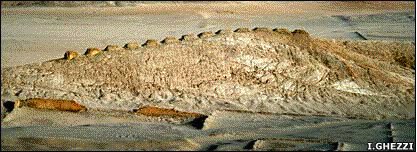


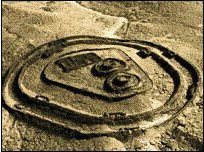
There are also huge geoglyphs in other places around the world but nothing as impressive as the Nazca Lines, which covers an area of approximately 450 km2, of sandy desert as well as the slopes of the contours of the Andes. Etched in the surface of the desert sand are about 300 hundred figures made of straight lines, geometric shapes most clearly visible from the air. The Nazca Lines were first spotted when commercial airlines began flying across the Peruvian desert in the 1920's. They were supposedly built by an ancient civilization called the Nazca.
The surface of the desert contain ferrous oxide, giving a dark tint, and when the surface is removed, it allows lines to be drawn. There appear to be two kinds of designs: the first are figures of various beings and things (animals, plants, objects, such as anthropomorphic figures of colossal proportions) and the others form geometric lines (angles, triangles, bunches, spirals, rectangles, wavy lines, concentric circles, etc.). The most well-known being The Astronaut stands at 32m length an E.T., discovered by Eduardo Herran in 1982.
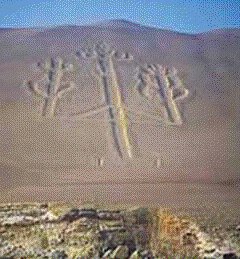
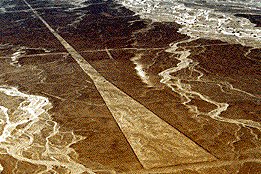
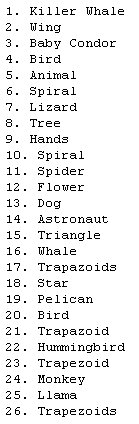
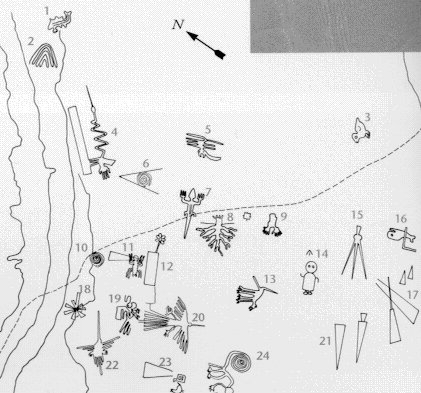
An Astronomical Calendar, which show the direction of the rising of important stars and planetary events like sun solstices and the spider and the monkey could show star constellations like Orion and Ursa Mayor. Since no one knows the age they were created and directions of stars change over the centuries due to the precession of the equinoxes, thus making it difficult to prove it astronomically. Studies done on 186 lines with a computer program found that only 20 per cent had any astronomical orientation, no more than by pure chance. One source has even claimed that in the formation he recognized a Zodiac.
One source claims that the Nazca Indians constructed the Lines relatively recently between 300 B.C. and A.D. 800. Since certain features found on Nazcan pottery, offers proof that the Nazcans had either designed the images or at least viewed them from the air. Another individual claims he recognized a culture atlas of the human history in the Nazca-line-system.
I would like to propose another theory, which I had previously mentioned above. Maybe the Annunaki or the ones that came to the Americas to be less visible in the Middle East area, and developed the above mentioned cultures and structures and geoglyphs for their own purpose.
The Late Bronze Age dates at 1,550-1,200 B.C.
Around 1,500 B.C. the Enuma Elish, the epic Babylonian story of Creation is compiled, which some claim the Hebrew scribes adopted into the first Chapters of the Book of Genesis for the Hebrew Bible.
From this point on in history, no mention of the Anunnaki is seen except for what is mentioned in writings after that. Their influence was supernatural after that. Some say that the Anunnaki may return with the end of the Mayan Calendar on or about 2,012 A.D. or maybe Nibiru is returning to cause more damage to the Earth as has been prophesied in the Book of Revelation.
The Iron Age dates at 1,200-586 B.C.
The Age of Pisces started in 210 B.C. - Day Eleven of Genesis. Messiah the bloodline from the Shem to a virgin earthling woman, Mary by a supernatural source, whose child will bring a New Testament to mankind, leading to the Fishers of Men, then the Dark Ages through the Rebirth. Enki was stated to take over during the Age of Pisces to guide mankind and was the prototype Aquarius. The Age of Aquarius, which should begin in 1,950 A.D., continues the Revelation and the New Age fulfillment of the time of secrecy, and the second coming.
This file was created on March 15, 2007, and updated on May 30, 2009, March 15, 2010, and July 30, 2010.
or Volume III - Introduction to the Sumerian Kings List
or the Volume III - New Released Files.