From The Alpha and the Omega - Volume III
by Jim A. Cornwell, Copyright © July 20, 2002, all rights reserved
"Volume III - Neteru versus Elohim"

    This file is to conduct an evaluation of the connection of the Egyptian Neteru, the Hebrew Elohim, and other god/goddess combinations from other ancient civilizations.

    The ancient Egyptians believed in One God, who was self-produced, self-existent, immortal, invisible, eternal, omniscient and almighty, which was never represented.    The attributes of this were called the neteru (net-er-u, also netjer, netjerou, and in singular form: neter [masculine] and netert [feminine]), but was misrepresented as gods.    The neter sign is the Egyptian ntr.w, means "god."    In ancient Egypt the Neteru is the "Era of the gods rule on Earth" associated with the "first time," known as Zep Tepi.    Zep means "time."    Tepi can mean "first," "precedes," "beginning," "commencement" or the "foremost point of a ship."    It can also mean "ancestor."    Thus, Zep Tepi could mean "before time" or the "beginning of time."    Therefore, at one time in the past the One God entity came upon the earth and through a divine origin affected the world through a multitude of attributes, qualities, powers and actions.
    The ancient Egyptians defined Ra as "The One Who Is The All," an aspect of the creative principle, and being recognized as the neteru (gods), whose interaction created the universe (i.e. world) as aspects of Ra (which has been noted to have around 75 forms).    These are also seen in the Hebrew concept as The 72 Names of God, as in such names as Ani, the masculine form and Anochi the feminine form as seen on the Names of Angels in Genesis.
    Therefore the ancients set up symbols of these attributes, forces and energies in human terms and in human form, using dress, headdress, crown, feather, animal, plant, color, gesture, and objects to represent them.
    The animal-headed neteru (gods/goddesses) are symbolic of spiritual understanding.    A total animal figure represents an attribute in its purest form of some force of nature, which some were more prominent in certain times, because of the change from one zodiac age to the next.
    This brings me to the subject of the Hebrew word in Genesis for God or gods.
    Some scholars believe that the early Mesopotamia civilizations, such as the Assyrians (Harranian, sacred Assyrian city of Harran, the same city where Abram was from), had a hand in the construction of the Great Sphinx.    Since the sphinx is not considered to have had its origin with the Egyptian culture, but to early Assyrian type cultures.
    Dr. Zahi Hawass, director general of Giza project in charge of excavations in Egypt, believes that the Sphinx is the soul of Egypt.    I have seen some sources that believe the ancient Egyptian people did referred to the Sphinx by it's Harranian or Assyrian name of 'Hwl,' and claim that name may point to the original builders.
    In reference to the Great Sphinx: a few names are Hwl, Hu, Horus in the Horizon - Hor-em-Ankhet, The living image of Atum - Seshep-ankh Atum.
    Of interest is that hwl could be the way that the Egyptians wrote their hieroglyphs for the name of God or the Elohim, as can be seen written in ancient Hebrew, thus, if we turn it left to right it is L W H, which may refer to the 'eloah, a form of the name of god.
    Hebrew 'el, ale; shortened from Heb. 'ayil, ah'-yil; from the same as Heb. 'ywl, ool; from an unused root meaning to twist, i.e. (by implication) be strong; properly strength; hence anything strong; thus strength; as adj. mighty, especially the Almighty (but used also of any deity): -- God (god), idol, might, power, strong.
    Note any similarities the 'uwl from the above and the Aramaic elah, Arabic ilah, Akkadian ilu.
    The root is an adjectival formation (intransitive participle) from which 'el was derived may have come from 'wl, "to be strong, powerful" meaning "The strong (powerful) One"; from an Arabic root 'ul, "to be infront of" as a leader from a Hebrew root 'lh to which both 'el and 'elohim belonged, with the meaning "strong"; from the preposition el, "to be infront of"; and using the same prepositions, as putting forth the idea of God as the goal for which all men seek.    A truly satisfactory theory is impossible, because 'el and the other terms for God, 'elohim and 'eloha, are all prehistoric in origin.

    Hebrew 'elahh (Chaldean), el-aw'; corresponding to Heb. 'elowahh, el-o'-ah; rarely (shortened) 'eloahh, el-o'-ah, probably prol. (emphatic.) from Heb. 'el, ale; a deity or the Deity; thus God: -- God, god.
    Surely one can see the relevance to 'e L o W a H, and the plural of this is the 'e L o W a H ee M.

    Hebrew 'elohiym, el-o-heem, plural of Heb. 'elowahh, el-o'-ah; rarely (shortened) 'eloahh, el-o'-ah, gods in the ordinary sense; but specifically used (in the plural thus, especially with the article) of the supreme God; occasionally applied by way of deference to magistrates; and sometimes as a superlative; -- angels, God (gods), judges.    The Hebrew word, "Elohim," is the Old Testament plural form of "Eloah" and "Eloah" meaning "gods."    Eloah and Eloah in the singular form appears forty times in Job alone.    The word God (Elohim) in Genesis 1:1 means the "plural majesty of the one God."    This "plural majesty" represents the attributes of the One God as seen in the concept of the different attributes of the Neteru.

    Genesis 6:2 "That the sons of God saw the daughters of men that they were fair; and they took them wives of all which they chose."

    Gen. 6:2 (2) {That} the sons of God [(Final Mem Yod He Lamed Aleph He Yod Nun Veth).
    So I am promoting the concept that the Egyptian Neteru and the Hebrew Elohim are both one and the same attributes of the one God, or gods that came to restore to order as it is called the Genesis or Zep Tepi.    Where I claim that Genesis/Zep Tepi occurred in the age of Capricornus at 21,800 B.C., many other sources promote that Zep Tepi occurred around 10,500 B.C. in the age of Leo, my sixth day of Creation.
    On the fourth day, which is Libra in 15,330 B.C. as promoted by my own work, we find that on the month of Athyr, Het-Her, Hathor, Hethara, Hat-hor, Coptic Hator on the Egyptian day 16, Gregorian: Oct. 2, Julian: Oct. 16, we find this as the Day of the appearance of the eight Great Names of Netjer (Primordials) and on day 17, Gregorian: Oct. 3, Julian: Oct. 17 also the Landing of the Great Names of Netjer in Abydos.    More of this can be seen on the Calendar Dates page.

    Remember as you read on and see the mention of a neteru god or goddess, that it's symbolism is an attribute of the one God, influencing that particular space in time as the wheel of the Mazzaroth moves through the Zodiacal Ages with the dates mentioned in connection with it's decan and a star reference.    The symbolism of each Neteru on the Denderah Decans (Round Zodiac) may connect with the Grand Temple Decans (Square Zodiac) with minor variations of attributes.
    Can we look at the Denderah Decan Neteru as a concept of what happens in the spiritual realm?
    Likewise is its Grand Temple Decan counterpart what happens on the earthly plane?
    These connections can be seen on my Volume III index page for the Zodiac of Denderah, where I have them aligned for one to view.

    The ancient Hebrew believed that the Elohim dwelt in nature and in the sky, and the tribes each had particular deities who dealt with their affairs.    One source believed that the ancient Hebrews and Sumerians called the Elohim, "the Shining Ones."    Apparently, some of these entities, one named Shemjaza and his group created male and female life forms from earlier human forms by genetic manipulation and even later mated with these humans.    Of course this was wrong in the eyes of the other "Shining Ones."    Yahweh, which was the main entity of "the Shining Ones, decided to make right the wrong that Shemjaza's group had done.
    Under the Pisces section, on Denderah Decan 34 and Grand Temple Decan 23 (associated with CEPHEUS, stars in Perseus as Mirfak, and Andromeda as Almach), which has the jackal head of Anubis (Egyp. inpw, Anpu, Ano-Oobist) is called Akhouy, Akhwey, Tepi-a Akhwey, or KhuKhu, which means "The Two Akh-Spirits."    Cyril Fagin claims that the Egyptian 3hwy (Akhuy), the "shining ones," because the sun rose in it on New Years Day of the lunar calendar.
    In the Egyptian month of Pachons, day 10, March 25th is mentioned as Day the Shining Ones of Heaven move upstream.

    The Elohim which included all the host of Heaven, were messengers, ascending and descending to and from Heaven to decree the will of God to mankind.    So with that said, I would like to mention the following viewpoint as of interest.    If you would like to see any of the following Neteru, as to their attributes then go to Egyptian Gods and Goddesses page, which is in alphabetical order.

    In "The Dawn of Astronomy" a study of the temple-worship and mythology of the Ancient Egyptians by J. Norman Lockyer, New York, The McMillian Company 1897, as seen on page 297, "We gather, then, that the wonderful old-world myth of Isis and Osiris is astronomical from the beginning to end."
    He continues on page 299, with "... it looks as if the mythology connected with Osiris is simply the mythology connected with any celestial body becoming invisible.    We have the sun setting, the moon waning, a planet setting, stars setting, constellations fading at dawn."

    First we will examine the male aspect (neter-gods) concept of the sun in rising/setting status and the relevance of mummies.
    In "The Dawn of Astronomy" by J. Norman Lockyer, New York, The McMillian Company 1897, as seen on page 25, "The god Ra symbolises, it is said, the sun in his noontide strength; while for the time of sunset we have various names, cheifly Osiris, Tum, or Atmu, the dying sun represented by a mummy and typifying old age.
    Ra compounded with other names, and in these forms of the god we possibly get references to the sun at different times of the year.    Amen-Ra, Sebak-Ra and Chnemu-Ra
(Khnum) are cases in point.    The former undoubtly refers to the sun at the summer solstices.    Min-Ra is an ithyphallic form."
    He continues on page 26, "The names given by the Egyptians to the sun then may be summarised as follows: --
    Hor, or Horus, or Harpocrates, and Chepera
(Khepera) (morning sun).
    Ra (noon).
    Tum or Atmu (evening sun).
    Osiris (sun when set)
."
    In "The Dawn of Astronomy" by J. Norman Lockyer, New York, The McMillian Company 1897, as seen on page 295, "... some of the gods symbolized setting stars.    We already know that the setting sun became Osiris, Atum, or Tmu, and whatever the names, they were all represented as mummies."
    J. Norman Lockyer then on page 296 provides a chart of these gods.     He continues on page 319, "... the worship of Min, otherwise read Amsu, or Khem in ithyphallic mummy form."    Spica and the Mut temple was founded on this.

    Next we will look at the concept of the moon.
    In "The Dawn of Astronomy" by J. Norman Lockyer, New York, The McMillian Company 1897, as seen on page 28-29, "With the moon we find two gods connected - Thoth-Lunus and Khons-Lunas.
    For the stars generally we find a special goddess, Sesheta (Shesat)
."

    Now to espound on the female aspect (netert - goddesses).
    In "The Dawn of Astronomy" by J. Norman Lockyer, New York, The McMillian Company 1897, as seen on page 29, "Isis (Aset) represents the Dawn and the Twilight; she prepares the way for the Sun-god.    The rising sun between Isis and Nephthys (morning)."
    He continues on page 149, "Horus equals the sun, planets, or constellation rising.
    Sun: Horus.
    Planets: Mars as Hor-kuti (Laughing Horus), (Red Horus).
    Constellations: Orion - Sah-Horus and Northern constellation - Set-Horus.
    The rising sun, planets and constellations were called Horus.
    We do not get any individual stars rising referred to as Horus, they were always considered as goddesses
."

    In "The Dawn of Astronomy" by J. Norman Lockyer, New York, The McMillian Company 1897, as seen on page 289, "2. There is evidence that many of the names of these goddesses are pure synonyms.    That is to say, we have the same goddess (or the same star) called different names in different places, and associated with different animal emblems, in consequence of the existence of different totems in different nomes.
    The temple of Hathor of Denderah was probably associated with the crocodile or hippopotamus ... suggestion that the goddess Mut was really the Theban form of the goddess Hathor of Denderah
."
    He continues on page 290, with "... seen at Thebes .. collection of statues of Sechet in the temple of Mut, all of them lion-headed ... we get a clear indication of the fact that Apet, Mut, Taurt, Sechet, Bast, were the same goddess under different names, and I may add that they, in all probability symbolise the star g Draconis."
    "3. All these goddesses have a special symbol - Hathor wears the cow's head and the horns with the disk.    Tuart, the hippopotamus goddess, is also represented with horns and disk.    The horns and disk are also worn by Serk-t, Sati and Ra-t, the wife of the sun-god Ra; many other goddesses might be added to this list.    Indeed, it looks as if all the goddesses who are stated to be variants either of Isis or Hathor have this symbol."
    He continues on page 291, with "This generic symbolism suggests that the names Isis and Hathor are themselves generalisations, meaning an accompaniment of sunrise, whether that light be dawn, or an helically-rising star, or even the moon.    They personify mythologically stars the rising of which was observed at the dawn at some time of the year or another."
    He continues on page 292, with "Many goddesses are 'represented by the Egyptians as Isis (the rising star-goddess) nursing Horus (the rising sun-god).'    Many of the goddesses are thus portrayed.    I may mention Renen-t, Serk-t, Ra-t, Amen-t as instances."
    J. Norman Lockyer then on page 293 provides a chart of these goddesses.
    Last we view the stars that never set.
    In "The Dawn of Astronomy" by J. Norman Lockyer, New York, The McMillian Company 1897, as seen on page 28, "As I shall show, the idea of darkness, was associated with the existence of those stars which never set, so that even here the symbolism was astronomical."    These were represented by Anubis, Typhon, Bes and Taurt.
    He continues on page 317-318, "We are driven, then, to the conclusion that the star Capella is personified by Ptah, and that as Capella was worshipped setting.    Ptah is represented as a mummy ... the temples both at Annu and Memphis were dedicated to Ptah."
    He continues on page 361, "I suppose there is now no question among Egyptologists that the gods Set/Sit, Typhon, Bes, Sutekh are identical.    Sutekh was a god of the Canaanites, and Bes is identified with Set in the 'Book of the Dead'."

    In regard to other civilizations that have correlation to the Hebrew Elohim and the Egyptian Neteru I provide the following:
    In "The Dawn of Astronomy" by J. Norman Lockyer, New York, The McMillian Company 1897, in regard to Canaanite and Babylon verses Egypt as seen on page 365, "Canaanite Sutekh is equal to the Babylonian Anu (which relates to the Egyptian Set).    Canaanite Baal (Phoenician Aleyin, Amurru) connected to the Babylonian Bïl (Sumerian Pa-bil-sag) and the Egyptian Taurt (Taueret, Thoueris, possibly Resheph)."
    He continues on page 375, in regard to sun-gods, "Babylonian Ninib equals Egyptian Horus, Babylonian Marduk was the Egyptian Amen-Ra."
    He continues on page 380, "Associated with I'a (Babylonian Ea) was an Ia-star, which Jensen concludes may be h Argus."
    He continues on page 384, "Ia (Ea) was represented as a goat-fish, and was a potter and 'maker of men' ... the southern Egyptian god Chnemu ... is represented goat-headed ... the creator of mankind, but he is a potter ... making man out of clay on a potter's wheel."

    He continues on page 408, "A few hundred years later, we learn from the works of Strassmeyer and Epping, a complete chain of twenty-eight stars along the ecliptic had been established, and most careful observations made of the paths of the moon and planets, and all attendant phenomena.    The ecliptic stars then used in Babylonia were as follows: (from "Astonomisches aus Babylon," pp. 117-133) ."
    For a comparison of the following table also see The MUL.APIN Tablet 1 and its constellation and star references.

The 28 Ecliptic Stars
Lockyer's Reference My star reference Number - Babylonian Name Number - Arabic Name Other sources
1.   h  Piscium
a Alrisha
#1 Kullat-nûnu
#28 Batn al Hut
#26 Batn al Kut
             If you would like to see more detail on the above then go to Table of Contents - Pisces or Pisces Star Names.
2.   b  Arietis
b Sheratan
#2 Mahrûšarîšu-ku
#1 Sharatayn
#27 Al Ashrat
             If you would like to see more detail on the above then go to Table of Contents- Aries or Aries Star Names.
3.   a  Arietis
d Botein
#3 Arkûšarîšu-ku
#2 Butayn
#28 Al But'ain
4.   h  Tauri
h Alcyone in Pleiades
#4, Temennu
#3 Thurayyâ
#1 Al Thurayya
             If you would like to see more detail on the above then go to Table of Contents - Taurus, Taurus Star Names or the Pleiades Star Cluster.
5.   a  Tauri
a Aldebaran
#5 Pidnu
#4 Dabarân
#2 Al Dab'aran
             If you would like to see more detail on the above then go to Table of Contents - Taurus or Taurus Star Names.
6.   b  Tauri
b El Nath-g Aurigae
#6 Surnarkabtišailtânu
.
.
7.   z  Tauri
z Taurii (no name)
#7 Surnarkabtišašutu
l Meissa, #5 Haq'a, Almices under Orion
#3 Al Heka
             If you would like to see more detail on the above then go to Orion Star Names.
8.   h  Geminorum
h Propus (Tejat' prior)
#8 Mahrûšapuu-mašmašu
.
.
             If you would like to see more detail on the above then go to Table of Contents - Gemini or Gemini Star Names.
9.   m  Geminorum
m Tejat' (posterior)
#9 Arkûšapuu-mašmašu
.
.
10.  g  Geminorum
g Alhena
#10 Mašmašu-šari'û
#6 Han'a, Athaya
#4 Al Han'ah
11.  a  Geminorum
a Castor,
Al Dhira' al Mabsutah'
#11 Mašmašu-mahrû
#7 Dhirâ'
#5 Al Dhira'
12.  b  Geminorum
b Pollux, Al Dhira'ain
#12 Mašmašu-arkû
.
.
             a-b Al Dhira' al Mabsutah', Al Dhira'ain, is Castor and Pollux combined together.
13.  d  Cancri
d Asellus Australis, Enat'ret
#13 Arkûšanangarušašûtu
#8 Nathra, Annathra, Al Nathrah
#6 Nathra, Annathra, Al Nathrah
             If you would like to see more detail on the above then go to Table of Contents - Cancer or Cancer Star Names.
14.  e  Leonis
b Tarf, Al Tarf (Cancer)
l Alterf (Leo)
#14 Rîšu-a
#9 Tarf, Atarf, Al Tarf
#7 Al Tarf, Al Terpha
             If you would like to see more detail on the above then go to Table of Contents - Leo or Leo Star Names.
15.  a  Leonis
a Regulus
g Algeiba, Algi'eba
#15 Šarru
#10 Jab-ha, Algebha, Al Jabhah (g Algeiba)
#8 Al Jab'hah
(d Scorpii)
16.  r  Leonis
o Subra
#16 Mârušaarkat-šarru
#11 Zubra, Azobra, Al Zubrah
#9 Al Zu'brah
17.  b  Leonis
b Denebola
#17 Zibbat(?)-a
#12 Sarfa, Acarfa
#10 Al Sar'tah
18.  b  Virginis
h Zaniah, Za'niah
#18 šêpuarkûša-a
#13 Awwâ', Alahue, Al Awwa
#11 Al 'Awwa'
             If you would like to see more detail on the above then go to Table of Contents - Virgo or Virgo Star Names.
19.  g  Virginis
a Spica
#19 šurmahrû-širû
#14 Simâk, Azimech, Al Simak
#12 Al Simak
20.  a  Virginis
"unknown star name."
#20 saša-širû
#15 Gafr, Argafra, Al Ghafr
#13 Al Ghaf'ar, Al Ghafr
21.  a  Librae
a Zubenelgenubi, Zuben' El Genu'bi
#21 Nûru-šašûtu
#16 Zubânayn, Azubene,
Al Jubana
#14 Al Zuban'ah
(a Cancri), Al Zaban' (Birfuni)
             If you would like to see more detail on the above then go to Table of Contents - Libra or Libra Star Names.
22.  b  Librae
b Zubeneschamali, Zuben Eschama'li
#22 Nûru-šailtânu
.
.
23.  d  Scorpionis
d Dschubba, Dscub'ba
#23 Qâbušarîšu-agrabi
#17 Iklil, Alichil, Iklil Al Jabhah
#15 Iklil al Jab'han (note: Corona)
             If you would like to see more detail on the above then go to Table of Contents - Scorpius or Scorpius Star Names.
24.  a  Scorpionis
a Antares
#24 Hurru
#18 Qalb, Alcalb, Al Kalb
#16 Al Kalb (a Leonis)
25.  d  Ophiuchi
d Yed Prior
(in Ophiuchus)
#25 Kaššudšakatar-pa
(in Ophiuchus)
#19 Shawla, Exaula,
Al Shaula
(l Shaula, Shau'la)
(in Scorpius)
#17, Al Shaula
             If you would like to see more detail on the above then go to Ophiuchus Star Names.
26.  a  Capricorni
s Nunki (in Sagittarius)
None specified for Sagittarius
#26 Qarnu-šahû (Capr.)
#20 Na'âyim, Nahaym,
Al Na'am
#18 Al Na'am
(Tau and Nu Pegasi)
             If you would like to see more detail on the above then go to Table of Contents - Sagittarius, Sagittarius Star Names or Capricornus Star Names regarding M30 a Globular Star Cluster noted with Praesepe.
27.  g  Capricorni
p Albaldah, Al Bal'dah (in Sagittarius)
None specified for Sagittarius
#27 Maharšahina-šahû (Capr.)
#21 Balda, Elbelda, Al Baldah
#19 Al Bal'dah
(p Sagittarii)
28.  h  Capricorni
b Dabih, Da'bih
#28 Arkatšahina-šahû
#22 Sa'd al-Dhâbih, Caadaldeba, Al Sad Al Dhabih
#20 Sa'd al Dhabih
N/A
e Albali, Al Bali'
None listed for Aquarius
#23 Sa'ad Bula
#21 Sa'd al Bula'
N/A
b Sadalsud, Sadalsuud, Sadan Suud
None listed for Aquarius
#24 Sa'd al-Su'ûd
#22 Sa'ad al Su'ud
             If you would like to see more detail on the above then go to Table of Contents - Aquarius or Aquarius Star Names.
N/A
g Sadachbia, Sadach'bia
None listed for Aquarius
#25 Sa'd al-Ahbiya
#23 Al Akhbiyah
N/A
a Markab, Markab'
(Pegasus in Aquarius)
None specified
#26 Farq al-Mugaddam,
Al miquedam, Al Fargh Al Mukdim (Muledim)
#24 Fargh al Aw'wal,
Al Fargh al Muk'dim
             If you would like to see more detail on the above then go to Pegasus Star Names.
N/A
a Alpheratz, Alpher'atz, Sir'rah (Andromeda in Pisces)
None specified
#27 Farq al-Mu'ahar,
Algarf Al muchar,
Al Fargh Al Thani
#25 Fargh al Mu'hir,
Al Fargh al Thani,
Al Fargu
             If you would like to see more detail on the above then go to Andromeda Star Names.

    He continues on page 409, "In Egypt, dating from the twentieth dynasty (1100 B.C.), is a series of star tables which have puzzled Egyptologists ... these observations are recorded in several manuscripts found in tombs.
    The hieroglyphs state that a particular star of a particular constellation is seen at a particular hour of the night.    We have twelve lines representing the twelve hours of the night, and it is stated that we have in these vertical lines the equivalent of the lines in our transit instruments, and that the reference 'in the middle,' 'over the right eye,' 'over the right shoulder,' or 'over the left ear,' as the case may be, is simply a reference to the position of the star
."
    "The observations were made on the 1st and the 16th of every month.    The chief stars seem to be twenty-four in number, and it looked at first as if we had really here a list of priceless value of twenty-four either ecliptic or equatorial stars, similar to the decans to which reference has already been made."
    He continues on page 409-410, in regard to the ecliptic stars of Babylon "Unfortunately, however, the list (shown in the list above from page 408) has resisted all efforts to completely understand it.    Whether it is a list of risings or meridian passages even is still in dispute.    Quite recently indeed, one of the investigators, Herr Gustav Bilfinger, has not hestitated to consider it not a list of observations at all, but a compiliations for a special purpose."


    In "The Dawn of Astronomy" by J. Norman Lockyer, New York, The McMillian Company 1897, as seen on page 411-412, "I give an abstract of the list of the twenty-four principal stars and the Egyptian constellations in which they occur:"
    The following is a chart of that abstraction with some correlating information.
    If you would like to see more detail on the following table then go to Table of Contents and select the constellation and star name of interest.
    For a comparison of the following table also see The MUL.APIN Tablet 1 and its constellation and star references.

The 24 Egyptian Stars

Lockyer's Egyptian Abstract Seiss' Lunar Mansion
Number & Name
Constellation
Name
Denderah
Decan #
Arabic number- name (Star Name)
Correlation to the Abstract.
1. Sahu = Orion
20. Al Debaran
Taurus
27, 26
#4 Dabarân (a Aldebaran)
2. Sothis = Sirius (in Canis Major)
21. Al Henah
Gemini
25
#6 Han'a, Athaya (g Alhena)
3. The two stars
22-23. Al Dirah
(Castor-
Pollux)
Gemini
24
#7 Dhirâ'
(a Castor
, Al Dhira' al Mabsutah')
b Pollux, Al Dhira'ain
4. The stars of the water
24. Al Nertha
Cancer
23
#8 Nathra, Annathra, Al Nathrah (d Asellus Australis, Enat'ret)
5. The lion (Leo).
25. Al Terpha
Leo

22
21
#9 Tarf, Atarf, Al Tarf
(b Tarf, Al Tarf (Cancer)
l Alterf (Leo))
6. The many stars
26. Al Geiba (Regulus)

27. Al Zubra

28. Al Serpha (Denebola)

Leo
20

19

18

#10 Jab-ha, Algebha, Al Jabhah
(g Algeiba)
#11 Zubra, Azobra, Al Zubrah
(o Subra)
#12 Sarfa, Acarfa
(b Denebola)
7. Mena's herald
1. Al Awa
Virgo
15
#13 Awwâ', Alahue, Al Awwa
(h Zaniah, Za'niah)
8. Mena (possibly Spica in Virgo)
2. Simak al Azel (Spica)

3. Caphir (Ghafr)

Virgo/Libra
14
#14 Simâk, Azimech, Al Simak
(a Spica)
#15 Gafr, Argafra, Al Ghafr
(unknown star name)
9. Mena's followers

4. Al Zubena


----------
5. Al Iclil (Dschubba)

6. Al Kalb (Antares)

7. Al Shaula (in Scorpius)

Libra/Scorpius

--------
Sagittarius


13,12,11


10

9
8

#16 Zubânayn, Azubene,
Al Jubana
(a Zubenelgenubi, Zuben' El Genu'bi)
-------------------
#17 Iklil, Alichil, Iklil Al Jabhah
(d Dschubba, Dscub'ba)
#18 Qalb, Alcalb, Al Kalb (a Antares)
#19 Shawla, Exaula, Al Shaula
(l Shaula, Shau'la) (in Scorpius)
10. Hippopotamus (Draco)
8. Al Naim
Capricornus
7
#20 Na'âyim, Nahaym,
Al Na'am (s Nunki (in Sagittarius))
11. Hippopotamus (Draco)
The netjer of Capricornus was Rekhur, at the Ramesseum: Jackal (rekh-ur), at Edfu: Hippopotamus (rekh-ur), Rekeh(uer), possibly Re'Khur.
9. Al Beldah

10. Al Dibah (Dabih in Capr.)

Capricornus
6

5

#21 Balda, Elbelda, Al Baldah
(p Albaldah, Al Bal'dah in Sag.)
#22 Sa'd al-Dhâbih, Caadaldeba,
Al Sad Al Dhabih (b Dabih, Da'bih)
12. Hippopotamus (Draco)
11. Sa'd al Bula (Albali)
Aquarius
4
#23 Sa'ad Bula (e Albali, Al Bali')
13. Hippopotamus (Draco)
12. Sa'ad al Su'ud (Sadalsud)
13. Al Akhbiyah (Sadachbia)

Aquarius
3

2

#24 Sa'd al-Su'ûd (b Sadalsud, Sadalsuud, Sadan Suud)
#25 Sa'd al-Ahbiya
(g Sadachbia, Sadach'bia)
Aquarius at Ramesseum: Jackal (rekh-netches), at Edfu: Hippopotamus (rekh-netches), note that REKEH (nezes) or Nasie is the 13th month.
14. Al Pherg al Muchaddem (Markab)
Pegasus
1
#26 Farq al-Mugaddam,
Al miquedam, Al Fargh Al Mukdim (Muledim) (a Markab, Markab'
(Pegasus in Aquarius))
---
15. Al Pherg al Muachher (Alpheratz)
Andromeda
36
#27 Farq al-Mu'ahar,
Algarf Al muchar, Al Fargh Al Thani (a Alpheratz, Alpher'atz, Sir'rah (Andromeda in Pisces))
14. Necht (another northern constellation)
16. Al Risha
Pisces
35
#28 Batn al Hut (a Alrisha)
15. Necht (another northern constellation)
---
Pisces
34
"
16. Necht (another northern constellation)
---
Pisces
"
"
17. Necht (another northern constellation)
---
Pisces
"
"
18. Necht (another northern constellation)
---
Pisces
"
"
19. Necht (another northern constellation)
---
Pisces
"
"
20. Necht (another northern constellation)
---
Pisces
"
"
21. Ari (Aries)
17. Al Sheratan
Aries
33
#1 Sharatayn (b Sheratan)
22. Goose
18. Al Botein
Aries
32
#2 Butayn (d Botein)
23. Goose
---
Aries
31
"
24. Sahu = Head of Orion
19. Al Thurayya
Taurus-Pleiades
30,29,28
#3 Thurayyâ (h Alcyone in Pleiades)

    Also note that all the Egyptian months and days in regard to the Gregorian calendar are around one month out of synch with the dates specified for the same constellation as referenced for the modern Zodiac and the Hebrew month.
    In "The Dawn of Astronomy" a study of the temple-worship and mythology of the Ancient Egyptians by J. Norman Lockyer, New York, The McMillian Company 1897, as seen on page 253-254, "The Sirius year, like the Julian was about eleven minutes longer than the true year, so that in 3,000 years we should have a difference of about 23 days.    Biot showed by his calculations using solar tables extant before those of Leverrier, that from 3,200 B.C. to 200 B.C. in the Julian year of the chronologists, Sirius had constantly, in each year, risen helically on July 20, which in Julian equals June 20 in the Gregorian."
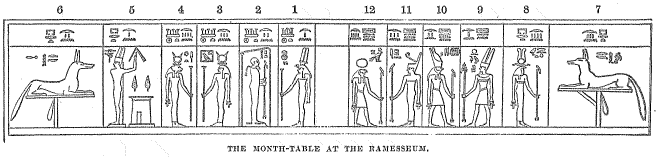
    In the image below as seen on Lockyer's page 276, he shows the Month-Table at the Ramesseum, with the hieroglyphic names and image of the Nerteru for each Egyptian month.    It should also be noted that each of the neteru seem to be facing each other in pairs of six, which may have been done for asthetics, instead of the usual facing one direction to determine the read on the hieroglyphs.    I found it interesting that it starts from left to right beginning with Capricornus and ending with Aquarius.    Another interesting point is the gap or spaced area centered between month 1 and 12, which turns out to be the area that represents the epo gomena, is left blank with no hieroglyphs or images.

Comparison of the 24 Egyptian Stars and the Denderah Zodiac Stars
Constellation
Name
Capricornus
Menchir
Sagittarius
Tybi
Scorpius
Choiach
Libra
Athyr
Virgo
Phaophi
Leo
Thuthi
Cancer
Mesori
Gemini
Epiphi
Taurus
Payni
Aries
Pachons
Pisces
Phaemoth
Aquarius
Phamoneth
Netjer of
the Month
Rekhur
Min
Sekmet
Pachet
Het-Hert
(Hathor)
Ptah
Thoth
Heru
(Horus)
Udjat
Wadjet, Apet
Horus
(Heru)
Khonsu
(Kensu, Chosu)
Renenutet
Renen, Renwet
Amun-Ra
Rekeh-nezes Nasie
Lockyer's
24 Stars
Al Naim
(10) Hippopotamus (Draco)
---
Al Beldah
Al Dibah (Dabih in Capr.)
(11) Hippopotumus (Draco)
Al Iclil (Dschubba) Al Kalb (Antares)
Al Shaula (Shaula in Scorp.)
(9) Mena's followers
Al Zubena
Simak al Azel (Spica) Caphir (Ghafr)
(8) Mena (possibly Spica in Virgo)
Al Awa
(7) Mena's hearald
----
Al Geiba (Regulus)
Al Zubra
Al Serpha (Denebola)
(6) The many stars
Al Terpha
(5)
The Lion (Leo)
----
Includes some in Virgo's
(6) The many stars
Al Nertha
(4) The stars of the water
(This may refer to Cancer and Canopus in Argo Navis
Al Henah
(2) Sothis = Sirius
----
Al Dirah (Castor & Pollux)
(3) The Two Stars
Al Debaran
(1) Sahu = Orion
Al Thurayya
----
(24) Sahu = Head of Orion)
eta Alcyone
Al Sheratan
(21) Ari (Aries)
----
Al Botein (22) Goose
----
?
(23) Goose
Al Risha
(14),(15),(16),(17),(18),(19),(20)
Necht
(another Northern constellation)
Al-Pherg al Muachher (Alpheratz in Andromeda)
Hippopotamus (Draco)
----
Sa'd al Bula (Albali)
(12)
Sa'ad alSu'ud (Sadal sud)
Al Akhbiyah (Sadachbia)
----
(13)
Al-Pherg Al Muchaddem (Marcab in Pegasus)
12 associated Constellations and their Stars in the Denderah Zodiac
Aquila
(Altair)
Lyra
(Vega)
Scorpius
(Antares)
Bootes
(Arcturus)
Leo
(Denebola)
Leo
(Regulus)
Canis Min.
(Procyon)
Canis Maj.
(Sirius)
ArgoNavis
(Canopus)
Orion
(Al Henah)
Pleiades
(Alcyone)
Aries
(Sheratan)
Pegasus
(Great Square)
Pegasus
(outer star)
The gods and 36 Decans of the Denderah Zodiac
Mars
Delphinus
Sagitta
Aquila
Lyra
Corona Australis
Ara
Hercules
Ophiuchus
Serpens Cauda/Caput
Lupus
Draco (Cor. Boreal)
Crux
Saturn
Bootes
Coma Berenices
Centaurus
Corvus
Crater
Hydra
Mercury
Ursa Major
Ursa Minor
Argo Navis
Jupiter
Canis Maj.
Canis Min.
Lepus
Auriga
Monoceros
Orion
Perseus
Cassiopeia
Eridanus
Eye (Utchat)
Luna
Andromeda
Cetus
Cepheus
Venus
Pegasus
Cygnus
Pisces Austrinus
Denderah Decan Number (DD##) constellations
and
(Decan Stars)
DD01
Perseus (Schedar, Ruchbah)
----
DD02
Cygnus, Pegasus (Enif), Aquarius (Sadalsuud)
----
DD03
Capricornus, Aqu-Peg (Scheat), Aquarius (Sadalmelik), Cyngus (Deneb Algedi)
----
DD04
Aquila, Draco,
Ursa Major, Equeleus
DD05
Sagitta, Capricornus (Dabih), Capr-Ursa Mj. (Algedi)
----
DD06
Hercules, Aquila (Altair),
Aqu.-Capr. (Deneb)
----
DD07
Sagittarius (Kaus A,B,C)
----
DD08
Lyra (Vega)
Scorpius (Lesath, Shaula),
Draco
DD09
Ursa Minor, Ophiuchus, Serpens (Sabik, Ras Al Hague)
----
DD10
Scorpius, Selket (Antares)
Centaurus (Rigel Centaurus)
----
DD11
Ara, Scorpius (Graffias), Ophiuchus (Yed Prior)
Crux (Acrux)
----
DD12
Lupus, Virgo (Spica)
Cor. Borealis (Alphecca)
DD13
Libra
(Zuben Eschamali,
Zuben Elgenubi)
Virgo (Spica)
DD14
Saturn,
Draco, Corona Borealis (Alphecca)
----
DD15
Virgo,
Bootes (Arcturus)
DD16
Centaurus, Coma Berenices (Vindemiatrix),
Argo Navis (Canopus)
----
DD17
Leo Minor, Crater (Alkes), Corvus,
Hydra (nu star)
----
DD18
Leo (Denebola),
Coma Berenices
----
DD19
Hydra (Alphard),
Leo (Zosma)
DD20
Cancer,
Leo (Regulus)
Canis Major (Adhara)
----
DD21
Canis Major (Sirius, Mirzam)
DD22
Lepus, Canis Minor (Procyon)
----
DD23
Orion (Saiph)
Ophiuchus (?)
----
DD24
Gemini (Pollux, Wasat, Alhena),
Orion (Betelguese, Rigel, Al Nilam)
DD25
Auriga, Gemini (Castor, Propus, Mebsuta)
----
DD26
Orion-Monoceros, Taurus (Aldebaran),
Auriga
(El Nath)
----
DD27
Taurus
(Al Heka)
Eridanus (Rana)
----
DD28
Cassiopeia, Cetus (Menkar, Hassaleh),
Monoceros
DD29
Eridanus, Auriga (Capella)
----
DD30
Aries, Pleiades-Taurus
(Alcyone),
Auriga (Menkalinan)
DD31
Cetus
(Deneb Kaitos)
----
DD32
Andromeda,
Auriga (Capella)
----
DD33
Pisces, Aries (Hamal, Sheratan),
Perseus (Algol)
----
DD34
Cepheus, Perseus (Mirfak),
Andromeda (Al mach)
DD35
Aquarius, Andromeda (Mirach),
Pisces Austrinus (Fomalhaut)
----
DD36
Pegasus, Andromeda (Alpheratz)


    This page created on March 31, 2005, and updated on June 18, 2005, June 15, 2006, and November 15, 2006.

Return to the Table of Contents or the Zodiac of Denderah