From The Alpha and the Omega - Volume III
by Jim A. Cornwell, Copyright © December 31, 2006, all rights reserved
"Volume III - Sumerian city of Hamoukar"
Go to the bottom of this page

    Syria is a relatively recent destination for archaeologists, because many of the Middle East countries do not allow access to the sites.    Because of the Gulf War and the isolation of Iraq, many have shown interest in Syria.    Many Muslim countries try to control what comes out of these discoveries, and we may not know the full extent of what they have until it is disclosed.    The time frame of the following article alerts me that it may enlighten us to events and historical personage that has long been buried in the past.

HAMOUKAR

    The following information is highlights from the following two websites: http://www.ancientx.com by Jason Martell and http://www.meme.essortment.com/hamoukar_rjcf.htm, with my comments added.
    Investigations at Hamoukar began in 1999, led by McGuire Gibson and Clemens Reichel, a research associate of the Oriental Institute of the University of Chicago and Muhammad Maktash and Salam al-Quntar of the Syrian Department of Antiquities, whom jointly announced their discoveries.    A 2005 excavation project on the Syrian-Iraqi border in the upper edges of the Tigris and Euphrates Valleys has uncovered an ancient settlement wiped out by invaders 5,500 years ago (3,500 B.C.).
    It is located between the Tigris and Euphrates rivers in what the Syrians call the gezira, or island in northeastern Syria in the Khabur River basin eight kilometers from the Iraq border.    The ruined city of Hamoukar appears to have been a large city by 4,500 B.C. (Late Chalcolithic period 4,000-3,500 B.C.), said archaeologists Clemens Reichel and Salam al-Quntar.
    Reichel said Hamoukar was a flourishing urban center at a time when cities were thought to be relegated hundreds of miles to the south.    Reichel said it may have been settled as long as 8,000 years ago (6,000 B.C.), at a time that I promote that the Biblical Deluge occurred and surely this land near the rivers would have been consumed for some time.    I found it interesting that the name of the city begins with "Ham," definitely a similarity to the Hamitic tribes that may have migrated south as the waters from the flood receded.

    Scholars had long believed that urbanized societies started and were isolated in Uruk, in southern Mesopotamia.    But excavations that started in 1999 at Hamoukar and at other sites in central Syria led to new ideas about how urban culture spread in the region.    Ancient Mesopotamia was a region that includes Iraq and parts of Syria.
    This year, the Syrian-American excavations discovered evidence of the battle that toppled and burned Hamoukar's walls and ended the city's independence.    Researchers found that invaders likely hurled more than 1,200 sling-fired bullets at Hamoukar and more than 100 heavy, 4-inch clay balls.
    "The whole area of our most recent excavation was a war zone," Reichel said.    The ruins have preserved not only local pottery and artifacts, but also vast amounts of Uruk pottery.    "The picture is compelling," Reichel said.    "If the Uruk people weren't the ones firing the sling bullets, they certainly benefitted from it.    They took over this place right after its destruction."    Reichel said if Hamoukar's residents were taken by surprise it will give researchers plenty to study because their possessions likely were buried with them under the debris.
    This discovery could mean that civilizations were advanced enough to reach the size and organizational structure that was necessary to be considered a city that could have actually occurred before the advent of a written language and functioning independently from Sumer.    Until now, the oldest cities with developed seals and writing were thought to be Sumerian Uruk and Ubaid in Mesopotamia, which would be the southern one-third of Iraq today.    Hamoukar's is such a large city with specialization of labor, a system of laws and government, and artistic development, and nothing compares to its size and magnitude.
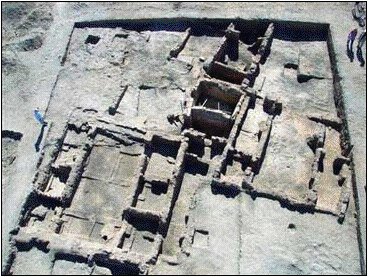
    Scientists from the University of Chicago's Oriental Institute dug beneath the already existing town called Tell Hamoukar in northeastern Syria and were astonished to find what they believed to be a 13-inch thick protective wall surrounding a city directly underneath Tell Hamoukar.
    The huge city is spread over 750 acres (105 hectares) and is believed to have been home to up to 25,000 people.    The archaeologists found five large stone ovens possibly bakeries or breweries, large enough to feed huge numbers of people, indicating a community with industries.    Also, astonishing is the fact that the living quarters were double walled with a 2-inch gap between the two walls to encourage airflow.    This seems to be a primitive form of air conditioning since the summer temperatures in that region could reach 40 C and above.    Discoveries include stone gods, jewelry, porcelain figurines of lions, leopards, bears and horses, together with porcelain-like pottery, 7,000 beads, more than a hundred clay seals with hieroglyphics used to record trade transactions, and a large protective city wall.
    The clay seals themselves have given the archaeologists much information regarding this civilization.    There was also evidence found with these seals that they were used in a crude but highly effective form of organization.    These seemed to be used to mark goods as belonging to or being made by a certain person or group of people.    A chart-like system of recording this information was discovered stamped into a nearby wall, causing further speculation regarding advanced trade that may have been occurring in this city.    Many of the items discovered are believed to have been mass-produced by a person who specialized in the production of that item.    This is further evidence that this was very definitely a city with it's own industry and trade.    The porcelain-like, egg shell thin pottery provides some of the clearest evidence of this specialization of skills.
    Evidence was discovered that they grew and ate wheat, oats, and barley, and also raised domesticated animals for food purposes.    How they grew these crops is not known because the area they were in is arid, some claim that the climate of northeastern Syria was once much wetter than it is today.
    The name of this city is mysterious itself, since translations of this word can lead to many different interpretations as to the origins of the settlers of this community.    In Kurdish, Hamoukar means the "deaf man" or more specifically the man with no ears.    Other experts lean towards a Sumerian word that refers to an economic or business center, which fits better, but until all the information is analyzed the actual name it was derived from is forthcoming.
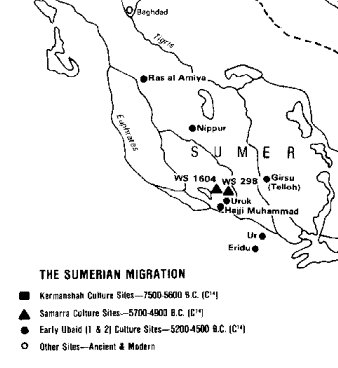
    To see a map of the Mesopotamia region then go to Map of the Mesopotamian Region.


    In comparison to the above information I would like to comment on the Samarran Culture which dated back to 5,500 B.C. to 4,800 B.C.    This civilization was the first finding of a significant irrigation, suggesting there was more investment in the land as far as farming for crops.    The setting up of irrigation also showed that the city was a very permanent settlement and that the settlement prospered as a result of the advances that they made.
    Traces were found of pre-historic artifacts: fine painted pottery decorated in dark colored backgrounds with figures of animals, birds, people and complicated looking geometric designs.    This type of pottery was first recognized at Samarra but at first was thought to be a southern variant of the Hassunan Culture, which is now associated mainly with the site of Tell Sawwan.
    The Hassuna Culture (6,000 B.C. - 5,250 B.C.) were a people who had moved into the foothills of northernmost Mesopotamia where there was enough rainfall to allow for "dry" agriculture in some places.    These were the first farmers in northernmost Mesopotamia (Assyria).    They made Hassuna style pottery (cream slip with reddish paint in linear designs).    Hassuna people lived in small villages or hamlets ranging from 2 to 8 acres.    Even the largest Hassuna sites were smaller than Jericho had been 1000 years before and much smaller than Çatal Hüyük, which was still occupied in Anatolia.    Probably few if any Hassuna villages exceeded 500 people.
    PreHistoric Tell Sawwan was a 6th millennium B.C. site of the Samarran Culture on the Tigris River north of Baghdad in Iraq.    Five building levels have been excavated at Sawwan and by Level III the settlement was defended by a ditch and wall except on the west where the land fell away steeply to the river.    Inside the wall were complex T-shaped buildings with up to 14 rooms each.
    The building material was true mudbrick (while contemporary sites further north used pise also known locally as tauf).    A number of graves, mostly of infants, found beneath buildings of level I, yielded a large number of ground stone objects including fine female figurines and bowls of alabaster.
    Their economy was based on irrigation agriculture (necessary in this arid zone where dry farming could not have been practiced): emmer and bread wheat, two varieties of barley, and linseed were grown, probably by flood cultivation on the flood plain of the river.    Domesticated animals including cattle were kept; a range of wild animals was hunted and fish and freshwater mussels from the river were also eaten.    This site, like its contemporary Chogha Mami to the southeast, shows an early development towards more complex forms in architecture, subsistence economy and social organization, presaging the development towards urban civilization that characterized the succeeding two millennia in Mesopotamia.

    This file was created on December 31, 2006.

Go to the top of this page
To return to Volume III - Introduction to the Sumerian Kings List - First Dynasty of Kish
To return to the Volume III New Released Files.
Return to the Table of Contents or the Zodiac of Denderah