- One source claims that the MUSH-SUR, of Mushur (Egypt), as the word-sign for "Egypt" in the form of Mush-ur or Mush-Sir, written by two signs of the great Serpent (Mush or Sir) and an Insect (Mush or Sur).
- From www.lexiline.com, "The Snake (MUSH), d.NIN.GISH.ZI.DA, lord of the underworld. Hydra. Sumerian MUSH equals 'something coiled.' Sumerian d.NIN.GISH.ZI.DA, 'biter of Anu'." "The star behind them, as d.Ea (and) rises as d.Ea sets: the swarm (NU.MUSH.DA), d.Adad."
- Sumerian muš: n., snake; reptile. adj., bitter.
- Sumerian muš2,3: n., diadem; a city's irrigated, cultivated territory; face, appearance, aspect. v., to glisten, shine.
- Sumerian muš4: a biting insect.
- Sumerian šúr, súr: n., fierceness. v., to be enraged (against someone: -da-). adj., fierce; furious.
- Sumerian šur, sur: to rain; to produce a liquid; to flow, drip; to extract seed oil; to process wine and juices; to flash, gleam.
Recently I had an email from Walter Reinhold Warttig Mattfeld, M.A. Ed. of www.bibleorigins.net.
He commented to me that he believed that I promoted the following statement:
"While you are CORRECT about the Semites (Hebrews) borrowing and reformatting Sumerian myths for the Bible."
However what can be seen on my webpage at http://www.mazzaroth.com/ChapterThree/TowerOfBabel.htm if reread there is no such statement or concept as claimed seen there.
Even the first paragraph on this website states:
"In the Babylonian flood account (the Gilgamesh Epic), Noah's counterpart is Utnapishtim. He likewise received divine warnings of the Flood, built a huge ark, preserved human and animal life, sent out birds, and offered sacrifices. However the gross polytheism and absurdities of the Babylonian account demonstrated that it suffered from a long oral transmission and that it did not influence Genesis in any way."
Walter also stated that "you ERR in thinking Ningishzida is a female and mother of Tammuz," which I believe is still a matter of speculation. As the webpage continues with these statements:
In the twentieth century Sir Leonard Wooley discovered at the mount of al'Ubaid near Ur and ancient temple dedicated by A-anni-pad-da, (king of Ur, son of Mes-anni-pad-da, who was the founder of the third dynasty after the Flood in the Sumerian lists of sovereigns) to the goddess Nin-Kharsag. The first of the divine kings was Dungi, the son of the goddess Ninsun.
Dungi-Dumuzi-Ninurta-Aannipadda
and the female:
Ninsum-Ningizzida-Gula-Ninmah-Ninkursag-Damkina-Ninka-Mesannipadda.
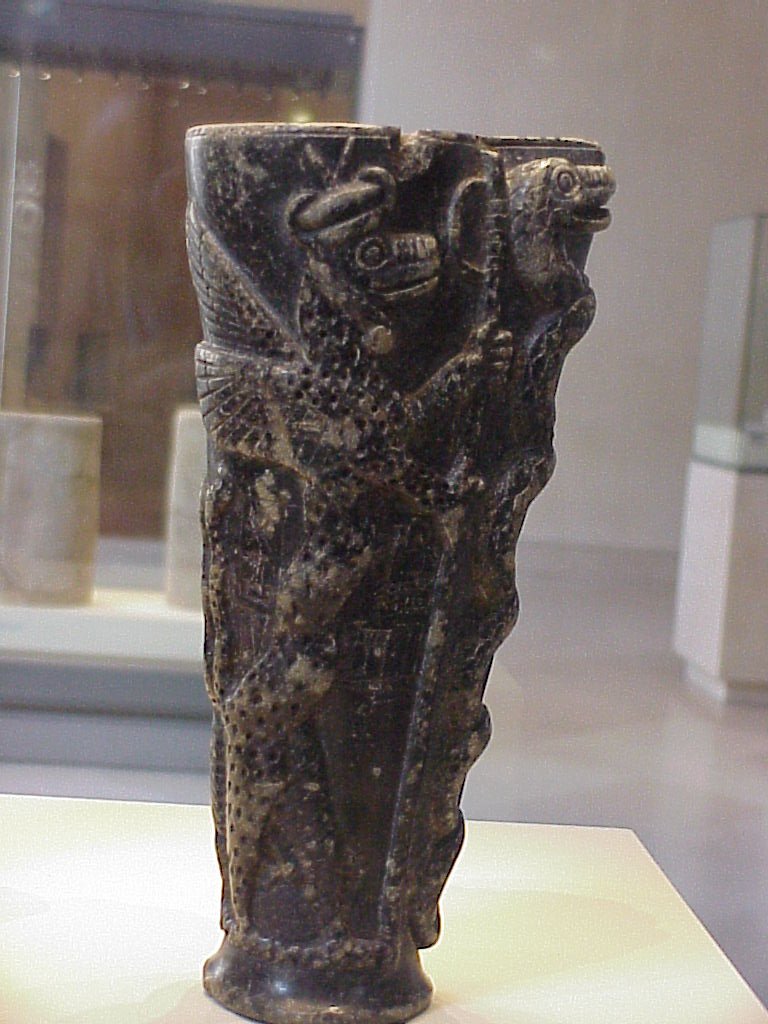
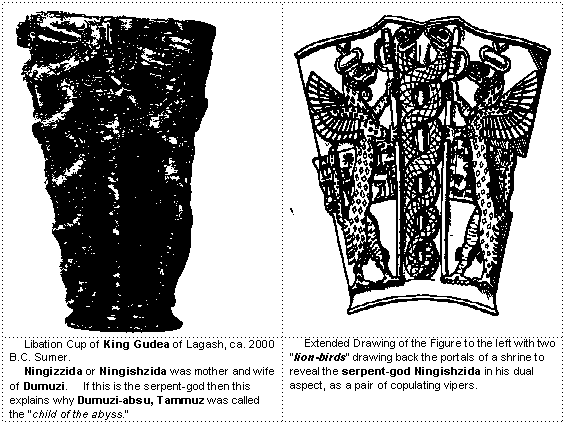
Again from The Mythic Image, page 282-283 the figures below show "an ornamental Sumerian ritual cup of the same period as the Indus Valley seal regarding a deity with worshipers and serpents. Two composite beasts of a type called "lion-birds" draw back the portals of a sanctuary, where an apparition appears of the great Mesopotamian serpent-god Ningishzida, under the aspect of a pair of copulating vipers. The two are entwined about an axial rod in such a way as to suggest both the caduceus of classical Hermes, guide of souls to rebirth in eternal life, and the Indian diagram of seven spinal centers touched and wakened to consciousness in Kundalini yoga by the rising Serpent Power."
Walter did not realize that even though my website is also theoretical as a slant on what may have happened in the past. I am not about proving that theory, but actually about promoting Christianity. I believe that there is a God (Jehovah God), the one in Genesis Two, that is above all the other gods, the Elohim mentioned in Genesis One, and the site is about making people take a second look at their Bible. Jehovah (LORD) God sent an Angel (or divine entity) to Moses, who informed him of what had happened during 17,000 years, which he orally translated to mankind. It is not hard to imagine how that tradition could have been mistranslated after the Flood and even after the Tower of Babel incident.
I also believe in Jesus Christ, as our Savior, whom will return and throw that serpent dragon in the abyss, and take those who believe in Him back to that Paradise that was lost. I hope that I will see all of you there when it comes.
I do thank Walter for providing me with more information on Ningishzida, it is a subject with very little information to research. And as you see in the above theory I might be in error, but then I might be right that it has dual aspects of male-female concepts.
Walter's site seems to be totally in the direction of disproving everything that the Bible stands for and promoting assumptions, and theory from the slant of Sumerian mythological Soap Operas, which could have been distorted greatly over many centuries as the albeit beginning of it all. Neither of us have one valid peice of information that could prove either theory. If so, we would be on CNN tomorrow stating what we found.
This little adventure into the ancient past, hopefully will be figured out someday.
Below are some of the highlights of Walter Mattfeld's, website at www.bibleorigins.net regarding Ningishzida.
Ningishzida appears on a cylinder seal of Gudaea of Lagash, in two forms, on all fours as a serpent-dragon or Mushussu, and again in human form as male god, bearded, with Mushussu serpent dragon heads erupting from his
shoulders. He also appears again in a bas-relief with Gudaea with serpent heads erupting from his shoulders, before him is probably Tammuz. Tammuz (Dumuzzi or Damu) is a "form" of Ningishzida, rather than the son of Ningishzida.
As seen at this site: http://www.bibleorigins.net/Serpentningishzida.html shows the following image from a cylinder seal of Gudaea dated to 2100 BCE, which is found on pg. 57 of an illustration from the work of C. Leonard Wooley, Vor 5000 Jahren. Ausgrabungen von UR. Stuttgart. Franckh'sche Verlagshandlung. 1928.
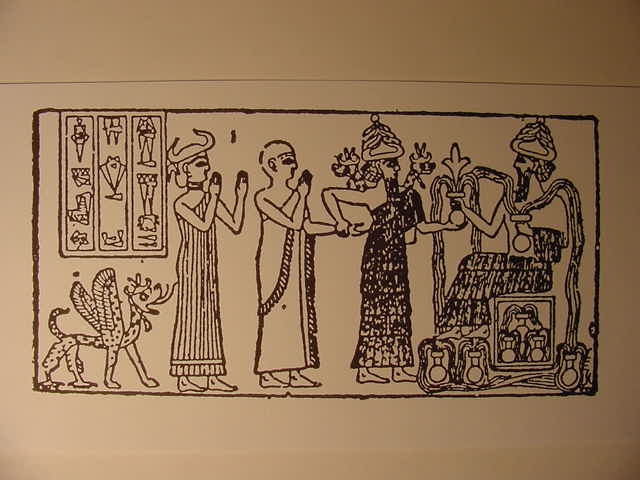
In the above illustration Nin-gish-zida is shown in the lower left in animal form as a winged and two-horned walking "serpent-dragon."
The figure in the middle is King Gudaea of Lagash, Sumeria, a human petitioner being presented, by the next figure which is Nin-gish-zida again appearing in human form as a god (denoted by the horned headdress) with "serpent-dragon" heads arising from his shoulders, to a seated god on the right (possibly Enki holding a vase of flowing waters on a throne of flowing waters). Enki was the Sumerian god of Wisdom and Knowledge, with a temple at Eridu and possibly associated with the island called Dilmun.
On his next page at: http://www.bibleorigins.net/Ningishzidabasrelief.html we see the image from fig.189. Anton Moortgat. Die Kunst des Alten Mesopotamien, Die klassische Kunst Vorderasiens. Darmstadt. Wissenschaftliche Buchgesellschaft. 1967 Verlag M.DuMont Schauberg. Koln.
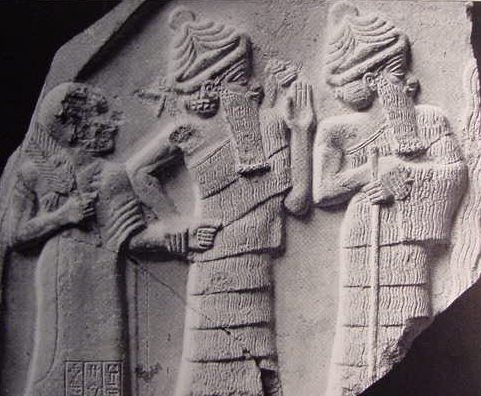
Gudaea of Lagash, seen above on the left, is grasped by his patron-god Ningishzida in human form, who has horned Mushussu dragons erupting from his shoulders. Before him is perhaps Tammuz (?), they are approaching perhaps Enki who dispenses freshwaters to sustain earthly life (note stream of water at right).
At this next site: http://www.bibleorigins.net/cherubim.html it presents a line drawing from a stone libation vase from the previous bas relief of King Gudaea of Lagash, Sumer, ca. 2100 BCE, which came from cf. p.285, figure 88. Stephen H. Langdon. The Mythology of All Races, Semitic. Vol.5. Boston. Marshall Jones & Co., 1931.
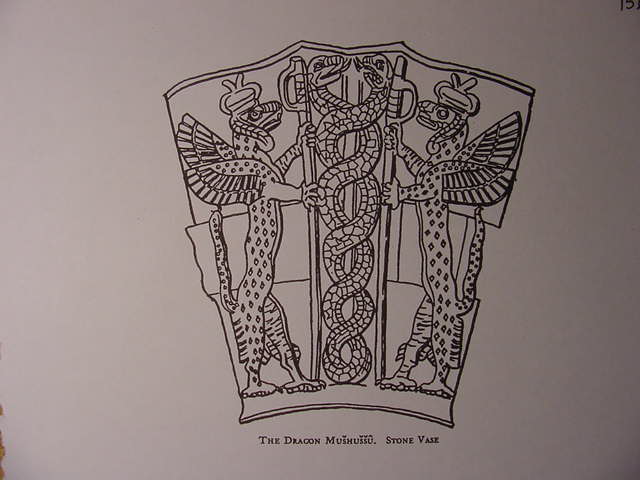
Nin-gish-zida, the Sumerian Serpent-Dragon of Heaven, who offered man (Adapa, priest of Enki [the God of Wisdom and Knowledge]) the food and drink that would have bestowed immortality. Langdon alternately calls Ningishzida a "Mushussu" dragon (p. 284).
The following link http://www.bibleorigins.net/ningishzida.html has the following information about Ningishzida.
"Now the Serpent. Genesis portrays the serpent as possessing two rather amazing characteristics, it has the ability to walk on legs, and it can carry on a conversation with humans. This serpent is also portrayed as dwelling in an earthly paradise with God, Adam and Eve. My research has concluded that the Sumerian Dragon-Serpent called 'Nin-Gish-Zida' is what lies behind the Genesis Myth.
Although Anu allows Adapa to become immortal, it is his servant, Nin-Gish-Zida, who actually put in a good word on Adapa's behalf, and who is instructed to actually present the food and drink to Adapa. Ningishzida was a guard at the heavenly gate with Tammuz (both had in earlier myths, been dwellers of the underworld, who achieved a resurrection to heaven). Some myths call Tammuz, 'Damu, the child Ningishzida,' so both gods are aspects of each other. No humans got to Anu's presence without first having Tammuz/Ningishzida take them by the hand and present them, putting in a good word for them.
Ningishzida was not only an alternate form of Tammuz, he was also called 'The Great Serpent-Dragon of Heaven," being identified with the star constellation Hydra (Hydra being a creature with multiple serpent heads). He was alternately associated with the winged and horned serpent dragon called 'Mushussu.' Mushussu apears standing on hind legs, holding a staff (or a gate ?) in his forepaws (Langdon p.285, fig. 88). A cylinder seal of Gudaea of Lagash, shows Ningishzida in human form, taking Gudaea by the hand and presenting him as a petitioner before the god, Enki (the source of the 'waters of life'). Arising from Ningishzida's human shoulders are two horned dragon heads. Behind Gudaea, on the same seal, we see Ningishzida in animal form as a horned, winged, serpent-dragon, walking on all four legs.
Ningishzida, however, is not the only serpent behind the Genesis narrative, another serpent also lurks, the serpent who deprived man of 'long life' in the Epic of Gilgamesh. Gilgamesh searches the world for the Land of Dilmun in which dwells the ONLY humans to obtain immortality, the survivors of the Great Flood which the gods sent to destroy the world and mankind (Utnapistim, wife and Pilot). He fails to attain immortality, but is given a consolation prize, a magical plant, which if consumed will lengthen one's life. While bathing in a pool, enroute to his home (Uruk in southern Mesopotamia), a serpent appears and consumes the plant. As the serpent slithers away it sheds its skin, it has rejuvenated its life, because of the plant. Gilgamesh bemoans his fate, all his effort has come to nought. So, apparently TWO SERPENTS are behind Genesis' serpent, Nin-gish-zida of the Adapa myth and the serpent of the Gilgamesh myth.
I conclude that Christianity's later imagery of Satan as the Serpent in the garden of Eden, is a reflex of some sort of Ningishizida, who had the power to take on human form (in human form he wears a multiple horned turban, a sign he is a god, and is beared, with robe), as well as that as the Mighty-Serpent-Dragon of Heaven and of the Underworld. In the Underworld he was called the bearer of the Throne, and 'binder' of those who do evil. Langdon understands he was originally a vegetation deity, and calls him a 'Tree-god' (p.90, Langdon)."
To return to Hydra Constellation Names.