From The Alpha and the Omega - Volume III
by Jim A. Cornwell, Copyright © July 20, 2002, all rights reserved
"Volume III - The Fifth Month - Constellation Names for Hydra"
In the Fifth Month - Leo.
Hydra, the Water-Snake (The Sea Serpent).
The constellation name for Hydra:
- Hydra, The Sea Serpent, is on the Meridian on April 20, and is the largest and longest constellation in the sky, stretching across a third of the heavenly skies with its head beneath the feet of the lion. (note: actually Hydra's head is below Cancer.)
- Hydra takes more than six hours for the whole constellation to rise.
- Even though Hydra was associated with a male figure in Greco-Roman mythology it is sometimes called the Female Water Snake, because its Latin name is feminine so to distinguish it from Hydrus (sometimes called the Male Water Snake).
- Greek Mythology Hydra was the many-headed monster that was slain by Hercules. Also called Snake is a persistent or multifaceted problem that cannot be eradicated by a single effort [Middle English Idra, from Latin Hydra, from Greek Hudra, Hydra, a water serpent].
- The great monster Hydra dwelt in the Lernaean Lake--a picture of the corruption and vileness of this world.
- The following is also found in Cetus, under the subject of Sea Monsters as:
- Lamentations of Jeremiah 4:3 "Even the sea monsters [note that whales are mammalian] draw out the breast, they give suck to their young ones: the daughter of my people is become cruel, like the ostriches in the wilderness."
- Sumerian kúšu: turtle (cf., ŠIM×KÚŠU, where 'whale' must be meant) (ku6, 'fish', + šú, 'to cover').
- Sumerian ušumgal: lord of all, sovereign; solitary; monster of composite powers, dragon (ušum, 'dragon', + gal, 'great').
- Sumerian ušum, ušu: n., dragon, composite creature (uš11, 'snake venom', + am, 'wild ox'), adj., solitary, alone.
- Sumerian si-šuš-nu: a sea creature ('antennae' + 'to sit down' + 'do not').
Leviathan, Dragon, Serpent and Behemoth
- Leviathan which is something strong and unusually large of its kind, especially a ship or a very large animal, especially a whale. Biblically it was a monstrous sea creature mentioned in the Old Testament [Middle English, huge biblical sea creature, from Late Latin, from Hebrew liwyatan Canaanite ltn, Lotan, the Hydra] was the many-headed monster that was slain by Hercules. It lived in Lake Lerna in Argolis. The NIV footnote suggest it as a hippopotamus or elephant, neither of which would be pulled in by a fishhook (as in the sickle of Leo).
- Gnostic View:
- The Ophitic cult of Gnostics places the seven spheres of Archons within a vast, encircling serpent called Leviathan.
- The Mandean or Mandaean [form of Aramaic, Mandean mandaya, having knowledge, from manda, knowledge] a Gnostic sect originating in Jordan and still existing in Iraq, called this serpent Ur and regarded him as father of the Archons.
- Leviathan is linked to Tiamat of Mesopotamia and the Ophis serpent of the Egyptians.
- Biblical View:
- Leviathan.
- Hebrew livyathan, liv-yaw-thawn', from Heb. lavah, law-vaw', to twine, thus a wreathed animal, i.e. a serpent (especially the crocodile or some other large sea-monster); fig. the constellation of the dragon (i.e. Draco); also as a symbol of Bab; leviathan, mourning. Of interest here is when Draco reaches the constellation of Virgo it ends its cycle through the procession of the zodiac.
- Dragon.
- Hebrew tanniyn, tan-neen', or (Ezek. 29:3) tanniym, tan-neem', intens. from the same as Heb. tan, from an unused root probably to elongate, a monster, thus a marine or land monster, i.e. sea-serpent or jackal:- dragon, sea-monster, serpent, whale. Seen originally in Gen. 1:21 as "whales."
- This is the connection between Leviathan and Cetus.
- Sumerian ušum, ušu: n., dragon, composite creature (uš11, 'snake venom', + am, 'wild ox'), adj., solitary, alone.
- Biblical References to Leviathan and Dragon:
- Job 41:1 Canst thou draw out leviathan [Lit., the twisted animal, gathering itself in folds: a synonym to the Thannin (Job 40:15, Psa. 74:14, type of Egyptian tyrants, Psa. 104:26, Isa. 27:1; the Babylon tyrant). This description applies to all cetacean, serpentine, and saurian monsters (Isa. 40:13), especially the crocodile, the river horse, both found in the Nile.] with an hook? or his tongue with a cord which thou lettest down [the crocodile has no tongue.]? 41:2 Canst thou put an hook [rather, a rope of rushes.] into his nose? or bore his jaw through with a thorn [rather, a ring or hook.]?
- Psalms 74:12 For God is my King of old [lit., And in an adversative sense], working salvation in the midst of the earth [74:13-15 are examples of salvation.]. 74:13 Thou didst divide the sea [i.e. Red or Reed Sea] by thy strength: thou brakest the heads of the dragons in the waters [Pharaoh and his host]. 74:14 Thou brakest the heads of leviathan [the world is a collective; and so used for many. This crushing the heads of Leviathan immediately follows a reference to the destruction of monsters of the sea. Notice the use of heads as Hydra was the many-headed monster.] in pieces, and gavest him to be meat to the people inhabiting the wilderness [i.e., wild beasts, as conies (Prov. 30, 25-26) are called a people. Others believe literally sea monsters were thrown out on dry land as food for the wandering Arabs.].
- Psalms 104:25 So is this great and wide sea, wherein are things creeping innumerable, both small and great beasts. 104:26 There go the ships: there is that leviathan, whom thou hast made to play therein. [Comment: The sea is man's activity in commerce, and home of countless multitude of creatures, also displays Divine power and benevolence. The mention of leviathan (Job 40:15) heightens the estimate of the sea's greatness, and of His power who gives such a place for sport to one of His creatures. This verse refers to its frolicking in the sea, and is probably a sperm whale.]
- Isaiah 27:1 In that day the LORD with his sore [rather, hard, well-tempered] and great and strong sword shall punish leviathan the piercing [rigid] serpent, even leviathan [lit., in Arabic, the twisted animal, applicable to every great tenant of the waters, sea serpents, crocodiles, etc. Also Satan or hostile potentates to Israel.] that crooked [winding] serpent; and he shall slay the dragon [Heb. tenin, the crocodile] that is in the sea [the Euphrates, or the expansion of it near Babylon].
- Isaiah 27:2 "In that day sing ye unto her, A vineyard of red wine." [This means in the day that Leviathan is destroyed, the vineyard (Church of God) purged of it's blemishes, shall be lovely in God's eyes.].
- Serpent (see snake) or suborder Ophidia in the Bible has always been a crafty and very dangerous creature, albeit a persuasive one. It was a symbol of evil (Gen. 3), but God was able to pierce it (Job 26:13) "By his spirit he hath garnished the heavens; his hand hath formed the crooked serpent." Paul referred to the cunning of the serpent (2 Cor. 11:3).
- Under Leo we find the following:
- One of the twelve simple Hebrew Letters is Teth (KJV Teth, also Teyth, tayth, Ps 119:65), the English letter is t which has a numerical value equal to 9, and an esoteric meaning of "Serpent," or "Snake."
- Serpent.
- Hebrew nachash, naw-khawsh', from Heb. nachash, naw-khash', a primary root properly to hiss, thus a snake (from its hiss), serpent.
- Hebrew saraph, saw-rawf', from Heb. saraph, saw-raf', a primary root to be on fire, thus burning, poisonous (serpent), spec. a saraph or symbolic creature (from their copper color), fiery (serpent), seraph.
- Greek ophis, of'-is, through the idea of sharpness of vision, a snake, Satan, serpent.
- Under Sagittarius in the constellation of Draco, the Dragon, one of the star names d Nodus II sometimes, "second knot," or Altais
which is Arabic for "serpent."
Sumero-Akkadian Tsir-gal, Great Snake.
Babylonian-Assyrian Tsiru-gallu, Great Snake.
Phoenician Nakhasch-maim, the Snake or Great Snake.
Associated with Tiamat.
Sumerian MUSH, "The Snake," Hydra.
- One source claims that the MUSH-SUR, of Mushur (Egypt), as the word-sign for "Egypt" in the form of Mush-ur or Mush-Sir, written by two signs of the great Serpent (Mush or Sir) and an Insect (Mush or Sur).
- From www.lexiline.com, "The Snake (MUSH), d.NIN.GISH.ZI.DA, lord of the underworld. Hydra. Sumerian MUSH equals 'something coiled.' Sumerian d.NIN.GISH.ZI.DA, 'biter of Anu'." "The star behind them, as d.Ea (and) rises as d.Ea sets: the swarm (NU.MUSH.DA), d.Adad."
- Sumerian muš: n., snake; reptile. adj., bitter.
- Sumerian muš2,3: n., diadem; a city's irrigated, cultivated territory; face, appearance, aspect. v., to glisten, shine.
- Sumerian muš4: a biting insect.
- Sumerian šúr, súr: n., fierceness. v., to be enraged (against someone: -da-). adj., fierce; furious.
- Sumerian šur, sur: to rain; to produce a liquid; to flow, drip; to extract seed oil; to process wine and juices; to flash, gleam.
Hydra was a great serpent, which in this is symbolic of Christ who was bruised by the serpent, but who will come again and destroy the head of the serpent, the seed of the serpent. Note: That Hydra's head is beneath Cancer in front of Leo, which is the point in time where Adam and Eve were in the Garden of Eden in Genesis 3.
- Genesis 3:14 "And the LORD God said unto the serpent, Because thou hast done this, thou art cursed above all cattle, and above every beast of the field; upon thy belly shalt thou go, and dust shalt thou eat all the days of thy life:"
- 3:15 "And I will put enmity between thee and the woman, and between thy seed and her seed; it shall bruise thy head, and thou shalt bruise his heel."
- 3:16 "Unto the woman he said, I will greatly multiply thy sorrow and thy conception; in sorrow thou shalt bring forth children; and thy desire shall be to thy husband, and he shall rule over thee."
Lucifer the archangel cast from heaven for leading the revolt of the angels; Satan.
- The planet Venus in its appearance as the morning star.
- Middle English, from Old English, morning star, Lucifer, from Late Latin Lucifer, from Latin, morning star, light-bringer: lux, luc-, light.
Satan in Theology the profoundly evil adversary of God and humanity, often identified with the leader of the fallen angels; the Devil.
- Middle English, from Old English, from Late Latin Satan, from Greek Satanas, Satan, from Hebrew satan, devil, adversary, from satan, to accuse.
- As seen above Lucifer (meaning "light-bearer"), the angel of light and the most glorious of God's creations, was cast down and became Satan, the Prince of Darkness, because of the sin and pride. Christ came into the world in order to destroy the works of Satan, and to end all of His acts.
- Also Satan is about to fall into the clutches (the claws) of the Lion and to be destroyed beneath the feet of Leo, Lion.
- Hebrew satan, saw-tawn', to attack, (fig.) accuse, adversary, thus an opponent, the arch-enemy of good.
- Greek Satanas, sat-an-as', of Chaldean origin corresponding to Gr. Satan, sat-an', of Heb. origin, i.e. the devil, an adversary the chief of the fallen spirits, the grand adversary of God and man. Satan in the Garden of Eden had cast his slime across the path of the history of man, deceiving and destroying mankind, and bringing all the world into subjection to his vile will. He was at the center of all things: the Prince of this earth, the Prince of the power of the air.
- Satan is a personality with many names: "an accuser"; the devil.
- Greek diabolos, the slanderer; "Abaddon" or "Apollyon"; "Accuser of our brothers"; "enemy," Greek antidikos; "Beelzebub"; "Belial"; "the one who leads the whole world astray"; "the evil one"; "the father of lies"; "the god of this age"; "a murderer"; "that ancient serpent"; "the prince of this world"; "the ruler of the kingdom of the air" (Eph 2:2); and "the tempter."
- Satan is not omnipresent, but through his subordinates he makes his influence practically world-wide. He also exercises domination over the world of lost humanity. He is "the prince of this world," with an evil world system that that he has organized on his own principles. The power over people he holds is by virtue of usurpation.
- His agelong struggle against God is to defeat God's divine plans of grace toward mankind as he who "leads the whole world astray" (Rev. 12:9). Often he transforms himself into "an angel of light" by presenting his apostles of falsehood as messengers of truth (2 Cor. 11:13-15).
- Satan was judged at the Cross (John 13:31-33), he is still permitted to carry on the conflict, but now his revealed doom is sure.
Behemoth.
- Hebrew behemowth, be-hay-mohth', in form a plural of Heb. behemah, be-hay-maw', type of beast, but really a singular of Egyptian derivation, thus water-ox, i.e. the hippopotamus or Nile-horse: - Behemoth.
- Job 40:15 "Behold now behemoth, which I made with thee; he eateth grass as an ox."
- "Behemoth seems to be the Egyptian Pehemout, water ox, Hebraized, so called as being like an ox, whence the Italian bombarino."
Egyptian/Coptic:
- On the Denderah Zodiac the Serpent under Leo is Hydra and is also known as Knem, who conquers or is conquered. This is that old serpent destroyed.
- In "Gospel of the Stars," by Joseph Seiss, page 136, he claims "In Denderah sphere the Lion stands directly on the Serpent, whilst underneath is the hieroglyphic name Knem, which means vanquished, conquered."
- In "The Witness of the Stars," by E.W. Bullinger, page 163-164 "The hieroglyphics read Knem, and are placed underneath. Knem means who conquers, or is conquered, referring to the victory over the serpent."
- The name Hydra according to Rolleston means, "He Is the Abhorred."
- In "Gospel of the Stars," by Joseph Seiss, page 136 "Hydra, the Abhorred."
- In "The Witness of the Stars," by E.W. Bullinger, page 166-167 "It (Hydra) is pictured as the female serpent, the mother and author of all evil. Hydra has the significant meaning, he is abhorred!"
- In "The Witness of the Stars," by E.W. Bullinger, page 167 "Al Drian, the abhorred."
- Rolleston claims "Al Drian, the abhorred (Isa. 66:24)."
- Abhorring.
- Hebrew dera'own, der-aw-one' or dera'own, day-raw-one', from an unused root (meaning to repulse) an object of aversion, abhorring contempt.
- Also see Hebrew ta'ab, taw-ab'.
- One source claims, "To understand the spirit nature of the serpent under the lion's feet we have to look back to the place where the adolescent child was released from its mother's bondage." See notes in Orion. "... when the serpent has no more folds. In other words, the mysteries of the journey have all been unwound."
- In "The Witness of the Stars," by E.W. Bullinger, page 163-164 "The Denderah picture exhibits all four in one. The Lion is presented treading down the Serpent. The Bird of prey is also perched upon it, while below is a plumed female figure holding out two cups, answering to Crater, the cup of wrath."
- In his work “BABYLONIAN STAR-LORE: An Illustrated Guide to the Star-lore and Constellations of Ancient Babylonia,” by Gavin White gives this image of Hydra which is seen on page 41 shown here as
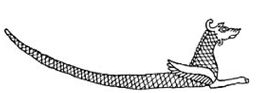
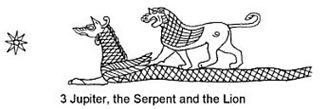 and comments, "The Serpent is one of the primary symbols of death and the underworld. Like its Greek counterpart, the Hydra, the Babylonian serpent was set in the heavens to guard an entrance to the underworld. This entrance was used by Dumuzi on his way to the underworld and it would be the most logical route used by the ancestral ghosts when they returned to earth for the great ancestral festival celebrated in the late summer. In Babylonian tradition the Serpent was held sacred to Nigishzida, the 'Lord of the Underworld' and when Death itself was envisioned it was thought to have the face of a serpent. The malign nature of the Serpent constellation is all too apparent in astrology omens where its appearance predicts famine, plague and pestilence.
I would argue that the Serpent performs a secondary role as a symbol of the summertime drought. The clearest expression of this function can be found in Greek myth where the (the 'water-serpent') was thought to withhold the underground waters thereby causing springs to dry up and river levels to fall.."
As you can see for yourself the image for Hydra above has some correlation with the Round Denderah image  and the Square Denderah image
 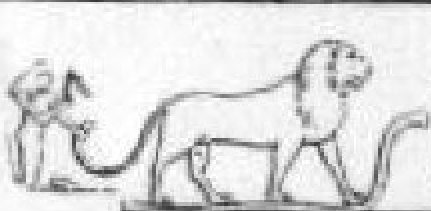 and the hieroglyphic image
 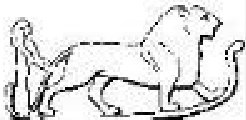 .
.
Other names for Hydra: Al sugahh' (Chilmead), As'ina, Asi'ua, Asui'a, Al Shuja, El Havic, Al Hay'yah, Min al A'zal (stars in the head), Pherd, Al Sharasif (stars), Sextans (the Egyptian Argo Navis), the sextant.
- From "Star Names" by Richard H. Allen:
In Low Latin it has been Hidra, Idra, and Ydra; and, in the Almagest of 1551, Hydrus in the masculine, which, correct enough before Bayer's day, would now confound it with the new southern figure (Hydrus). Riccioli, and Hyde in his translation of Ulug Beg's catalogue, had it thus, showing its continuance till then as a common title, although often written Idrus and Idrus aquaticus, as well as changed to Serpens aquaticus.
Other names, also used for the northern Dragon (Draco), have been Draco, Asiua, and Asuia, or Asvia. Chilmead wrote it Alsugahh. Still another conception and title may be seen in the Arabo-Latin Almagest's Stellatio Ydre: et est species serpentium; et jam nominatur Asiua.
Coluber, the Snake, and Echidna, the Viper, also obtain for Hydra, with the adjectives Furiosus, Magnanimus, and Sublimatus, here used as proper nouns, as they were for Orion. The Arabians similarly called it Al Hayyah, another of their words for a snake, — El Havic in Riccioli's New Almagest.
Bayer cited from Turkish maps Etanin, and from others Aben, Taben, and Etabin; Riccioli, Abeen vet Taeben; Postellus, Daban; Chilmead, Alanin; and Schickard, Attanmo. Al Shuja', the Snake, also was applied to Draco by the Arabians, as it was to Hydra; and Al Hayyah, the Snake, appeared for it, though more common for our Serpens, with which word it was synonymous.
Here, too, was the 7th nakshatra, Aclesha, or Acresha (Ashlesha, ninth nakshatra or Moon Mansion), the Embracer, figured as a Wheel, with Sarpas, the Serpents, as presiding divinities; epsilon marking the junction with the nakshatra Magha.
Hydra is supposed to be the snake shown on a uranographic stone from the Euphrates, of 1200 B.C., "identified with the source of the fountains of the great deep," and one of the several sky symbols of the great dragon Tiamat. Certain stars near, or perhaps in the tip of Hydra's tail and in Libra, seem to have been the Akkadian En-te-na-mas-luv, or En-te-na-mas-mur, the Assyrian Etsen-tsiri, the Tail-tip.
Theon said that the Egyptians considered it the sky representative of the Nile, and gave it their name for that river.
Al Sufi mentioned an early Arab figure, Al H'ail, the Horse, formed from stars some of which now belong to our Hydra, but more to Leo and Sextans.
See Star Names of Hydra.
This file was updated on July 15, 2008, and March 30, 2010.
Return to the Table of Contents or the Zodiac of Denderah