From The Alpha and the Omega - Volume III
by Jim A. Cornwell, Copyright © July 20, 2002, all rights reserved
"Volume III - Göbekli Tepe Temple 9,500 B.C."
Go to the bottom of this page
Göbekli Tepe Temple 9,500 B.C.
The following articles are about a structure, which is found in a time frame, that would have been built long before conservative Biblical dating of creation occurred, and even when Adam and Eve would have experienced the Fall and eviction from Eden, dated by most in 4,000 B.C., but in my work pushed to 8,000 B.C. Long before the Deluge and Tower of Babel and the confounding of language. This temple was buried under a hill of dirt before any of this occurred. So, who was this advanced civilization?
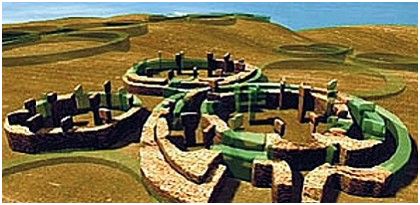
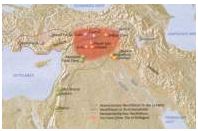
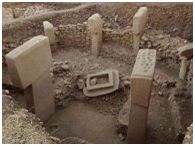
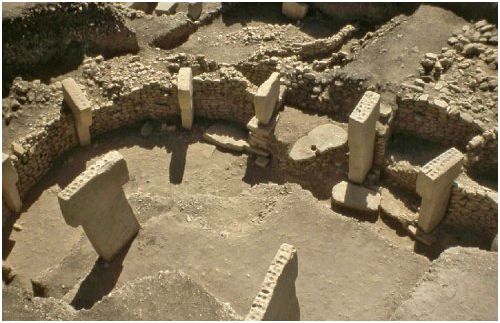
The above image is a reconstruction of the site, located in the Urfa region of turkey.
March 1, 2010 - History in the Remaking - A Temple Complex In Turkey That Predates Even The Pyramids Is Rewriting The Story Of Human Evolution by Patrick Symmes, Newsweek.
In 10,000 B.C. Neolithic revolution begins - 9,500 B.C. Göbekli Tepe, Turkey world's oldest temple compared to what we found in the early 3,000 B.C. with the White Temple, Iraq erected mankind's first city, Uruk (Erech), Mesopotamia and Stonehenge, England, one of Europe's first monuments, then below 3,000 B.C. was Pharaoh Djoser's Step Pyramid, Egypt, the countries oldest.
They call it Potbelly Hill, after the soft, round contour of this final lookout in southeastern Turkey. To the north are forested mountains. East of the hill lies the biblical plain of Harran, and to the south is the Syrian border, visible 20 miles away, pointing toward the ancient lands of Mesoptamia and the Fertile Cresent, the region that gave rise to human civilization. And under our feet, according to archeologist Klaus Schmidt are the stones that mark the spot -- the exact spot -- where humans began the ascent.
Standing on the hill at dawn, overseeing a team of 40 Kurdish diggers, the German-born archeologist waves a hand over his discovery here, a revolution in the story of human origins. Schmidt has uncovered a vast and beautiful temple complex, a structure so ancient that it may be the first thing human beings ever built. The site isn't just old, it redefines old: the temple was built 11,500 years ago -- a staggering 7,000 years before the Great Pyramid, and more than 6,000 years before Stonehenge first took shape. The ruins are so early that they predate villages, pottery, domesticated animals, and even agriculture -- the first embers of civilization. In fact, Schmidt thinks the temple itself, built after the end of the last Ice Age by hunter-gatherers, became the ember -- the spark that launched mankind toward farming, urban life, and all that followed.
Göbekli Tepe (pronounced Go-beckly Tepp-ay) -- the name in Turkish for "potbelly hill" -- lays art and religion squarely at the start of that journey. After a dozen years of patient work, Schmidt has uncovered what he thinks is definite proof that a huge ceremonial site flourished here, a "Rome of the Ice Age," as he puts it, where hunter-gatherers met to build a complex religious community. Across the hill, he has found carved and polished circles of stone, with terazzo flooring and double benches. All the circles feature massive T-shaped pillars that evoke the monoliths of Easter Island.
Though not as large as Stonehenge -- the biggest circle is 30 yards across, the tallest illars 17 feet high -- the ruins are astonishing in number. Last year Schmidt found his third and fourth examples of the temples. Ground-penetrating radar indicates that another 15 to 20 such monumental ruins lie under the surface. Schmidt's German-Turkish team has also uncovered some 50 of the huge pillars, including two found in the most recent dig season that are not just the biggest yet, but, according to carbon dating, are the oldest monumental artworks in the world.
The new discoveries are finally beginning to reshape the slow-moving consensus of archeology. Göbekli Tepe is "unbelievably big and amazing, at a ridiculously early date," according to Ian Hodder, director of Stanford's archeology program. Enthusing over the "huge great stones and fantastic, highly refined art at Gobekli, Hodder - who has spent decades on rival Neolithic sites -- says: "Many people think that it changes everything...It overturns the whole apple cart. All our theories were wrong."
schmidt's thesis is simple and bold: it was the urge to worship that brought mankind together in the very first urban conglomerations. the need to build and maintain this temple, he says, drove the builders to seek stable food sources, like grains and animals that could be domesticated, and then to settle down to guard their new way of life. The temple begat the city.
This theory reverses a standard chronology of human origins, in which primitive man went through a "Neolithic revolution" 10,000 to 12,000 years ago. In the old model, shepherds and farmers appeared first, and then created pottery, villages, cities, specialized labor, kings, writing, art, and -- somewhere on the way to the airplane -- organized religion. As far back as Jean-Jacques Rousseau, thinkers have argued that the social compact of cities came first, and only then the "high" religions with their great temples, a paradigm still taught in American high schools.
Religion now appears so early in civilized life -- earlier than civilized life, if Schmidt is correct -- that some think it may be less a product of culture than a cause of it, less a revelation than a genetic inheritance. The archeologist Jacques Cauvin once posited that "the beginning of the gods was the beginning of agriculture," and Gobekli may prove his case.
The builders of Göbekli Tepe could not write or leave other explantions of their work. Schmidt speculates that nomadic bands from hundreds of miles in every direction were already gathering here for rituals, feasting, and initiation rites before the first stones were cut. The religious purpose of the site is implicit in its size and location. "You don't move 10-ton stones for no reason," Schmidt observes. "Temples like to be on high sites," he adds, waving an arm over the stony, round hilltop. "Sanctuaries like to be away from the mundane world."
Unlike most discoveries from the ancient world, Göbekli Tepe was found intact, the stones upright, the order and artistry of the work plain even to the untrained eye. Most startling is the elaborate carving found on about half of the 50 pillars Schmidt has unearthed. There are a few abstract symbols, but the site is almost covered in graceful, naturalistic sculptures and bas-reliefs of the animals that were central to the imagination of hunter-gatherers. Wild boar and cattle are dipicted, along with totems of power and intelligence, like lions, foxes, and leopards. Many of the biggest pillars are carved with arms, including shoulders, elbows, and jointed fingers. The T shapes appear to be towering humanoids but have no faces, hinting at the worship of ancestors or humanlike deities. "In the Bible it talks about how God created man in his image," says John Hopkins archeologist Glenn Schwartz. Göbekli Tepe "is the first time you can see humans with that idea, that they resemble gods."
The temples thus offer unexpected proof that mankind emerged from the 140,000-year reign of hunter-gatherers with a ready vocabulary of spiritual imagery, and capable of huge logistical, economic, and political efforts. A Catholic born in Franconia, Germany, Schmidt wanders the site in a white turban, pointing out the evidence of that transition. "The people here invented agriculture. They were inventors of cultivated plants, of domestic architecture," he says.
Gobekli sits at the Fertile Cresent's northernmost tip, a productive borderland on the shoulder of forests and within sight of plains. The hill was ideally situated for ancient hunters. Wild gazelles still migrate past twice a year as they did 11 millennia ago, and birds fly overhead in long skeins. Genetic mapping shows that the first domestication of wheat was in the immediate area -- perhaps at a mountain visible in the distance -- a few centuries after Gobekli's founding. Animal husbandry also began near here -- the first domesticated pigs came from the surrounding area in about 8,000 B.C., and cattle were domesticated inTurkey before 6,500 B.C. Pottery followed. Those discoveries then flowed out to places like Catalhoyuk (Chapter Three - Eighth Day, Noah and the Oncoming Deluge copyright 1995 -- The Alpha and the Omega, Volume I -- by Jim A. Cornwell - Chapter Three page 161-163 - file updated 6/26/98, includes Catal Hoyuk and textiles found at Cayonu), the oldest-known Neolithic village, which is 300 miles to the west.
The artists of Göbekli Tepe depicted swarms of what Schmidt calls "scary, nasty" creatures: spiders, scorpions, snakes, triple-fanged monsters, and most common of all, carrion birds. The single largest carving shows a vulture poised over a headless human. Schmidt theorizes that human corpses were exposed here on the hilltop for consumption by birds -- what a Tibetan would call a sky burial. Sifting the tons of dirt removed from the site has produced very few human bones, however, perhaps because they were removed to distant homes for ancestor worship. Absence is the source of Schmidt's great theoretical claim. "There are no traces of daily life," he explains. "No fire pits. No trash heaps. There is no water here." Everything from food to flint had to be imported, so the site "was not a village," Schmidt says. Since the temples predate any known settlement anywhere, Schmidt concludes that man's first house was a house of worship: "First the temple, then the city," he insists.
Some archeologists, like Hodder, the Neolithic specialist, wonder if Schmidt has simply missed evidence of a village or if his dating of the site is too precise. But the real reason the ruins at Gobekli remain almost unknown, not yet incorporated in textbooks, is that the evidence is too strong, not too weak. "The problem with this discovery," as Schwartz of John Hopkins puts it, "is that it is unique." No other monumental sites from the era have been found. Before Gobekli, humans drew stick figures on cave walls, shaped clay into tiny dolls, and perhaps piled up small stones for shelter or worship. Even after Gobekli, there is little evidence of sophisticated building. Dating of ancient sites is highly contested, but Catal-hoyk is probably about 1,500 years younger than Gobekli, and features no carvings or grand constructions. The walls of Jericho, thought until now to be the oldest monumental construction by man, were probably started more than a thousand years after Gobekli. Huge temples did emerge again -- but the next example dates from 5,000 years later, in southern Iraq.
The site is such an outlier that an American archeologist who stumbled on it in the 1960s simply walked away, unable to interpret what he saw. On a hunch, Schmidt followed the American's notes to the hilltop 15 years ago, a day he still recalls with a huge grin. He saw carved flint everywhere, and recognized a Neolithic quarry on an adjacent hill, with unfinished slabs of limestone hinting at some monument buried nearby. "In one minute -- in one secod -- it was clear," the bearded, sun-browned archeologist recalls. He too considered walking away, he says, knowing that if he stayed, he would spend the rest of his life digging on the hill.
Now 55 and a staff member at the German Archeological Institute, Schmidt has joined a long line of his countrymen here, reaching back to Heinrich Schliemann, the discoverer of Troy. He has settled in, marrying a Turkish woman and making a home in a modest "dig house" in the narrow streets of old Urfa. Decades of work lie ahead.
Disputes are normal at the site -- the workers, Schmidt laments, are divided into three separate clans who feud constantly. So far Schmidt has uncovered less than 5 percent of the site, and he plans to leave some temples untouched so that future researchers can examine them with more sophisticated tools.
Whatever mysterious rituals were conducted in the temples, they ended abruptly before 8,000 B.C., when the entire site was buried, deliberately and all at once, Schmidt believes. The temples had been in decline for a thousand years -- later circles are less than half the size of the early ones, indicating a lack of resources or motivation among the worshipers. This "clear digression" followed by a sudden burial marks "the end of a very strange culture," Schmidt says. But it was also the birth of a new, settled civilization, humanity having now exchanged the hilltops of hunters for the valleys of farmers and shepherds. New ways of life demand new religious practices, Schmidt suggests, and "when you have new gods, you have to get rid of the old ones."
The following articles and images of Göbekli Tepe Temple excavations are from the three websites listed below.
- http://terraeantiqvae.blogia.com/2006/061203-gobekli-tepe-turquia-.-en-busca-del-paraiso-de-adan-y-eva.php
- http://sirlaugh.wordpress.com/2009/03/17/do-these-mysterious-stones-mark-the-site-of-the-garden-of-eden/ (Do these mysterious stones mark the site of the Garden of Eden?)
- http://noeticdigest.wordpress.com/2009/11/04/gobekli-tepe-11000-year-old-site/ , Which has a good video of all these images.
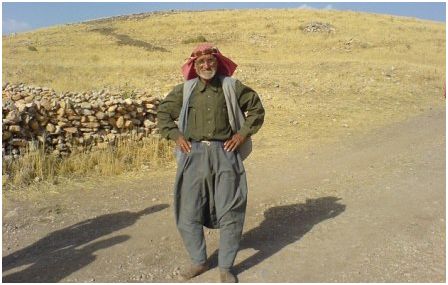
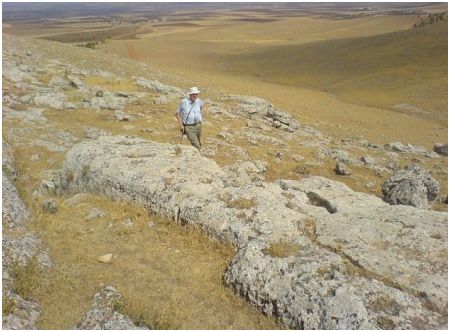
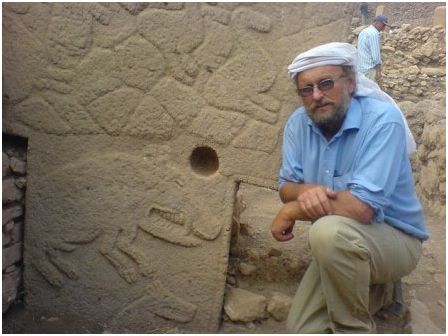
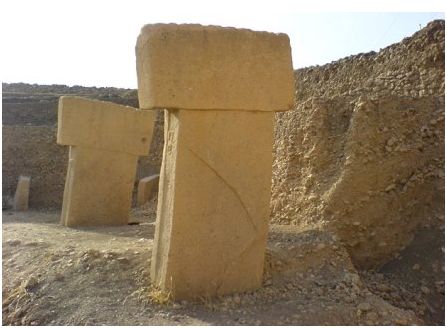
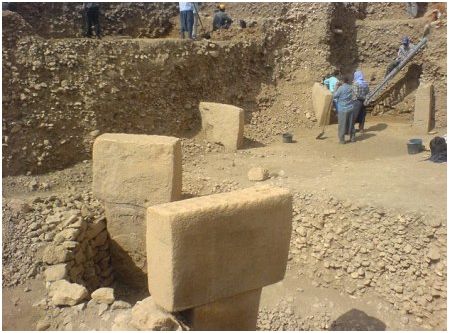
The shepherd who discovered the stones of Göbekli Tepe, which when unearthed turned out to be the flat tops of T-shaped megaliths. Archaeologist Klaus Schmidt poses next to some of the carvings at Gobekli.
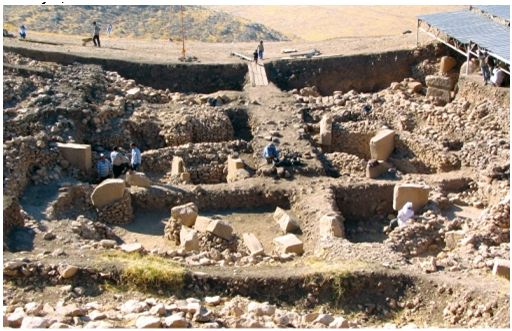
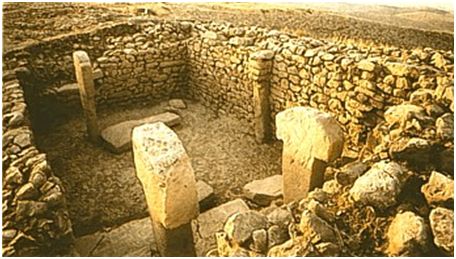
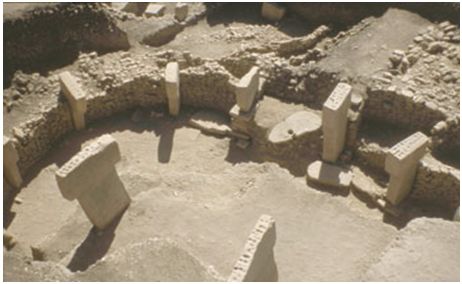
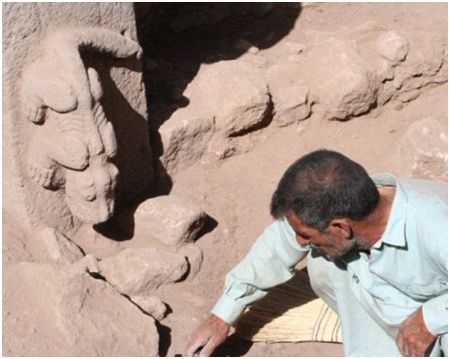
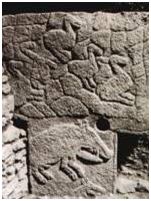
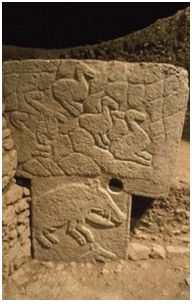
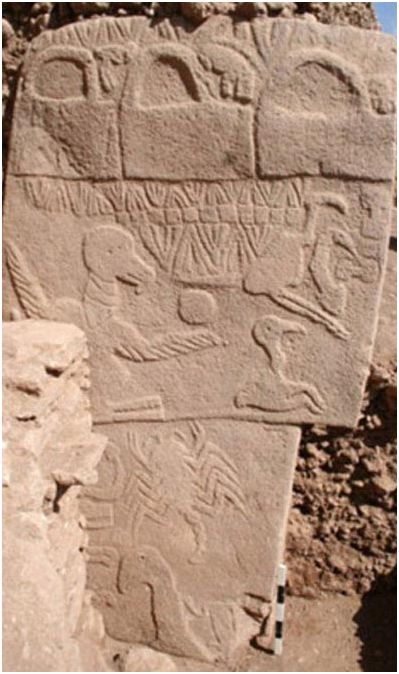
Remarkable find: Wild boar carved on one of the pillars. A frieze from Göbekli Tepe.
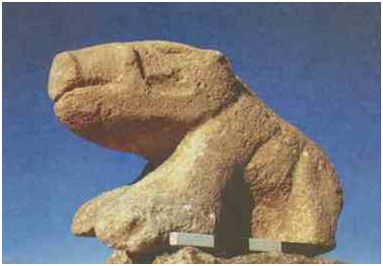
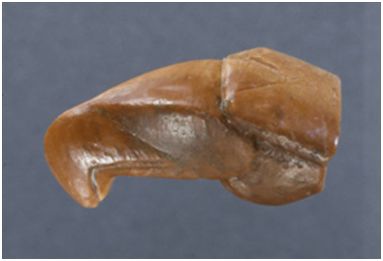
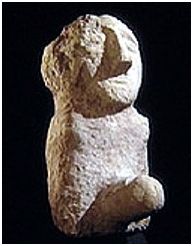
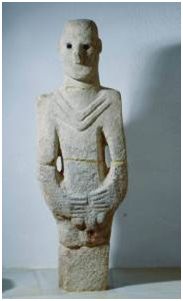
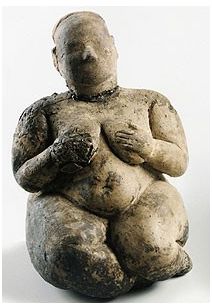
Only a few of human figures have been recovered so far. The man is the world’s oldest statue, the 13,500 year old, 2m tall Balikligöl Statue. The lady is a smaller figurine.
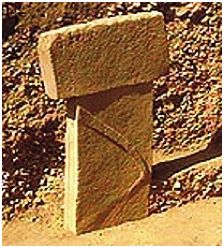
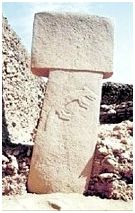
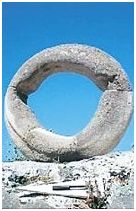
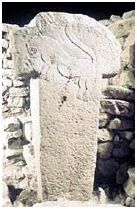
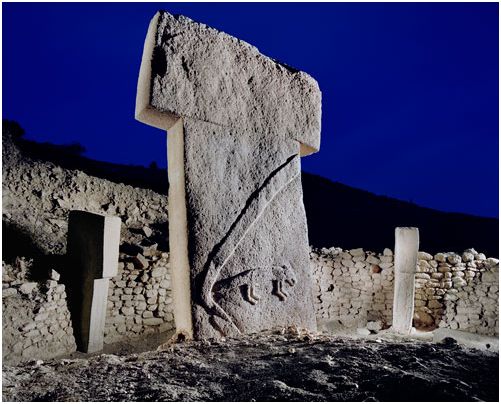
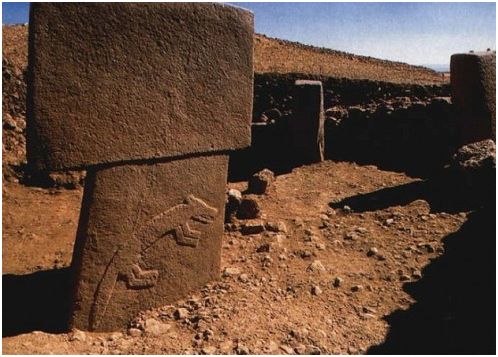
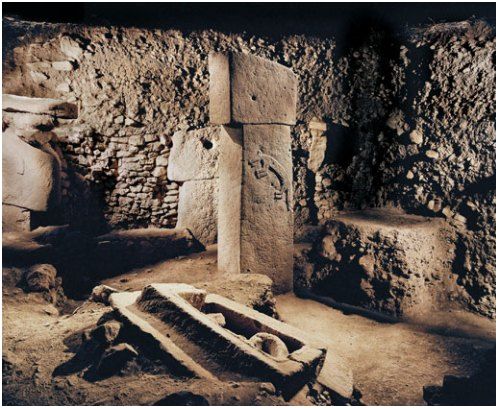 Six miles from Urfa, an ancient city in southeastern Turkey, Klaus Schmidt has made one of the most startling archaeological discoveries of our time: massive carved stones about 11,000 years old, crafted and arranged by prehistoric people who had not yet developed metal tools or even pottery. The megaliths predate Stonehenge by some 6,000 years. The place is called Göbekli Tepe, and Schmidt, a German archaeologist who has been working here more than a decade, is convinced it’s the site of the world’s oldest temple.
Göbekli Tepe was first examined—and dismissed—by University of Chicago and Istanbul University anthropologists in the 1960s. As part of a sweeping survey of the region, they visited the hill, saw some broken slabs of limestone and assumed the mound was nothing more than an abandoned medieval cemetery. In 1994, Schmidt was working on his own survey of prehistoric sites in the region. After reading a brief mention of the stone-littered hilltop in the University of Chicago researchers’ report, he decided to go there himself. From the moment he first saw it, he knew the place was extraordinary.
Unlike the stark plateaus nearby, Göbekli Tepe (the name means “belly hill” in Turkish) has a gently rounded top that rises 50 feet above the surrounding landscape. To Schmidt’s eye, the shape stood out. “Only man could have created something like this,” he says. “It was clear right away this was a gigantic Stone Age site.” The broken pieces of limestone that earlier surveyors had mistaken for gravestones suddenly took on a different meaning.
Schmidt returned a year later with five colleagues and they uncovered the first megaliths, a few buried so close to the surface they were scarred by plows. As the archaeologists dug deeper, they unearthed pillars arranged in circles. Schmidt’s team, however, found none of the telltale signs of a settlement: no cooking hearths, houses or trash pits, and none of the clay fertility figurines that litter nearby sites of about the same age. The archaeologists did find evidence of tool use, including stone hammers and blades. And because those artifacts closely resemble others from nearby sites previously carbon-dated to about 9000 B.C., Schmidt and co-workers estimate that Göbekli Tepe's stone structures are the same age. Limited carbon dating undertaken by Schmidt at the site confirms this assessment.
Today, Schmidt oversees a team of more than a dozen German archaeologists, 50 local laborers and a steady stream of enthusiastic students. He typically excavates at the site for two months in the spring and two in the fall. (Summer temperatures reach 115 degrees, too hot to dig; in the winter the area is deluged by rain.) In 1995, he bought a traditional Ottoman house with a courtyard in Urfa, a city of nearly a half-million people, to use as a base of operations.
The world’s oldest stone temple, Göbekli Tepe, May 9, 2008.
Göbekli Tepe has been dated to about 11,500 years old, and is located in Urfa, Southern Turkey, quite close to the border with Syria. It’s believed that the temples were built by the last hunter gatherers before the conversion to agriculture. It’s quite possible the people that built these temples were the first ever wheat farmers as recent DNA analysis of modern domesticated wheat compared with wild wheat has shown that its DNA is closest in structure to wild wheat found in a mountain (Karacadag) 20 miles away from the site, leading one to believe that this is where modern wheat was first domesticated. Domesticated rye 13,000 years old has been found just to the South in Syria, and the domestication of sheep goats and cattle is known to be at about the 11,000 to 12,000 year mark in the Zagros, so it’s entirely possible these people were the early Turkish farmers and not hunter gatherers.
Excavations began there in 1994. The massive sequence of stratification layers suggests several millennia of activity, perhaps reaching back to the Mesolithic. The oldest occupation layer (stratum III) contained monolithic pillars linked by coarsely built walls to form circular or oval structures. So far, four such buildings, with diameters between 10 and 30 meters have been uncovered. Geophysical studies suggest 16 further structures.
The walls are made of unworked dry stone and include numerous T-shaped monolithic pillars of limestone that are up to 3 meters high. Another, bigger pair of pillars is placed in the centre of the structure. The floors are made of terrazzo (burnt lime), and there is a low bench running along the whole of the exterior wall.
The reliefs on the pillars include foxes, lions, cattle, wild boars, herons, ducks, scorpions, ants and snakes. Some of the reliefs have been deliberately erased, maybe in preparation for new pictures. There are freestanding sculptures as well that may represent wild boars or foxes. As they are heavily encrusted with lime, it is sometimes difficult to tell. Comparable statues have been discovered in Nevali Çori and Nahal Hemar.
The quarries for the statues are located on the plateau itself, some unfinished pillars have been found there in situ. The biggest unfinished pillar is still 6.9 meters long, a length of 9 meters has been reconstructed. This is much larger than any of the finished pillars found so far. The stone was quarried with stone picks. Bowl-like depressions in the limestone-rocks have maybe been used as mortars in the epipalaeolithic already. There are some phalloi and geometric patterns cut into the rock as well, and their dating is uncertain.
The oldest known city in Turkey is Catal Hoyuk, and this temple is about 2,000 years older than that. Domesticated grain made it down into Syria by about 13,000 years ago, so I’m guessing there are probably older cities buried in Turkey that no-one has dug up yet.
This would make it unlikely that the Natufians were actually the very first farmers, the ancient Anatolians seem to have discovered that.
Göbekli Tepe, July 30, 2008
Göbekli Tepe is a 15 meter high hill located in an arid steppe to the south of Turkey, not far from the settlement of Urfa. It was soon discovered something truly phenomenal in this place. We are in Turkey to 11,000 years ago at the end of the last Ice Age, people still hunted animals to feed, while in other parts of the world built some circles of stones, bones of mammoth, branches, Göbekli Tepe area they were able to do much more, were able to cut and transport stone blocks which this old temple dating to 9000 years B.C.
Led by archaeologist Klaus Schmidt originating in Germany, the German Archaeological Institute in Istanbul and the Museum of Urfa found that Göbekli Tepe is an artificial hill which gives notes on how capable were those who built this "temple."
Written by Tom Cox, Tuesday, March 3, 2009
For the old Kurdish shepherd, it was just another burning hot day in the rolling plains of eastern Turkey. Following his flock over the arid hillsides, he passed the single mulberry tree, which the locals regarded as 'sacred.' The bells on his sheep tinkled in the stillness. Then he spotted something. Crouching down, he brushed away the dust, and exposed a strange, large, oblong stone.
The man looked left and right: there were similar stone rectangles, peeping from the sands. Calling his dog to heel, the shepherd resolved to inform someone of his finds when he got back to the village. Maybe the stones were important.
They certainly were important. The solitary Kurdish man, on that summer's day in 1994, had made the greatest archaeological discovery in 50 years. Others would say he'd made the greatest archaeological discovery ever: a site that has revolutionized the way we look at human history, the origin of religion - and perhaps even the truth behind the Garden of Eden.
The site has been described as 'extraordinary' and 'the most important' site in the world.
A few weeks after his discovery, news of the shepherd's find reached museum curators in the ancient city of Sanliurfa, ten miles south-west of the stones.
They got in touch with the German Archaeological Institute in Istanbul. And so, in late 1994, archaeologist Klaus Schmidt came to the site of Göbekli Tepe (pronounced Go-beckly Tepp-ay) to begin his excavations.
As he puts it: 'As soon as I got there and saw the stones, I knew that if I didn't walk away immediately I would be here for the rest of my life.'
Schmidt stayed. And what he has uncovered is astonishing. Archaeologists worldwide are in rare agreement on the site's importance. 'Göbekli Tepe changes everything,' says Ian Hodder, at Stanford University.
David Lewis-Williams, professor of archaeology at Witwatersrand University in Johannesburg, says: 'Göbekli Tepe' is the most important archaeological site in the world.'
Some go even further and say the site and its implications are incredible. As Reading University professor Steve Mithen says: 'Göbekli Tepe is too extraordinary for my mind to understand.'
So what is it that has energized and astounded the sober world of academia?
The site of Göbekli Tepe is simple enough to describe. The oblong stones, unearthed by the shepherd, turned out to be the flat tops of awesome, T-shaped megaliths. Imagine carved and slender versions of the stones of Avebury or Stonehenge.
Most of these standing stones are inscribed with bizarre and delicate images - mainly of boars and ducks, of hunting and game. Sinuous serpents are another common motif. Some of the megaliths show crayfish or lions.
The stones seem to represent human forms - some have stylized 'arms', which angle down the sides. Functionally, the site appears to be a temple, or ritual site, like the stone circles of Western Europe.
To date, 45 of these stones have been dug out - they are arranged in circles from five to ten yards across - but there are indications that much more are to come.
Geomagnetic surveys imply that there are hundreds more standing stones, just waiting to be excavated.
So far, so remarkable. If Göbekli Tepe was simply this, it would already be a dazzling site - a Turkish Stonehenge. But several unique factors lift Göbekli Tepe into the archaeological stratosphere - and the realms of the fantastical.
The Garden of Eden come to life: Is Göbekli Tepe where the story began?
The first is its staggering age. Carbon-dating shows that the complex is at least 12,000 years old, maybe even 13,000 years old.
That means it was built around 10,000 B.C. By comparison, Stonehenge was built in 3,000 B.C. and the pyramids of Giza in 2,500 B.C.
Göbekli is thus the oldest such site in the world, by a mind-numbing margin. It is so old that it predates settled human life. It is pre-pottery, pre-writing, pre-everything. Göbekli hails from a part of human history that is unimaginably distant, right back in our hunter-gatherer past.
How did cavemen build something so ambitious? Schmidt speculates that bands of hunters would have gathered sporadically at the site, through the decades of construction, living in animal-skin tents, slaughtering local game for food.
The many flint arrowheads found around Göbekli support this thesis; they also support the dating of the site.
This revelation, that Stone Age hunter-gatherers could have built something like Göbekli, is world changing, for it shows that the old hunter-gatherer life, in this region of Turkey, was far more advanced than we ever conceived - almost unbelievably sophisticated.
It's as if the gods came down from heaven and built Göbekli for themselves.
This is where we come to the biblical connection, and my own involvement in the Göbekli Tepe story.
About three years ago, intrigued by the first scant details of the site, I flew out to Göbekli. It was a long, wearying journey, but more than worth it, not least as it would later provide the backdrop for a new novel I have written.
Back then, on the day I arrived at the dig, the archaeologists were unearthing mind-blowing artworks. As these sculptures were revealed, I realized that I was among the first people to see them since the end of the Ice Age.
And that's when a tantalizing possibility arose. Over glasses of black tea, served in tents right next to the megaliths, Klaus Schmidt told me that, in his opinion, this very spot was once the site of the biblical Garden of Eden. More specifically, as he put it: 'Göbekli Tepe is a temple in Eden.'
To understand how a respected academic like Schmidt can make such a dizzying claim, you need to know that many scholars view the Eden story as folk-memory, or allegory.
Seen in this way, the Eden story, in Genesis, tells us of humanity's innocent and leisured hunter-gatherer past, when we could pluck fruit from the trees, scoop fish from the rivers and spend the rest of our days in pleasure.
But then we 'fell' into the harsher life of farming, with its ceaseless toil and daily grind. And we know primitive farming was harsh, compared to the relative indolence of hunting, because of the archaeological evidence.
To date, archaeologists have dug 45 stones out of the ruins at Göbekli.
When people make the transition from hunter-gathering to settled agriculture, their skeletons change - they temporarily grow smaller and less healthy as the human body adapts to a diet poorer in protein and a more wearisome lifestyle. Likewise, newly domesticated animals get scrawnier.
This begs the question, why adopt farming at all? Many theories have been suggested - from tribal competition, to population pressures, to the extinction of wild animal species. But Schmidt believes that the temple of Göbekli reveals another possible cause.
To build such a place as this, the hunters must have joined together in numbers. After they finished building, they probably congregated for worship. But then they found that they couldn't feed so many people with regular hunting and gathering.
'So I think they began cultivating the wild grasses on the hills. Religion motivated people to take up farming.'
The reason such theories have special weight is that the move to farming first happened in this same region. These rolling Anatolian plains were the cradle of agriculture.
The world's first farmyard pigs were domesticated at Cayonu, just 60 miles away. Sheep, cattle and goats were also first domesticated in eastern Turkey. Worldwide wheat species descend from einkorn wheat - first cultivated on the hills near Göbekli. Other domestic cereals - such as rye and oats - also started here.
But there was a problem for these early farmers, and it wasn't just that they had adopted a tougher, if ultimately more productive, lifestyle. They also experienced an ecological crisis. These days the landscape surrounding the eerie stones of Göbekli is arid and barren, but it was not always thus. As the carvings on the stones show - and as archaeological remains reveal - this was once a richly pastoral region.
There were herds of game, rivers of fish, and flocks of wildfowl; lush green meadows were ringed by woods and wild orchards. About 10,000 years ago, the Kurdish desert was a 'paradisiacal place', as Schmidt puts it. So what destroyed the environment? The answer is Man.
As we began farming, we changed the landscape and the climate. When the trees were chopped down, the soil leached away; all that ploughing and reaping left the land eroded and bare. What was once an agreeable oasis became a land of stress, toil and diminishing returns.
And so, paradise was lost. Adam the hunter was forced out of his glorious Eden, 'to till the earth from whence he was taken' - as the Bible puts it.
Of course, these theories might be dismissed as speculations. Yet there is plenty of historical evidence to show that the writers of the Bible, when talking of Eden, were, indeed, describing this corner of Kurdish Turkey.
In the Book of Genesis, it is indicated that Eden is west of Assyria. Sure enough, this is where Göbekli is sited.
Likewise, biblical Eden is by four rivers, including the Tigris and Euphrates. And Göbekli lies between both of these.
In ancient Assyrian texts, there is mention of a 'Beth Eden' - a house of Eden. This minor kingdom was 50 miles from Göbekli Tepe.
Another book in the Old Testament talks of 'the children of Eden which were in Thelasar,' a town in northern Syria, near Göbekli.
The very word 'Eden' comes from the Sumerian for 'plain'; Göbekli lies on the plains of Harran. (Note look this up)
Thus, when you put it all together, the evidence is persuasive. Göbekli Tepe is, indeed, a 'temple in Eden,' built by our leisured and fortunate ancestors - people who had time to cultivate art, architecture and complex ritual, before the traumas of agriculture ruined their lifestyle, and devastated their paradise.
It's a stunning and seductive idea. Yet it has a sinister epilogue. Because the loss of paradise seems to have had a strange and darkening effect on the human mind.
Many of Göbekli's standing stones are inscribed with 'bizarre and delicate' images, like this reptile.
A few years ago, archaeologists at nearby Cayonu unearthed a hoard of human skulls. They were found under an altar-like slab, stained with human blood.
No one is sure, but this may be the earliest evidence for human sacrifice: one of the most inexplicable of human behaviors and one that could have evolved only in the face of terrible societal stress.
Experts may argue over the evidence at Cayonu. But what no one denies is that human sacrifice took place in this region, spreading to Palestine, Canaan and Israel.
Archaeological evidence suggests that victims were killed in huge death pits, children were buried alive in jars, and others roasted in vast bronze bowls.
These are almost incomprehensible acts, unless you understand that the people had learned to fear their gods, having been cast out of paradise. So they sought to propitiate the angry heavens.
This savagery may, indeed, hold the key to one final, bewildering mystery. The astonishing stones and friezes of Göbekli Tepe are preserved intact for a bizarre reason.
Long ago, the site was deliberately and systematically buried in a feat of labor every bit as remarkable as the stone carvings.
The stones of Göbekli Tepe are trying to speak to us from across the centuries - a warning we should heed.
Around 8,000 B.C., the creators of Göbekli turned on their achievement and entombed their glorious temple under thousands of tons of earth, creating the artificial hills on which that Kurdish shepherd walked in 1994.
No one knows why Göbekli was buried. Maybe it was interred as a kind of penance: a sacrifice to the angry gods, who had cast the hunters out of paradise. Perhaps it was for shame at the violence and bloodshed that the stone-worship had helped provoke.
Whatever the answer, the parallels with our own era are stark. As we contemplate a new age of ecological turbulence, maybe the silent, somber, 12,000-year-old stones of Göbekli Tepe are trying to speak to us, to warn us, as they stare across the first Eden we destroyed.
Göbekli Tepe is so far the oldest temple discovered by man, its age is that of 12,000 years. He had previously been considered that the labor needed to construct a megalithic stone circle could not be organized until the people came to the stage of development. The three stone circles in Göbekli Tepe was deliberately buried for unknown reasons. Some people believe that Göbekli Tepe and the surrounding region were the historical basis behind biblical Garden of Eden.
The location of prehistoric settlement that also makes one wonder. According to the Bible account, Eden was a place full of vegetation which came four rivers: Pison (yet unidentified), Gihon (yet unidentified), Tigris (now known as Tigris) and Euphrates. Several investigations, including the University of Cologne (Germany) have shown that what today is Egypt, Turkey and the desert areas of Africa until only 4,000 years, green meadows were full of swamps and rivers, luxuriant forests and rich with crops, thus the issue would be resolved green of Eden, and the area to search, no doubt coincide with these Turkish ruins.
Klaus Schmidt, director of the excavations at Göbekli Tepe, said that it is a "unique" to that of Stonehenge. Some of the biggest pillars weigh 50 tons. Schmidt assumed that this place will soon achieve world fame, as it has the potential to modify many of our beliefs about the past. "Until now the only thought that they had built temples and permanent settlements had been sedentary farmers," he explains. But it took some 500 workers to build this place. Clearly, there is not the work of pastors only. To get an idea of its archaeological importance, at the time that lighted bonfires and celebrated sacrificial worship in these temples, although there was the first farming village on Earth.
(Chapter Two - Seventh Day of Rest, Adam and Eve, the Serpent's lies, and Enoch's translation, the other accounts of the Creation of Mankind and the Oncoming Flood, updated 6/26/98), also to see in more detail at my Sumerian Creation Story seen at the link at the bottom of this page.
Why in all the above information that the best they can promote is that a bunch of hunter-gatherers built these complex temples, or try to push it off as the "Garden of Eden," just does not cut it. Did no one considered that the time frame that this occurred yes would have been in the Edenic process, but biblically what occurred is shown very clear in Genesis 5:1-3,6 and Genesis 4:15 a whole culture that developed alongside the patriarchs before the Deluge.
Adam (I) of Gen. 5:1-3, Adam (Heb. 'adam, aw-dawm', from 'adam, aw-dam', to show blood, ruddy, a human being or species of mankind).
In Gen. 5:1 “This is the book of the generations of Adam. In the day that God (Heb. ‘elohim) created man, in the likeness of God made he him.” The Sumerian Lullu, the 'one that is mixed'), ADAMA or Adapa and the Sumerian Eve was called KHAWA or TI.TI. In Gen. 5:2 “Male and female created he them; and blessed them, and called their name Adam, in the day when they were created.”
Then there was the Chemical Earth-animal a Secondary creation or Adam (II), Man (Heb. 'iysh, eesh, contraction of Heb. 'enowsh, en-oshe', a mortal, hence man, Gr. anthropos, also Gr. Adam, of the ground or taken out of the red earth) of Gen. 5:2. Then we have Eve (Heb. Chavvah, khav-vaw' or hawwah, life-giver, life, living) the first woman.
As you may know their first born Abel was slain by Cain according to the scriptures, resulting in their next son:
(1) Seth (Heb. Sheth, shayth, put, appointed, substituted.) As in Gen. 4:25; my dating for this is at 7,426-7,526 B.C. the third son born to Adam at age 130 and Eve. Gen. 5:3 “And Adam lived an hundred and thirty years, and begat a son in his own likeness, and after his image; and called his name Seth:”
As usual we have a Sumerian SAT.NAAL / SATI (He Who Life Binds Again), which at the 95th sar (claimed to be 103,000 B.C.) SAT.NAAL took as his spouse AZURA and begat ENSHI.
Here I take a little deter to show that in Gen. 4:15 “And the LORD said unto him, Therefore whosoever slayeth Cain, vengeance shall be taken on him sevenfold. And the LORD set a mark upon Cain, lest any finding him should kill him.”
Now back to Gen. 4:25 “And Adam knew his wife again; and she bare a son, and called his name Seth: For God, said she, hath appointed me another seed instead of Abel, whom Cain slew.”
When the Sumerians came to earth they built Eridug (Eridu) which was the first settlement on Earth, established by Ea; his everlasting center and abode in Shumer. E.RI.DU, was given to Nufimmud, the leader. There were two kings for 64,800 years or 18 sar according to Sumerian texts, which is suspect. The first: ALULIM ("The man thousand of years before the flood") ruled for 28,800 years. The second: ALAGAR ("One Who Established Irrigation") for 38,000 years.
Now back to the biblical line, the next Enos (Heb. 'Enowsh, en-ohsh', same as Heb. 'enowsh, en-oshe', mortal, Enosh, Gr. Enos), and in Gen. 4:26, 5:6 Seth at age 105 begat Enosh around 7,031-7,331 B.C., was the first to be taught rites and worship and was 90 years old when he begat Cainan. As we can see the Sumerian ENSHI (Master of Humanity) was the First king, and at the 98th sar (92,200 B.C.) when his sister and wife NOAM begat KUNIN.
The next biblical son was Cainan (Heb. Qeynan, kay-nawn', from the Heb. qen, kane, nest, erect, thus fixed, Ka-i’nan, Kenan). Gen. 5:9 also known as the Biblical Kenan dates between 6,696-7,196 B.C. and at age of 70 begat Mahalaleel. To continue with the Sumerian KUNIN (He Of The Kilns), or the art of smelting and refining gold ore, and was the Second king. and at the 99th sar (88,600 B.C.) KUNIN and his wife, half sister, MUALIT, begat MALALU.
This all started in order for me to get to the line of Cain, in Sumerian QAYIN / KAIN, but biblically seen in Gen. 4:16 “And Cain went out from the presence of the LORD, and dwelt in the land of Nod (Heb. nodh, wandering), on the east of Eden.”
So I will not continue the line of Cain since you can read it for yourself in Genesis 4:16-22. What I do want you to note is that he went to the land of Nod, which means wandering, and this place was east of Eden, which being Cain was up in the early years when Adam was evicted from the Garden.
I did not show this to you to imply that the tribes of Adam or Cain built these temples, instead I conclude that it was built by entities that we have no empirical evidence of, a speculative race that was not initially from this planet, and may have left and around 8,000 B.C. covered their temples if that was what they were to them, with the onset of mankind as we know them today to begin roaming the area.
.
Some veiwpoints on what for and who may have built the Gobekli Tepe Temple.
As seen on my website http://www.mazzaroth.com/Introduction/FrontCoverBook.htm the Age of Leo calendars date their beginnings there at around 11,010 B.C., “Lunar calendars of Babylon and the Solar calendar of Egypt coincide with the date 11,542 B.C. Also India shows its beginnings at 11,562 B.C. The Sphinx with its human head on a Lions body, is proposed by recent Geological evidence of being older than the Pyramids and is shown to be dated in this age approximately 10,000 years ago.”
So lets look at Genesis chapter 1, concerning my Day Six, which is 2,160 days long the Age of Leo, the Lion, which began in 11,010 B.C. and ends at 8,850 B.C. as the Age of Cancer begins.
1:24 And God (Elohim in Chapter 1) said, Let the earth bring forth the living creature after his kind, cattle, and creeping thing, and beast of the earth after his kind: and it was so. (four-footed beasts)
1:25 And God made the beast of the earth after his kind, and cattle after their kind, and every thing that creepeth upon the earth after his kind: and God saw that it was good.
A further advance was made by the creation of terrestrial animals, all the various species of three classes: beast (wild animals with ravenous natures), cattle (the herbivores used for labor and domestication) and the creeping things (huge reptiles to caterpillars).
One source claims that Gobekli Tepe Temple was described in some detail in the Sumerian texts, where the Earth's indigenous wild animals were domesticated, and that if extensive DNA testing were to be done on the numerous animal remains there, it could result in large gaps/jumps in the DNA sequences of each species in step with the time the animals were cast aside. The animals were not "sacrifices," they were just carrying defective and or undesirable genes.
Then as you can see the entity Elohim extended on into the creation of some form of mankind after the animal world was complete.
1:26 And God said, Let us make man in our image, after our likeness: and let them have dominion (authority and rule as visible head) over the fish of the sea, and over the fowl of the air, and over the cattle, and over all the earth, and over every creeping thing that creepeth upon the earth.
1:27 So God created man in his own image, in the image of God created he him; male and female created he them.
1:28 And God blessed them, and God said unto them, Be fruitful, and multiply, and replenish the earth, and subdue it: and have dominion over the fish of the sea, and over the fowl of the air, and over every living thing that moveth upon the earth.
1:29 And God said, Behold, I have given you every herb bearing seed, which is upon the face of all the earth, and every tree, in the which is the fruit of a tree yielding seed; to you it shall be for meat.
1:30 And to every beast of the earth, and to every fowl of the air, and to every thing that creepeth upon the earth, wherein there is life, I have given every green herb for meat: and it was so.
1:31 And God saw every thing that he had made, and, behold, it was very good. And the evening and the morning were the sixth day.
It was not until the "sixth day" Gen. 1:24-31 that the enterprise of forming man in the "image and likeness of the Elohim" (Genesis 1:26), gave man domain over the fish, birds, cattle and etc. The Bible tells us clearly, that some form of man was created by the Elohim, implying that Darwin's evolutionary man could have a missing link but that the one created by Yahweh (Lord God in Genesis 2:7) can not have a missing link between His man and that of thinking man, Adam. Much time has passed since Darwin and still no one has found the missing link. Darwin only suggested that there was an evolutionary link between ape and man.
This hill that Gobekli Tepe Temple was built on with the singularly rounded top ...was it covered up with dirt for a special purpose? A "high place" which needed to be put out of commission for a reason? It has the look and feel of evil practices done here.
The effects of the glaciation had certainly been dissipated before 10,000 B.C., at which point the general conditions were very similar to what they are now.
SOME STANDARD COMMENTS BY THE MASSES
Confirmation:
- Some are asking for independent second research team corroborated by reliable and verifiable techniques of the age of the burial site, as to stone implements (flint, knives, wood fragments, pottery shards) that resemble those found in another site, where the artifacts in the other site radiocarbon date to 11,000 B.C. Thus prove that Gobekli Tepe dates around 11,000 B.C. as claimed.
Structure information
- Interesting how the "T" shaped monuments are arranged and carved on, as many seem carved on the stem, but not the top, is it possible the stems are hollowed out to hold something then capped off with the top rock of the tee.
One source claims the carvings have a similar appearance to those depicted in the cave paintings in Europe, noting the position of the feet and tail of the lion, and the wings of the vulture as awkward, as in poor artistry, but a more likely explanation is that these represent animals as they lie dead, which fits Schmidt's theory of hunter/gatherer society, and also a belief system similar to Native American spirituality.
As to the iconography! One sees analogs to Mayan, Egyptian and Mesopotamian symbology and style confirms a connection so much earlier these must undoubtedly have been a source. The style of working and the shapes seem unique in archaeology. The way some of the pillars narrow at the base recalls ancient carvings from the Mediterranean isles, and the pillars worked at the edges and some of the animal figures echo prehistoric Olmec tombs, nearly as old.
- Round structures are stronger and less likely to be blown over or shaken down, and a group of people stand around a fire - they stand in a circle, since heat radiates in a circle.
- The construction of the structure required a fairly high degree of social organization, as evidenced by other structures near Stonehenge. Random groups of hunter gatherers could not accomplish the language and engineering skills. Schmidt presents no such evidence. Finally (and most bothersome) the artwork on the stones --the carvings and friezes--represents a skillfulness and imagery that is unlike anything in the Neolithic period. Gobekli Tepe represents an advanced, unknown culture that is distinct from virtually all other sites of the time. Or two, it is a hoax.
Who, What and Why It Was Built?
- Since it is being dated to 11,000 years ago, it predates the Black Sea Deluge that Robert Ballard confirmed as 7,000 years old seen at http://en.wikipedia.org/wiki/Black_Sea_Flood due to it's location in southeastern Anatolia; it would be on a direct geographic line between the now-flooded Southern Black Sea plain and the Tigris-Euphrates Valley. Since agriculture was developed between 10-15,000 years ago, both areas would have been prime candidates for Neolithic agriculture.
It does however have many of the features which would have been left by a party of angels and watchers from the Kharsag (Sumerian head enclosure) settlement 25 miles west of Damascus in the Rachaiya Basin South, Lebanon. Called much later the Garden of Eden, Kharsag provides today the remains of the Great Watercourse (which went out of Eden to water the garden via sluices and irrigation channels - not rivers), a dam, a reservoir, a flat basin of rich soil which could be irrigated, together with all the other topographical features, which are described in the Sumeriah Kharsag Epics recovered by the University of Pennsylvania expedition to Nippur (near Bagdad) in 1897. It is the probable links between Gobekli Tepe and Kharsag, which will assist in the breakthough towards understanding that a small group of survivors from global catastrophe brought the technologies required for civilization to start again to this area.
More likely an educational place, early Colosseum, or a gathering place, where their children learned the names of the animals, stories of the animals, bragging of the hunt, what to fear, the world around them, of entertainment where the stories of their ancestors were passed on by the elders. The world as they saw it, attempted explanations for the unexplainable things they feared, discussions of their superstitions, flood stories, earth quake stories, wars, etc.
Not to mention the place was built like a fort and on a hill like forts usually are.
- WILL WE FIND ASTRONOMICAL CONCEPTS?
- Is all circles or rings a way to establish a calendar to mark positions of Sun to predict seasons. Since the find of wheat nearby shows an agriculture based society and they may have built an observatory on a high point to avoid getting shadows from any other tall structure or trees or walls/rocks etc. The vicinity to Syria definitely points to a very early stage of astrology as we know it today. Many symbols carved such as Lion, Scorpio, and others are astrological symbols.
- Are the stones laid out to coincide with the sun, moon or other heavenly bodies? And this could be the beginning of research for Stonehenge, and over the course of 6,000 years the process and knowledge could have been refined and migrated to what we see at Stonehenge.
- Does the art work on the pillars correspond with constellations? This would take observation over time. And the carvings collectively, may have some larger story. One source claims the bird with outstretched wings has a disk above the wings; the sun or moon perhaps. What were the artist(s) trying to say? What do we know of other cultures around the area?
- One claims that some of the hieroglyphs appear to have some similarities to Egyptian symbols, while others do not.
- One of the site photos shows twelve stones in a ring. Is it possible the root of astrology goes back that far?
- What is the alignment of the stones? Could they be indicating migration seasons by alignment with the sunrise or planet Venus?
- Gobekli Tepe suggests an astrological calendrical alignment of monumental carved stones, based on a Lunar mathematical system, where thirteen stones are arranged in a circle. The two inner pillars might symbolize the male/female duality, the creation principle. The specific renderings of the scorpion and the lion, as well as other animals specific to their zodiac, suggest a dedication to the relationship of the stars to the sequential seasonal rhythms.
- Gobekli Tepe seems to be an ancient astronomical observatory, and the megalithic pillars contain bas-relief of many of the animals (like fox and boar) common to myth and folklore that dates to pre-history. Among the animals found are a lion (Leo), bull, (Taurus) and scorpion (Scorpios). There is also a bird with a sun like object on its wing similar to Egyptian art of 7,000 years later - indicating motion of the sun. This is how precession is measured over the long term - by the motion of the sun through the constellations on a fixed solar date such as the equinox or solstice. Much work remains to be done to see if this was a purpose of the site. Love to know the specific orientation of each pillar and how these relate to the constellations on those pillars.
- The original, authentic and right name of this Kurdish place is Girę Navokę, and not "gobekli tepe." Tepe means hill in Turkish, but what about "Gobleki" and "Gire Navoke"? "Gire," if similar to the Greek word, would mean a circle, something which rotates.
- You can see the images of scorpion, lion and other animals sculptured, and maybe they could represent constellations; its strange to find scorpion in ancient iconography. It could be an ancient astronomic calendar that could represents stars related with hunting and shooting season.
- Why the site was buried
- The T symbol shows up many times or as one of the photos suggests the shape is similar to a hammer. The same shape appears on the stones at Stonehenge. I have found Native American artifacts that suggest that the T or Hammer was a small asteroid (or large if it hit the earth and causes a plume that goes high into the sky. The fact that the hill could be the navel of the earth would suggest that if it was the site of a meteor impact, the plume could represent an umbilical cord to heaven. The path of the asteroid may well be indicated on some of the megaliths and it appears that there is a scratched line across a lion or "Leo" in astronomy. When one builds such a site, no one in their right mind would bury it. It's too much work for only nature would do such a thing and it fits with the time period of an impact that would have raised enough dust to cover the site naturally. I would suggest as I would also suggest about Stonehenge that there was a flying star in the shape of a hammer or "T" that was caught by Earth's gravity and it may well have circled many times before finally coming down. Ergo Stonehenge and this Site too were tracking the object to know when it would be seen next and if it was going to fall from the sky.
- Zecharia Sitchin's "The Earth Chronicles" fans will claim this type of interpretation, on Gobekli Tepe fits perfectly into the search for our earth's history and our possible beginnings, since this find is antediluvian in nature. More and more, archaeologists are uncovering sites that were destroyed in the biblical flood. One source claimed these pictures look more like the result of a traumatic event like a big explosion and the only thing left stuck in ground are the support beams that more likely held up something. Is this a good explanation of why the site had been buried. But then maybe the Turks buried it to hide its history. This temple is consistent with (and perhaps identified in) Zecharia Sitchin's "The Earth Chronicles." Perhaps this is more evidence of the Nefilim/Annuaki?
- AS TO THE IBERIAN
One source believes this ancient site may have something to do with the ancient extinct race of the Iberi people of the Caucasus.
- WERE THEY BUILT BY REFUGEES FROM THE YET-TO-BE-UNDISCOVERED ATLANTIS?
- Those who promote the existance of Alantis believe the Atlantean’s left before the devastation, placing themselves in the mountain areas of what we know today as Tibet (Shaolin secrets), Peru (Maccu Piccu/Incas/Nazca/etc), and Turkey (well.. now we know).
The sun gates in Peru which when lined according to solstice and equinox points dates to at least 10,500 which is as old as the aforementioned (and world's largest statue by the way) would have to have been weathered by water.
However, though the contemporary archeological establishment is loathe to admit, major structures from the Giza Plateau predate even this find. Edgar Cayce described them to be constructed by Atlantean Refugees circa 10,500 in the Age of Leo, so is this the evidence?
Human culture and civilization is way older than we suppose and they corroborated this by the Piri Reis map with the contour of an Antarctic continent that has been covered by ice for the last 9,000 years, but would mean a civilization perfectly mapped the coast of Antarctica before that. The cause was from the theory of earth crust displacement that was accepted by non-other than Einstein when he went out of his way to write an introduction to Hapgood's book on this principle in 1952. In this theory it was possible that Antarctica was at that time at the height of today's Argentina, thus devoid of ice.
So most believe that this was a clearly sophisticated site that obviously took advanced architecture and engineering skills to build, yet it was before before farming. This site could not have been built by stone age hunter gatherers! There had to be advanced civilizations in this "prehistoric times," which they claim was Atlantis or Lemuria.
- One claims the ancient Armenians came from Atlantis before that continent sunk; they brought with them horses (introduced horses) into Asia Minor and Caucasus, they brought with them the shape of the cross inside a circle which was one of their symbols for the Sun God, also they came with advanced knowledge of mathematics and the cosmos specially that of the constellations. By and by those Atlantean Armenian new comers absorbed some local primitive tribes into their ranks mostly doing the farm work and taking care of domesticated animals for them. Some of those advanced Armenian Atlantean tribes migrated later on toward south into the Mesopotamia and established the Sumerian civilization there with the help of some local primitive tribes who became servants and looked to ancient Armenians as their teachers who taught them about building, farming, craftsmanship, and about the planets of our solar system. The patriarch Abram was of Ancient Armenian descent with lineage going back to Atlantis. The name 'Armenia' comes from Armen which some kings used in the island called Armenia which was part of the continent of Atlantis which was composed mainly of three big islands in the ocean presently knows as Atlantic Ocean.
Later on some of those Armenian Atlanteans would go back toward the direction of the West; they were not able to find any remains of their island in the Atlantic ocean so they settled in the island of Britain or Britannia.
- The Atlanean Armenians, who were white in complexion, even reached the Caspian Sea and lived by its shores. There was a king by the name of Ar, 'Ar' comes from Ar-men, 'Ar' being the name of the capital city of the island of Armenia in the Atlantic ocean. This king Ar with some followers traveled south, even now those living in the Caucasus region know how harsh the climate is there to live, he reached Egypt and established a civilization there and taught the local Egyptians many things.
But before King Ar there were some other Atlanteans already established in Egypt who had come directly from Atlantis.
Was each stone circle in the site known presently as Gobekli Tepe a classroom and the whole complex of circles amounted to a school complex with various grades and different kinds of teachings. When not in used for teaching purposes they served as playground for children. The carvings on the stones were for signs and marking purposed only. As to their living quarters..they lived in tents.
- THE POLITICS OF THE ARMENIANS
- Were Armenians among the first people on earth even before the Africans? There was no Turkey 6000 years ago or 600 years ago, at one point in time Urfa was the cradle of the Armenian civilization, as well the Greeks, Asurians, Urartu's. Before 1915 it was part of ancient Armenia and its history was vanished, as Armenians were killed and deported during a genocide.
- Urfa is a city with a Kurdish majority, located today in Turkey's Kurdistan though the Turks don't recognize the Kurds nor the Armenians.
- Of interest is a place called CARAHUNGE in southern Armenia which is an observatory 7-8000 years old and may be connected to CARNAC and STONEHENGE. You can see more on that at http://www.carahunge.com/ or http://www.carahunge.com/history.html and http://www.google.com/images?hl=en&q=Carahunge&um=1&ie=UTF-8&source=univ&ei=-pgsTP-7BcGblge4sPCcCQ&sa=X&oi=image_result_group&ct=title&resnum=4&ved=0CC0QsAQwAw and http://www.youtube.com/watch?v=4nuV4moskA4.
- There is no history of Armenians or any ancestral predecessor prior to 3,000 to 2,000 B.C., so there is no current ethnicity that you can attribute to that area at that time. Armenians came from Phrygia, some ways to the west, and they originally came from the Balkans. Some speculate the builders were Proto-Hittites or even Proto-Sumerians.
- This temple was from the Neolithic period and the culture of that period was Kebarans or Natufian.
- The Kebaran was an archaeological culture in the eastern Mediterranean area (c. 18,000 to 10,000 BC), named after the type site, Kebara Cave south of Haifa. The Kebaran were a highly mobile nomadic population, composed of hunters and gatherers in the Levant and Sinai areas who utilized microlithic tools. The Kebarans were characterized by small, geometric microliths, and were thought to lack the specialized grinders and pounders found in later Near Eastern cultures. The Kebaran people were believed to practice dispersal to upland environments in the summer, and aggregation in caves and rockshelters near lowland lakes in the winter. This diversity of environments may be the reason for the variety of tools found in the toolkits. Being situated in the Terminal Pleistocene, the Kebaran is classified as an Epipalaeolithic society. They are generally thought to have been ancestral to the later Natufian culture that occupied much of the same range.
- The Natufian culture (pronounced natjufian) was a Mesolithic culture that existed in the Levant, a region in the Eastern Mediterranean, but was unusual in that it was sedentary, or semi-sedentary, before the introduction of agriculture. The Natufian communities are possibly the ancestors of the builders of the first Neolithic settlements of the region, which may have been the earliest in the world. There is no evidence for the deliberate cultivation of cereals, but people at the time certainly made use of wild cereals. Animals hunted include gazelles. The name "Natufian" was chosen by Dorothy Garrod who studied the Shuqba cave in Wadi an-Natuf, Palestine, about halfway between Jaffa and Ramallah.
- The kingdom of Urartu was located there, which Were Armenians, but Armenians are proto-Indo Europeans and Indo-Europeans go back 9,000 years so if indo europeans go back 9,000 years think about the proto-indo europeans, which are Armenians..... who some claim go back way before 10,000 years! The claim is these indo-European ancestors who were living on the land of ArArAt (ArArIch – means CREATOR in ArMenian, amazing can you see the similarity? The Ar root? Or ArIan? Or ArEg – means sun in ArMenian? The Ar root here plays something with creation of the earth, life, something big).
- Arameans lived in Syria from 1,700 B.C. to the time of Christ, and became the language of much of the Talmud, and one-half of the Book of Daniel was written in Aramaic.
- Aramaic (Heb. ‘aramith) a West Semitic language, comprising several dialects, originally of the ancient Arameans but widely used by non-Aramean peoples throughout southwest Asia from the seventh century B.C. to the seventh century A.D. Also called Aramean, Chaldean. Aramaic is closely related to Hebrew, as in Gen. 31:47 which calls attention to Laban’s use of Aramaic in contrast to Jacob’s use of Hebrew. It became dominate in the OT literature because of the men in the Assyrian government at the time of the return of the exile from Babylon. Jesus spoke Aramaic but knew Greek and Hebrew also.
- Aram-Damascus was a powerful seat of Aramaean strength and a foe of Israel from about 900 to 750 B.C. Aramaean states such as Zobah, Maacah, Geshur and Beth-rehob were conquered by David. Aram Zobah (Zobah, Assyrian Subatu) finally located north of Damascus, in the days of Saul and David was the most powerful of the Aramean states of Syria, as a kingdom of Hadadezer. Who declined after David defeated him and was replaced by Damascus. Other Aramean states such as Maacah (east of Jordan near Mt. Hermon), Geshur (on the south from Huleh to the southern extremity of the Sea of Galilee) and Tob (east of Jordan, identified with et-Taiyibeh, ten miles south of Gadara) arose also on the borders of Palestine.
- The Aramaic tongue became the international language of trade and diplomacy (2 Kings 18:26), especially in the Persian Empire and its Semitic territories from the East to Egypt. The Book of Ezra is in Aramaic, as Hebrew rapidly gave way to Aramaic after the close of the canonical period of the Old Testament Scriptures. Syria or Syrian (Heb. ‘aram, Gr. Syria, Syroi, the language is Syriac, (Heb. ‘aramith). An abbreviation of Assyria or possibly from the Babylonian Suri. Herodotus first applied the name Syria to the area occupied by the Arameans.
I have now created this link to a new extended file in a Word Document format named "Gobekli Tepe News 2011-2022 for all new News Articles or websites regarding this subject for you to read. It will span the years 2011 through 2022. I did this since the archaeology will take many generations.
This file was created on March 20, 2010, and updated on July 10, 2010, and January 15, 2012.
Go to the top of this page
To return to Volume III - Sumerian Creation Story
or the Volume III - New Released Files.
Return to the Table of Contents or the Zodiac of Denderah