From The Alpha and the Omega - Volume III
by Jim A. Cornwell, Copyright © July 20, 2002, all rights reserved
"Volume III - ?"
Go to the bottom of this page
Highlights from the works of Louis Waddell
Egyptian Civilization Its Sumerian origin & Real Chronology And Sumerian origin of Egyptian Hieroglyphs by L. A. Waddell copyrighted 1933.
To return to Before the Flood City: Sumerian Kings:
Eridu:
Alulim;
Alaljar.
Badtibira:
En-men-lu-ana;
En-men-gal-ana;
Dumuzid.
Larak:
En-sipad-zid-ana;
Sippar:
En-men-dur-ana.
Shuruppak:
Ubara-Tutu.
To return to After the Flood City: Sumerian Kings:
Kish - First Dynasty:
Jacur.
Unug - First Dynasty:
La-ba'cum;
En-nun-tarah-ana;
Mec-he;
Melem-ana;
Lugal-kitun.
Urim - First Dynasty:
Mec-Ane-pada;
Mec-ki-aj-Nanna;
Elulu;
Balulu.
Awan:
Peli;
Ukkutahes.
Kish - Second Dynasty:
Susuda;
Dadasig;
Mamagal;
Kalbum.
Agade:
Sargon;
Rimuc;
Man-icticcu;
Naram-Suen;
Car-kali-carri;
Irgigi;
Imi;
Nanum;
Ilulu;
Dudu;
Cu-Durul.
Unug - Fourth Dynasty:
Ur-nijin.
The following is from my work The Alpha and the Omega, Volume I -- by Jim A. Cornwell -- Chapter Four page 350-351.
Continuing Louis Waddell's chart of Kings No. 2 (3348 B.C.) through No. 34 ( 2751 B.C.).
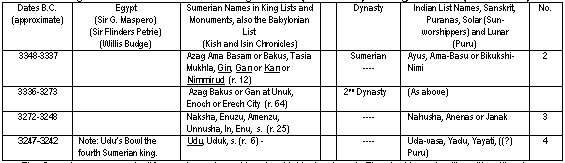 The Sumerians were a scientific people, and considered as highly developed.
They had been familiar with writing for centuries before the founding of their First Dynasty of Kings.
Evident in the form of the writing in the inscription of Udu's Bowl, where pictographs are reduced to conventional diagrams.
 The Great Gap of 430 years with 26 (or 27) Kings.
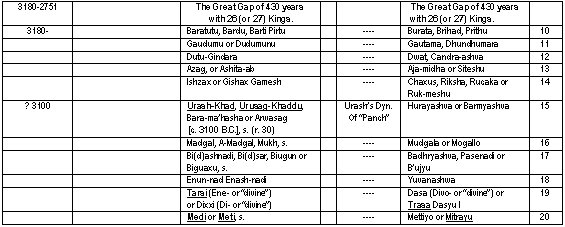 Medi or Meti, (between 3180-2751 B.C.) the twentieth Sumerian king, was called Semitic
and Semitize his name into "Me-silim" is placed by some around 3638 B.C.
 The above chart is seen on pg. 150-151 of Waddell's book
and will only be reviewed for its connection as to Mesopotamian influence in Egypt's earlier dynasties.
From this point on we look at Sargon's dynasty.
From my work The Alpha and the Omega, Volume I -- by Jim A. Cornwell -- Chapter Four page 352.
Egyptian Civilization Its Sumerian origin & Real Chronology And Sumerian origin of Egyptian Hieroglyphs by L. A. Waddell copyrighted 1933.
Louis Waddell Ch. XV The Chronology of Early Egypt and Its Civilization c. 2704 B.C.
On pg. 141-142 claimed in 1933 that "the discrepancy of 2246 years between the estimates for the date of Menes by the two different schools of present-day Egyptologists, each claiming support by an appeal largely to archaeological arguments, and the date of 4000 B.C. for Minos of Crete arrived at also by the same means."
The Assyriologists purported dynasties, with absurdly fabulous ages, which the superstitious and ill-informed later Isin priests prefixed to the First Dynasty of the Kish Chronicle, which is the first of all Sumerian dynasties. All this prefixed Isin chronology, with its prefixed dynasties purporting to extend for geological (241,200 years) ages "before the Flood," with reigns of individual kings for 43,200 to 1,500 years for each king - an average of several centuries for each postdiluvian king, none of whom could be traced, and all of them before the First Dynasty of the Kish Chronicle. This was the basis of the present-day Early pre-Sargonic Mesopotamian Chronology of Assyriologists!
Waddell on pg. 142-143 states that "Nabonidus, the last king of Babylon, who reigned 555-538 B.C., while preparing the Sun-temple at Sippara, recorded on a clay cylinder, that he found in the foundations the foundation-tablet of 'Naram Sin the son of Shar-Gena,' which that founder had deposited there 3200 years previously."
If one assumes that the date of Naram Sin was "approximately 3750 B.C." and that of his grandfather Sargon "3800 B.C.," thus the Sumerian history would have begun around 5000 B.C. and even 10,000 B.C. Most scholars will argue that such an early date for Sargon at about 3800 B.C., based on an isolated statement by the last Babylonian king and a Semite is not possible.
Waddell also claimed, "The buildings, culture, art and form of writing and shape of the clay tablets of Gudia are so very similar to those of Sargon's dynasty as to show that the two ages followed each other without any considerable break. The date of Gudia had become relatively fixed at 'about 2450 B.C.,' not only by his art, business documents, etc., but also by local synchronism's with the equally well-known Ur Dynasty, including Dungi, and the actual buildings of Gudia and Dungi were found to be almost directly on the top of the foundations of Sargon's dynasty, with practically no intervening stratum separating them. It was therefore supposed that Nabonidus had made a mistake of 1000 years in his inscription, and that the date of Sargon was 'about 2800 B.C.' and extended to 2872 B.C."
At present an individual named Gudea, who was king of the Sumerian city-state of Lagash, which is dated (2144-2124 B.C.) by modern standards.
Be aware that the figure for Sargon's date by its semblance of exactitude misleads historians and other readers into believing that the date has been definitely ascertained, whereas it merely rests on suppositions.
Waddell continues on pg. 146 with this claim, "The Sumerians were the most advanced Sun-worshippers and were the first systematic agriculturists, for whom a yearly system of reckoning was indispensable. They are admitted to have evolved the system of the calendar year of 360 days, which was borrowed by the Ancient Egyptians, divided into three seasons of four months each, thus forming twelve calendar months, with the expedient of adjusting it to the solar year by inter-calvary additions of a month at the end of a specified number of years, which the Egyptians modified to an annual addition of five days, thus making the year 365 days."
From my work The Alpha and the Omega, Volume I -- by Jim A. Cornwell -- Chapter Four page 353.
Louis Waddell in his book XV pg. 147 states:
FIXED DATE OF FIRST BABYLONIAN DYNASTY BY ASTRONOMICAL COMPUTATION
"Now, however, the date of the Foundation of the First Babylonian Dynasty has lately been definitely fixed by astronomical data with remarkable precision. The astronomical observations which now fortunately fix for us this date are admirably exact series made at Babylon on the morning and evening disappearances of the planet Venus, recorded by the orders of Ammi-"Zadugga," (1857-1837 B.C. Ammi-Saraga or -Saduga) the tenth king of this dynasty, for the twenty-one years of his reign. Of these observations, the most critical of all for the exact fixation of the date, are those taken in the sixth year of his reign. The original calculations made by Father Kugler, S.J., who was the first to recognize the unique importance of these observations for dating purposes for this king and his dynasty, have now been revised by other astronomical experts, Schoch and others, with better values for the apparent acceleration of the Sun and Moon in relation to the Gregorian calendar. The results of these revised calculations have been published (F. T. Dangin, RA. 1927, 181 f.), and show that the date of the Foundation of the First Babylonian Dynasty, which satisfies alike astronomy, the Babylonian seasonal calendar and history, is the year 2105 B.C., with a possible alternative of 2113 B.C., being one eight-year period of Venus." (These dates were calculated by Schoch, who, however, abandoned them, presumably under the influence of the school which tends to further reduce the date of this Babylonian Dynasty. But these dates are shown by Dangin to be the only ones which satisfy the calendar references of history.)
Waddell continues on pg. 148-149: entitled
DATED CHRONOLOGY OF THE SUMERIAN KINGS, FROM THE FIRST KING
AT RISE OF CIVILIZATION TO THE KASSI DYNASTY, c. 3378 B.C. to 1200 B.C.
As to pg. 148, "With this fixed date for the Foundation of the First Babylonian Dynasty ... calculations backwards to recover all the dates of the Sumerian kings and dynasties back to the first Sumerian king.
The connecting link between the First Babylonian Dynasty and the Imperial Sumerian main-line list of imperial kings we have found was the capture of Isin City by "Sin Mubalit" (2023-2004 B.C. Anuha-Mubalit and the father of Khammu-Rabi), the fifth king of the First Babylonian Dynasty in the seventeenth year of his reign, and who reigned as emperor three years."
Then on pg. 149 "The omission ... for 27 kings of the Great Gap of the Kish Chronicle and its supplementary Isin and Nippur Chronicles, namely kings number 10 to 36 does not affect this dating since the total duration of this gap is specified as 430 years."
"The Ur Dynasty in the Isin Chronicle gives King Dungi (2334-2277 B.C. Duk-gin or Shamu-) a reign of only 46 years, but his own date-years in his monuments and business documents specify 58 years of reign, which is the figure here adopted."
The date for the beginning of the Kassi Dynasty is 1790 B.C. at King No. 74 which the List extends to King No. 78, and in history comes to its end in 1175 B.C.
This file was created on November 20, 2004.
Go to the top of this page
To return to Volume III - Introduction to the Sumerian Kings List
or the Volume III - New Released Files.
Return to the Table of Contents or the Zodiac of Denderah