- Corona Borealis -- has no Denderah Zodiac representation, but it is included in Draco. As we know that Draco, the Dragon, encompasses one-third of the constellations, or three Ages of the zodiac.
- I have come across and interesting concept to consider. In "The Dawn of Astronomy" a study of the temple-worship and mythology of the Ancient Egyptians by J. Norman Lockyer, New York, The McMillian Company 1897, as seen on page 148 in reference to his question - Is Isis the chain?, "In the square zodiac at Denderah we find an illustration of the Hippopotamus and the Thigh (Mesket) and the chain referred to in the inscription is there also. It will be quite worthwhile to see whether this chain is not justified by some line of stars between the chief stars in Draco and those of the Great Bear."
I am proposing as you will see in Draco that the chain may actually be the Denderah version of the constellation of Corona Borealis.
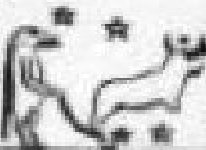
- I have come across and interesting concept to consider. In "The Dawn of Astronomy" a study of the temple-worship and mythology of the Ancient Egyptians by J. Norman Lockyer, New York, The McMillian Company 1897, as seen on page 148 in reference to his question - Is Isis the chain?, "In the square zodiac at Denderah we find an illustration of the Hippopotamus and the Thigh (Mesket) and the chain referred to in the inscription is there also. It will be quite worthwhile to see whether this chain is not justified by some line of stars between the chief stars in Draco and those of the Great Bear."
- In the Denderah Zodiac, Draco is the serpent under the forefeet of Sagittarius and called Her-fent, "the serpent accursed." Fent means serpent.
- In "The Witness of the Stars," by E.W. Bullinger, page 72 "In the Zodiac of Denderah it (Draco) is shown as a serpent under the fore-feet of Sagittarius, and is named Her-fent, which means the serpent accursed!"
- On the Denderah Zodiac there is no representation for Corona, which helps confer with the above omission.
- This is why on the Denderah Zodiac, Draco is in the center, seen just above Libra, instead of as proposed in Sagittarius (under the feet). It is possible that Draco, could well be located as a decan of Libra with Lupus, Crux, and Corona Borealis. The Denderah Zodiac allows for it, but then it is also connected with Sagittarius, and seen with Lyra, Ara, and Corona Australis.
To return to the Sumerian Aga dANim. More on this can be found at Corona Australis constellation, or the Libra Introduction and Pisces Introduction.
- Rolleston poses that the Latin is in Vulgate Zech. 6:11, and Rev. 6:2, but then the Greek stephanos, stef'-an-os, from primary stepho, (to twine or wreathe), crown, is also found in Zech. 6:11, and Rev. 6:2.
- Allen stated: It was the only stellar crown known to Eratosthenes and the early Greeks, but they called it Stephanos, a Wreath; and their successors, who had begun to locate the Southern Crown (Corona Australis), added to this title of the original the distinguishing protos; and beta Borelos to show its priority and its northern position.
- From www.lexiline.com, "The heavenly steer (GU4.AN.NA), the god of the (wooden)-tablet (GISH)Le, the Crown of Anu."
- Sumerian AGA dA-nim, (aga(3), crown + dA-nim, divine father + high, above),
thus "The Crown of Anu," or "The Crown of the Divine Father From Above."- Sumerian aga(3): turban, crown.
- Sumerian ugula-àga-ús: overseer of vassals ('overseer' + 'crown' + 'to follow').
- Sumerian men(4): diadem, crown.
- Sumerian muš2,3: n., diadem; a city's irrigated, cultivated territory; face, appearance, aspect; v., to glisten, shine.
- Sumerian muš4: a biting insect.
- Sumerian dA-nim which is from (dA, divine father + nim, high, above), the Sumerian an: n., sky, heaven; the god An; grain ear/date cluster; v., to be high; adj., high.
- Sumerian a, e4: n., water; watercourse, canal; seminal fluid; offspring; father; tears; flood; interj., alas!; prep., locative suffix - where; in; when - denotes movement towards or in favor of a person; def. article, nominalizing suffix for a noun or noun clause, denoting 'the'.
- Sumerian á: (cf., áhi) or a5: (cf., aka).
- Sumerian nim: n., prince; flying insect; highland; east; morning; v., to be high; to multiply in arithmetic; adj., high; early; adv., above.
- Sumerian igi-nim: upper country ('to face' + 'east').
- Sumerian nim... gír: to lighten; to flash ('east' + 'lightning flash').
- Sumerian sila4-nim: early spring lamb ('lamb' + 'early').
- Sumerian a, e4: n., water; watercourse, canal; seminal fluid; offspring; father; tears; flood; interj., alas!; prep., locative suffix - where; in; when - denotes movement towards or in favor of a person; def. article, nominalizing suffix for a noun or noun clause, denoting 'the'.
- Sumerian aga(3): turban, crown.
- Crown.
- Hebrew qodqod, kod-kode', from Heb. qadad, kaw-dad', the crown of the head.
- Hebrew nezer, neh'-zer, or nezer, nay'-zer, from Heb. nazar, naw-zar', to hold aloof, thus something set apart, dedication (of a priest or Nazirite), crown.
- Hebrew kether, keh'-ther, from Heb. kathar, kaw-thar', a prim. root, to enclose, to crown, thus properly a circlet, diadem, crown.
- Greek stephanos, stef'-an-os, from primary stepho, (to twine or wreathe), crown.
- Allen comments: The Latins adopted the Greek name and adjectives in Corona borea, borealis, and septentrionalis; and further knew it as the Crown of Vulcan fashioned ex auro et indicis gemmis; or of Amphitrite, probably from its proximity in the sky to the Dolphin (Delphinus) associated with that goddess. But generally it was Ariadnaea Corona, Corona Ariadnae, Corona Ariadnes, Cressa Corona, Corona Gnosida, Corona Cretica and Gnossis, varied by Minoia Corona and Minoia Virgo found with Valerius Flaccus and Germanicus, and Ariadnaea Sidus with Ovid; these classical designations referring to Ariadne, or to her father Minos, king of Crete, and to her birthplace in that island, at Gnosos, where Theseus married her. When deserted by him she became the wife of Liber Bacchus, and so took his name Libera; while the crown that Theseus — or, as some said, the goddess Venus — had given her was transferred to the sky, where it became our Corona.
- Rolleston and in "The Witness of the Stars," by E.W. Bullinger, page 53 "The Hebrew name for the constellation is Atarah, a royal crown, and its stars are known to-day in the East by the plural, Ataroth."
- Allen states: The Hebrews are said to have called it ‘Ataroth, the Crown, — perhaps of the Semitic queen Cushiopeia; and the Syrians, Ashtaroth, their Astarte, the Aphrodite of the Greeks and the Venus of the Latins; but all this seems doubtful, as also is Ewald's conjecture that it was the biblical Mazzaroth.