From The Alpha and the Omega - Volume III
by Jim A. Cornwell, Copyright © July 20, 2002, all rights reserved
"Volume III - The Sixth Month - Constellation Names for Centaurus"
In the Sixth Month - Virgo.
Centaurus, the Centaur.
The constellation name for Centaurus:
- Centaurus, The Centaur, which in Greek Mythology was one of a race of monsters having the head, arms, and trunk of a man and the body and legs of a horse [Middle English, from Latin Centaurus, from Greek Kentauros], appears on the Meridian on May 20.
- Centaurus is one of the two centaurs--mythical creatures that are half man, half horse--in the sky; Sagittarius is the other.
- Because it is the zodiac, Sagittarius is probably the earlier of the two centaur constellations to have been identified. Centaurs may have found their way into classical Greek stories from earlier Indian myths. They were later identified by the Greeks with fierce northern tribes, whom they considered barbaric and only half human.
- Centauri is known as the star system nearest to our own solar system. To find it look south of the star Spica, in Virgo, in mid-May.
- Half-Horse and Half-Man:
- Horse.
- Sumerian sisi (ANŠE.KUR.RA): horse (reduplicated si, 'to stand upright').
- Also see the subject matter of the horse in the Pegasus constellation under Aquarius.
- Hebrew çuwç, soos, or çuç, from an unused root meaning to skip (properly for joy): a horse (as leaping), also a swallow (from its rapid flight), crane, horse.
- Man ... Horse.
- One source claims that Centaurus originally was a combination of man-bull-horse, called in:
- Akkadian Gud-elim, "The Horned Bull
."
- Sumerian gud-lah5[DU-DU]: ox driver ('bull, ox' + 'to drive').
- Star in Bootes: b Nekkar or Nakkar' is a name that comes from the Arabic word for "ox-driver," or "cattle man."
- Some claim that this is also the Arabic name for the constellation.
- Arabic Al-Baqqar, "The cattleman." Note Al Bakkar.
Semitic Kusarikku, "Strong-Horned-One."
Greek Cheiron, who clutches an animal, a boar or lion, now Lupus, Greek Theiron, "Wild Animal" or "Beast", Romans Bestia, Hostia, Victima.
- Rolleston "Greek Chiron, the pierced, who pierces (Isa. 9:6)."
- In "Gospel of the Stars," by Joseph Seiss page 30 "Cheiron, the despised, Hebrew root, the pierced, or who pierces."
- Chiun (ki'un), possibly Saturn as god, but the meaning of the Hebrew is uncertain.
- Hebrew Kiyuwn, kee-yoon', from Heb. kuwn, koon, a primary root to be erect, to set up, properly a statue, i.e. idol, but used (by euphemism) for some heathen deity (perhaps corresponding to Priapus - a son of Dionysus and Aphrodite and god of procreation, phallus or Baal-peor - a Moabitish deity), Chiun.
- Thus as seen in Amos 5:26 where:
- KJV has "tabernacle of your Molech and Chiun your images, the star of your god."
- NIV has "the shrine of your king, the pedestal of your idols, the star of your god".
- RSV translates: "Sakkuth your king, and Kaiwan your star-god, your images."
- Also see Remphan.
- Acts 7:43 "the star of your god Remphan, figures..."
- Greek Rhemphan, hrem-fan', by incorrect transliteration for a word of Hebrew origin [Kiyuwn, kee-yoon'], Remphan (i.e. Kijun), an Egyptian idol.
- Under Centaurus star names k Centauri (no name).
- One source calls this Ke Kwan, meaning "calvary officer."
- It seems to be a reference to Hebrew Kiyyan, or the Greek Chiron.
Under the other names for Centaurus we find the following names: Asem'arik and Asme'at (which are referenced as stars in Centaurus and Lupus).
- Centaurus is pictured going forth as a hunter with a spear and is slaying a beast called the Victim (Lupus).
- Biblically this promotes Christ slaying Himself as a victim, on a cross.
- Centaurus also has claims, "Elsewhere, the Centaur fights Lupus, the wolf, which is a symbol of the material beast, Anubis, thus giving his meaning to the Centaur."
- In "The Witness of the Stars," by E.W. Bullinger, page 40 "Centaurus is known as the Hebrew Asmeath, meaning sin-offering (Isa. 53:10), and also the Greek Cheiron."
- Rolleston also claimed "Hebrew Asmeath, as sin-offering (Isa. 53:10)."
- Sin-offering.
- Hebrew 'ashem, aw-shame', from the Heb. 'asham, aw-sham' or 'awshem, aw-shame', to be guilty, thus guilt, by implication a fault, hence presenting also a sin-offering, guiltiness, offering for sin.
- Allen comments: Some of the Centaur's stars, with those of Lupus, were known to the early Arabs as Al Kadb al Karm, the Vine Branch; and again as Al Shamarih, the broken-off Palm Branches loaded with dates which Kazwini described as held out in the Centaur's hands. This degenerated into Asemarik, and perhaps was the origin of Bayer's word Asmeath. He also had Albeze; and Riccioli, Albezze and Albizze, — unintelligible unless from the Arabic Al Wazn, Weight, that was sometimes applied to alpha (Toliman or Bungula) and beta (Agena).
To return to Sumerian EnTeNaBarChum or the Sumerian City of Unug (Uruk/ Erech)- Fourth Dynasty, also see Corona Australis Constellation Names and Libra Introduction, all in regard to the Sumerian Ningirsu and the name Gudea.
Sumerian EN.TE.NA.BAR.HUM, Akkadian habasiranu, Centaurus.
Thus the Sumerian reads (en, lord, high priest + te, to approach, attack + na, human being, future/past tense (genative) + bar, (out)side, foreign, wild + hum, to bruise, to smash)
Its meaning is uncertain, but something like this "The Lord [High Priest] Who Approaches [Attacks] and Smashes [Bruises] The Foreign [Wild] Ones."
- In the Libra Introduction section we find:
- From www.lexiline.com, "On the 15th of Tashritu the scales ZI.BA.AN.NA (zibanitum), the wolf UR.IDIM, wild boar EN.TE.NA.BAR.CHUM, and the sitting dog UR.KU are visible. The agrarian worker LU.CHUN.GA sets, the Goat UZ rises in 30 days and the opposite is the Lion UR.GU.LA."
- From www.lexiline.com, "The wild boar (EN.TE.NA.BAR.CHUM), d.NIN.GIR.SU [Sumerian GIR.SU means boar], Sumerian BAR.CHUM means wild animal, Akkadian bulu, wild."
- In his work “BABYLONIAN STAR-LORE: An Illustrated Guide to the Star-lore and Constellations of Ancient Babylonia,” by Gavin White claims on page 44, "As a final symbol of the farmers we meet the Wild Boar, whose habit of churning up the earth in search of its food has led it to be a fitting astral symbol for Ningursu, the son of Enlil and like his father, one of the principle gods of the farmers.
The farming themes found in the autumnal heavens all revolve around the symbolism of seeding. Although burying the seed effectively brings about its death, it is only through this transformation that a new plant can come forth. As a mythical metaphor, the buried seed can be compared to the death and burial of the dying god, whose demise is but a prelude to his inevitable return from the underworld and the accompanying bounty that he brings in his train."
White's image of the Babylonian version of d.NIN.GIR.SU is  , where in his exerts he claims "The penultimate figure of this sequence is sometimes described as a lion-like creature, which has its front feet resting on the Abyss symbol. Judging by the surrounding constellations it is very likely to be located in the region of Centaurus.
In Babylonian tradition this region of the sky is occupied by the Wild Boar; some omen texts even describe it as being located close to the Abyss. In the section on the Wild Boar, I argue that the protruding tongue of the Dendera beast is actually a misunderstanding of the Boar’s tusks and that its mane is similarly a misrepresentation of the Boar’s spinal brush."
My comment is that the round Denderah image for Centaurus is  and is seen as a small jackal standing on the circle enclosing Libra, the lion-like creature White refers to is Lupus
  .
.
- As seen in Virgo under Bootes in the Egyptian/Coptic section:
- On the Denderah Zodiac beneath the feet of Virgo, Bootes is seen as a male figure with a swine-like head and horn or crescent-shaped crown holding in both hands a great ploughshare or sickle.
- Boar or Swine.
- Hebrew chaziyr, khaz-eer', from an unused root probably meaning to inclose, a hog (perhaps as penned), boar, swine.
- Greek choiros, khoy'-ros, of uncertain derivation, a hog, swine.
- Sumerian en: n., dignitary; lord; high priest; ancestor (statue). v., to rule. adj., noble.
- Sumerian en(2,3): n., time; background. prep., until.
- Sumerian te, de4; ti: v., to approach, meet (someone: dative); to attack, assault; to be frightened (alternating class, hamtu stem; cf., te-ge26).
- Sumerian te, de4: n., cheek, chin.
- Sumerian tè: an alkaline plant (?); soapwort (?); cardamon (cf., naga).
- Sumerian te8: bearded vulture.
- Sumerian a-u4-te-na: at the cool of the day ('when' + 'day' + ten, 'coolness').
- Sumerian ní-te-na: alone ('fear' + 'to be frightened').
- Sumerian na: n., human being; incense. adj., no. modal prefix, emphatic in past tense; prohibitive in present/future tense.
- Sumerian ná, nú: (cf., nud).
- Sumerian na4: pebble, stone; token; hailstone; weight.
- Sumerian na5: chest, box.
- Sumerian ni; na: he, she; that one.
- Sumerian sag-apin(-na): plow guide ('head' + 'plow' + genitive).
- Sumerian bar: n., (out)side; soul, innards; fleece. v., to open; to uncover, expose; to see; to remove; to release; to peel, pare, shell; to select; to divide; to split; to distribute; to keep away (with -ta-). adj., foreign. prep., because of.
- Sumerian bár: (cf., barag).
- Sumerian bar6,7: v., to shine, be bright; to break (of the day). adj., white.
- Sumerian ba7: (cf., bar).
- Sumerian a-sal-bar: architrave ('water' + 'to spread' + 'to distribute, remove').
- Sumerian anše-bar-an-mi2: female donkey ('equid' + 'foreign' + 'high' + 'female').
- Sumerian anše-bar-an-nita2: male donkey ('equid' + 'foreign' + 'high' + 'male').
- BARA, of the House of the Pharaoh, Bar or Bara, Paraa or Egypt. "Pharaoh," from Sumerian house-sign, Bar or Par, "The Great House"; Sumerian Bar, Bara, "great house or palace or temple."
- Pharaoh.
- Hebrew Par'oh, par'o', of Egyptian der., Paroh, a general title of Egyptian kings, Pharaoh, and means "Great House," in Egypt "Per-o."
- Also the Akkadian word pr and SAG.AZ = Apiru, Habiru, Hebrew.
- Bull.
- Hebrew par, par, or pawr, from the Heb. parar, paw-rar', a bullock (as breaking forth in wild strength).
- Sumerian šenbar: a type of wild boar (šeg9, 'boar', + bar, 'foreign').
- Also found under Corona Australis Star Names:
- The wild boar (EN.TE.NA.BAR.CHUM), d.NIN.GIR.SU.
- Sumerian hum: to wrestle; to be passionate; to bruise, punch; to smash, break; to thresh grain; to paralyze.
- Sumerian ga-ba-ra-hum: revolt (gaba, 'rival' + 'to overflow' + 'to smash, break').
- Sumerian dalhamun: tornado; violent storm; duststorm; whirlpool; riot, revolt (dal, 'to fly', + hum, 'to smash, break', + an, 'sky').
The Despised One
- Others say the Centaur is an unusual man having two natures: part man and part horse.
- The Hebrew name for this is Bezeh, which means "the despised one."
- Despised.
- Hebrew bazah, baw-zaw', a primary root to disesteem, despise, disdain, contemn(-ptible).
- Rolleston claims this as "Hebrew Beze, the despised."
- Rolleston also claims that "Arabic Al Beze, the despised (Isa. 53:3)."
- Allen states: Some of the Centaur's stars, with those of Lupus, were known to the early Arabs as Al Kadb al Karm, the Vine Branch; and again as Al Shamarih, the broken-off Palm Branches loaded with dates which Kazwini described as held out in the Centaur's hands. This degenerated into Asemarik, and perhaps was the origin of Bayer's word Asmeat. He also had Albeze; and Riccioli, Albezze and Albizze, — unintelligible unless from the Arabic Al Wazn, Weight, that was sometimes applied to alpha (Toliman or Bungula) and beta (Agena).
- Isaiah 53:3 "He is despised and rejected ["forsaken of men" "He who ceases from men," i.e., is no longer regarded as a man] of men; a man of sorrows [i.e. whose distinguished characteristic was sorrows], and aquainted with grief [Jesus never was sick]; and we hid as it were our faces [as one who causes men to hide their faces from Him] from him; he was despised, and we [the prophet identifying with the Jews] esteemed him not [negative contempt]."
- In "Gospel of the Stars," by Joseph Seiss page 30 "Cheiron, the despised, Hebrew root, the pierced, or who pierces."
- Rolleston proposes "Greek Chiron, the pierced, who pierces (Isa. 9:6)."
- Isaiah 9:6, in the KJV represents the birth of the messianic king.
- Some claim that the two natures are the double-edge sword of Revelation.
- Although the original meaning of this sign became corrupted, as it went out and combined with the mythology and the paganism, even still the original meaning shines through.
Egyptian/Coptic:
- On Denderah Zodiac, Centaurus is seen as a small jackal standing on the circle enclosing Libra.
- Normally seen as a wolf, Anubis (Egypt. Anpu, Ano-Oobist) a son of Nephthys and either Set or Osiris. Seen as a jackal or jackal headed man. Associated with embalming.
- Worshipped as "Wepuat, Opener of the Ways," also Apuat.
- Also seen with a rabbit's head, conducting the souls of dead to judgment and monitored the Scales of Truth.
- In "Gospel of the Stars," by Joseph Seiss page 57, he believes "Ara is the throned human figure wielding the flail, the implement of threshing and bruising, and that figure at the same time is set over a jackal, often identified with the dragon."
- This wolf-like figure is seen in the Denderah above the head of Ophiuchus and standing on the circle of Libra. This may be Centaurus.
- In his work “BABYLONIAN STAR-LORE: An Illustrated Guide to the Star-lore and Constellations of Ancient Babylonia,” by Gavin White in his exerts claims, "Up in the northern regions of heaven, behind the monstrous figure of the Hippo and Mooring Post, we can see the tiny figures of an enthroned goddess and a dog-like creature – they are very likely to be representations of the well-known Babylonian constellations known as the She-Goat and the Sitting Dog."
White's image of the Sitting Dog is seen on page 49-50 shown here 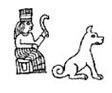 compared to the Round Denderah image
  , which White claims, "The She-Goat is a polite name for the goddess Gula, who is famous as the patroness of healing and medicine. However, behind her more benevolent facade she also has a darker side as the goddess of witchcraft and sorcery whose power extends far into the land of the dead. Her sacred dog, which is set before her in the stars, appears in omen lore as a bringer of disease and in world mythology it appears as the guardian of the underworld, where it is often charaterized as the eater of corpses - a fitting, if rather gruesome, symbol of all-devouring death."
As seen under Lupus, White shows Centaurus as combined with Lupus as seen here 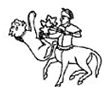 .
.
Other names not identified:
- Rolleston states "Pholas, the mediator."
- In "Gospel of the Stars," by Joseph Seiss page 30 "Pholas, Hebrew for the mediation."
Other names for Centaurus: Asem'arik and Asme'at (stars in Centaurus and Lupus), Taraapoz, Al Birdun (Birdhaun), Kadb al Karm, Al Kentau'rus, Al Shamarih, Al Wazn.
- Allen states: Some of the Centaur's stars, with those of Lupus, were known to the early Arabs as Al Kadb al Karm, the Vine Branch; and again as Al Shamarih, the broken-off Palm Branches loaded with dates which Kazwini described as held out in the Centaur's hands. This degenerated into Asemarik, and perhaps was the origin of Bayer's word Asmeat. He also had Albeze; and Riccioli, Albezze and Albizze, — unintelligible unless from the Arabic Al Wazn, Weight, that was sometimes applied to alpha (Toliman or Bungula) and beta (Agena).
- Allen states in his Lupus section: Caesius said that in Persia it was Bridemif, but Hyde, commenting on this from Albumasar, asserted that the word should be Birdun, the Packhorse, and was really intended for the Centaur.
See Star Names of Centaurus.
This file was created on November 20, 2004, and updated on July 15, 2008, and March 30, 2010.
Return to the Table of Contents or the Zodiac of Denderah