From The Alpha and the Omega - Volume III
by Jim A. Cornwell, Copyright © July 20, 2002, all rights reserved
"Volume III - The Ninth Month - Constellation Names for Ara"
In the Ninth Month of Sagittarius
Ara, the Altar.
The constellation name for Ara:
- None of the stars a Arae, b Arae, g Arae, d Arae, and e Arae in Ara have names:
- Once considered part of the constellation Centaurus and Lupus, which was separated when the modern constellation Norma was interposed.
- Ara has precessed considerably from the position it held when named. It lies far to the south but was visible from the Mediterranean in 1000 B.C. and was so named because of its apparent similarity to an altar.
- Other names for Ara: Almegra'mith, Almugam'ra
, Al Mij'marah.
- In Arabia it was Al Mijmarah, a Censer, which, being its only title in that country, implies that it was unformed there before the introduction of Greek astronomy. Derivations from this word are found in the Alme-gramith of Riccioli and the Almugamra of Caesius.
- Altar in Germany, Altare in Italy, Autel and Encensoir in France.
One source claims that Ara was an altar upside down, pointing to Tartarus as seen in (Isaiah 63:4, 5), but it is more likely Isaiah 65:3.
Arabic Al mugamra, meaning "the completing or finishing (Psalm 21:9-12)."
- Rolleston and in "The Witness of the Stars," by E.W. Bullinger, page 69 "In Arabic it is called Al Mugamra, which means the completing, or finishing."
- In the "Gospel of the Stars," by Joseph Seiss, page 57 "Arabic Al Mugamra, the completing, the finishing, the making of an end of what was undertaken."
- Rolleston clarified that Al Mugamra, came from the word perfect from Psalm 138:8.
- Perfect.
- Hebrew gamar, gaw-mar', a prim. root, to end (in the sense of completion or failure), cease, come to an end, fail, perfect, perform.
The first Hebrew altar is in:
- Genesis 8:20 from Noah after leaving the ark (Gemini), of significance here in Sagittarius the opposite.
- Abram built his altars in Gen. 12:7-8, 13:4, 18.
- Abraham did it in Gen. 22:9.
- Isaac in Gen. 26:25.
- Jacob in Gen. 35:1-7.
- Moses in Exod. 17:15.
- And last Joshua in Josh. 8:30-31.
Ara, the Altar represents the following names:
- Sumero-Akkadian Kisal-Bat-Ala.
- Babylonian-Assyrian Kisallu-Iabiru, "The-Ancient-Altar-Below."
- Phoenician Mizbaiach.
- Hebrew mizbeach, miz-bay'-akh, from Heb. zabach, zaw-bakh', a primary root to slaughter an animal (usually in sacrifice), kill, offer, (do) sacrifice, slay, thus an altar.
- Sumerian unu(2,6)-gal: great dining hall ('elevated shrine, fortress' + 'great').
- Sumerian unug, unu6 [TEMEN-ÈŠ]: elevated shrine, temple.
- Sumerian unug is Uruk, the biblical Erech.
In the introduction of the Ninth Month of Sagittarius, which is the month of Kislev (kiz'lev also kis'-lew, KJV Chisleu, Neh. 1:1; Zech. 7:1, "of the ninth month, even in Chis'-leu").
This month correlates with the above Kisal names for Ara.
- Hebrew Kiclev, kis-lave', probably of foreign origin, Kisleu, Chisleu.
- The ninth month of the Hebrew ritual year, and the third month of the Jewish calendar.
- Akkadian kislimu, kisliwu. Also Kissilimu.
- One-source claims that the Hebrew kislew, comes from the Akkadian kishmu, or kishwu.
Egyptian/Coptic:
- On the Denderah Zodiac in front of Scorpius and below Libra, Ara is an animal like and tailed figure standing up on its hind legs, which is wearing a white crown of Egypt on its hawk like head and with a raised right hand that is holding either a flail or a vial, very hard to see.
- In "Gospel of the Stars," by Joseph Seiss, page 57, he believes "Ara is the throned human figure wielding the flail, the implement of threshing and bruising, and that figure at the same time is set over a jackal, often identified with the dragon."
- My comments: Actually the figure Seiss refers to is seen above the head of Ophiuchus and Libra. It is a small figure of a man seated on a throne with his right arm extended and holding an object, which is hard to see, but could be a flail. This would seem more likely to be Centaurus, or even Corona.
- In "The Witness of the Stars," by E.W. Bullinger, page 68 "In the Zodiac of Denderah we have a different picture, giving us another aspect of the same judgment. It (Ara) is a man enthroned, with a flail in his hand. His name is Bau, the same name as Hercules has, and means He cometh. It is from the Hebrew Boh, to come."
- In his work “BABYLONIAN STAR-LORE: An Illustrated Guide to the Star-lore and Constellations of Ancient Babylonia,” by Gavin White in his exerts claims, "Finally, the strange creature that stands in front of Scorpio can be confidently located among the stars of Lupus. It is depicted as a composite figure made up of human and hippo elements, which wears the white crown of Upper Egypt.
The corresponding Babylonian figure that occupies the stars of Lupus is known as the Mad Dog. It is also a human-beast composite depicted in Neo-Assyrian art as a standing human figure with a lion’s tail and hindquarters, like the Dendera beast it is crowned with a horned headdress that signifies its divine nature."
White's image of Mad Dog is seen on page 46 shown here 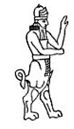 compared to the Round Denderah image
  which White claims, "The composite figure known as the Mad Dog is, I believe, an ancient relic that would originally have been paired to the Bison-man. Together they constituted an image of the 'lion-bull conflict,' which represented the incessant seasonal conflict between the drought-bringing lion of summer and the fertile rains of spring autumn, which were symbolized by the bull. Here in the autumn skies the Bison-man portrayed overcoming the summer lion - his victory over the lion thus symbolized the welcome return of the rainy season. However, the Bison-man has subsequently been removed from the star-map, leaving the Mad Dog as an isolated relic of former times."
See Lupus Constellation Names for more on references to Mad Dog.
which White claims, "The composite figure known as the Mad Dog is, I believe, an ancient relic that would originally have been paired to the Bison-man. Together they constituted an image of the 'lion-bull conflict,' which represented the incessant seasonal conflict between the drought-bringing lion of summer and the fertile rains of spring autumn, which were symbolized by the bull. Here in the autumn skies the Bison-man portrayed overcoming the summer lion - his victory over the lion thus symbolized the welcome return of the rainy season. However, the Bison-man has subsequently been removed from the star-map, leaving the Mad Dog as an isolated relic of former times."
See Lupus Constellation Names for more on references to Mad Dog.
White also claims on page 31, "It is possible that Ara, the Altar, is derived not from a Babylonian constellation but from the name of Lisi (a goddess associated with the Breast of the Scorpion) whose name is written with sign for 'fire brazier'." See Scorpius Star Names for more on references to Lisi, seen under star Antares.
It appears on old star maps as a tripod censer or brazier, depicted with smoke rising.
- Censer.
- Sumerian dinig: potash; salt; crucible, kiln, brazier; air vent (dè, 'ashes', + na a, 'potash').
- Hebrew machtah, makh-taw', the same as Heb. mechittah, mekh-it-taw', from Heb. chathah, khaw-thaw', a primary root to lay hold of, espec. to pick up fire, thus properly a dissolution, conr. a ruin, or censternation, destruction, ruin, terror, thus in the sense of removal, a pan for live coals, censer, firepan, snuffdish.
- Hebrew miqtereth, mik-teh'-reth, fem. of Heb. miqtar, mik-tawr', from Heb. qatar, kaw-tar', a primary root to smoke, (as an act of worship), burn (incense, sacrifice) (altar for), something to fume (incense) on, i.e. a hearth place, to burn .. upon, thus something to fume (incense) in, i.e. a coal-pan, censer.
- Greek thumiasterion, thoo-me-as-tay'-ree-on, from a der. of Gr. thumiao, a place of fumigation, i.e. the altar of incense (in the Temple), censer.
- Greek libanotos, lib-an-o-tos', from Gr. Ilibanos, frankincense, a censer for burning it, censer.
Other meanings of Ara are "Consuming Fire Prepared for His Enemies."
- Light, Lamp.
- Sumerian nu11: light; fire, lamp.
- Hebrew nuwr (Chald.), noor, from an unused root (corresp. to that of Heb. niyr, neer, or nir, also neyr, nare or ner, or (fem.) nerah, nay-raw', from a primary root to glisten, a lamp (i.e. the burner) or light, candle, lamp, light, thus meaning to shine, fire.
- Fire.
- Sumerian izi: fire.
- Sumerian ne-mur: fire.
- Hebrew 'esh, aysh, a primary word, fire.
- Hebrew be'erah, be-ay-raw', from Heb. ba'ar, baw-ar', a primary root to kindle, i.e. consume (by fire or by eating), also (as denom. from Heb. ba'ar, bah-ar) to be brutish, thus a burning, fire.
Sumerian IM.SHU.RIN.NA, Akkadian tinuru, "The Oven,"
- as the Sumerian reads like this:
- (im, clay + šu, portion + rin-na, genitive) "Make Clay," or "Pottery in an Oven."
- or (im-šu: paragraph, extract (on a tablet) + rin-na, genitive), "To extract (or press into) a clay tablet."
- Ara has similarity to burning kilns, ovens, coal pans, etc.
- Sumerian immindu: roasting, baking oven (imi/im, 'clay', + ninda, 'bread').
- Sumerian ninindu, nindu, inda4: oven; stove (cf., immindu).
- Sumerian dúruna, dilina, dìlim: oven for baking and roasting.
- Sumerian im-šu: paragraph, extract (on a tablet) ('clay tablet' + 'portion'), "To extract (or press into) a clay tablet."
- Sumerian imi, im, em: clay, mud; tablet.
- Sumerian im, em: (cf., imi).
- Sumerian imi/im, 'clay, mud' (cf., gim4).
- Sumerian im-babbar(2): gypsum ('clay' + 'white').
- Sumerian im-gíd-da: small, one column tablet ('clay tablet' + 'long' + 'side').
- Sumerian im-nun: edge of the civilized world ('writing tablet' + 'great').
- Sumerian im-šu-gub: list tablet ('clay tablet' + 'portion' + 'to write down').
- Sumerian imi, im, em: wind; direction; weather; storm; cloud; rain (cf., tumu).
- Sumerian im-gíri: lightning storm ('storm' + 'lightning flash').
- Sumerian im-hul: evil wind ('wind' + 'evil').
- Sumerian šu: n., hand; share, portion, bundle; strength; v., to pour.
- Sumerian šú: (cf., šuš(2)).
- Sumerian šùde, šùdu, šùd, šu12: n., prayer, blessing; v., to pray, bless (šu, 'hand', + dé, 'to hail').
- Sumerian rin-na: ?
- Example is the Sumerian (giš)ná-gi4-rin-na: divine bed ('bed' + 'fruit, flower' + genitive).
- Sumerian rín: to be/make bright (reduplication class).
- Sumerian na: n., human being; incense; adj., no; modal prefix, emphatic in past tense; prohibitive in present/future tense.
- Sumerian ná, nú: (cf., nud).
- Sumerian na4: pebble, stone; token; hailstone; weight.
- Sumerian na5: chest, box.
- Sumerian ni; na: he, she; that one.
- Sumerian sag-apin(-na): plow guide ('head' + 'plow' + genitive).
See Star Names of Ara.
This file was updated on July 15, 2008, and March 30, 2010.
Return to the Table of Contents or the Zodiac of Denderah