From The Alpha and the Omega - Volume III
by Jim A. Cornwell, Copyright © July 20, 2002, all rights reserved
"Volume III - The Tenth Month - Constellation Names for Capricornus"
 CAPRICORNUS
Capricornus, the Sea-Goat
The constellation name for Capricornus:
- Sumerian SUHUR.MÁSH, (Suhur-mas, Suhu-massa, Fish-Goat) is the last lunar mansion.
- Sumerian Mashdagu, first month of the year.
- Sumerian suhurku6: giant carp, barbel.
- Sumerian suhur: hair, scalp; tree top; crest (su6, 'beard', + he, 'abundant', + ùr, 'roof'; cf., suhuš).
- Sumerian suhuš: roots; support, foundation; to lift; support (su4, 'to grow, multiply', + he, 'abundant', + uš, 'to support'; cf., suhur).
- Sumerian šu-ha: fisherman ('hand' + 'fish').
- Sumerian *ha: fish (not the usual word for fish, but the fish sign may get its syllabic reading of HA from *h 'many' + a 'water' = 'fish', an alternative to the usual ku6, kua).
- Sumerian ku6, kua: fish (kú, 'food', + a, 'water'.
- Sumerian a-dar-túnku6: a fish ('water' + 'to slice' + 'to smash').
- Sumerian ku6gam-gam(-ma): a fish (Pomadasys stridens) (reduplicated 'curved; shriveled').
- Sumerian ku6gír-ús: an inexpensive fish ('knife' + 'length').
- Sumerian gir5-gir5ku6: a fish (reduplicated 'to seek refuge').
- Sumerian kíg/kinku6: a fish.
- Sumerian ku6sag-kúr[PAP]: a fish ('head' + 'strange').
- Sumerian agargaraku6 [NUNtenû]: a fish.
- Sumerian enku: fishing overseer (en, 'lord', + ku6/kua, 'fish'; same signs (ZAG.HA) as ešsad).
- Sumerian maš; máš: kid; he-goat.
- Sumerian šu-maš-gíd-gíd: diviner ('hand' + 'goat kid' + reduplicated 'to reach out').
- Sumerian máš-anše: animals ('goats' + 'equids').
- Sumerian amaš: sheepfold, cattle-pen (é, 'house', + maš, 'goat').
- Sumerian máš-da-ri-a; maš-da-rá-a: offering ('goat kid' + 'driven [animal]').
- Sumerian ùz, ud5, ut5: she-goat.
- Sumerian síg-ud5: goat's hair ('hair' + 'she-goat').
- Sumerian ešgar: young she-goat, kid.
- Sumerian zeh (SAL.ÁŠ.GÀR): female goat-kid.
- From www.lexiline.com it claims, "The Cargo-Boat (MA.GUR8, Ma.gurch) and the Goat-Fish (SUCHUR.MASH.KU6). Also Sumerian MA.GAR 'fisher, fishing boat and not cargo boat.' Sumerian SUCHUR.MASH.KU6 'goat-fish'."
- Akkadian suhurmashû, "The Goat Fish."
- In ancient Akkad, Tebetu, the tenth month was called "The Cave of the Rising" (of the Sun); the Sea-Goat, Capricornus, as the Sun rising from the great deep of the underworld, the "blind cave of eternal night," and is thus half mountain-climbing goat, half swimming fish.
- Richard H. Allen states, Brown gives for it the Akkadian Su-tul of the same meaning; and another possible title, resembling the early Hindu, was Makhar, claimed also for Delphinus. It seems likewise to have been known as the Double Ship. Jensen says that "the amphibious Ia Oannes of the Persian Gulf was connected with the constellation Capricornus"; Sayce, that a cuneiform inscription designates it as the Father of Light, — a title which, astronomically considered, could not have been correct except about 15,000 years ago, when the sun was here at the summer solstice; that "the goat was sacred and exalted into this sign"; and that a robe of goatskins was the sacred dress of the Babylonian priests.
- Babylonian SUCHUR.mash.
- In his work “BABYLONIAN STAR-LORE: An Illustrated Guide to the Star-lore and Constellations of Ancient Babylonia,” by Gavin White gives this image of Pisces which is seen on page 37 shown here as
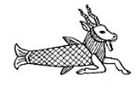 and comments, "I believe that the Goatfish actually combines various elements of symbolism that we have already examined. In short, I would argue that the Goatfish is essentially a combination of the horned Stag of solar renewal and the Fish that rescues the sun from the watery depths of winter."
As you can see for yourself the image for Capricornus above has some correlation with the Round Denderah image  and the Square Denderah image
  and the hieroglyphic image
 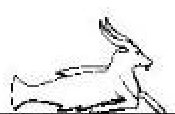 .
.
- Egyptian SOKAR (Sokhar, Seker, Socharis).
- Egyptian/Coptic:
- To see more on the Denderah Zodiac for Capricornus.
- Hu-penius.
- Rolleston stated that the Coptic name was Hupenius, meaning "station of bearing," from the Biblical chamber - Psalm 19:5.
- Chamber.
- Hebrew chuppah, khoop-paw', from Heb. chaphah, khaw-faw', a primary root to cover, by implication a veil, thus a canopy, chamber, closet, defence.
- In the "Gospel of the Stars, by Joseph Seiss, page 65, "Coptic Hupenius the station or mansion of bearing."
- In "The Witness of the Stars," by E.W. Bullinger, page 75 "In the Zodiacs of Denderah and Esneh, in Egypt, it (Capricornus) is half-goat and half-fish, and it is there called Hu-penius, which means the place of the sacrifice."
- Richard H. Allen states, some connect the sign in Egyptian astronomy with Chnum, Chnemu, Gnoum, or Knum, the God of the Waters, associated with the rising of the Nile and worshiped in Elephantine at the Cataracts, this divinity bearing goat's, not ram's, horns. Others have said that it was the goat-god Mendes; and La Lande cited the strange title Oxirinque from the Greek adjective descriptive of a Swordfish, our constellation sometimes being thus shown, when it was considered the cause of the inundation. In Coptic Egypt it was Opeutus, Brachium Sacrificii; and Miss Clerke says that it was figured in that country as a Mirror, emblematic of life.
- Hebrew name is Gedi, "A Kid," or "A Goat," also means "The Cut-Off," as in atonement.
- En-gedi.
- Hebrew 'Eyn Gediy, ane geh'-dee from:
- Hebrew 'ayin, ah'-yin, primary word, an eye, by analogy a fountain, it is also seen as the esoteric meaning of Capricornus.
- Hebrew gediy, ghed-ee', from the same as Heb. gadah, gaw-daw', from an unused root (meaning to cut off); thus a young goat (from browsing), kid; thus fountain of the kid, a place in Palestine.
- Goat.
- Hebrew sa'iyr, saw-eer', or sa'ir, from Heb. sa'ar, saw-ar', a primary root to storm, shiver, fear; thus shaggy, as noun, a he-goat, by anal. a fawn, devil, goat, hairy, rough, satyr.
- Hebrew 'ez, aze, from Heb. 'azaz, aw-zaz', a primary root, to be stout, be strong, thus a she-goat (as strong), but masc. in plur., (she) goat, kid.
- Hebrew 'aqqow, ak-ko', probably from Heb. 'anaq, aw-nak', a primary root to shriek, cry, groan, thus slender, i.e., the ibex, wild goat.
- Hebrew tayish, tah'-yeesh, from an unused root meaning to butt, he-goat.
- Hebrew tsaphiyr, tsaw-feer', from Heb. tsaphar, tsaw-far', a primary root to skip about, return, thus a male goat (as prancing), (he) goat).
- Rolleston promotes the Hebrew Gad'a, "the kid, cutoff, the hewn-down, the sacrifice slain."
- Arabic star name a Giedi or Algedi, also Al Gedi, means "The Kid."
- It also has a star named d Deneb Algedi, "tail of the goat," or Deneb Al Gedi, "The Sacrifice Cometh," also "the sacrifice of the kid." This is the same for the Syriac, in Syria Gadjo.
- Sayce, Bosanquet, and others connect it with the Assyrian Munakha, the Goat-Fish; and other probable names in Shah or Shahu, the Ibex, and in Niru, the Yoke.
- As to the constellation of Leo, Allen claims: These same Sickle stars were a lunar asterism with the Akkadians as Gis-mes, the Curved Weapon; with the Khorasmians and Sogdians as Khamshish, the Scimetar; but with the Copts as Titefui, the Forehead.
This is illustrated in the 47th volume of Archaeologia, and it appeared as a distinct constellation in a 15th-century German manuscript, perhaps the original of the work of 1564 from which Ideler quoted. Brown repeats a Euphratean inscription, "The constellation of the Yoke like a flag floated," although he claims no connection here, and associates the Yoke with Capricorn.
- In Persia it was Bushgali, Bahi or Vahik, and Goi.
- In the Pahlavi tongue, Nahi.
- In Turkey, Ughlak.
- Latin Capricornus, means "goat."
- Rolleston called it the "goat, the atonement, sinking down."
- Richard H. Allen states, The common Latin name was varied by the Caper of Ausonius, flexus Caper of Manilius, Hircus corniger of Vergil, hircinus Sidus of Prudens, Capra and aequoris Hircus, the Sea Goat; while Minpheu's "Capra illa Amalthea" indicates that it was identified by some with the goat usually assigned to Auriga. All this, doubtless, was from oriental legends, perhaps very ancient, which made Capricorn the nurse of the youthful sun-god that long anticipated the story of the infant Jupiter and Amalthea. The Latin poets also designated it as Meptuni proles, Neptune's offspring; Pelagi Procella, the Ocean Storm; Imbrifer, the Rain-bringing One; Signum hiemale, and Gelidus, because then at the winter solstice, the equivalent Athalpes appearing with the Greeks, which Riccioli repeated as Athalpis."
- Greek Aigokereus, "the goat."
- In "Hamlet's Mill" by Giorgio de Santillana and Hertha von Dechend, Gambit Inc. 1969 they call Capricornus, "Aigokeros."
- Capricornus is from caper, 'goat', + cornu, horn, literally 'having horns similar to those of a goat,' a loan translation of Aigokeros, the old Greek name for this constellation. One source claims the Capricornus Goat represents Aigipan, a character distinct from Pan, sometimes said to be the father of Pan, or a companion of Pan, and he has been depicted together with Pan. When the gods fled from the monster Typhon and hid themselves in animal form, Aigipan assumed the form of a fish-tailed goat. According to Hyginus, Aigipan was the son of Zeus and a goat, or of Zeus and Aega (Aix or Aex), the wife of Pan, who some think might be Aix Amaltheia, identified with the star Capra (Capella) in the constellation Auriga.
- Aratos called it Aigokeros, the Horned Goat, to distinguish it from the Aix of Auriga (a female or nanny-goat), as did Ptolemy, but Ionic writers had Aigokereus and this word, Latinized as Aegoceros.
- Of interest is that Ea, Sumerian E.A "He Whose House Is Water," or "House of Water," who was depicted as a goat with a fish's tail.
- Suhur could be a "whale" at the surface of the water of EA with the sucking-spout of the whale, thus the "hole," or "sucking eddy" to the underworld.
- From www.louisville.edu, "The Goat Fish is Capricornus, 'Suhurmasu, the carp-goat.' Associated with the Sumerian god Enki, Babylonian god Ea, and the Canaanite/Philistine Dagon."
- Other names for the constellation of Capricornus are:
- Capricornus, the horned goat.
- French Capricorne, Italian Capricorno, and the German Steinbock, — Stone-buck, or Ibex, — the Anglo-Saxon Bucca and Buccan Horn.
- Alcan'tarus, Alcau'curus, The Arabo-Latin Almagest of 1515 turned this into Alcaucurus, explained by habens cornua hirci; and Bayer mentioned Alcantarus.
- Al Jady', Al Jadr, in Arabia, Al Jady, usually written by us Giedi; all meaning the Goat, or, in the latter country, the Badan, or Ibex, known to zoologists as Capra beden.
- Burritt's Tower of Gad, in Hebrew, may be a bungled translation of the Arabic word Burj signifying both Constellation and Tower, or Fortress, from the Arabic, and is not connected with the Jewish tribe. Riccioli had Elgedi, Elgeudi, and Gadio.
- According to Richard H. Allen, in Hindu Mriga and Makara, — the Cingalese Makra and the Tamil Makaram, an Antelope; but occasionally it was shown with a goat's head upon the body of a hippopotamus, signifying some amphibious creature, and a later term was Shi-shu-mara or Sim-shu-mara, the Crocodile, although this originally was marked by stars of Draco. Varaha Mihira took his title for it, Akokera, from the Greeks; and it was the last in order of the zodiacal signs of India, as on the Euphrates. In the Aztec calendar it appeared as Cipactli, with a figure like that of the narwhal.
- According to Richard H. Allen, it was the zodiacal Bull, or Ox, of Chinese astronomy, that later became Mo Ki, the Goat-Fish. Williams says that, with stars of Sagittarius, it was Sing Ki, the Starry Record, and with a part of Aquarius Hiuen hiau; while in very early days, with Aquarius and Sagittarius, it was the Bark Warrior, etc., the so-called Northern one of the four large divisions of the zodiac. Flammarion asserts that Chinese astronomers located among its stars a conjunction of the five planets 2,449 B.C.
One of the twelve simple Hebrew Letters is Ayin (KJV, Ain, Ps 119:12), in the English as ' which has a numerical value equal to 16, and an esoteric meaning of "Eye."
Seen above as below the Hebrew word (Gedi) for the constellation of Capricornus is En-gedi.
- Hebrew 'Eyn Gediy, ane geh'-dee from:
- Hebrew 'ayin, ah'-yin, primary word, an eye, by analogy a fountain, it is also seen as the esoteric meaning of Capricornus.
- Hebrew gediy, ghed-ee', from the same as Heb. gadah, gaw-daw', from an unused root (meaning to cut off); thus a young goat (from browsing), kid; thus fountain of the kid, a place in Palestine.
- Richard H. Allen made a statement of interest "Berossos (Babylonian historian, 200 BC) is reported by Seneca to have learned from the old books of Sargon [mythical founder of the first Semitic empire, 3,850 BC.] that the world would be destroyed by a great conflagration when all the planets met in this sign." This world catastrophy would have to occur when the precession returns to Capricornus in the near future.
Continue to Star Names of Capricornus or return to the Introduction of Capricornus.
This file was updated on March 14, 2005, June 18, 2005, July 15, 2008, and March 30, 2010.
Return to the Table of Contents or the Zodiac of Denderah