From The Alpha and the Omega - Volume III
by Jim A. Cornwell, Copyright © July 20, 2002, all rights reserved
"Volume III - The Sixth Month - Constellation Names for Coma Berenices"
In the Sixth Month - Virgo.
Coma Berenices, Hair.
The constellation name for Coma Berenices:
- Coma Berenices, is called Berenice's Hair [New Latin Coma Berenices, Berenice's hair : Latin coma, hair + Latin Berenices, genitive of Berenice].
- Berenice (a queen of Egypt who promised her hair to Venus), which appears on the Meridian on May 15.
- The origin of the name lies in Ptolemaic Egypt when a Pharaoh's sister, Berenice, promised to offer her severed hair to Venus if her husband returned safe from the Syrian wars. He did, but the locks were lost from the temple of Venus and the story developed that Jupiter had removed them to form the constellation.
- Ptolemy III Evergetes, 246-221 B.C. ruled Egypt with his queen, Berenice II, daughter of Magas, king of Cyrene.
- Among others, Eratosthenes mentions this constellation.
- This constellation was not drawn until Tycho Brahe's catalog of 1602, although Coma Berenices is of ancient origin and is connected with one of the more charming stories of the sky.
- Tycho Brahe who lived from 1546-1601 A.D. and was a Danish astronomer whose accurate astronomical observations formed the basis for Johannes Kepler's laws of planetary motion. He was burned at the stake by the church for his statements that the stars were just like the sun.
- No record of Coma Berenices is found on the ancient Babylonian Tablets.
- In his work “BABYLONIAN STAR-LORE: An Illustrated Guide to the Star-lore and Constellations of Ancient Babylonia,” by Gavin White he claims in his exerts, "Similarly, the figure of Virgo from the Dendera Zodiac is much closer, in terms of its size and orientation, to its Babylonian prototype than it is to its Greek counterpart. In addition, there is a second goddess stationed at the tail of Leo and this is very likely to be an image of the Babylonian constellation called the Frond of Erua, which is said to stand at the tail of the Lion."
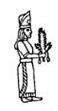 This image of White also states on his page 43. "The abundance of autumn is symbolized by the two-fold goddesses of the Frond and the Furrow, which respectively represent the two principle cultivated foodstuffs of Babylonia - dates and barely. The constellation of the Frond, which depicts the goddess Erua with a branch of the date palm, makes its annual appearance as the dates start to ripen on the frond.."
My comment: None of the images on the Denderah round or square show a Frond, only show the goddess holding the tail of Leo, the square zodiac does have the goddess holding a flail. See information below under Sumerian A.EDIN, Akkadian Erua.
- It is usually seen as the "Tuft (Hair) of the tail of Leo."
- Hair.
- Hebrew sa'arah, sah-ar-aw', feminine of Hebrew se'ar, say-awr' or sa'ar (Isa. 7:20), sah'-ar, from Heb. sa'ar, saw-ar', a primary root to storm, thus in the sense of dishevelling, hair (as if tossed or bristling), hair, hairiness.
- Hebrew marat, maw-rat'.
- Sumerian siki, síg: hair (of head, beard, body); wool; fur, hide (si, 'long, thin things', + ku10, 'black' ? or kul, 'thick, heavy' ?).
- Sumerian múš...dub: comb or set hair ('appearance' + 'to heap up').
- Sumerian suhur: hair, scalp; treetop; crest (su6, 'beard', + he, 'abundant', + ùr, 'roof'; cf., suhuš).
- Greek Co-me (Wig), also Kome in the New Testament.
- Greek kome, kom'-ay, apparently from the same as Gr. komizo, kom-id'-zo, thus the hair of the head (locks, as ornamental, and thus differing from Gr. thrix, threeks, generally Gr. trichos, of uncertain der., hair, which properly denotes merely the scalp, hair.
- Allen states: The Arabian astronomers knew Coma as Al Halbah, or Al Dafirah, the Coarse Hair, or Tuft, in the tail of the Lion of the zodiac, thus extending that figure beyond its present termination at the star Denebola.
- From www.lexiline.com, it is noted that "Erua and Chegalaju," as references to stars in Coma Berenices which is seen in the following two sections.
- The Erua is Akkadian form of the Sumerian A.EDIN.
- "On the 15th of Arachsamma, the goat UZ and GAB.GIR.TAB
are visible, and the Old One SHU.GI and the Shepherd SIPA.ZI.AN.NA begins to set. The rise of the Leopard UD.KA.DUCH.A is 30 days, and its opposite is Erua (Coma Berenices)."
Chegalaju seems to be a transliteration of the Sumerian HÉ.GÁL-a-a, Akkadian kakkab nushi.
Sumerian A.EDIN, Akkadian Erua, g Comae Berenices (?) and possibly others.
Its meaning is uncertain, as the Sumerian (a, the, movement towards + edin, steppe, plain, land between two long rivers [i.e. As in Garden of Eden], against or on).
Thus the assumption "The Plain (or specific place)," or "Moving Against."
- Sumerian a, e4: n., water; watercourse, canal; seminal fluid; offspring; father; tears; flood. interj., alas!. prep., locative suffix - where; in; when - denotes movement towards or in favor of a person. def. article, nominalizing suffix for a noun or noun clause, denoting 'the'.
- Sumerian á: (cf., áhi).
- Sumerian a5: (cf., aka).
- Sumerian edin: n., steppe, plain; grazing land between the two long rivers; back, spine (éd, 'to send forth', + in, 'straw'). prep., on; against.
- Sumerian edimx, edin: earthenware vat for oil and fats.
- Sumerian anše-edin-na: wild ass ('equid' + 'steppe' + a(k), genitival postposition).
- As seen under Virgo one star name called Vindemiatrix, is also referenced as Al Muredin'.
- In "The Witness of the Stars," by E.W. Bullinger, page 33 "The star e, in the arm bearing the branch, is called Al Mureddin, which means 'who shall come down' (as in Psalm 72:8), or who shall have dominion." "Also known as Vindemiatrix, a Chaldee word which means 'the son,' or branch, who cometh."
- Come Down as found in Psalm 72:6.
- Hebrew yarad, yaw-rad', a primary root to descend (lit. to go downwards, or conventionally to a lower region, as the shore, a boundary, the enemy.
- Dominion as seen in Psalm 72:8. (See Virgo Introduction for more on this subject).
- Hebrew radah, raw-daw', a primary root to tread down, i.e. subjugate, spec. to crumble off, (come to, make to) have dominion, prevail against, reign, rule.
- Hebrew Ba'al, bah'-al, the same as Heb. ba'al, bah'-al, from Heb. ba'al, baw-al', a primary root, to be master, hence to marry, a master, hence a husband, or (fig.) owner (often used with another noun in modifications of this latter sense), + archer, + babbler, captain, chief man, thus Baal, a Phoenician deity, plural Baalim.
- Rolleston in regard to Coma Berenices states "Al Mureddin, who shall come down, shall have dominion." "Chaldean Vindemiatrix, the son, who cometh, or the branch."
To return to the Sumerian City of Unug (Uruk/ Erech)- Fifth Dynasty in regard to Hegal or for the Utu-hejal.
To go to Sumerian HÉ.GÁL-a-a or Coma Berenices Star Names, all in regard to the Sumerian HÉ.GÁL-a-a.
Sumerian HÉ.GÁL-a-a, Akkadian kakkab nushi, "Star of Abundance," is part of Coma Berenices (?), as part of Virgo.
Sumerian hé-gál: abundance ('abundance' + 'to be available').
So this Sumerian reference to a star or constellation should be called as stated "Star of (Great) Abundance,"
since usually: -a-a or -A-A, means as if reduplicated "The Great."
- dShala (Seen also in the Virgo constellation section is the following):
- From www.lexiline.com, "The Seed-Furrow (AB.SIN), d.Shala (with the) sheaf of grain." "AB.SIN rises 10 days after SHU.PA, which rises 60 days after KAK.SI.SA, thus it can only be the star SPICA (seed furrow, also refers to vulva.)."
- Shala equates to Virgo, "The Woman," the Bright star. Later named Spica, which as Ab-Sin (Sumerian) meaning "the furrow," and some call this Inanna's vulva. Shala was also called Ishtar AB.SIN.
- Abundance.
- Hebrew shaluah, shal-vaw', and Hebrew shalvah, shal-vaw', from Heb. shalah, shaw-law', or Heb. shalav (Job 3:26 i.e. saftey), shaw-lav', a primary root to be tranquil, secure, prosper, thus security (genuine or false), abundance, peace (-ably), prosperity, quiteness.
- In Assyro-Babylonian Myth, one of the many names that Anshar gave to Marduk after defeating Tiamat was Hegal.
- Sumerian hé-gál: abundance ('abundance' + 'to be available').
- Sumerian hé: precative and affirmative verbal prefix (same as ha).
- Sumerian he(2): abundance; abundant.
- Sumerian ha: precative and affirmative verbal prefix: may; let; indeed.
- Sumerian *ha: fish (not the usual word for fish, but the fish sign may get its syllabic reading of HA from *h 'many' + a 'water' = 'fish', an alternative to the usual ku6, kua).
- Sumerian há, hi-a: numerous; diverse; assorted; mixed.
- Sumerian hà, hù, a6, he, hi: to mix.
- Sumerian gál; gá: to be (somewhere); to be available; to place, put (with -ni- or bi-); to place into (with -ši-); to be with someone (with -da-); to have on one's person (with -da-); to be possible (with -da-); to take an oath; to dwell.
- Sumerian gal, gal: n., a large cup. adj., big, large, great.
- Sumerian gal4: vulva, genitalia (cf., gála).
- Sumerian unu(2,6)-gal: great dining hall ('elevated shrine, fortress' + 'great').
- Sumerian kungal, gukkal [LU.HÚL]: fat-tailed sheep (kun, 'tail', + gal, 'big').
- Sumerian kingal: commander, director (kíg, 'to order', + gal, 'big, great').
- Sumerian gišgal: chair; throne; station (giš, 'wooden thing', + gal, 'big, great').
- Of note as seen earlier in reference to the Virgo Introduction section for Hebrew Baal and the word Dominion.
- Hebrew memshalah, mem-shaw-law', feminine of Heb. mimshal, mim-shawl', from Heb. mashal, maw-shal', thus a ruler or (abstr.) rule, dominion, that ruled, thus rule, also (concr. in plural) a realm or a ruler, dominion, government, power, to rule.
The Desired or Longed For:
- Some call the constellation Coma Berenices, 'The Desired,' where Coma Berenices depicts a woman sitting in a chair holding a child in her arms. Before the history of Coma Berenices you will only find myths of a woman seated on a chair holding a child in her arms.
- In fact, the name for the sign Coma Berenices in the Egyptian language is Shes-nu, which means "The Desired Son."
- This Coma Berenices means the "Desired One," or "Longed for One."
- It represents the "desire of all nations" who should come:
- In Christianity this is Jesus Christ, and would indicate a virgin woman with a son.
- In Coma Berenices we have a picture of a woman who is a virgin, who is going to bring forth a Seed, who is to be called a Branch, and He is the "desire of all nations" (Haggai 2:7).
- Haggai 2:6 "For thus saith the LORD of hosts; Yet once, it is a little while, and I will shake the heavens, and the earth, and the sea, and the dry land;"
- Haggai 2:7 "And I will shake [cause the agitation which is to proceed the Messiah] all nations, and the desire of all nations shall come: and I will fill this house with glory, saith the LORD of hosts."
- The Desire of all nations a phrase only in Haggai 2:7 (KJV).
- Desire.
- Hebrew chemdah, khem-daw', fem. of Heb. chemed, kheh'-med, from Heb. chamad, khaw-mad', to delight, thus delight, thus desire, goodly, pleasant, precious.
- RSV renders "treasures of all nations."
- NIV "desired of all nations."
- The Messiah was not desired by all nations, but "a root out of the dry ground," having "no beauty that we should desire Him" (Isa. 53:2).
- Jews desired Him, but the Gentiles accepted Him.
- The Jews looked for Shiloh to come unto whom the gathering of the people was to be, from Jacob's prophecy (Gen. 49:10), the early patriarchs, Job and Abraham desired Him.
- Ezra assured that God would shake the heavens, the earth, the sea, the dry land and the nations, and "the desire of all nations" would come to fill the house with his glory.
- Some refer the prophecy to Christ's first advent, and others to a second advent, still others deny a messianic application altogether.
- In "The Witness of the Stars," by E.W. Bullinger, page 34 "Comah, the desired, or longed for, from the Hebrew word which occurs only in Psalm 63:1, 'my flesh longeth for thee.' It is akin to the Hebrew, to desire (Psalm 14:10, Isa. 53:2, Hag. 2:7)."
Daniel, Zoroaster to the star of Bethlehem, and the Magi
- Ancient tradition supposes that the star of Bethlehem was in the constellation Coma Berenices.
- That same tradition tells us that Zoroaster, the Persian religious leader, was a student of Daniel when he was in Babylon. He learned from Daniel that a star would appear in the constellation Coma Berenices when that One whom it foretold was to be born.
- In "The Witness of the Stars," by E.W. Bullinger, page 37-39 "Thomas Hyde, Orientalist (1636-1703) quoted Abulfaragius, (Arab Christian Historian 1226-1286), who says that ZORASTER or ZERDUSHT, the Persian, was a pupil of Daniel the Prophet, and that he predicted to the Magicians (who were astronomers of Persia)."
Egyptian/Coptic:
- On the Denderah Zodiac, Coma Berenices is always seen as a female figure in a long robe grasping Leo's tail.
- It is also noted that the small bird or crone (Corvus) is also perched on Hydra, which Leo stands on.
- In "The Witness of the Stars," by E.W. Bullinger, he concludes that "on the Zodiac of Denderah the figure below, referring to an image of a woman seated on a throne holding a child on her hand was Coma."
- I believe Mr. Bullinger is in error here as to the images. This is not Coma as he described, but represents Corvus. He also claimed the name to be the Egyptian Shes-nu."
- Coma probably was known in early Egypt as the Many Stars.
Rolleston's proposed notes on Coma Berenices, which make references to many items in Virgo.
- "Al Thaum, the twin of the united.
- Aleced, the united.
- Al Mureddin, who shall come down, shall have dominion.
- Chaldean Vindemiatrix, the son, who cometh, or the branch.
- Hazamethon, the branch
(in Coma Berenices).
- Under the other names for Spica: Hazimet' Ala'zel, Hazimeth' Alha'cel, Huzimeth'un.
- Greek Prometheus, the deliverer, who cometh or branch."
- "Hebrew Subilah, who bears. (carry, Isa. 46:4).
- Carry.
- Hebrew çabal, saw-bal', a primary root to carry, be burdensome, bear.
- Arab Adarah, a pure virgin, separated (chambers, Job 9:9).
- Chamber.
- Hebrew cheder, kheh'-der, from Heb. chadar, khaw-dar', to enclose, thus chamber, and south.
- Adrenosa, the virgin who carries (carry, Gen. 46:5).
- As seen under Virgo is some of its other names: Adrentdesa, Andren'edesa.
- Greek/Latin, Astrea, the starry, the bright.
- Hebrew Coma, the desired, longed for (Psalm 63:1).
- Arabic Al Awa, the desired.
- Seen under the star b Zavijava or Zavij'ava in Virgo referenced as Arabic #13 Awwâ', Alahue, Al Awwa, "Barker."
- To Rolleston it is the 13th manzil of the lunar mansion, called "Al Awa, the desired (Isa. 26:8-9)."
- Rolleston also stated "Arabic Al Awa, the desired, Gen. 3:6 in Coma."
- Desired.
- Hebrew chamad, khaw-mad', a primary root to delight in, desire.
- Al Zimon, the desired."
- Rolleston claims "Aziman, the two ears of corn (ears, Isa. 17:5)."
Other names for Coma Berenices: Al Kissin (a star), Al A'tha, Al 'Ul'thah, Al Haud, Al Hul'bah (Arab) seen in Spica also, Al Huz'mat.
- Allen states: But very differently in early Arabia it was Al Haud, the Pond, into which the Gazelle, our Leo Minor, sprang when frightened at the lashing of the Lion's tail; although some of the Desert observers claimed that this Pond lay among the stars of the neck, breast, and knees of the Greater Bear (Ursa Major); and Lach substituted it for the Gazelle in our location of Leo Minor. The Arabian astronomers knew Coma as Al Halbah, or Al Dafirah, the Coarse Hair, or Tuft, in the tail of the Lion of the zodiac, thus extending that figure beyond its present termination at the star Denebola.
- Seen as the Chevelure of the French, Chioma of the Italians, and the Haupthaar of the Germans.
See Star Names of Coma Berenices.
This file was created on November 20, 2004, and updated on July 15, 2008, and March 30, 2010.
Return to the Table of Contents or the Zodiac of Denderah