From The Alpha and the Omega - Volume III
by Jim A. Cornwell, Copyright © July 20, 2002, all rights reserved
"Volume III - The Sixth Month - Star Names for Coma Berenices"
In the Sixth Month of Virgo
Star Names of Coma Berenices
To return to the Sumerian City of Unug (Uruk/ Erech)- Fifth Dynasty in regard to Hegal or for the Utu-hejal.
To go to Coma Berenices Constellation Names or Sumerian HÉ.GÁL-a-a, all in regard to the Sumerian HÉ.GÁL-a-a.
Sumerian HÉ.GÁL-a-a, Akkadian kakkab nushi, "Star of Abundance," is part of Coma Berenices (?), as part of Virgo.
Sumerian hé-gál: abundance ('abundance' + 'to be available').
So this Sumerian reference to a star or constellation should be called as stated "Star of (Great) Abundance,"
since usually: -a-a or -A-A, means as if reduplicated "The Great."
Note that HÉ.GÁL-a-a, could be either a or b Comae Berenices.
- In his work “BABYLONIAN STAR-LORE: An Illustrated Guide to the Star-lore and Constellations of Ancient Babylonia,” by Gavin White gives this image of a Lamma-goddess with an overflowing vase seen on page 55 shown here as
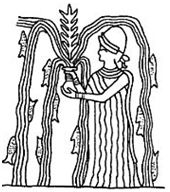 where he comments on The Star Of Abundance "The Star of Abundance appears to be a single star located in the western half of Bootes; as such it would rise at the start of the autumn rainy season. Although it's celestial image is not known, its Akkadian name hengallu, is the name of the fertility symbol generally known as the 'overflowing vase' that is commonly found in the artwork (image above). The vase is not specifically attributed to any deity, but appears to be a general symbol of fertility held by many deities and semi-divine figures.
Its symbolism is most clearly manifest in the final section of the Epic of Creation, where Marduk, newly crowned as supreme god of the pantheon, receives 50 divine titles to emphasize his suzerainty over all the other gods. The written forms of each divine name are in turn, interpreted and expanded into a series of epithets. One of these names - the 'god of Abundance' - is interpreted as the god who 'amasses a surplus for the peoples, who brings rain of abundance to the broad earth to make plant life bountiful'.
The fertility symbolism of the Star of Abundance is reflected in its written name, which includes a sign depicting a large storage vessel - an appropriate symbol for the overflowing bounty of the land; written as "Mul He-gal-a-a' or MUL HE2 GAL2 A A.
In astrology texts the Star of Abundance is associated with two goddesses - Ninlil and Sarpanitu - both of whom have a strong affiliation to the planet Venus. Ninlil and Sarpanitu are considered to be the spouses of the two supreme gods of Babylonia, Enlil and Marduk - and there can be little doubt that their attribution to the Star of Abundance is dependent on their husbands being the commonest deities associated with the adjacent star figure known as Shupa."
a Diadem.
- A jewel in the crown worn by Berenice.
- Note that for other names for Coma: Al Kissin (a star).
b Comae Berenices (no name).
g Comae Berenices (no name).
- Sumerian A.EDIN, Akkadian Erua, g Comae Berenices (?) and possibly others.
Its meaning is uncertain, as the Sumerian a, the, movement towards + Sumerian edin, steppe, plain, land between two long rivers (i.e. As in Garden of Eden), against or on.
Thus the assumption "The Plain (or specific place)," or "Moving Against."
- From www.lexiline.com, it is noted that "Erua and Chegalaju," as references to stars in Coma Berenices
- Sumerian a, e4: n., water; watercourse, canal; seminal fluid; offspring; father; tears; flood. interj., alas!. prep., locative suffix - where; in; when - denotes movement towards or in favor of a person. def. article, nominalizing suffix for a noun or noun clause, denoting 'the'.
- Sumerian á: (cf., áhi).
- Sumerian a5: (cf., aka).
- Sumerian edin: n., steppe, plain; grazing land between the two long rivers; back, spine (éd, 'to send forth', + in, 'straw'). prep., on; against.
- Sumerian edimx, edin: earthenware vat for oil and fats.
- Sumerian anše-edin-na: wild ass ('equid' + 'steppe' + a(k), genitival postposition).
- As seen under Virgo one star name called Vindemiatrix, is also referenced as Al Muredin'.
- In "The Witness of the Stars," by E.W. Bullinger, page 33 "The star e, in the arm bearing the branch, is called Al Mureddin, which means 'who shall come down' (as in Psalm 72:8), or who shall have dominion." "Also known as Vindemiatrix, a Chaldee word which means 'the son,' or branch, who cometh."
- Come Down as found in Psalm 72:6.
- Hebrew yarad, yaw-rad', a primary root to descend (lit. to go downwards, or conventionally to a lower region, as the shore, a boundary, the enemy.
- Dominion as seen in Psalm 72:8. (See Virgo Introduction for more on this subject).
- Hebrew radah, raw-daw', a primary root to tread down, i.e. subjugate, spec. to crumble off, (come to, make to) have dominion, prevail against, reign, rule.
- Hebrew Ba'al, bah'-al, the same as Heb. ba'al, bah'-al, from Heb. ba'al, baw-al', a primary root, to be master, hence to marry, a master, hence a husband, or (fig.) owner (often used with another noun in modifications of this latter sense), + archer, + babbler, captain, chief man, thus Baal, a Phoenician deity, plural Baalim.
- Rolleston in regard to Coma Berenices states "Al Mureddin, who shall come down, shall have dominion." "Chaldean Vindemiatrix, the son, who cometh, or the branch."
Coma Berenices only contains 3 stars, but the region is rich in extragalatic nebulae.
Coma Star Cluster is called Melotte 111, others are M53, M64, M85, M88, M91, M98, M99, and M100.
Return to Constellation Names of Coma.
This file was updated on November 20, 2004, and April 4, 2010.
Return to the Table of Contents or the Zodiac of Denderah