From The Alpha and the Omega - Volume III
by Jim A. Cornwell, Copyright © July 20, 2002, all rights reserved
"Volume III - The Second Month - Constellation Names for Taurus"
 TAURUS
Taurus, the Bull, and the Pleiades.
The constellation name for Taurus:
- Taurus the Bull was probably one of the first constellations to be named, and is reminiscent of the oldest domesticated and respected animal. Prior to 3000 B.C. Taurus lay across the vernal equinox and so became a stellar system of awe and magnificance. The beast and the constellation have been deified in almost every known civilization in the ancient Middle East, along with the Pleiades and Hyades clusters, and the faint Crab Nebula.
- Sumerian GU4.AN.NA, "The Bull of Heaven," Taurus, seen below in Sumerian breaks down as (gu4, bull + an, heaven + na, that one, nominative).
- Sumerian gud, gu4: domestic ox, bull (regularly followed by rá; cf., gur(4)).
- Sumerian gu4-ud: to jump; to flutter (reduplication class: gu4-gu4-ud); the planet Mercury ('bull' + 'sun').
- Sumerian gud-am; gu4-dam: a mythological entity ('bull' + 'wild ox').
- Sumerian gú-gú-GUD: a type of pea (reduplicated 'chick pea/bean' + 'ox, bull').
- Sumerian gud-gal-gal: full-grown ox ('bull, ox' + reduplicated 'great').
- Sumerian gud-du7(-du7): unblemished (?) bull; fierce (?) bull ('bull, ox' + 'complete; suitable; to butt, gore, toss').
- Sumerian gud-dub: ox (recorded) on a tablet ('bull, ox' + 'tablet').
- Sumerian gud-dun-a: subordinate ox ('bull, ox' + 'subordinate' + nominative).
- Sumerian gud-giš: work ox ('bull, ox' + 'tool').
- Sumerian gud-lah5[DU-DU]: ox driver ('bull, ox' + 'to drive').
- Sumerian gud-mu-x: x years-old ox ('bull, ox' + 'name, year' + number).
- Sumerian nínda, inda: flower; funnel; seeding apparatus of the seeder plow; bushel; breeding bull.
- Sumerian an: n., sky, heaven; the god An; grain ear/date cluster; v., to be high; adj., high.
- Sumerian an-ki: universe ('sky' + 'earth').
- Sumerian an-na: tin ('sky' + 'stone').
- Sumerian an-pa: zenith ('sky' + 'branch' of sun dial ?).
- Sumerian an-ta: above ('heaven' + 'from').
- Sumerian an-ta-gál: high, superior ('sky; high' + 'from' + 'to be').
- Sumerian an-ta...gi4: to meet ('heaven' + 'from' + 'to return').
- Sumerian an-ta-sur-ra: a stone ('heaven' + 'from' + 'boundary marker' + a, 'the').
- Sumerian an-úr: horizon ('sky' + 'base, floor').
- Sumerian an-za-kàr: tower ('heaven' + 'stone' + 'round, high thing').
- Sumerian na; ni: he, she; that one.
- Sumerian ní: self; body.
- Sumerian ní; ne4: fear; respect; frightfulness; awe.
- Sumerian nì: (cf., níg).
- Sumerian ne: this (one).
- From www.lexiline.com, "The heavenly steer (GU4.AN.NA) the god of the (wooden)-tablet (GISH)Le, the Crown of Anu. Taurus, the steer, is the Sumerian GU4.AN.NA, 'steer.' Sumerian GISH.LE, means 'wooden'. Note the a Tauri (Aldebaran) and the Hyades."
- Under Sagittarius in Corona Australis is the Sumerian AGA dA-NIM, "The Crown of Anu."
- In Sumerian Myth, Ereshkigal's (sometimes referenced as the wife of Nergal) husband Gugalana, was the Bull of Heaven. Some sources claim the Sumerians had a "bull of light."
- Babylonian-Assyrian Alap-same: "Bull-of-Heaven" or "Strong Wild-Bull" and "Great-Horned Bull."
- The Assyrians "Winged Lion-Bull" with a human head (possible Genii) is found at the doorway at Nimrud (Calah), which was a city built originally by Nimrod (Gen. 10:6-12).
- Richard H. Allen comments: Epping says that it was the Babylonians' Shur, and that four of their ecliptic constellations were marked by its stars; while Jensen mentions it as symbolic of Marduk, the Spring Sun, son of Ia, whose worship seems to have been general 2,200 B.C., — probably long before, — and that it was originally complete and extended as far as the Fish of Ia, the northern of the two Fishes. This high authority carries the formation of Taurus still farther back, to about 5,000 B.C., even before the equinox lay here.
- In his work “BABYLONIAN STAR-LORE: An Illustrated Guide to the Star-lore and Constellations of Ancient Babylonia,” by Gavin White gives this image of Taurus which is seen on page 39 shown here as
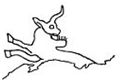
 and comments, "The Bull of Heaven is probably the oldest exemplar of the theme of the shepherd and his flocks, which is so strongly represented in the springtime skies. As a basic celestial symbol cattle seem to represent all the fertile powers of the springtime skies - world mythology frequently relates the image of bulls, cows and calves to a whole range of heavenly phenomena including rain-clouds, rays of sunlight and the newborn sun. More specifically, the Sumerian Bull of Heaven is described as a destructive beast, which came down from heaven to drink the rivers dry and to parch the land. These seasonal attributes are no doubt derived from the fact that the constellation rises late in the 2nd month of the year when the temperature starts to rise and the rains diminish."
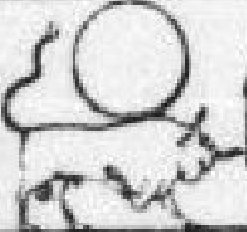
As you can see for yourself the image for Taurus above has some correlation with the Round Denderah image  and the Square Denderah image
  and the hieroglyphic image
 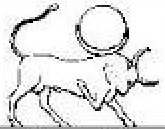 .
.
- Sumero-Akkadian Gu.ud an.na, which could only come from the Sumerian gu4-ud: to jump; to flutter (reduplication class: gu4-gu4-ud); the planet Mercury, Akkadian shihtu, "Jumping."
- Richard H. Allen comments: This appears on a Babylonian cylinder seal of about 2,150 B.C. Still earlier in Akkadia it seems to have been known as the Bull of Light, its double title, Te Te, referring to its two groups, the Hyades and Pleiades, which in every age have been of so much interest to mankind; and a cylinder has Gut-an-na, the Heavenly Bull, mentioned in connection with rain, so recalling the rainy Hyades.
- From www.lexiline.com, "Sumerian d.GU4.d.UD, 'steer of the sun,' or the 'child of the sun.' Mercury is (LU.BAD) GU4.UD, called d.MASH. LU.BAD is 'morning star.'"
- Another source states Mercury is called Kokah.
- Unsure of a Hebrew Kokah, but is likely called by Neba, the tutelary deity of Borsippa (Isaiah 46:1, Nebo), shun in the sky as Mercury.
- Hebrew neba' (Chald.), neb-aw', corresponding to Heb. naba', naw-baw', a primary root to prophecy, make self a prophet, thus prophecy.
- Nebo (ne'bo).
- Hebrew Nebow, neb-o', probably of foreign derivative, Nebo, the name of a Babylonian deity, also of a mountain in Moab, and of a place in Palestine.
- One source claims this is the Egyptian PIL PE(da)-SED(is)-AIR-ri-is.
- Sumerian PA.BIL.SAG. Other Sumerian names are (LU.BAD) GU4.UD, with (LU.BAD) meaning "moving star," used for Saturn and Mercury. It is called d.MASH and also d.GU4.d.UD, meaning, "steer of the sun," or "child of the sun."
- Egyptian/Coptic:
- On the Denderah Zodiac, Mercury is a male figure (face undetermined) facing Cancer and has the Egyptian waas scepter in his left hand. He has a white star either above his head or for a crown. Above the star is a hieroglyph shaped like a serpent with a brightly shining head or maybe just a u-shaped figure. It is possible that this is a hieroglyphic name, but it is undetermined.
- Egyptian Apis.
- Hebrew noph, moph.
- Memphis (mem'-fis) see also Noph (Hosea 9:6).
- Hebrew Moph, mofe, of Egyptian origin, Moph, the capital of Lower Egypt, Memphis, compared to Hebrew Noph.
- Noph (nof) (Found in Isaiah, Jeremiah and Ezekiel)
- Hebrew Noph, nofe, a variant of Hebrew Moph, mofe, Noph, the capital of Upper Egypt, Noph.
- Coptic menphe, memphi.
- Allen states: In Coptic Egypt it, or the Pleiades, was Orias, the Good Season, Kircher's Static Hori, although it was better known as Apis, the modern form of the ancient Hapi, whose worship as god of the Nile may have preceded even the building of the pyramids.
- Greek Bull of Memphis.
- In "The Witness of the Stars," by E.W. Bullinger, page 120 "The Egyptian Zodiac of Denderah already, 4,000 years ago had forgotten the truth to which the prophecy had referred, and called him (Taurus) Isis, i.e., who saves or delivers, and Apis, i.e., the head or chief. In Chaldee it is Tor, Arabic Al Thaur, Greek Tauros, Latin Taurus (Messiah coming in judgment), Hebrew Shur, coming and ruling."
- On the Denderah Zodiac, Taurus is seen as a Bull in a running forward position, but glancing backwards towards Gemini as if looking at something coming.
- Crete had the Minotaur, a creature with a body of a bull and the head of a man.
- Persian (and later Roman Sun God) was Mithras.
- Allen comments: Representations of the Mithraic Bull on gems of four or five centuries before Christ, reproduced in Lajarde's Culte de Mithra, prove that Taurus was at that time still prominent in Persico-Babylonian astronomy as well as in its religion. One of these representations, showing the front of the Bull's head, may very well be the origin of our present symbol of this sign, gamma, although it also has been considered a combination of the full and crescent moon, associated with this constellation as a nocturnal sign; and some assert that Taurus was drawn as a demi-bull from his representing the crescent moon.
- The Romans also saw this as Bacchus.
- Canaanite Baal, Baalim.
- Hebrew Ba'al, bah'-al, the same as Heb. ba'al, bah'-al, from Heb. ba'al, baw-al', a primary root, to be master, hence to marry, a master, hence a husband, or (fig.) owner (often used with another noun in modifications of this latter sense), + archer, + babbler, captain, chief man, thus Baal, a Phoenician deity, plural Baalim.
- Hebrew Ba'al Zebuwb, bah'-al zeb-oob', means Baal of (the) Fly, this fly was one of a stinging nature, Baal-Zebub, a special deity of the Ekronites.
- Hebrew Ba'al Peowr, bah'-al peh-ore', Baal of Peor, to yawn, gape, open, a gap, a Moabitish deity, Baal-Peor, a mountain East of Jordan where the deity was worshipped.
- Hebrew Ba'al Tsepown, bah'-al-tsef-one', Heb. tsaphown, tsaw-fone', or tsaphone, properly hidden, i.e. dark, used only of the north as a quarter (gloomy and unknown), north, thus in the sense of cold), an Egyptian form of Typhon, the destroyer, Baal of winter, Baal-Tse-phon, a place in Egypt, Baal-zephon.
- Hebrew connection to Taurus, the Bull.
- Unicorn (Rimu, Rheem, Reem, also Ramah, Indian Ram, Latin Roma):
- Hebrew re'em, reh-ame', or re'eym, reh-ame', or reym, rame, from Heb. ra'am, raw-am', a primary root to rise, be lifted up, thus, a wild bull (from its conspicuousness), unicorn.
- In "The Witness of the Stars," by E.W. Bullinger, page 120 "Hebrew Reem (idea of loftiness, exaltation, power and pre-eminence)." "We find the root in other kindred languages (Etruscan, Sanskrit, etc.), and it can be traced in the name of Abram, which means pre-eminent or high father; Ramah, high place, etc."
- This may bring a relationship to the ignored constellation of Monoceros, by the likes of Rolleston, Bullinger and Seiss.
- Bull, Bulls.
- Hebrew showr, shore, from Heb. shuwr, shoor, a primary root, to turn, travel, thus a bullock (as a traveler), bull, cow, ox.
- One source claims that the word Taurus is of Semitic origin, from Hebrew shor, but in Judaea it was also known there as Re’em, a word that zoologically appears in the Authorized Version of our Bible as the "unicorn," and later in the Revised as the "wild ox." Epping says that it was the Babylonians' Shur, and that four of their ecliptic constellations were marked by its stars.
- Hebrew teow, teh-o', and tow' (the original form), toh, from ta'ah, taw-aw', a primary root, to mark off, designate, point out, thus a species of antelope (probably from the white stripe on the cheek), wild bull (ox).
- Hebrew par, par, or par, pawr, from Heb. parar, paw-rar', a primary root to break up, thus a bullock (appar. as breaking forth in wild strength, or perhaps as dividing the hoof) bull, calf, ox.
- Hebrew 'abbiyr, ab-beer', for Heb. 'abiyr, aw-beer', from Heb. 'abar, aw-bar', a primary root, to soar, fly, thus mighty (spoken of God), thus angel, bull, chiefest, mighty (one), stout, strong (one), valiant.
- Hebrew baqar, baw-kaw', from Heb. baqar, baw-kar', a primary root to plough, thus a beeve or animal of the ox gender (as used for ploughing), bull, calf, ox.
- To be found also under Monoceros, the Unicorn in the Taurus group is:
- Sumerian alim: wild ram; bison; aurochs; powerful.
- Sumerian sún: aurochs cow; beerwort.
- Sumerian áma, am: wild ox or cow (aurochs).
- Arabic rim is a two-horned animal.
- Aurochs, also urus and wisent, are obsolete German, variant of German Auerochs, from Middle High German urohse, from Old High German urohso: uro, aurochs + ohso, ox.
- Urus is an extinct wild ox (Bos primigenius) of Europe, northern Africa, and western Asia, believed to be the ancestor of domestic cattle [Latin urus, of Germanic origin].
- Wisent is the European bison (Bison bonasus) having a smaller and higher head than the North American bison [German, from Middle High German, from Old High German wisunt].
- Other names for Taurus: Altaur'o, Ataur', Al Daika (vacant space), Al Thaur, Tur, Al Thura'ja, Altor', El Taur', Taur, Al Hatt (Arabic division).
- Richard H. Allen commented that Taurus bore synonymous titles in various languages:
in Arabia, Al Thaur, which degenerated to El Taur, Altor, Ataur, Altauro, by Schickard; Tur, by Riccioli; and even now Taur, in our Standard Dictionary.
In Syria it was Taura;
in Persia, Tora, Ghav, or Gau;
and in Turkey, Ughuz.
- Taurus was the Cingalese Urusaba, the early Hindu Vrisha, Vrishan, or Vrouchabam, — in the Tamil tongue, Rishabam; but subsequently Varaha Mihira gave it as Taouri, his rendering of Taurus, and Al Biruni, in his India, as Tambiru.
- Seen as le Taureau of France, il Toro of Italy, and der Stier of Germany.
One of the twelve simple Hebrew Letters is Vau (KJV, Vau, vawv, Ps 119:41, vav, vaw, probably a hook, the name of the sixth Hebrew letter.), the English letter is v or w which has a numerical value equal to 6, and an esoteric meaning of "Peg," or "Nail."
- Nail.
- Heb. yathed, yaw-thade', from an unused root meaning to pin through or fast, a peg, nail, paddle, pin, stake.
- Sumerian (giš)gag, kak: peg; nail, spike; bone; hinge, joint, knee.
- Sumerian gag-ha-har-ra-na: a peg or nail ('peg' + 'roads' ?).
- Sumerian gag-maš: a peg or nail ('peg' + 'one-half').
- Some believe that there is an esoteric connection to Heb. Vau as seen in the Pleiades cluster as representing a "hinge", and one source claims this is the Greek Khemia or Kimia, which correlates to the Sumerian/Babylonian Kimash.
- Greek helos, hay'-los, of uncertain affinity, a stud, i.e. spike, nail.
Sumerian EN.ME.SHÁR.RA, which builds as (en, lord + me, power, divine decree + šár, totality, world + ra, nominative ending, overflow, or with šár-ra, temple) leaving the meaning possibly as "universal decrees of divine authority of the (lord) spiritual head of the temple."
- Perhaps, the northern stars of Taurus, g Taurii (no name) is the vertex of the V of the Hyades and the o Atik, Arabic "collarbone," a lower star found in Persei, have some mysterious connection to events to come.
- From www.lexiline.com, "Perseus, the Old Man (SHU.GI), ... d.Enmesharra."
- In Assyro-Babylonian Mythology we find Enmesharra - as an Underworld god, who was possibly slain by Ellil (Enlil) - Sumerian for "wind/storm-god".
- Sumerian en: n., dignitary; lord; high priest; ancestor (statue); v., to rule; adj., noble.
- Sumerian en(2,3): n., time; background; prep., until.
- Sumerian nam-en: lordship (abstract prefix + 'lord').
- Sumerian enten(a): winter (en, 'time', + ten, 'cold', + a(k), 'of').
- Sumerian engar: irrigator, farmer (en, 'lord', + agar, 'field'; Akk. 'ikkar from Semitic "to hoe, cultivate").
- Sumerian ezen: festival, feast (uzu, 'cut of meat', + en, 'time').
- Sumerian me, ge: n., ideal norm; office, responsibility, function; the phenomenal area of a deity's power; divine decree, oracle; v., to be; to say, tell; poss. suffix, our.
- Sumerian me3,6,7,9: battle.
- Sumerian me6: to act, behave.
- Sumerian dumu-me-KA.UD: a cult servant ('child' + 'function' + ?).
- Sumerian šár, sár: n., totality; world; horizon; v., to be many; to multiply or mix (with -da-); to slaughter; to request, implore; adj., numerous.
- Sumerian šár: šar: (cf., sar).
- Sumerian lúšár: a military officer.
- Sumerian šar8 (NI): to interpret, explain.
- Sumerian inim...šár: to search for clarification ('word' + 'to request, implore').
- Sumerian ki-šár: horizon; everywhere ('place' + 'totality').
- Sumerian ša-ra-ab-du: (cf., šár-ra-ab-du).
- Sumerian šár-ra-ab-du: a temple official (from Akkadian šarru, 'king', + abdu, 'slave').
- Sumerian (.RA) + nominative ending.
- Sumerian rá: (cf., re7).
- Sumerian rà: (cf., ara4).
- Sumerian ra(-g/h): n., inundation; v., to strike, stab, slay; to stir; to impress, stamp, or roll (a seal into clay); to flood, overflow; to measure; to pack, haul, or throw away (with -ta-).
- Sumerian buranun, 'Euphrates river' (bu5, 'to rush around' + ra, 'to flood, overflow' + nun, 'noble, great');
- Sumerian a-ra-zu: prayer ('tears' + 'to overflow' + 'to inform').
- Sumerian a-še-ra: lamentation (Semitic loan ?).
- Sumerian an-ta-sur-ra: a stone ('heaven' + 'from' + 'boundary marker' + a,'the').
- Sumerian ga-àr-ra: cheese ('milk' + 'to chew' + nominative).
- Sumerian ga-ba-ra-hum: revolt (gaba, 'rival' + 'to overflow' + 'to smash, break').
- In "Hamlet's Mill" by Giorgio de Santillana and Hertha von Dechend, Gambit Inc. 1969 it states on page 266-277, "EN.ME.SARRA, 'Lord of all the me,' ... Lord of 'norms and measures,' 'Lord of the World Order,' ... 'Lord of the Universe' equal to Ea. Enmesharra, is Enki-Ea, Enmesharra's chariot is the vehicle of Auriga, b and z Taurii."
Continue to Star Names of Taurus or Star Clusters of Taurus for more information on Pleiades and Hyades or return to the Introduction of Taurus.
This page updated on March 14, 2005, July 15, 2008, and March 30, 2010.
Return to the Table of Contents or the Zodiac of Denderah