From The Alpha and the Omega - Volume III
by Jim A. Cornwell, Copyright © July 20, 2002, all rights reserved
"Volume III - Neutrinos and the missing matter"
Go to the bottom of this page
Volume III - Neutrinos and the missing matter
This file created on July 31, 2003 is connected to Volume III Dark Matter for 2002-2003.
The following is the personal notes of Jim. A. Cornwell regarding neutrinos as the missing matter in the universe and also their interaction with mass in motion.
Select one of the following to go to that subject:
||
Neutrino Introduction ||
Gauge Theory
||
Gravity
||
Unified Equation ||
Mass ||
||
TOE - Theory of Everything, String Theory, Supersymmetry
||
Black Holes ||
Age of the Universe ||
||
Quark-gluon plasma quest
||
Higgs Field ||
Large Hadron Collider history, new results 2010, What it might find, and String Theory's future ||
||
Other subjects of Physics and Cosmology
||
New Science News Articles for 2011 through 2022 ||
|| Bottom of page ||
Neutrino Introduction.
Mass is strictly neutral, electrically. This net balance of positive and negative charge, the electric force is stronger than gravity.
Neutrinos are any of three electrically neutral subatomic particles in the lepton family [Italian, from neutro, neuter, from Latin neuter, neutr-]. These particles have an amazing capacity to pass through ordinary matter, closely related to the electron and heavy electron.
Neutrinos travel at or near the speed of light. They are produced when unstable atomic nuclei or subatomic particles disintegrate. Neutrinos belong to the lepton family of particles, which included electrons and two heavier types called muons and taus. Neutrinos can be transformed into charged leptons by colliding with atomic nuclei. A type of neutrino called an electron-neutrino can only be transformed into an electron. Mu- and tau-neutrinos change only into muons and taus. Neutrinos have counterparts called antineutrinos. These particles also have no electrical charge and an unmeasurable mass, but they differ from neutrinos in the direction of their spin. See antimatter.
Neutrinos interact with matter only through a form of electromagnetic force called the weak interaction. Because this force acts at extremely short distances, neutrinos can pass through solid matter with only a slight chance of a collision. A beam of neutrinos can travel entirely through the earth with no significant loss in strength.
The ability of neutrinos to penetrate matter makes them useful in the study of nuclear particles. In particle accelerators, Physicists have learned much about the makeup of neutrons and protons by observing rare collisions between neutrinos and atomic nuclei.
Some nuclear reactions that occur deep within the sun produce neutrinos. Such neutrinos provide the only means of studying the sun’s interior. In addition, scientists have theorized that neutrinos carry off much of the energy released by exploding stars called super novae. It was Wolfgang Pauli proposed the existence of the neutrino in 1921 to account for the mysterious disappearance of energy in the atom-smashing experiments.
�From notes:
Transmitting a proton into a neutron thus involves changing an up quark into a down quark. The successful burning of the Sun and the making of the chemical elements depended on the ability of the weak forces. Quarks are not alone in feeling the weak force, which shared with gravity the distinction of acting on matter of all kinds. It affected even the ghostly neutrinos, which have a special place in the story of the weak force.
The burning and explosions of stars create more neutrinos, every time the weak force changed one quark into another it produced a neutrino. Their existence explained why radioactive atomic nucleus, shooting out an electron, lost more energy than represented in the electron. Neutrinos have no mass, nor charge, an electron without electricity. It has energy and spin. It is not a force carrying particle. ***(Can this be true?) It can casually appear and disappear again. Does the neutrino feel the force of gravity? If it does, since it travels at the speed of light, any deflection would be very slight. Apart from gravity, the neutrino would react with ordinary matter only by the weak force, so its inertness testified to the extreme weakness of the weak forces.
The ordinary electron, the heavy electron and the two neutrinos were all basic constituents called the electron family the “leptons.”
One theory current in 1970, a novel version of the weak force - a form never seen before. It would allow a neutrino to react with other matter and yet remain a neutrino. This new force finally showed up, with a neutrino reacting without changing its identity (like seeing gravity throw an apple sideways off of a tree). This new cosmic force was named “weak interaction via the neutral current.”
Exploding stars were unexplained, but a possible factor that might account for it was the production of very large numbers of neutrinos caused by the final nuclear reactions and by the squeezing of the core. Neutrinos would act on the other matter of the star, by the weak force, which was too weak to accomplish this reversal involved in breaking the star. The new form of the weak force became respectable. Silicon and iron form in abundance in the last stages of nuclear burning, the swarming neutrinos could now interact with the heavy atomic nuclei, exerting a pressure on a nucleus as a whole which would be much stronger than the effect of a neutrino on an individual quark.
Neutrinos do react with nuclear matter and the new force is seen when a lone electron suddenly set in motion by the passage of an invisible neutrino.
Weak force might be the electric force in disguise. The weak force was far weaker than the electric force and extremely limited in its range, also it did change the charges.
Could the weak force being carried by a force carrying particle, in much the same way as a particle of light carried the electric force.
A neutrino (neutral electron) emitting a force carrying particle labeled W+ (W for weak) and changing into an ordinary electron. The force carrying particle then reacts with an electron and changes it into a neutrino. This process is reversible with a (W¯).
If an up quark emits a (W+) and changing into a down quark. But now the (W+) breaks up, into a neutrino and an anti-electron, giving interesting clues about the nature of the W+ particle. The up quark could then join up with the remaining anti-down quark to make the W+ particle, but it could also consist of a neutrino and anti-electron. The W+ particle could change its spots as it traveled along and change back again.
This variability enabled the W particles to react with all kinds of matter.
The W+ and W¯ force carriers carried electric charges and could account for the activities of the weak force. Another force carrier, with no electric charge, (Wº) and would allow a neutrino to react with a quark and still remain a neutrino. In other words, the weak force could be understood as the electric force in disguise. If only one force carrying particle of light in 1000 behaved oddly, it would account for the weak force and all the cosmic alchemy of which it was capable.
Question: Why does the weak force only operate at very short, sub-nuclear ranges, while the electric force has unlimited range? How heavy are the W particles carrying the weak force?
In order to reduce the electric and weak force to one you must first increase them to three, by adding the weak force (Mark II), represented by Wº. The W particles had to be very heavy perhaps 50 to 70 times heavier than a proton, or as heavy as an iron atom, very short lifetime. W particles, show discrepancy in mass, Yang and Mills developed mathematics to unify forces acting between particles, particles without mass, this would allow unification of electric and weak forces.
Discrepancy in masses, between the particle of light on the one hand and the heavy W particles on the other, was a severe case of broken symmetry. The weak force exhibited a broken symmetry called parity violation in that nature knew the difference between right and left. When a radioactive material threw out electrons they were much more likely to be spinning to the left than to the right. This is interpreted as meaning that the associated neutrino always spun to the left, and was confirmed experimentally.
Electric forces does show broken symmetry in superconductivity.
Broken symmetry created peculiar new vibrations or new particles. So W particles would swallow these new particles and become heavy, while an ordinary particle of light, by spurning them stayed slim.
Left handedness shown by the weak force meant that only these coupling particles (left-handed force carriers) could make the W particles and carry out the operations of the weak force.
S. Weinberg’s theory to unify electric and weak forces puts light and W particles into the same package. His theory was in the form of the variation of the weak force with the neutral force carrier Wº and said that neutrinos could react with other particles and disturb them, while remaining neutrinos themselves.
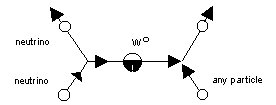 This states that the weak forces was indeed the electric force in disguise. The proof is in, alternating the speed of radioactive decay, or the break up of particles using a very powerful magnet.
- 2/25/1997 - 1987 supernova still a bright spot for modern-day scientists.
Supernova 1987A (a star known as Sanduleak -69 202) that died 166,000 years ago in a nearby galaxy, but the first of its kind in modern astronomy, as of 4:35 a.m. Chilean time on Feb. 23, 1987 was detected by the tiny particles known as neutrinos. This proved the theory that exploding stars emit a burst of neutrinos as they collapse.
Could this mean that neutrinos is what makes a unified field of space-time?
The following is highlights from an article written by Edward L. Wright, last updated on September 21, 1998 found at http://www.astro.ucla.edu/~wright/neutrinos.html entitled "Dark Matter and Neutrinos."
Neutrinos are very weakly interacting, electrically neutral particles that are involved in nuclear interactions where protons are changed into neutrons or vice versa, and in other reactions as well. An example of a weak nuclear interaction involving a neutrino is the free neutron decay.
neutron --> proton + electron + anti-neutrino
This decay has a mean life of 887 seconds or a half life of 10.25 minutes. The cross section for a typical interaction involving a neutrino is 5 x 10-44 (E/[1 MeV])2 cm2 which is very small when compared to the Thomson scattering cross section of 7 x 10-25 cm2. Thus a 1 MeV neutrino could travel through about 35 light years of water before interacting. Even with this very small probability of interactions, neutrinos have been detected coming from nuclear reactors, the Sun, and from supernova 1987A in the Large Magellanic Cloud.
Experiments show that the neutrinos produced in muon interactions are different from the neutrinos involved in interactions with electrons. A third kind of particle, the tau, appears to be a heavier version of the muon which is itself a heavier version of the electron. It is assumed to have its own kind of neutrino as well. Thus there are 3 kinds of neutrinos:
- electron neutrinos, known to have a mass at least 50,000 times smaller than the mass of the electron, and neutrinos are often assumed to be massless, which means zero rest mass.
- muon neutrinos.
- tau neutrinos.
At one time the universe at Hubble time 1/H, there was a thermal background (CMBR - Cosmic Microwave Background Radiation) of neutrinos in equilibrium with the thermal background of photons. Since neutrinos interactions are so weak, this thermal equilibrium only survived until 1 second after the Big Bang. The neutrino background is still present today, with about 56 electron neutrinos, 56 electron anti-neutrinos, 56 muon neutrinos, etc., per cubic centimeter, for a total of 337 neutrinos per cubic centimeter in the Universe. Photons of the CMBR are slightly more numerous with 411 photons/cc.
Measuring the Neutrino Mass
Because the number of neutrinos in the Universe is so large, even a very small neutrino mass can have drastic consequences for cosmology. There are three ways to detect a neutrino mass:
- The energy spectrum of the observable electrons in a radioactive beta decay is modified if the electron neutrino has a non-zero mass. The unseen neutrinos are emitted uniformly in momentum, but for a massive neutrino the change in energy for momenta up to about 0.5*m*c is small, so a relatively large number of electrons are emitted at close to the maximum energy. This leads to a large number of electrons being emitted at just below the maximum possible energy, and thus an abrupt decline to zero at the maximum possible energy. For zero rest mass, the number of electrons per unit energy declines at a constant slope to zero at the maximum energy. What is actually seen is a smooth transition from zero to a constant slope instead of the "cliff" expected for non-zero mass, so only an upper limit of several eV is obtained for the mass of the electron neutrino. Radioactive decays producing muon and tau neutrinos are very hard to observe, so this method gives very weak limits on their masses.
- Time-of-flight data can be used to detect the fact that massive neutrinos travel slightly slower than the speed of light. The speed is given by
v/c = sqrt[1-(mc2/E)2] = 1 - 0.5 *(mc2/E)2 + ...
which leads to an arrival time difference of
Dt = (L/c)*0.5*(mc2/E)2
Since Dt<10 seconds with (L/c)=5*1012 seconds for 10 MeV neutrinos from SN1987A in the LMC, the mass is less than 20 eV. All the detected neutrinos from SN1987A were electron neutrinos, so this limit only applies to one of the three types. The Sudbury Neutrino Observatory (SNO) will be able to detect all three types of neutrinos, and if we are lucky enough to have a nearby supernova SNO may be able to improve the limits on the muon and tau neutrinos.
- Neutrino oscillations: quantum mechanics says that the wavefunction for any particle oscillates at a frequency of mc2/h cycles per second, in the rest frame of the particle. Relativity says that a particle see a time interval in its rest frame that is smaller by the factor (mc2/E) than the lab frame time interval due to time dilation. Thus the effective lab frame oscillation frequency of a particle is [mc2]2/[Eh] and the beat frequency between two particles of different masses is
Df = [c4/Eh]*[m22-m12]
which is 2.7 kHz for m1 = 0, m2c2 = 0.1 eV, and E = 1 GeV. Since it takes 40 msec for neutrinos to travel through the Earth, many cycles of the beat frequency can occur and the neutrinos become a mixture of types when traveling through the Earth.
The cosmological effects of the neutrino mass would be obvious if the sum of the masses of the three types were larger than 40 eV, so this gives a limit on all three types.
Technical Discussion of the Neutrino Background
At the time of weak decoupling, about 1 second after the Big Bang, the neutrinos and the photon-electron-positron plasma had the same temperature, which I will call Tn. All these particles were relativistic since k*Tn>1 MeV, where k is the Boltzmann constant (i.e. 1.380658*10-23 joule/K). The energy of a relativistic plasma occupying a volume a3 ("a" will be the scale factor of the Universe) is
Q = (2\sigma/c) (gb+ (7/8)gf)a3 T4
where \sigma is the Stefan-Boltzmann constant (i.e. 5.67051*10-8 watt/m2k4),
c is the speed of light,
and gb and gf are the number of spin degrees of freedom for bosons (integral spin particles) and fermions (half-integral spin particles).
For photons gb=2, since even though the spin is 1, there are only 2 spin states instead of 2*Spin+1,because the longitudinal EM mode doesn't propagate.
For neutrinos gf=1, even though the spin is 1/2, because one of the helicity states doesn't exist.
Finally for electrons with spin of 1/2, gf is 2 and for positrons gf is 2.
Thus the photon-electron-positron plasma has Q = (4\sigma/c) (1 + 7/4) a3 T4
As the Universe expands and cools adiabatically the entropy in the volume a3 is conserved. Since the photon-electron-positron plasma has decoupled from the neutrinos its entropy is separately conserved. The entropy can be found by a thought experiment of heating the volume from 0 to T and
using dS = dQ/T or S = (4\sigma/c) (1 + 7/4) a3 \int 4 T2 dT
therefore giving us S = (4/3) (4\sigma/c) (1 + 7/4) a3 T3
In the absence of annihilation conservation of entropy gives aT = constant.
During the period from 1 second after the Big Bang until 3 minutes after, the temperature falls to well below the rest mass of the electron. Thus the electron-positron plasma annihilates and transfers its energy and entropy to the photons. This leaves the photons with a temperature Tp that is larger than the neutrino temperature Tn. Energy is not conserved in an adiabatically expanding gas because the pressure of the gas does external work, but the entropy is conserved. Thus the entropy before from photons and the electron-positron pairs.
(4/3) (4\sigma/c) (1 + 7/4) a3 Tn3,
is equal to the entropy afterward just from photons,
(4/3) (4\sigma/c) a3 Tp3,
so
Tn/Tp = (4/11)1/3.
The photon temperature now is Tp = 2.728 K and the neutrino temperature now is 1.947 K.
- If neutrinos are massless then we can compute their equivalent mass density using
rho = [Q/a3]/c2 = Nn (2\sigma/c) (7/8)gf Tn4
where Nn is the number of neutrinos species: Nn=6 for 3 types of neutrinos and 3 types of anti-neutrinos.
This density works out to be very small compared to the critical density.
It is 0.5*[Nn*7/8](4/11)4/3=0.68 times the equivalent mass density of the photons and only 3*10 grams per cubic centimeter.
Even though this density is negligible now, it was significant during the time that helium was formed during Big Bang Nucleosynthesis. The increased density due to the neutrino background during helium synthesis caused the universe to expand faster, and this reduced the time required for the temperature to fall to the point where deuterium could survive. As a result the helium abundance is a few percent larger than it would have been without the neutrino background.
- If the neutrinos are not massless, then they could have a larger mass density now consisting of their number density times their rest mass.
Each neutrino species has a number density of
n = (3/4) (4\pi)\Gamma(3)\zeta(3) (kTn/hc)3
where \Gamma is the gamma function (\Gamma(n=1)=n! so \Gamma(3)=2),
\zeta is the zeta function \zeta(s) = 1 + 1/2s = 1/3s = ... and \zeta(3) = 1/202...
With Tn=1.947 K now the number density of each neutrino species is 56 per cubic cm. This is just (3/22) times the number desity of photons at Tp.
With Nn=6 species the total number density of neutrinos is 336 per cc.
The mass density for massive neutrnos is then rho = 112*(mn-e + mn-mu + mn-tau) gm/cc
compared to the critical density of 8*10-30 gm/cc for Ho=65.
- Thus a neutrino rest mass of 40 eV for one type would give the critical density in neutrinos, and a rest mass of 10 eV for one type or a sum of test masses of 10 eV would be a significant factor in the formation of large scale structures in the Universe such as clusters and super clusters of galaxies.
For these masses the neutrinos are traveling slowly now but their thermal velocities were large in the past. The typical momentum of a relativistic particle in a thermal distribution is p=3kT/c, and the product of the scaled factor and the momentum, ap, is a constant.
Thus neutrinos with rest mass m will be moving at redshift z with a typical velocity
v = pc/sqrt[p2 + (mc)2] = 3(1+z)k(1.947 K)/mc - ...
and the distance traveled, measured now (the comoving distance), is
D = \int (1+z) v dt = 2(c/Ho) sqrt(3*k*(1.947 K))/mc2 + ...
which gives D=100 Mpc for mc2=5 eV in a critical density model Ho=65.
Thus neutrinos can free stream out of the perturbations that make galaxies and cluster of galaxies, but it will remain in the perturbations that make superclusters. Because this behavior is caused by the thermal velocity of the neutrinos, this form of dark matter is called Hot Dark Matter.
The following are recent news article and some also listed in the file, click here to return to Volume III file "Dark Matter Discoveries in 2002-2003"
- 7/20/2000 - Scientists break speed of light - Doctored vapor in tube helped achieve landmark - by Curt Suplee, The Washington Post.
In a landmark experiment, scientists have broken the cosmic speed limit, causing a light pulse to travel at many times the speed of light -- so fast that the peak of the pulse exited a specially prepared test chamber before it even finished entering it.
That seems to contradict not only common sense but a bedrock principle of Albert Einstein's theory of relativity, which sets the speed of light in a vacuum, about 186,000 miles per second, as the fastest that anything can go.
But the findings -- the long-awaited first clear evidence of faster-than-light motion -- are "not at odds with Einstein," said Lijun Wang, who with colleagues at the NEC Research Institute in Princeton reported. "However," Wang said, "our experiment does show that the generally held misconception that ' nothing can move faster than the speed of light' is wrong." Nothing with mass can exceed the light-speed limit. But physicists now believe that a pulse of light -- which is a group of massless, individual waves -- can.
To demonstrate that, the researchers created a carefully doctored vapor of laser-irradiated atoms that twist, squeeze and ultimately boost the speed of light waves in such abnormal ways that a pulse shoots through the vapor in about 1/300th the time it would take the pulse to go the same distance in a vacuum.
As a general rule, light travels more slowly in any medium more dense than a vacuum. In water, light travels at about three-fourths its vacuum speed; in glass, it's around two-thirds.
The ratio between the speed of light in a vacuum and its speed in a material is called the refractive index. The index can be changed slightly by altering the chemical or physical structure of the medium. Ordinary glass has a refractive index around 1.5, and if lead is added it rises to 1.6. The NEC researchers did the opposite by creating a gaseous medium which, when manipulated with lasers, exhibits a sudden and precipitous drop in refractive index, Wang said, speeding up passage of a pulse of light. The team used a 2.5-inch-long chamber filled with a vapor of cesium, a metallic element with a goldish color. The laser beams on the atoms, put them in a stable but highly unnatural state.
A pulse of light is drastically reconfigured as it passes through the vapor, with some of the component waves are stretched out, others compressed. Yet at the end of the chamber, they recombine and reinforce one another to form exactly the same shape as the original pulse, Wang said. "It's called re-phasing."
The key issue is that the reconstitued pulse re-forms before the original intact pulse could have gotten there by simply traveling through empty space.
That is, the peak of the pulse is, in effect, extended forward in time. Thus the detectors attached to the beginning and end of the vapor chamber show that the peak of the exiting pulse leaves the chamber about 62 billionths of a second before the peak of the initial pulse finishes going in.
When sunlight, a combination of many different frequencies - passes through a glass prism, the prism disperses, or spreads out, the white light's components. This happens because each frequency moves at different speed in glass, smearing out the original light beam. Blue is slowed the most, and thus deflected the farthest; red travels fastest and is bent the least. That phenomenon produces the familiar rainbow spectrum.
The NEC laser zapped cesium vapor producing the opposite outcome, by bending red more than blue in a process called "anomalous dispersion," causing a reshuffling of the components of light waves, causing the accelerated re-formation of the pulse, hence the speed-up.
This is the opposite of an experiment last year by Lene Hau, Harvard University and Stanford physicist S.E. Harris who created ultracold gas of sodium atoms that slowed the speed of light pulse to an amazing 38 mph.
The NEC results do not violate the fundamental law of causality; namely, that an effect cannot occur before its cause.
It still leaves in tact that no meaningful signal or energy can exceed light speed.
- 4/2/2001 - Antarctic telescope detects neutrinos by The Washington Post.
A telescope 164 stories tall and 400 feet across, buried a mile deep in Antarctic ice, has detected some of the most exotic particles known. Neutrinos are invisible particles that have no electrical charge or mass. They are devilishly difficult to catch, but considered worth the bother, because they carry information about the most distant and violent events in the universe. The telescope has for the first time observed high-energy neutrinos, according to a team of scientists reporting in a recent issue of Nature. The ability to find high-energy neutrinos promises new insights into such phenomena as colliding black holes, gamma-ray bursters and the wreckage of exploded stars, the researchers said.
- 4/2/2001 - Dark Matter detected by its influences by Gannett News Service.
Scientists from the United States and the United Kingdom have for the first time detected the presence of dark matter in our galaxy. Scientists say that to account for the galaxy's rotation, unseen dark matter must exist. They can detect its presence by its influence on the motion of stars and other galaxies.
The researchers, who published their work in the journal Science, studied ancient white dwarf stars -- dense, cool, faded stars that no longer produce energy through nuclear fusion. They found a population of dwarf stars that may account for at least 3 percent of the halo dark matter. Since these degenerated stars are also very ancient, they could give astronomers a glimpse of the earliest history of our galaxy as well.
- 12/26/2009 - Will dark matter neutralinos top trump the god particle? Supersymmetry is SO 2010 By Patrick Goss, World of tech News.
Found at http://www.techradar.com/news/world-of-tech/will-dark-matter-neutralinos-top-trump-the-god-particle--660224
All talk (at least around the physics lab water-cooler) may have been about the Higgs Boson – or the God Particle to give it its more dramatic moniker – but the humble neutralino could potentially steal its thunder in the coming year, according to scientists.
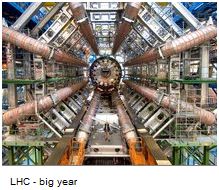 With the Large Hadron Collider now active and continuing on its path to enlighten/destroy humanity, the Higgs Boson could now potentially be spotted for the first time in the twenties/teenies.
However, according to New Scientist, the as-yet unseen neutralino could be ready to steal in from stage left and elbow its way onto the front pages.
Supersymmetry
For those that aren't sure what the neutralino is (tssk), we can inform you that it is a key part of the theory of supersymmetry – where every elementary particle has a super-partner.
Perhaps more headline grabbing is the suggestion that neutralino could well be what is generally known as dark matter, and that it could be properly discovered outside of theory in the coming 12 months.
We wait with baited breath.
- February 2010 At the Heart of All Matter - The hunt for the God particle by Joel Achenbach, National Geographic.
Found at http://ngm.nationalgeographic.com/2008/03/god-particle/achenbach-text
If you were to dig a hole 300 feet straight down from the center of the charming French village of Crozet, you'd pop into a setting that calls to mind the subterranean lair of one of those James Bond villains. A garishly lit tunnel ten feet in diameter curves away into the distance, interrupted every few miles by lofty chambers crammed with heavy steel structures, cables, pipes, wires, magnets, tubes, shafts, catwalks, and enigmatic gizmos.
This technological netherworld is one very big scientific instrument, specifically, a particle accelerator-an atomic peashooter more powerful than any ever built. It's called the Large Hadron Collider, and its purpose is simple but ambitious: to crack the code of the physical world; to figure out what the universe is made of; in other words, to get to the very bottom of things.
Starting sometime in the coming months, two beams of particles will race in opposite directions around the tunnel, which forms an underground ring 17 miles in circumference. The particles will be guided by more than a thousand cylindrical, supercooled magnets, linked like sausages. At four locations the beams will converge, sending the particles crashing into each other at nearly the speed of light. If all goes right, matter will be transformed by the violent collisions into wads of energy, which will in turn condense back into various intriguing types of particles, some of them never seen before. That's the essence of experimental particle physics: You smash stuff together and see what other stuff comes out.
- Found at http://www.eurekalert.org/pub_releases/2010-01/smu-ndt010810.php
Contact: Kim Cobb, cobbk@mail.smu.edu, 214-768-7654, Southern Methodist University
Neutrino data to flow in 2010; NOvA scientists tune design, International collaboration hunting oscillation of muon to electron
Physicists may see data as soon as late summer from the prototype for a $278 million science experiment in northern Minnesota that is being designed to find clues to some fundamental mysteries of the universe.
But it could take years before the nation's largest "neutrino" detector answers the profound questions that matter to scientists.
Construction is underway now on a 220-ton detector that is the "integration prototype" for a much larger 14,000-ton detector. Both are part of NOvA, a cooperative project of the Department of Energy's Fermi National Accelerator Laboratory near Chicago and the University of Minnesota's school of physics and astronomy. The project may ultimately aid understanding of matter and dark matter, how the universe formed and evolved, and current astrophysical events.
DOE gave approval Oct. 29, 2009 for "full construction start" as part of the American Recovery and Reinvestment Act. There are 180 scientists and engineers from 28 institutions around the world collaborating on NOvA.
About 40 scientists from the international collaboration are meeting Jan. 8-10 at Southern Methodist University in Dallas. The meeting is the first for the collaboration since DOE's approval, said John Cooper, NOvA project manager at Fermilab. For more information see www.smuresearch.com. Collaboration scientists will hear technical presentations from one another during the three-day SMU meeting, where they'll refine NOvA's design, including the technical details of software, hardware and calibration, said Thomas Coan, associate professor of physics at SMU and a scientist on the collaboration team.
The integration prototype, known as the Near Detector because it's at Fermilab, and the larger detector, known as the Far Detector because it's farther from Fermilab — are essentially hundreds of thousands of plastic tubes enclosing a massive amount of highly purified mineral oil. The purpose is to detect the highly significant fundamental subatomic particle called the "neutrino" and better understand its nature. NOvA, when construction is completed, will be the largest neutrino experiment in the United States. "The 'detector prototype' has two purposes," said Cooper. "First it serves as an 'integration prototype' forcing us to find all the problems on a real device, and second it will become the 'Near Detector' at Fermilab." The integration prototype will operate on the surface at Fermilab for about a year starting in late summer 2010, Cooper said. Then in 2012 it will move 300 feet underground to become the Near Detector, he said. Construction on the Far Detector project began in June near Ash River, Minn. The detector should be fully operational by September 2013, according to Fermilab.
A hard-to-observe fundamental particle that travels alone, the neutrino has little or no mass, so rarely interacts with other particles. Neutrinos are ubiquitous throughout our universe. They were produced during the Big Bang, and many of those are still around. New ones are constantly being created too, through natural occurrences like solar fusion in the sun's core, or radioactive elements decaying in the Earth's mantle, as well as when the particle accelerator at Fermilab purposely smashes protons into carbon foils.
Our sun produces so many that hundreds of billions are zinging through our bodies every second, Coan said. It's hoped the new detector can resolve questions surrounding three different kinds of neutrinos — electron, tau and muon — and their "oscillation" from one type to another as they travel, he said. Scientists at the new detectors will analyze data from Fermilab's neutrino beam to observe evidence of neutrinos when the speedy, lightweight particles occasionally smash into the carbon nuclei in the scintillating oil of the detector, causing a burst of light flashes, Coan said.
NOvA is looking for the most elusive oscillation of the muon type of neutrino to the electron type, Cooper said.
SMU is a private university in Dallas where nearly 11,000 students benefit from the national opportunities and international reach of SMU's seven degree-granting schools. For more information see www.smuresearch.com.
- 2/16/2010 - New results confirm standard neutrino theory Provided by Fermi National Accelerator Laboratory.
Found at http://www.physorg.com/news185555541.html
The MINOS detector a half mile underground in Soudan, Minn.
(PhysOrg.com) -- In its search for a better understanding of the mysterious neutrinos, a group of experimenters at DOE’s Fermi National Accelerator Laboratory has announced results that confirm the theory of neutrino oscillations and help rule out two alternative scenarios: neutrino decay and the existence of sterile neutrinos.
The Main Injector Neutrino Oscillation Search experiment, or MINOS, explores the properties of muon neutrinos produced at Fermilab. When sending a beam of neutrinos 735 kilometers through the earth to a neutrino detector in the Soudan Underground Laboratory in Soudan, Minn., scientists find that a significant fraction of the muon neutrinos disappears along the journey. The standard explanation is that the missing muon neutrinos morph into two other known types of neutrinos: electron neutrinos and tau neutrinos. This process is known as neutrino oscillations or neutrino mixing.
But could there be another explanation? Scientists are exploring alternatives such as the decay of muon neutrinos into yet-to-be discovered particles or the transformation of muon neutrinos into a fourth type of neutrino, which is often called a sterile neutrino since it would not interact with ordinary matter like the other three known types of neutrinos.
MINOS scientists found that neutrino decay is an unlikely option. They looked at two scenarios: First, the possibility that no neutrino oscillations take place and hence all muon neutrinos decay. Second, they considered the possibility that some muon neutrinos transform into other neutrinos and some decay during their trip from Fermilab to Soudan, which takes about four hundredths of a second. In both analyses, the MINOS results provide strong evidence against the existence of neutrino decay.
The MINOS results also disfavor the existence of a fourth, sterile neutrino. Past analyses have shown that if muon neutrinos are oscillating into sterile neutrinos, only 68 percent of the disappearing neutrinos can do so. The new MINOS analysis shrinks that percentage to 50 percent, and future MINOS data are expected to reduce it further. The MINOS collaboration submitted its results to Physical Review D.
More information: http://www-numi.fnal.gov/PublicInfo/index.html
From this point on all articles on Dark Matter will be entered in the following file Science News Articles From 2011 through 2022
This will open a file as a Word Document with news articles about the latest science regarding many of the subjects above.
|| Top of page || Bottom of page ||
Gauge Theory.
The Gauge Theory tried to unite the weak and electric force. Is there consistency or symmetry in time and space? How do local events connect with distant events?
If one charges a lohole laboratory up to a high voltage then your measurement of the force between two electrons would be quite unaffected. The theorists are at liberty to specify circumstances for which they choose to calculate the local effects of one electron on another. They called this choosing the GAUGE. Conservation of electric charge and the ability of electric charges in different parts of the universe to communicate with one another help the problems of electric force.
Virtual particles of light passed between electric charges, carrying the force and the passage of these particles of light guaranteed that any discrepancies between one part of the universe and another would be ironed out.
Theorist ran into difficulties when they applied the gauge idea to the weak and strong forces. The snag is that the force carriers for the weak force were not nearly such perfect messengers as particles of light. They were massive and short-lived and slow. But consistency could be achieved provided the force carrying particles felt the force themselves.
As the theory which the force carrying particles felt the force themselves and is used in colour force theories with quarks.
�COSMIC FORCES
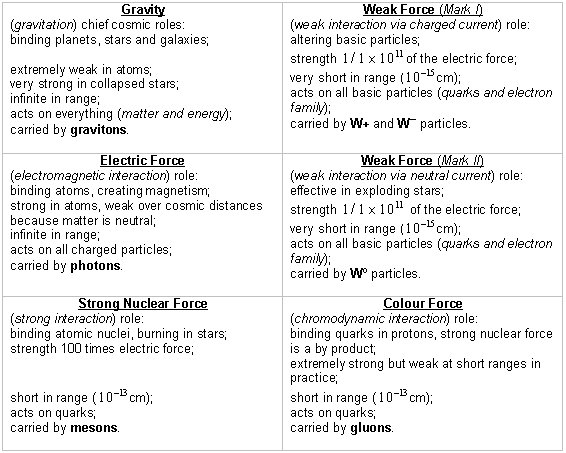
Helium was lighter than four protons, so there was the loss of mass, supplying the energy. This strong nuclear force released enough energy that the mass was reduced by more than ½ of 1%, later calculations shows more than ¼ of the energy was lost, in the form of inert neutrinos.
Uranium can gradually rid itself of excess protons by throwing out small pieces of its nucleus. With less opposition from the electric force, the strong nuclear force could bind the constituents more tightly, with a corresponding release of energy. Eventually it changes to lead, the heaviest of stable elements, with 82 protons.
When neutrinos encountered quarks, they occasionally react with them by the weak force. Neutrinos ought to be able to generate charm (charmed quarks), reacted by the weak force with the quarks in the nucleus of an atom the neutrino changed into a heavy electron.
A neutrino seems to charm a proton, changing it into a heavier particle that quickly breaks up into a strange particle and other normal particles.
The only stuff in the universe that looks reasonably secure in its existence is the neutrino.
The answer to some mathematical scheme of nature must require the large number of particles - quarks of different types and colour, and the members of the electron family to succeed in an overall unified theory.
Although gravity is still missing from the scheme.
|| Top of page || Bottom of page ||
Gravity.
When matter is closely packed together gravity could overwhelm all the other forces. Natures own accelerator in the form of varying magnetic fields that caused particles to orbit and gather speed.
Matter deforms space-time, so particles of light did not travel in straight lines. The effects of the curvature of space are equal to the force of gravity.
Can neutrinos be blacked out by Black Holes?
Is space-time grainy and is that where the qualities of the particles come from?
Could the interaction of neutrinos set these grainy particles in motion and thus this motion of matter makes so-called gravity effective to the scale of the motion and the mass involved?
The Shrinking Sun
A theoretical source of all solar energy and an example of errant behavior. In the string of nuclear reactions that eventually produce helium from hydrogen, a couple of elusive atomic particles, called neutrinos, are created. They have no electrical charge and can pass through most matter almost unimpeded. A neutrino could pass completely through the earth with only one chance in 10 billion of being stopped.
If the sun is heated by fusion, the experiment required should detect a certain number of neutrinos per day. What was found was only a fifth of the number expected. Although we may not understand the physics of neutrino production or detection. Or the temperature inside the sun and hence the rate at which the nuclear fires produce energy is much lower than we thought. Both may be correct.
Jack Eddy found a slight shrinkage of the sun of about 0.1% per century. That is only about 13.7 kilometers per year. Perhaps gravity alternates with nuclear power in providing energy.

d = 1/2at2 = distance earth falls toward the sun 1/9 inch per second.
R = 93,000,000 miles = distance from earth to sun.
G = 6.6732 c 1--8n - m2 / g2
diameter = 865,400 miles (110 times that of the earth).
Surface gravity = 900 ft./sec. (27.9 times the earth)
Temperature = 5750º A, 9900º F
Rotation = 24 days, 16 hours.
Bow Wave Equation maintains an exact 19 degrees 28 minutes and is a function of the gravitational force of the whole earth.

|| Top of page || Bottom of page ||
Unified Equation.
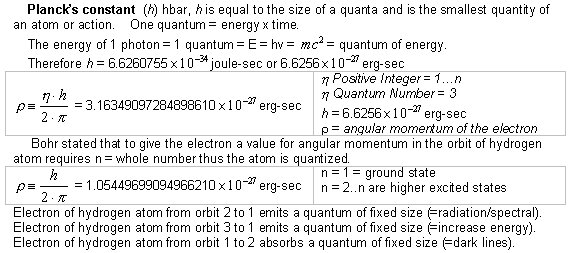
The UNIFIED EQUATION is an ultimate theory that would have only a one-dimensional constant, the Planck mass and a cosmological constant, and it must explain all natural phenomena - from galaxies to quarks and beyond.
Planck Mass = ten millionths of a gram, which is the smallest imaginable black hole - such that the diameter of the black hole was equal to the uncertainty about the location of the mass in space. In principle it might define the speed of light, the relationship of masses and charges in all particles, the strengths of the various forces, the limit to borrowed energy (Planck’s constant).
|| Top of page || Bottom of page ||
Mass.
MASS is often defined as the amount of matter in an object. Usually defined as a measure of inertia, a property of matter. Inertia is the tendency of a stationary object to remain motionless and of a moving object to continue moving at a constant speed and in the same direction.
The greater an object’s mass, the more difficult it is to speed it up or slow it down.
Force, mass, and acceleration are related to Newton’s second law of motion F = ma, where F is force, m is mass, and a is acceleration.
Mass and Weight are not the same thing. Weight is the force on an object due to the pull of earth’s gravity. A body weighs less the farther it gets from the surface of the earth. But its mass remains constant, no matter where it is (weightlessness in space). The moon has less mass than the earth, thus the reason for its gravitational pull being 1/6th of the earth.
Conservation of Mass. Since the discovery of the loss of mass accompanied by a release of energy in atomic bomb or nuclear reactions, it is now believed that the total mass and energy in the universe does not change. However, the quantity of each does vary.
Mass (matter) and energy are related by Albert Einstein’s famous equation E = mc2, E is energy, m is mass, and c is the velocity of light. The formula indicates that large quantities of energy can result from tiny amounts of mass if the mass is completely changed into energy.
*** Is it possible as mass is in motion it changes to energy and creates neutrinos which permeate the space-time around the mass, and result in the creation of gravity? Some objects in motion are not affected by gravitational forces or magnetic forces. Is this the gravitons?
An example is the Gyroscope (a spinning wheel in a movable frame) a mechanical device that seems to defy the force of gravity. The gyroscope (Gr. Gyros, revolution, and skopein, view, view the revolution of the earth) holds its original position in space while the earth turns under it. It is interesting to note that the earth holds its original position in space while the universe turns under it. A housefly’s top speed is 4 ½ miles per hour, but yet it can keep its position in space while enclosed in an automobile moving at 80 miles per hour. When you ride a bicycle you must control gyroscopic forces in order to keep the bicycle standing. The wheels must be kept spinning, and if you lean slightly to one side, you will not fall over, but only turn in the direction of the lean. Bicycles show two gyroscopic forces: (1) gyroscopic inertia and (2) precession.
Gyroscopic Inertia is the ability of the spinning axle of a gyroscope always to point in the same direction, no matter how the support of the gyroscope moves about. It is gyroscopic inertia that keeps the bicycle upright as long as the wheels keep spinning. Another example is a spinning football traveling straight to its target.
Does the gyroscope weigh less while it is spinning? If mass is constant, and weight can vary depending on it’s relative location to a gravitational force, is it possible that an object spinning or in motion can lose mass as energy (released as neutrinos).
Precession is the tendency of a gyroscope to move at right angles to the direction of any force applied against it. Precession makes the bicycle turn a corner when you lean to one side. Another example is a hula hoop which is being pushed from the side against the top, it merely will turn a corner, a precesses, or turns at right angles to the force you applied against it.
A spinning Gyroscope is not affected by the downward pull of the earth’s gravity or by the presence of a magnetic field. On a moving ship the gyroscope always points in the same direction regardless of the ships direction. In a Gyrocompass it always indicates true north, and is unaffected by the earth’s magnetism or by the rolling and pitching of the ship.
The Sun
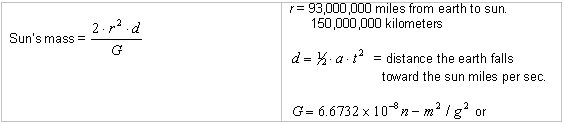
Sun’s mass = 2.2 x 1027 tons (333,400 Earth mass tons); 1.98 x1030 kilograms; 2 x 1033 grams
Neutron Star = 1010 kg/m
Sun’s diameter miles = 865,400 earth diameter miles x 110 = 9.519 x 10⁵
Pluto is 6,000,000,000 kilometers from the Sun.
Sun’s density = Earth’s density pound per cubic feet x 0.4
Sun’s density = 137.28 lb./cubic ft, 0.05 lb./cubic inch, 1.41 gram/cubic cm
White Dwarf Star density of matter = 1 x 10⁸Kg/m
Sun’s surface gravity = 27.9 x Gravitational Constant feet per sec squared (of the Earth).
Sun’s surface gravity = 897.655 feet per sec squared, averages 900 ft./sec.2 (27.9 x the earth)
Sun’s temperature = 5750º A, 9900º F Surface K = 5800
Sun’s rotation = 24.6667 or 24 days, 16 hours.
Sun light constant energy = 1.94 recorded at the earth in calories per cm squared/min.
Star’s orbit = 2 x 10⁸ years; Sun’s orbital velocity = 250 km/sec. (clockwise)
Sun’s distance to the galaxy center = 10 KPC
Sun’s luminosity = 4 x 1026joules/sec.
Recent articles about the universe's missing mass:
- 1/17/1996 New theory on universe’s missing mass presented.
San Antonio, Texas - Up to half of the so-called missing matter in the universe may be burned out and invisible stars, according to astronomers who used bent light from distant stars to probe for objects called MACHOs (Massive Compact Halo Objects). This mysterious and invisible matter that shapes galaxies and keeps them from flying apart. Lawrence Livermore National Laboratory is searching the Milky Way galaxy for events that suddenly cause light from stars in another galaxy, the Large Magellanic Cloud to appear to brighten, a phenomena known as “microlensing.” The gravity of a passing object causes light from a star to bend and the star’s image becomes brighter, as if magnified by a lens. So far seven instances were detected each lasting an average of 2.5 months. Assumed to be white dwarves, the burned remnants of ordinary stars. The analysis over two years suggests that these objects make up to 50 percent of the unseen, or dark, matter in the halo surrounding the Milky Way galaxy. This search was prompted by the theory that only about 10 percent of the matter in the universe emits light or radiation that can be detected by telescopes. How much matter would be needed for the gravitational effects observed in the universe? Since the unseen matter issues no light or heat, it is called cold dark matter. The search for this material is one of the major quests of modern astronomy. Other theories that dark matter comprises exotic types of subatomic particles, yet to be identified. Some researchers have proposed brown dwarfs, failed stars. Also, cold dark matter may reside in black holes.
- 1/7/2003 - Ring of stars could be leftovers from gobbling galaxy by Dan Vergano, USA Today.
Seattle -- Long hidden by gas and dust, a band of stars encircles our Milky Way Galaxy, astronomers say.
Galaxies are huge collectors of stars that fill space like islands of light. In seeking to discover how they are formed, scientists have in recent years discovered more signs that big ones, like our own, grow by swallowing stars ripped from their smaller brethren.
Orbiting our galaxy more than twice as far from the center as our sun, the distant band of perhaps 500 million stars look like the remains of one of those meals, says Heidi Newberg of Rensseaer Polytechnic University. Her Sloan Digital Sky Survey team presented the discovery at the American Astronomical Society meeting.
About 120,000 light-years in diameter (one light-year equals about 5.9 trillion miles), the doughnut-shaped ring was observed by Newberg's team members, who digitally examined hundred of images for a peek at a wedge of space most astronomers saw as blocked by closer stars in the flat disk of our galaxy.
Tens of thousands of stars orbiting our galaxy in an organized fashion told the astronomers that they were looking at a large, unknown structure, Newberg says. Their mission is to completely map one-quarter of the sky, determining the distances of about 1 million distant galaxies.
Also a Dutch, English and Australian scientists presented evidence of the size of the ring. Looking at a separate portion of the sky, they also detected signs of the star ring in the direction of the constellation Andromeda.
The very large ring is "unmistakable" evidence that the Milky Way consumes smaller galaxies, say astonomer Bruce Margon of the Space Telescope Science Institute. Adding to the evidence, two University of California astronomers announced they had found signs of debris trail stars, leftovers from a consumed small galaxy, in the nearby Andromeda Galaxy. Andromeda is a large spiral galaxy like our Milky Way.
The astonomers hope the band of stars will tell them more about the mysterious "dark matter" that encircles our galaxy.
|| Top of page || Bottom of page ||
TOE - Theory of Everything, String Theory, Supersymmetry.
� In the Scientific American, January 1996 - an article “Explaining Everything” by Madhusree Mukerjee, staff writer - page 88-94.
Renata Kalloch of Stanford University, “I want my four-dimensional canonical gravity to be one at infinity?”
Jeffery A. Harvey of the University of Chicago ask “What does it mean that your black holes have zero mass? Do they move at the speed of light?”
“No, they have nothing, no momentum,” Gary T. Horowitz of the University of California at Santa Barbara replies. No energy, no momentum, nothing there!
These theoretical physicists gathered at the Aspen Center for Physics in the Colorado Rockies for the Theory of Everything, or TOE. This theory must be simple enough to write down as a single equation and to solve. The solution will describe a universe that is unmistakably ours: with three spatial dimensions and one time dimension: with quarks, electrons and other particles that make up chairs, magpies and stars; with gravity, nuclear forces and electromagnetism to hold it all together; with even the big bang from which everything began. The major paradigms of physics - including quantum mechanics and Einstein’s gravity - will be revealed as intimately related. “Concepts of physics as we know them today will be completely changed as the story unfolds,” predicts Edward Witten of the Institute for Advanced Study in Princeton, N.J.
A decade ago the “string theory” promoted the idea that the most elementary object in the universe is an unimaginably tiny string, whose undulations were posited to yield all the particles and forces in the universe. These loops or segments of strings are about centimeter long and vibrate in many different modes, just as a violin string can. Each vibrational mode has a fixed energy and so by the laws of quantum mechanics can be thought of as a particle. The string theory ran into mathematical barriers and diverged into five competing theories with thousands of solutions, most of which looked nothing like our universe.
A new symmetry, called duality, is making all the different strings twine into one another, and redefining a fundamental particle - or string. Elementary objects now seem to be made of the very particles they create. Witten believes duality not only will lead to TOE but also may illuminate why the universe is the way it is. “I think we are heading for an explanation of quantum mechanics,“ he asserts. String mathematics is so complex that it left behind the vast majority of physicists and mathematicians.
At the same time, the world of duality is getting even more bizarre. Strings mutate with ease into black holes, and vice versa; new dimensions blow up in different realms; and not only strings but bubbles and other membranes shimmer down the byways of the universe.
A New Symmetry
Two theories are said to be dual is they are apparently dissimilar but make the same physical predictions. For example, if all the electrical and magnetic quantities in Maxwell’s equations for electromagnetism are interchanged, one nominally obtains a different theory. But if in addition to electrical charges, the world is presumed to contain magnetic charges (such as the isolated north pole of a bar magnet), the two theories become exactly the same - or dual.
Duality makes elementary and composite objects interchangeable: whether a particle or other entity is irreducibly fundamental or is itself made up of even more fundamental entities depends on your point of view.
The first signs of duality appeared while physicists were working on quantum-field theories, theories that describe particles as quantum-mechanical waves spread out in space-time. In the field theory called quantum chromodynamics, or QCD, quarks are elementary particles that have a kind of charge, much like electrical charge, called color. Color makes quarks attract one another very strongly, clumping into pairs and triads to form larger, composite particles such as protons.
In the world there are no particles with magnetic charge, there are no particles with color magnetic charge. In 1974 Gerard’t Hooft of Utrecht University in the Netherlands and Alexander Polyakov, then at the Landau Institute near Moscow, describe how fields making up quarks might knot into small balls endowed with color magnetic charge. Such clumps - which are visualized as spheres studded with arrows representing vectors - are called solitons and behave like particles. The theory of quarks with color charge now implied the existence of solitons with color magnetic charge, otherwise known as monopoles. Monopoles are composite particles, derived from the fields of more elementary quarks.
In 1977 David Olive and Claus Montonen, working at CERN near Geneva, speculated that field theories involving color might be dual. Instead of quarks being elementary and monopoles composite, perhaps one could think of the monopoles as being elementary. Then one might start with a field theory of interacting monopoles, finding that it gave rise to solitons that looked like quarks.
Elementary String, on closer inspection, turns out to be an intricate, composite object, woven from the very particles and strings to which it gives rise.
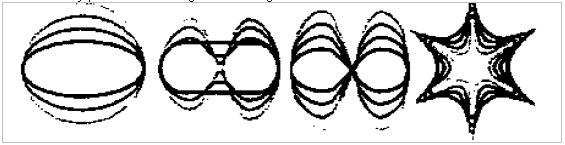
Diverse Modes of vibration can be induced in any string. Quantum mechanics allows the waves to be interpreted as particles. If loops of string about 10-33 centimeter long are fundamental constituents of matter, then their vibrational energies are the masses of elementary particles such as electrons, quarks and photons.
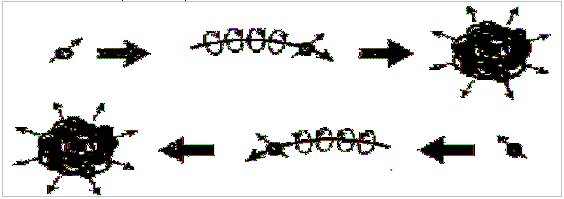
Duality a type of symmetry, allows a view of composite entities as equivalent to fundamental particles, and vice versa. For example, a quark has a kind of charge called color (red). Moving electrical charges generate magnetic fields; likewise, moving quarks generate color magnetic fields (blue). Sometimes many quarks can tangle into composite object, called a monopole, that has a color magnetic charge (top tight). Because of duality we look at a monopole as a fundamental particle (bottom right). Monopoles can clump to form quarks - which are now composite objects (bottom left). The arrows (black) signify properties of the particles that are vectors, such as angular momentum.
Angular momentum the vector product of the position vector (from a reference point) and the linear momentum of a particle. The vector sum of the angular momentums of each component particle of an extended body.
� Establishing the mathematics came in February 1994, as Ashoke Sen of the Tata Institute in Bombay, India, showed that on occasion, predictions of duality could be precisely tested - and were correct.
Meanwhile Nathan Seiberg of Rutgers University was developing an extremely helpful calculational shortcut for studying QCD. His work was based on supersymmetry the idea for each kind of particle that constitutes matter, there should be a related particle that transmits force, and vice versa. The symmetry has yet to be found in nature. Seiberg used supersymmetry to constrain the interaction between particles, and with Witten went on to demonstrate that versions of QCD that include super symmetry are dual.
Symmetry is an exact correspondence of form and constituent configuration on opposite sides of a dividing line or plane or about a center or an axis.
QCD is difficult to calculate with because quarks interact, or “couple,” strongly. But monopoles interact weakly, and calculations with these are easy. Duality would allow theorists to deal with monopoles - and automatically know all the answers to QCD.
Armed with duality, Seiberg and Witten went on to calculate in great detail why free quarks are never observed in nature, verifying a mechanism put forth in the 1970s by ‘t Hooft and Stanley Mandelstam.
The validity hinges on the assumption that supersymmetry exists. In duality something thought of as composite becomes fundamental. Seiberg speculated that quarks are solitons, duals of some other elementary particles that are even smaller.
Stringing Strings Together
The concept of duality grew out of the field theories, and is natural in the string theory. Duality can unite strings of different kinds, existing in different dimensions and in space-times of different shapes. A peculiarity of string theory - it is consistent only if strings originally inhabit a 10-dimensional space time. The real world has four dimensions, three of space and one of time. The extra six dimensions are assumed to curl so tight that they pass undetected by large objects such as humans - or even quarks.
From a distance a garden hose looks like a one-dimensional surface, like a line, but as you get closer it has a two-dimensional surface, with one dimension curled up tight. To string theorists the extra six dimensions can curl up in very many different ways.
A type of duality called mirror symmetry found in the late 1980s has helped lessen this problem by merging some of the alternative solutions. Mirror symmetry revealed that strings in two different curled spaces sometimes yield the same particles. For example, if one dimension becomes very small, a string looped around that dimension - like a rubber band around a hose - might create the same particles as a string moving around a “fat” dimension.
The size to which a dimension shrinks is rather similar, in string theory, to another parameter: the strength with which particles interact. In 1990 Anamaria Font, Luis E. Ibanez, Dieter Lust and Fernando Quevedo, collaborating at CERN, suggested that something like mirror symmetry also exists for coupling strengths. Just as large spaces can have the same physics as small ones, perhaps a string theory with large coupling could give the same results as another having small coupling.
Strings look like particles, so that duality in string theory implies duality in field theory, and vice versa. Each time duality was tested in either case, it passed with flying colors and helped to draw the two realms closer together.
As duality emerged from supergravity, a unified theory attempt to stretch Einstein’s gravity to include supersymmetry. String theory tried to modify particle theory to include gravity. In 1986 Michael J. Duff of Texas A&M University was able to derive a picture for super gravity that involved vibrations of a new fundamental entity: a bubble. Whereas strings wiggled through 10 dimensions, this bubble floated in 11. Duff continued to work on closed membranes. He found that a five-dimensional membrane, or a “five-brane,” that moved through a 10-dimensional space could serve as an alternative description of string theory.
The five-brane could wrap itself around an internal curled space, like a skin around a sausage. But if this internal space shrank to nothing, the bubble ended up looking like a string. Duff suggested that this convoluted string was actually the same as the ones in string theory, positing a “string-string” duality. Christopher M. Hull and Paul K. Townsend also were working with generalizations of duality in string theory independently of Duff.
December 18, 1994 Looking into fourth dimension. Princeton, N.J.--a discovery by Nathan Seiberg, a professor of physics at Rutgers University, and Edward Witten, professor of mathematical physics at the Institute for Advanced Study, makes solving equations in four-dimensional space as easy as solving them in two-dimensions. Einstein showed that we live in a four-dimensional world and these two professors believe they have solved a decades-old puzzle and unlocked some of its mysteries. For physicists, the discovery offers insight into the strange behavior of subatomic particles called quarks, the smallest building blocks of matter.
Building on discoveries made in the 70s and early 80s they took an extremely complex equation of the behavior of quarks, simplified it and solved it. Quarks are the particles at the heart of the atom that bind together to comprise all matter. Experiments seems to indicate that quarks cannot be individually extracted: the harder you try, the more fiercely they stick together. Physicists have methods to describe this behavior but until now, no way to calculate it.
The Seiberg-Witten breakthrough will allow us to understand more things about four-dimensional spaces. It will be compatible to inventions on the scale of lasers, magnetic resonance imaging equipment and the data compression methods.
Explosions of Dualities
In March 1995 Witten at a conference at USC pulled together evidence for duality from diverse realms. He recognized that Hull, Townsend and Duff were all talking about the same idea and went on to conjecture that Duff’s bubbles in 11 dimensions were solitons of a particular string in 10 dimensions. Witten believes the five string theories involving 10 dimensions that now prevail will all turn out to be reflections of an ultimate, supreme, quantum string.
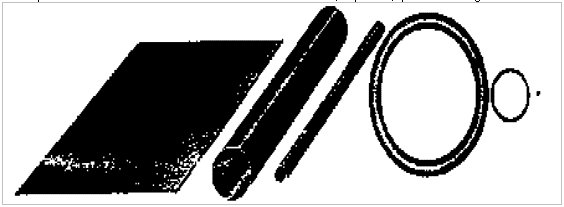
Reducing dimensions of a space can be achieved by pasting its edges together and shrinking it. For example, (1) a two-dimensional sheet of rubber is first curled into (2) a cylinder, and the curled dimension is then shrunk. (3) when thin enough, the cylinder looks like a (one-dimensional) line or hose. Twisting around this length of “hose” and by sticking its ends together, one gets (4) a doughnut shape. The radius of the doughnut can be shrunk until it is small enough to approximate (5) a point - a zero-dimensional space. Such changes could explain why the extra dimensions of space-time that string theory says must exist are too small to be detectable.
Duff even proposed a “duality of dualities” - the duality between spaces, and that between elementary particles and composite objects, might turn out to be connected. Among the most peculiar predictions of such ideas is that the size of a curled space influences the strength with which particles interact, and vice versa. So if an internal dimension is big, coupling between particles might also be large.
If a curled dimension blows up, in a far corner of the universe, space-time acquires a new fifth dimension. Where it squeezes tight, as in our immediate environment, quantum effects appear. Indeed, the fundamental scale associated with quantum theory, called Planck’s constant, is intimately entwined with duality: it relates, for example, the mass of a particle or string with that of its dual. This is the most compelling evidence that string theory might teach us about quantum mechanics.
Black Holes
In April of 1995 a connection emerged between strings and black holes - promising to overcome a major embarrassment in string theory. Strominger, Greene and David R. Morrison of Duke University found that black holes help connect thousands of solutions to string theory in a complex web. If enough mass accumulates in one place it collapses under its own gravitational pull to create a black hole. But as Stephen W. Hawking of the University of Cambridge has argued, a black hole - which absorbs everything, even light - may also radiate particles, slowly losing mass and shrinking. If the original mass were made up of strings, the decay would ultimately lead to an object with zero size - an “extremal” black hole, looking in fact rather like a particle, or black bubbles or black sheets - may simply be clumps of string fields, otherwise know as solitons. As seen on the previous page a black hole can be a dimension of space-time which curls up very tight, as taking an infinitely long hose, looping it around and sticking the ends together so that it resembles a doughnut. Both dimensions of the surface of the hose can be shrunk, creating a much smaller space. If the doughnut becomes very thin at one point allowing it to become massless, and can be included in the calculations as quantum mechanical waves.
When an electron falling into the point charge of a proton gives you infinities. Only when you add quantum mechanics do you see that the electron goes into orbit.
The Theory
The ultimate theory is still far off. A problem is that there may never be any experimental tests for strings. No one can even conceive of a test for something so minute: modern equipment cannot probe anything smaller than centimeter. Hopes that the Large Hadron Collider at CERN in 2005 will discover supersymmetry. In the real world the four dimensional space-time is flat, an imperfect supersymmetry attributed to nature, which makes space-time curl up impossibly tight in all dimensions. Witten plans on getting around this impasse, which relies on duality between theories in different dimensions. Beginning with a universe in which only three dimensions are initially flat - one of the four we know is still curled up, then induce the fourth dimension to expand, leading to a world like the one we know.
The peculiarity of gravity also raises many difficult questions. Einstein found that gravity arises from the curvature of space-time. Therefore to quantize gravity is to quantize space and time, which may emerge as some approximate structure at large distances.
The Mathematics of Duality
Free-flowing mathematics inspired by nature allowed physicists to solve some long-standing problems in classical mathematics. They are also forcing open a new branch of mathematics, called quantum geometry.
In 1990 Edward Witten of the Institute for Advanced Study in Princeton, N.J., was awarded the Fields Medal - the Nobel of mathematics - for the manifold ways in which he had used theoretical physics to unravel mathematical puzzles. A key concept from physics, supersymmetry, turns out to connect intimately with modern geometry. The latest triumph of supersymmetry is a means of classifying four-dimensional spaces, the real world, are also the most complex.
In 1982 Simon K. Donaldson of the University of Oxford had shown how to use quantum field theories to count the number of holes in a four-dimensional space and thus to classify it topologically. (For example, a sphere, a doughnut and a pretzel all belong in different categories of two-dimensional surfaces because they contain different numbers of holes.) But the calculations were horrendous because of the intractable nature of the field theories.
In 1994 Nathan Seiberg of Rutgers University and Witten pointed out that the results of one supersymmetric quantum-field theory could be provided by another, vial a symmetry called duality. They provided a set of numbers that could calculate almost 100 times faster than the “Donaldson numbers.” Seiberg-Witten theory allowed us to answer most of the outstanding questions completely.
Duality of a different kind, called mirror symmetry, is used to solve the question, “How many curves of a given complexity can be drawn in a particular space?,” especially for convoluted curves. Brian R. Greene of Cornell University and Ronen Plesser of Hebrew University of Jerusalem found that strings inhabiting two apparently unrelated spaces can yield the same results. Using mirror symmetry, Philip Candelas of the University of Texas at Austin and others were able to tell the results of virtually impossible calculations in one space by looking to the mirror space - thus deriving the long-sought numbers.
Quantum effects make it possible for spaces with different numbers of holes - such as a doughnut and a sphere - to transform smoothly into one another, a no-no for mathematicians. (The standard rules for manipulating spaces allow them to be stretched or compressed, but no holes can be opened or closed in them.) The study of such spaces is becoming the brand new field of quantum geometry (reviving algebraic geometry and number theory).
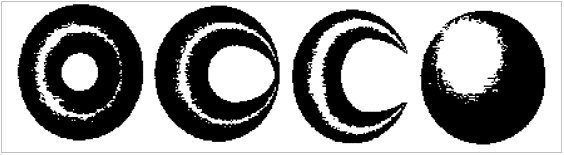
Eliminating holes in closed spaces was thought impossible in mathematics, but physicists have found a way. A doughnut and a sphere are both ways of curling up a two-dimensional surface, but they differ in the number of holes they contain. (A doughnut has one; a sphere has none.) If part of the doughnut thins to a point, however, the rest of it can be separated. The doughnut can then be remodeled into a sphere.
A new page on Volume III - String Theory Equations, History and Concepts.
And also new page on Volume III - M-Theory Equations, History and Concepts.
Recent news articles:
- 2/9/2001 - Scientists pose questions about theory of how universe works by Matt Crenson, The Associated Press.
New York -- Physicists may have poked a hole in their current theory of how the universe operates.
Researchers at the Brookhaven National Laboratory on Long Island reported experiments that showed a subatomic particle deviating slightly from its expected behavior.
That tiny discrepancy could provide support for exotic theories such as supersymmetry, which hypothesizes that every particle has a much heavier, yet-to-be-observed counterpart.
"I would say it's a glimpse or a suggestion that there's supersymmetry out there," said James Miller, a physicist at Boston University and a member of the team that conducted the Brookhaven research.
But team members and physicists not involved with the experiment cautioned that the case is not yet proven.
"These people are doing beautiful work," said Charles Prescott of the Stanford Linear Accelerator Center. "But it is too early to say thery're seeing supersymmetry."
Much of physics today is based on the Standard Model, a complex set of equations that describes how all the fundamental forces except gravity interact with known particles.
For decades, physicists have designed experiments to challenge the model. The Brookhaven experiment may be the first time physicists have contradicted the Standard Model in more than three decades of trying. "If you find an experiment that disagrees with it then that's fairly significant," Miller said.
The experiment examined the behavior of muons, heavier relatives of electrons, as they floated in a powerful magnetic field. In a magnetic field, a muon modifies its spin, a subatomic property similar to the rotation of a toy top.
Earlier experiments had found a spin modification fairly close to that predicted by the Standard Model. But the Brookhaven experiment called g - 2 (gee minus two), was several times more precise than previous measurements.
It concluded that the actual change in the muon's spin differed from predictions by just a few parts in a million.
That samll discrepency suggests there is something lacking in the Standard Model, though there is still a chance that further results could bring theory and experiment back into line.
The most likely explanation for the anomalous result is supersymmetry, a theory that goes beyond the Standard Model.
In Supersymmetry, every known particle has a much heavier counterpart paired with it. Unlike the Standard Model, the theory has a place for gravity and explains why the various particles have the masses they do.
- 3/18/2002 - Researchers report antimatter success by The Washington Post.
Physicists think they may have, for the first time, created the antimatter equivalent of hydrogen atoms -- a long sought accomplishment researchers hope will help them better understand the fundamental nature of matter.
A team of scientists working at the CERN physics laboratory outside of Geneva used electirc and magnetic fields to bring together antiprotons and positrons. The researchers believe they have succeeded, and that it's likely they combined to form antihydrogen atoms. But more research will be needed to confirm that, the researchers said.
The eventual goal of the work is to determine whether the fundamental laws of physics, such as gravity, apply to anti-atoms.
|| Top of page || Bottom of page ||
Black Holes.
� May 26, 1994 Black hole proof said found. Washington - Researchers say they have proof for the existence of a super-massive black hole, an extremely dense galactic body that is gobbling up nearby stars. Holland Ford of John Hopkins University and Richard Harms of Applied Research Corp. in Landover, Md., announced that in Hubble Space Telescope images of Virgo galaxy M87 they found a spiral disk rotating at about 1.2 million miles an hour around a center point. A huge black hole containing a mass equal to more than 2 billion suns would have the gravity to keep such a fast-moving disc from braking apart.
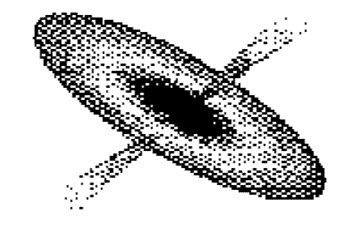
The existence of a black hole was predicted in the general theory of relativity. M87 is a giant among a cluster of galaxies about 52 million light years (light year = 5.87 trillion miles) away from Earth. The Hubble pictures of the center of the galaxy revealed a spiral formed by fast-moving gas clouds being drawn toward the center, rather like water going down a drain. M87 contains a mass 2.3 billion suns in an area only about the size of the Earth’s solar system. To the left is a telescopic view of a black hole.
Digging a gravity well
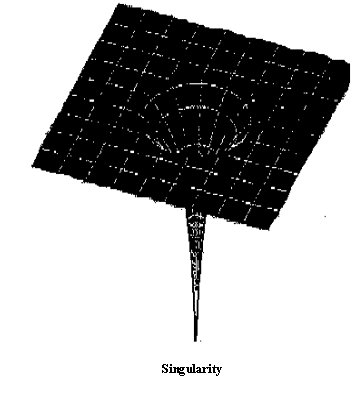
Einstein’s 1915 General Theory of Relativity predicted that the gravity of massive objects warps space and time. If space is represented by a flat sheet, the warping caused by gravity can be visualized as a well or depression. The more massive the object, the more powerful is its gravity and the deeper the resulting well. The gravity of a star or planet will dig a depression into space. When an object becomes massive and dense enough, it collapses. The elementary particles of matter becomes crushed into each other, until the forces that normally keep them apart are overwhelmed and all the matter is crushed into a point called a singularity. When that happens, the object is said to have become a black hole. Its powerful gravity traps anything that falls into it, even light.
� From Scientific American March 1993
Black Holes and the Centrifugal Force Paradox by Marek Artur Abramowicz.
An object orbiting close to a black hole feels a centrifugal force pushing inward rather than outward. This paradoxical effect has important implications for astrophysics.
Centrifugal force n. The component of apparent force on a body in curvilinear motion, as observed from that body, that is directed away from the center of curvature or axis of rotation.
Centrifugal force: the outward push, away from the center of the curve that grows stronger as a vehicle’s speed increases. A.R. Prasanna of the Physical Research Laboratory in Ahmedabad, India and myself (chair of the astrophysics department at the University of Goteborg in Sweden) were surprised to find out that Einstein’s general theory of relativity predicts that in certain circumstances the centrifugal force may be directed toward, not away from the center of a circular motion. If an astronaut came close to some extremely massive and compact object, such as a black hole, the astronaut would feel a centrifugal force pushing inward, not outward. This inward push would increase if the orbital speed is increased.
Albert Einstein predicted in 1915, a gravitational field warps space and bends light rays. In 1919 Sir Arthur Stanley Eddington confirmed this prediction by measuring the minute deflection of rays passing close to the sun. The gravitational field of the sun will bend a light ray less than one thousandth of a degree if the ray grazes the surface. Therefore a black hole can deflect light to a greater extent.
November 9, 1995 A black hole? Hubble watches. The Hubble Space Telescope was aimed at an ancient globular cluster known to astronomers as M15, and which appears to earthbound telescopes as simply a blur of light. It is believed to be a black hole formed early in the cluster’s history, gradually gaining mass as more stars spiraled inward (several thousand times more massive than our sun). The area is about 37,000 light years away, in the constellation Pegasus. In the vacuum of space, light travels 5.88 trillion miles in one year.
Astronomers have gathered enough evidence to convince most that black holes must really exist. A black hole traps forever any radiation or matter that gets too close to it. This point of no return defines the size of the black hole, or its gravitational radius. A black hole with the same mass as our sun would have a gravitational radius of about three kilometers. If a light ray travels parallel to the surface of the black hole at a distance equal to three times the gravitational radius, it will be bent by about 45 degrees. At 1.5 times the radius, it will orbit the black hole in a perfect circle. The existence of the circular light ray is a key element in the centrifugal force paradox.
A complicated formula derived from the general theory of relativity yielded a prediction about what force an object would feel if it orbited around a black hole along the same path as a circular light ray. The formula implied that no matter how fast the object moved, it would always feel exactly the same total force pushing inward. A motionless object would feel exactly the same inward force as a projectile that traveled around the circle at almost the speed of light.
According to elementary dynamics, the centrifugal force depends on the orbital speed, whereas gravitational force does not. Therefore, the total force - which is just the sum of the centrifugal and gravitational forces - must also depend on the orbital speed. After rechecking all calculations of the formula and finding no mistakes, confirming the results of the prediction about how matter behaves when traveling along the path of a circular light ray.
Centrifugal Forces Near a Black Hole
In a space station built around a black hole, such that the station is a circular tube centered exactly on the path of the circular ray so that the axis of the tube and the path of the ray coincide. The astronauts know that the axis of the tube is circular because they have measured the curvature of the walls along the length of the tube using straight rulers. Yet because of the bending of the light rays they see the tube as perfectly straight!
If one hung a lamp in the center of the tube, no matter how far you walked along the tube, the lamp would still appear in the center, and it is never obscured from view by the bend of the tube. In theory you could see the lamp in front of you as well as behind you. It is also possible to see multiple images of the lamp. One might conclude that the tube is straight, and would not expect any centrifugal effects to act on objects moving inside the tube. Therefore one would deduce that the centrifugal force should be zero.
Three tubes built around a black hole would appear circular to a distant observer but would not necessarily appear that way to someone inside the tubes.
The first tube (a) is far away from the black hole, where light rays travel in nearly straight lines. Both observers would see the tube curve around the black hole, and both would predict correctly that an object traveling within the tube would be pushed outward, away from the black hole, by the centrifugal force. A gyroscope traveling within the tube will precess as a result of the centrifugal force.
The second tube (b) is constructed around a region of space where light rays are bent in perfect circles by the gravitational field of the black hole. Because the light bends, the observer inside the tube would see it as perfectly straight and would correctly predict that there should be no centrifugal force.
The third tube (c) is very close to the black hole. Light rays are curved so much that the tube appears to curve away from the black hole. The observer inside the tube would now correctly predict that the centrifugal force would push an object inward, toward the black hole, and would cause the gyroscope to precess.
Regarding the relativity theory in 1985 Brandon Carter of the Paris Observatory realized that if an object moves at a constant speed along the path of any light ray - circular, curved or straight - the force that keeps the object on course does not depend on how fast the object is moving.
If an object traveled at constant speed along the path of a light ray that was curved by some gravitational field, the object would behave as if it were traveling in a straight line. This is correct so long as the associated gravitational field did not change over time. We developed the concept of optical geometry, a framework for understanding the dynamic behavior of objects in strong gravitational fields. Optical geometry depends on measurements made using light signals.
In conventional geometry, one can measure the length of a curve by counting how many rulers fit along a curve. The distance between two points in space can then be defined as the length of the shortest curve between them, known as a geodesic. If one makes measurements in a flat space, free from gravitational fields, the shortest curve, or geodesic, between two points is just a straight line.
In optical geometry the distance between two points in space is defined as half of the time it takes for light to travel from one point to the other and back.
According to Einstein’s general theory of relativity, the three dimensions of space and the one dimension of time together form a four-dimensional space-time. In any space-time, with or without a gravitational field, light always moves along geodesics, and therefore it always traces the geometry of space-time. In the space warped by a gravitational field the light rays are curved and do not coincide with geodesics. Therefore in the general case, the geometry of space is not traced by light rays.
Although light propagation and dynamics are not connected in conventional geometry of space, they are connected in optical geometry, as a rescaling mathematical procedure often used in the theory of relativity, known as a conformal transformation. The rescaling straightens the curved light rays, and so they appear as geodesics in optical geometry. This allows the isolation of technicalities imposed by the curvature of space so that one can concentrate on the basic physical issues. This type of conformal transformation allows us to understand dynamics in curved spaces, seeing is believing, which explains the paradoxical behavior of objects moving along the path of the circular light ray.
Malcolm Anderson and Jose P. S. Lemos demonstrated that if a cloud of gas travels in orbit very close to a black hole, the viscous stresses in the cloud transfer angular momentum inward. Ordinarily viscous stresses transfer angular momentum outward. This helps to explain how a cloud of gas (known as an accretion disk) orbiting a central black hole supplies the energy that powers the active nuclei of some galaxies. The viscous stress tends to make the rotation of the accretion disk more rigid, thereby slowing down the rapidly rotating inner part of the disk and speeding up the slowly rotating outer part. In this way the angular momentum is carried outward.
Optical geometry suggest that the space close to the black hole is turned inside out. The outward direction of straight rulers is different than the outward direction defined by light rays. Success has been found involving the behavior of rotating matter in very strong gravitational fields. The two most important problems are the gravitational collapse of rotating stars and the coalescence of two extremely dense objects known as neutron stars.
In 1974, Subrahmanyan Chandrasekhar of the University of Chicago and Miller, found that, according to Einstein’s theory, in the late stages of the contraction, when the gravitational field is very strong, the increase in flattening ceases and the rotating star becomes more spherical. The explanation for this is found in optical geometry in the unusual behavior of the centrifugal force in the strong gravitational field.
Two spaceships that travel in the same orbit around a black hole. Each craft carries a gyroscope and a weight that hangs on a spring. By measuring its length, each can determine the tension in the spring. The tension equals the sum of the two forces acting on the weight: the gravitational force and the centrifugal force.
If one ship comes to a halt, it’s gyroscope does not precess, and they can conclude that the force stretching the spring is the gravitational force alone. Then this result is communicated to the other spacecraft, which continues to speed around the black hole on the same orbit. They measure the total force that stretches their spring and finds the centrifugal force by subtracting the gravitational force that the first craft measured. This would be true in both weak and strong gravitational fields.
Optical geometry tries to show that “inward” and “outward” are not absolute concepts; they are relative in spaces warped by strong gravitational fields. We understand that left and right, as well as up and down, are relative.
Recent news about black holes:
- 1/17/2000 - Galaxy's Black Hole Weaker Than Thought by Curt Suplee, The Washington Post.
The supermassive black hole at the center of our Milky Way galaxy appears to be sort of a wimp, surprised astronomers announced recently. With a mass of 2.6 million suns, its perimeter should be ablaze with X-rays created as trillions of tons of ultra-hot compressed gas vanish into its bottomless maw. Instead, eagerly awaited first findings from the Chandra observatory show that the output "is really puny," said Gordon Garmire of Pennsylvania State University. A hole that hefty should be "a million or even a billion times brighter than what we're seeing. That's a real puzzle."
Discovery of this spectacular galactic underachievement was only one of many unprecedented observations from Chandra -- a 45-foot-long X-ray observatory placed in orbit last year -- reported at a meeting of the American Astronomical Society.
Chandra scientists also revealed several heretofore unknown features of both the local and distant cosmos, including the richest field fo X-ray star sources ever seen (in the sword of Orion, which contains the nearest massive star-forming region), the innards of a violently expolding "starburst" galaxy, an eerie supernova remnant containing enough oxygen to supply 1,000 solar systems, and an oddball aspect of the Andromeda galaxy, the closet one that resembles ours in size and shape.
Astronomers have long believed that our galaxy, like so many others, has a supermassive, super-hungry black hole at its core. The radiation generated from gas, dust and stellar material falling into a black hole should create electriaclly charged particles called a plasma, which should revolve in a spiral fashion, in effect creating a giant antenna that "broadcast" in long wavelengths that can be detected by radio telescopes. Previous observations had spotted the apparent location of our galaxy's central black hole toward the constellation Sagittarius.
Another way to detect a hole is to measure the X-ray output from the compressed plasma. But Earth is about 26,000 light-years from the center of the Milky Way, and X-rays originating there have to penetrate an enormous amount of matter on the way here. So the X-ray signal from the presumptive black hole has been too faint to observe.
Now Chandra finally has detected an X-ray source very close to the radio-wave source. But if it is our central black hole, it is pathetically weak. There are several possible explanations, most involving the environment around the galactic center. Infalling gas might pile up, becoming so heated and pressurized that it pushes away from the hole, limiting the amount of gas available to produce X-rays.
Something similar seems to be happening in the Andromeda galaxy which is weaker than ours, said Chandra scientist Stephen Murray of the Harvard-Smithsonian Center for Astrophysics.
- 2/14/2000 - Black Hole in a Lab by James Glanz, The New York Times.
Astronomers believe that nothing, not even light, can escape after it has been captured by the gravity of a black hole in space and goes, so to speak, down the cosmic drain.
Two physicists, Dr. Ulf Leonhardt and Paul Piwnicki of the Royal Institute of Technology in Stockholm, Sweden and University of Saint Andrews in Scotland, have now theorized that the same strange effects might be produced in laboratories on Earth, though not with gravity. Instead, they suggest, light itself could be gobbled up by swirling gases and fluids, called an optical black hole, a creation relying on the recent discovery that in certain sustances, light can be slowed from its usual 186,000 miles a second to 40 mph. In that sort of fluid medium, according to the physicists, a very fast vortex would also have a point of no return for light rays that came too close to its center.
Experiments performed last year by Dr. Lene Vestergaard Hau of Harvard University, Dr. Stephen E. Harris of Stanford University using an ultracold cluster of sodium atoms called a Bose-Einstein condensate to slow light to about 40 mph. Related experiments have been done in a vapor of rubidium atoms, Leonhardt said.
In fact, Leonhardt and Piwnicki suggest that experimenters create vortexes in those substances while shining laser light through them. They calculate that the black hole effect could take over in small vortexes moving at the outer edge of the effective black hole with speeds of from hundreds of yards per second to just a few feet per second, depending on how much further progress is made on the slow-light substances.
- 5/14/2001 - Finding Sheds Light On Spinning Black Holes by Kathy Sawyer, The Washington Post.
For the first time, astronomers have evidence that a black hole can spin like a top. In this case, a black hole 10,000 light-years from Earth appears to be whipping matter around itself at 27,000 revolutions per minute, flashing X-rays in unsteady spasms and twisting the fabric of space-time. "We can see the light emitted from matter plunging into the black hole, said Todd Strohmayer, of NASA's Goddard Space Flight Center in Greenbelt, Md. This material "whips frantically around the black hole before it is lost forever." The study of black holes is suppose to move science closer to a theory that explains how all the forces of nature work together, so called "theory of everything." This would represent the workings of gravity to fit harmoniously with the other forces of nature, said Virginia Trimble, of the University of Maryland and the University of California, Irvine. Albert Einstein's theory of gravity has passed a series of observational tests, but nobody has figured out how to make it compatible with the laws of quantum physics that govern the subatomic world. Black holes, where all these forces reach extremes, make ideal -- if difficult -- laboratories. What Strohmayer found were unique patterns in the X-ray radiation emitted around the black hole as it pulls material at almost the speed of light from a companion star orbiting around it. At the same time, the maelstrom around the hole ejects particles in jets from its north and south poles, also at incredibly high velocities. "Black holes are one of the greatest energy sources in the universe," Strohmayer noted. They surmised that the black hole inherited the rotation properties, or angular momentum, of the star that formed it.
- 1/10/2002 - Astronomers get X-ray pictures with clear view of galaxy's center by Paul Recer, The Associated Press.
Washington -- The sharpest picture ever taken of the center of the Milky Way galaxy, home of the solar system, shows bizarre stellar characters -- neutron stars, dwarf stars and small black holes -- clustered around a supermassive black hole. The galactic center is bathed in a fog of superheated gas and extremely active with stars being born, old stars blowing up into supernovae and black holes sucking in clouds of matter, said Q. Daniel Wang of the University of Massachusetts at the American Astronomical Society. Our solar system is in the suburbs of the Milky Way, about halfway out one of the galaxy's spiral arms and about 25,000 light years from the center, resulting in astronomers unable to get a clear picture of the center using ordinary telescopes.
But X-rays generated by the churning energy at the center penetrate the dust. The Chandra X-Ray Observatory, launched in 1999, has been able to take a series of 30 pictures that are combined. Wang said the portrait captures more than a thousnad X-ray sources. Earlier X-ray telescopes detected only about a dozen, he said. By analyzing the spectra of the X-rays, his team was able to determine that the galactic center has hundreds of white dwarfs stars, also neutron stars, and stellar black holes And at the very center, said Wang, is a supermassive black hole.
- 1/7/2003 - Bad-tempered black hole burps up blast of X-rays by Dan Vergano, USA Today.
Seattle -- Like most fabled monsters that are big and hard to look at, the supermassive black hole lurking in the center of our Milky Way Galaxy has a few untidy personal habits.
In research results unveiled by NASA's Chandra X-Ray Observatory probe at the American Astronomical Society meeting, astronomers describe the black hole, called Sagittarius A* in scientific parlance, as a messy eater that spits up near-daily X-ray blasts. Each blast could hold 12 to 45 times the daily energy output of our sun, packed into a 10-minute tantrum.
The X-rays are thought to be from gas accelerated to near the speed of light and heated to millions of degrees by a close encounter with the black hole. Anything not eaten by the giant as the object passes is shot away by the strength of the black hole's gravity.
|| Top of page || Bottom of page ||
Age of the Universe.
- 3/21/1993 - Spacecraft to search for faint echoes thought part of Big Bang.
Pasadena, Calif. - Three spacecraft designed to study Mars, Jupiter and the sun will start searching today for gravitational waves, faint echoes believed to have been left by the creation of the universe and other cataclysmic events.
Albert Einstein’s general theory of relativity predicted that gravitational waves should ripple through space and time after they are generated by the most violent events in the universe.
So scientists from the National Aeronautics and Space Administration and the European Space Agency will conduct one of the most sensitive searches till April 11th. During the experiment, radio signals from Mars Observer, the Jupiter-bound Galileo and the Ulysses solar explorer spacecraft will be tracked continuously by big antenna dishes near Madrid, Spain; Canberra, Australia; and Goldstone, Calif.
If strong enough gravitational waves move through the solar system during the experiment, they should warp the fabric of space between Earth and the three spaceships, causing slight changes in the frequency of the radio signals.
Finding gravitational waves would verify Einstein’s prediction. Moving at the speed of light, gravitational waves are traveling distortions of space time, possibly events that created the universe roughly 15 billion years ago. This experiment could detect very long gravitational waves, such as those produced by the “big bang,” supermassive black holes (believed to occupy the centers of galaxies) or the collision of two such objects. The experiment won’t detect shorter gravitational waves generated by exploding stars or supernovas, ordinary black holes or the motion of two dense neutron stars orbiting each other.
- 10/27/1994 - Hubble closes in on answers.
Scientists say the Hubble Space Telescope has brought new evidence to astronomy’s biggest questions: How fast is the universe expanding? The result renewed a long-standing paradox in which the universe appears to be younger than some of its stars. Will there be a revision of the theories of the cosmos. The success came easily while looking at a galaxy called M100, hoping to get a sharp image of a particular kind of star used to estimate distance. In this case M100 was 56 million light-years away (light year = 5.9 trillion miles). With this accurate distance scale the rate of expansion of the universe could be determined. The long-debated number called the Hubble constant can be combined with assumptions to estimate the age of the universe.
Their estimate was 80 kilometers per second per megaparsec. A megaparsec is about 3.3 million light-years, and it is needed in the Hubble constant to reflect the fact that more distant objects are flying away faster than those closer ones. The M100 galaxy is moving fast enough to cross the continental United States in about three seconds.
The new estimate of the expansion rate implies that the universe is a relatively young 8 billion years old, given the standard theory.
The age becomes 12 billion years old if one assumes the universe contains far less matter than many theorists believe.
Prior estimates have ranged up to 16 billion years. Scientists have estimated the age for the oldest stars at 14 billion. A dilemma to whether we assume that the star ages are correct and revise the standard theory about the universe. Will scientist resurrect the concept that the vacuum of space somehow exerts a repulsive force that opposes gravity making an older age to the universe.
- 12/18/1994 Primal universe viewed.
Fourteen billion years ago, the universe was a chaotic collection of stellar fragments amid neat galactic clusters according to Hubble Space Telescope photos released by NASA. These views are from objects 14 billion light years from Earth, and adds to the debate about the age of the universe previously measured in October at a rate of expansion, at 8 to 12 billion years. Still astronomers are confronting the impossible dilemma of finding stars that are older than the universe. These objects at 14 billion light years are fuzzy points of light on ground based telescopes. Hubble is getting sharp enough vies to determine the shapes and character of such distant objects. At 9 billion light years away there were many ellipticals and few spirals that were asymmetrical and distorted. At 12 billion light years away they found very old elliptical galaxies, but no spiral galaxies, instead there were a collection of “ragged objects” with no definite shape. At 14 billion years ago the universe was chaotic, messy and different.
- 7/16/1995 - Chilly tests confirm Einstein right about state of matter.
Seventy years after Albert Einstein predicted it, scientists have proved it: existence of a new state of matter. In a tabletop experiment atoms of gas were chilled to the lowest temperature ever achieved to create a “superatom.” Using a laser and an exotic evaporation to plunge the temperature of rubidium gas to within 20 billionths of a degree of absolute zero, or minus 459.67 degrees F. Carl Wieman, a physicists has found a new state of matter with completely different properties from any other kind of matter.
The matter is called Bose-Einstein condensate from an idea by Satyendra Nath Bose, and Indian physicist in 1925.
- 9/6/1995 - Space telescope study renews debate on universe.
The standard theory of the universe may have to be revised because the age it implies for the cosmos is too young, new observations from the Hubble Space Telescope suggest. This universe in the standard theory is estimated about 9.5 billion years old. This clashes with solid evidence that some stars are older, at least 12 billion to 17 billion years old. Hubble studies were suppose to find the most sought after so-called Hubble constant, which is the rate at which the universe is expanding. It shows that the standard assumptions about the cosmos might be wrong. Assumption upon assumptions. If the universe contains less matter than the standard theory assumes, which would mean the universe will continue to expand without slowing. - 11/3/1995 - Hubble photos show the birth of stars.
Astronomers hail a photograph of stars forming inside a 6-trillion-mile-long cloud of gas as “perhaps the most spectacular picture we’ve seen from the Hubble Space Telescope.” This will become strong operational evidence that this process works and actually happens.
- 2/18/1999 - Danish physicists finds way to slow the speed of light - Scientists says her achievement has many potential uses - by Malcolm W. Browne, The New York Times.
A Danish pysicist Dr. Lene Vestergaard Hau of Rowland Institute for Science in Cambridge, Mass., and at Harvard University and her colleague Dr. Steve Harris of Stanford University have found a way to slow light down to about 38 miles an hour, and expect to slow the pace of light still further, to 120 feet an hour.
Both commented that it has many potential uses, not only as a tool for studying a very peculiar state of matter but also in optical computers, high-speed switches, communications systems, television displays and night-vision devices.
One of the most desirable features of the apparatus it does not transfer heat energy from the laser light it uses to the ultracold medium on which the light shines. This could have a stabilizing effect on the functioning of optical computers, which use photons of light instead of conventional electrons. A switch using the system could be made so sensitive that it could be turned on or off by a single photon, Hau said.
The medium used in slowing light by a factor of 20 million was a cluster of atoms called a "Bose-Einstein condensate" chilled to a temperature of only fifty-billionths of a degree above absolute zero. Absolute zero is the temperature at which nothing can be colder. It is minus 273.15 degrees on the Celsius scale, minus 459.67 on ehe Fahrenheit scale and zero on the Kelvin scale.
Hau's group reached an ultralow temperature in stages, using lasers to slow the atoms in a confined gas and then evaporating way the warmest remaining atoms.
Bose-Einstein condensates, named for the theorists who predicted their existence, Satyendra Nath Bose and Albert Einstein, were first prepared in a laboratory four years ago and became the objects of research in the United States and Europe. They owe their existence to some of the rules of quantum mechanics. One of these is Werner Heisenberg's uncertainty principle, which states that the more accurately a particle's position is known the less accurately its momentum can be determined, and vice versa. In the case of a Bose-Einstein condensate, atoms chilled nearly to absolute zero can barely move at all, and their momentum therefore approaches zero. But because zero is a precise measure of momentum, the uncertainty principle makes the positions of these atoms uncertain. In a condensate, as a result, such atoms are forced to overlap and merge into super atoms sharing the same quantum mechanical "wave function," or collection of properties.
It was such a super atom, made of a gas of superpositioned sodium atoms, that provided Hau and her associates with the optical molasses they needed to slow light down.
The group tuned a "coupling" laser to the resonance of the atoms in their condensate, shot the laser into the cold cluster of atoms and therby created a quantum mechanical system of which both the laser light and the condensate of atoms were components. At this stage, the system was no more transparent than a block of lead, Hau said. They then sent a brief pulse of tuned laser light from a probe into the condensate, at a right angle to the coupling laser, in such a way that the laser-condensate system interacted with the probe laser. Under these conditions about 25 percent of the probe laser light passed through the "laser-dressed condensate," but at an astonishingly low speed. The light that emerged from the apparatus, not visible to the naked eye, was only 25 percent as strong as the light that entered, but detectors found that it had roughly the same color.
- 2/12/2003 - NASA photo reveals previously unknown details of universe by The Associated Press.
Washington -- NASA's Wilkinson Microwave Anistropy Probe, a satellite orbiting 1 million miles from Earth for 12 months, allowed a release of what it called the most vivid snapshot of the infant universe ever taken, giving evidence that answers of longstanding questions about the age, composition and evolution of the universe has been gathered.
Charles Bennet, WMAP principal investigator at the Goddard Space Flight Center in Greenbelt, Md., said after NASA released the picture "The patterns in the picture tell us all kinds of things about the universe." One key finding in the data is that the first generation of stars to shine in the universe ignited much earlier than previously thought -- only 200 million years after the Big Bang, the theoretical explanation for the explosion that gave birth to the universe.
The image shows the "afterglow" of the Big Bang, called the cosmic microwave background. Thus this portrait pegs the age of the universe at 13.7 billion years old, with a small 1 percent margin of error. Patterns in the afterglow of the Big Bang are frozen in place only 380,000 years after the Big Bang, NASA said.
- 4/27/2003 - Earth is not, but universe really flat by Matthew Fordahl, The Associated Press.
Pasedena, Calif. -- The first detailed images of the embryonic universe suggest the cosmos will expand forever and not someday collapse upon itself, according to new research on the Big Bang.
U.S. team leader Andrew Lange of the California Institute of Technology for a $4 million international project dubbed "Boomerang," a sensitive telescope carried aloft for nearly 11 days in late 1998 measured minute variations in the cosmic microwave background radiation. This faint glow is believed to be the fading remnants of the Big Bang 12 billion to 15 billion years ago.flat" universe in which parallel lines never cross, thus ruling out the possibility that the fabric of space time is curved onto itself like a sphere or bent outward like a saddle. It also means that the universe will not collapse in a big crunch, said Italian team leader Paolo deBernardis of the University of Rome, La Sapienza.
The flat universe also fits the so-called inflationary theory that the universe underwent a rapid expansion in a fraction of a second after its birth.
Measurements of the small ripples indicate the large-scale geometry of the universe, which the general theory of relativity says is determined by the total amount of matter and energy in the cosmos.
The Boomerang data also reveal hundreds of complex structures that represent the effects of the density variations in the early universe. They are the seeds in which clusters of galaxies would form, said Boomerang scientist John Ruhl, a physicist at the University of California, Santa Barbara.
Scientists hope to further refine the data to better quantify the nature of the matter that makes up the cosmos. "What we will get is a census of the universe but without knowing what kind of things make up the population," said Edward Wright, an astronomer at the University of California, Los Angeles. He also promotes that neutrinos may be the missing matter in the universe "dark matter."
|| Top of page || Bottom of page ||
Quark-gluon plasma quest.
Scientific American March 1993 page 32-34
Quark Quest - Have all six flavors finally been observed?
Beauty, also known as the bottom quark, was discovered two decades ago, but truth, the top quark, cannot be found anywhere in the cosmos, except at Fermi National Accelerator Laboratory in Batavia, Ill. A discovery of the top quark, would require five to 20 events in each of several decay modes.
Top remains the only one of the six quarks whose existence has not been confirmed. Most matter - proton and neutrons - is made up of quarks known as up and down. Other flavors - strange, charm and bottom - can be produced only in particle accelerators and perhaps in dense, massive stars. Top, if it exists, has probably not made an appearance since the hot, explosive birth of the universe.
Steven Weinberg of the University of Texas believes the top quark exists and that we know its mass within a certain range. The top quark should provide the clue as to why all particles have the masses they do. Physicists are puzzled about why every fundamental particle has two siblings that are the same in every way except for their mass. For example: the bottom quark responds to weak, strong and electromagnetic forces in very much the same way as the strange and down quarks, yet bottom is 25 times more massive than strange and 700 times heavier than down.
To explain why some particles have more mass than others, physicists have devised several theories, the simplest of which is the Higgs mechanism. Just as the electric charge of a particle says something about how strongly it interacts with electromagnetic fields, the mass of a particle is related to how strongly it couples to the so-called Higgs field, according to theory. Such a field would manifest itself as a new type of particle, the Higgs boson.
The bottom quark has been hard to find because it is heavy, at least as massive as a silver atom, and more than 20,000 times heavier than an up quark. Producing massive particles by smashing protons together with their antimatter counterparts can release 1.8 trillion electron volts of energy, which may or may not be enough energy to generate top quarks. Top quarks also elude detection because it is extremely unstable, with a life of a millionth of a billionth of a billionth of a second, which disintegrates into detectable secondary particles.
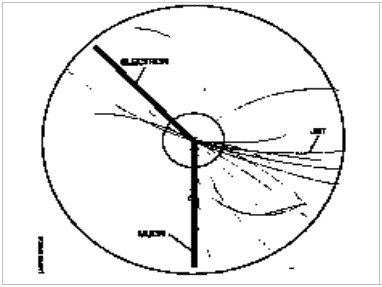
Physicists at Fermilab detected, in 1989, an event consisting of an electron, a muon and many jet particles. So recently they believed they have detected it again. The event could represent the decay of a top quark and its antimatter partner (antitop quark). Each of these two particles decays into a bottom quark and a particle called W, associated with conveying weak force. The bottom quark then disintegrates, producing jets of particles. The W particle decays into either an electron or its sibling, a muon.
The missing link - the top quark, an elusive subatomic particle that existed for a billionth of a second at the beginning of time, has been sought for 17 years as the missing link in the Standard Model, a framework of 12 particles thought to form all matter.
The Structure of Matter - in the center of the atom is a nucleus, which consists of particles such as protons and neutrons, which are composed of triplets of quarks. A proton may consist of two up quarks and one down quark. A proton and antiproton collide in the Fermilab accelerator, where a top quark is created from the energy produced.
Particles in the Standard Model
Mass shown is measured in billions of electron volts
Quarks are particles bound together by the strong interaction.
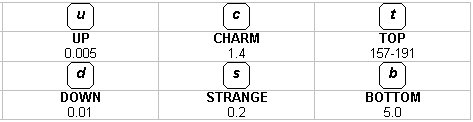
Leptons are particles not subject to strong interactions
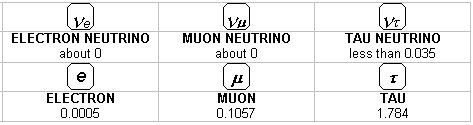
- 5/1/1994 - Scientists find first evidence of top quark.
Batavia, Ill. - The big-bang theory is intact, along with the universe as physicists know it. A 17-year search has yielded evidence of the existence of the top quark, a basic building block of nature without which the big-bang theory and our understanding of time and matter would fall apart. Using the world’s most powerful particle accelerator at a U.S. Energy Department’s Fermi National Laboratory outside of Chicago, 440 researchers have been trying to find the top quark. This is only the first direct evidence of the top quark, and with 12 to 18 more months of experiments they might actually prove its existence. As you have seen above the top quark is one of the six kinds of quarks believed to make up protons and neutrons inside atoms. Over the years, five quarks have been discovered.
Scientists used an electronic field to accelerate larger particles to nearly the speed of light, then made them collide. The collisions produced miniature energy bursts like the big bang. The bursts appeared to yield a quark that was heavier than the colliding particles. It is as if two tennis balls collided and a bowling ball flew out.
- 2/11/2000 - Scientists create 'new state of matter' - Studies are said to verify parts of Big Bang theory - by Curt Suplee, The Washington Post.
Luciano Maianim, general director of the CERN laboratory in Geneva and scientists at Europe's premier high-energy physics facility announced that they have created a "new state of matter" that has not existed since a few millionths of a second after the Big Bang that generated the cosmos. The CERN team smashed lead atoms together so hard that they achieved densities 20 times greater than an ordinary atomic nucleus and temperatures 100,000 times as hot as the center of the sun.
In the new state, which scientists have inferred from seven experiments over the past six years, tiny sub-nuclear particles called quarks and gluons are squeezed together and heated to such an extreme that they can move freely.
This never happens under ordinary conditions. In all but extreme circumstances, quarks are tightly bound into groups of three to form neutrons and protons, or into pairs to form particles called mesons. There is no such thing as a free quark.
Although theory indicates that quarks might become unbound in an ultra-high-energy environment, free moving quarks would last have been seen in the ferocious energy torrent just after the Big Bang, before the quark-and-gluon soup cooled and congealed into conventional protons and neutrons, so this new matter verifies important predictions of the present theory.
Experts in the United States called the claim as premature at best, since no one knows exactly what a free-quark condition is supposed to look like. The CERN achievement is promising for the next stage of research, slated to begin this summer at Brookhaven National Laboratory's new Relativistic Heavy Ion Collider on Long Island.
The collisons produced at CERN disintregrated the lead into their constituent quarks and gluons, making them behave in weird ways. The more familiar forces of nature, such as gravity or magnetism, get weaker over distance. But the so-called "strong force" that binds quarks together works in reverse: the closer the particles are, the more freely they can move about.
Theory has long predicted that if quarks and gluons could be crammed close enough together and brought to sufficiently high energies, they would create a "quark-gluon plasma" in which particles would be unconfined. It is this plasma that is thought to have filled the universe microseconds after the Big Bang.
As that plasma cools, the quarks would recombine into new forms including numerous mesons. Mesons are unstable and break up almost immediately. But CERN's detectors are able to identify the particular types of mesons emitted during the experiment. The distinctive types of mesons emitted were exactly what theory predicted would result from the plasma condition, the scientists said.
CERN officials stopped short, however, of saying that they had achieved the long-sought quark-gluon plasma, declaring only that they had shown quark deconfinement.
The following articles are also shown in the
Dark Matter for 2002-2003:
- 7/21/2000 - Scientists find first direct evidence of subatomic particle tau neutrino - Discovery supports standard model theorized in 1978 - by Joseph B. Verrengia, The Associated Press.
After a two-decade search, scientists have found the first direct evidence of one of the most elusive subatomic particles in nature -- the tau neutrino. The discovery announced by the scientists from the United States, Japan, Korea and Greece at the Fermi National Accelerator Laboratory outside of Chicago after searching since 1997. The tau is one of the fundamental building blocks of all matter. It is the last of the tiny particles described in the Standard Model of Particle Physics to be confirmed in experiments.
The standard model seeks to encapsulate all elementary particles and forces in a single explanation. Now the bits have been identified, though the many forces that guide their interplay remain a mystery.
"It's a tremendous milestone," said Stanford University physicist and Nobel Prize winner Martin perl, who theorized the existence of the tau neutrino in 1978. "Now it has been seen and it behaves in the way we expected."
Neutrinos are hurtling everywhere at the speed of light. Trillions pass through each of us every second. Yet they are among the hardest to detect of all subatomic particles, carrying no electrical charge and virtually no mass -- perhaps one-millionth that of an electron.
The tau neutrino is the third and perhaps final type of neutrino to be found. The first two types -- electron neutrinos and muon neutrinos -- were discovered in 1956 and 1962. In 1978, tests by Perl and others at Stanford discovered the existence of another class of subatomic particle, the tau lepton. This suggested there would be a tau neutrino, too, because neutrinos are precursors to leptons.
In 1997, scientists using the ring-shaped particle accelerator at Fermilab fired an intense neutrino beam into a 50-foot detector composed of iron plates coated with an emulsion. Then they analyzed the 6 million impressions left on the coating, and with computer assisted video camera to create 3-D images of the particle tracks. After narrowing it down they found four clear tracks of a tau lepton that were caused by tau neutrino collisions. They can never be detected directly, since they have no charge, only their signature is detected.
- 1/22/2001 - Densest Matter by James Glanz, The New York Times.
Scientists at Brookhaven National Laboratory in New York have used the particle accelerator called the Relativistic Heavy Ion Collider, to smash the nuclei of gold atoms together at nearly the speed of light to make the highest density of matter ever created in an experiment, they announced at a conference. The debris speeding away from the collisions, made them conclude that they had produced densities more than 20 times higher than those that exist within the nuclei of ordinary matter. Temperatures in the compressed matter reached more than a trillion degrees, similar to the large amounts of matter at those densities and temperature lasted a few millionths of a second after the start of the Big Bang.
These experiments are hoped to shed light on the compressed matter at the cores of exploding stars called supernovas, the stellar cinders called neutron stars.
The figure between 1.5 to 2 times, broke the record density announced last year at CERN, a European particle physics laboratory. in Geneva.
Both still have the ultimate goal to produce a state of matter never before recorded on Earth and known as a quark-gluon plasma.
- 3/19/2001 - Unusual States of Matter by Earl Lane, Times-Post News Service.
Reinhard Stock remembers the days in the late 1970s when a small band of physicists speculated that ordinary matter, if compressed enough, might transform into a new state that would mimic some of the conditions at the birth of the cosmos. Theorists argued that the protons and neutrons at the core of the atom, under extreme conditions, would "melt." That could allow the constituent building blocks, called quarks, to briefly roam free (along with particles called gluons that bind the quarks tightly together) in a state called the quark-gluon plasma. Physicists figured they might get a glimpse of it by accelerating heavy ions -- atoms stripped of their outer electrons -- to nearly the speed of light. The ions would then be sent crashing into each other or against stationary targets.
Last year, officials at CERN, the European physics research center near Geneva, Switzerland, announced that heavy ion experiments at that lab had produced circumstantial evidence for a new state of matter in which quarks had been briefly "deconfined." Many physicists were skeptical, since the current heavy ion program at CERN winds down, for the researchers to make their best case for having found a hint of the quark-gluon plasma. Evidence from other colliders may take two or three years. The goal is to explain why the universe turned out the way it looks today, physicists say. Quarks combine in trios or pairs to form the bulk of the matter we see today in the cosmos, and they are tightly bound through the strong nuclear force transmitted by uncharged particles called gluons. The experiment suggest that force gets only stronger as efforts are made to separate pairs of quarks.
|| Top of page || Bottom of page ||
Higgs Field.
Over the past few decades, particle physicist have developed the theoretical Standard Model, which provides a framework to understand the fundamental particles and forces of nature.
One hypothesis in this model is the quantum field, which is supposed to be responsible for giving particles their masses, why they have the masses they do or any mass at all, as if the universe is permeated by an undetectable form of energy and this field is called the Higgs field. The Higgs field gives all other particles a mass, every particle in our universe swims through this field, particles with no mass do not feel or interact with this field, only those with mass. This field is not considered a force, it cannot accelerate particles, nor can it transfer energy. A consequence of wave-particle duality, is that all quantum fields have a fundamental particle associated with them, so the particle associated with the Higgs field is called the Higgs boson, nicknamed the "God particle" by some.
Since the Higgs field would be responsible for mass, thus the fact that the particles do have mass indicated the existence of the Higgs field. Thus the assumption that the Higgs boson exists, based on the effect it would have on the properties of other particles and fields. The Higgs boson is a particle, it gets its mass like all other particles, by interacting with the Higgs field. The Higgs boson does interact with all other kind of particles and may be the mediating particle that gives the mass to particles. it is not a stable particle and can be created in collisions, but will decay eventually. This particle prefers to interact with the heaviest elementary particles, especially the top quark (about the mass of a Gold atom), which was discovered at Fermilab in 1995. Neutrinos, the lightest particles with almost zero mass, barely interact with a Higgs boson.
The Standard Model describes three types of forces:
- Electromagnetic interactions, which cause all phenomena associated with electric and magnetic fields and the spectrum of electromagnetic radiation. This was the most familiar force to be understood, and its influence extends to infinite distances, because it describes particles interacting with the massless photons, the most basic units of the electromagnetic field.
- strong interactions, which bind atomic nuclei.
- weak nuclear force, which governs beta decay - a form or natural radioactivity - and hydrogen fusion, the source of the sun's energy. The influence of the weak interaction is confined to subnuclear dimensions, less than about 10-15 centimeters, and has particles W and Z which has 100 times the mass of the proton. The Higgs particle is connected with the weak force.
Since the 1970s, we have come to understand the strong and weak forces almost equally well as the electromagnetic force. High-energy experiments at CERN, the European laboratory for particle physics, near Geneva and at the Stanford Linear Accelerator Center (SLAC), physicists have made precision tests of the Standard Model. The Standard Model does not describe the fourth force, gravity.
As we stated the Higgs particle is connected with the weak force, and modern theory of weak interactions describes particles (the W and Z particles) interacting with electrons, neutrinos, quarks and other particles.
We know the photon has no mass at all, or that it can be no more massive than a thousand-billionth-billionth-billionth (10-30) the mass of an electron, theoretically exactly zero mass. The W and Z particles, however, would have enormous masses: more than 80 times the mass of a proton, which makes it a puzzle. The inconsistency occurs in that two high energy particle would probably never collide with one another, leaving the conclusion there must be additional particles. The simplest models that explain the masses of the W and Z have only one such particle: the Higgs boson. Other proposals suggest there may be several Higgs bosons, entirely new types of strong interactions and a possible new fundamental physical symmetry, called supersymmetry.
The U.S. Congress in 1993 set progress for discovery of the Higgs boson. The large accelerator in Geneva known as LEP (the Large Electron Positron collider), accelerates electrons and their antimatter twins (positrons) to very high energies, then allows them to collide.
If it is found the Higgs boson would decay into a b quark and a b antiquark. If not found and the Higgs bosons have larger masses, they might be unveiled at the Fermi National Accelerator Laboratory in Batavia, Ill, by 2000.
Also a new accelerator, LHC (the Large Hadron Collider), is scheduled to start operation at CERN in 2005. It is hoped that they will uncover what hides the symmetry between the weak and electromagnetic interations, by studying collisions among quarks at energies approaching 1 TeV, or a trillion (1012) electron volts. This will determine the mechanism by which the electroweak symmetry is hidden and possibly show us what makes the W and Z particles massive.
The Higgs boson is hypothetical and has not been observed, and as an agent that hides electroweak symmetry as British physicist Peter Higgs determined in the 1960s, that the giver of mass is a neutral particle with zero spin. Today's version of the electroweak theory, the W and Z particles and quarks and leptons all get their masses by interacting with the Higgs boson. The Higgs boson must weigh more than about 60 billion electron volts (GeV), or 0.06 TeV and less than 1 TeV.
|| Top of page || Bottom of page ||
Large Hadron Collider history, new results 2010, What it might find, and String Theory's future.
The Large Hadron Collider (LHC) built by the European Organization for Nuclear Research (CERN), is the world's largest and highest-energy particle accelerator, intended to collide opposing particle beams of either protons at energy of 7 TeV per particle, or lead nuclei at energy of 574 TeV per nucleus. It is expected that it will address the most fundamental questions of physics to help in understanding the deepest laws of nature. The LHC lies in a tunnel 27 kilometers (17 mi) in circumference, as much as 175 meters (570 ft) beneath the Franco-Swiss border near Geneva, Switzerland.
The LHC will test various predictions of high-energy physics, including the existence of the hypothesized Higgs boson and of the large family of new particles predicted by supersymmetry.
On September 10th 2008, the proton beams were successfully circulated in the main ring of the LHC for the first time.
On September 19th 2008, the operations were halted due to a serious fault between two superconducting bending magnets. Repairing the resulting damage and installing additional safety features took over a year.
On November 20th 2009 the proton beams were successfully circulated again. Three days later the machine recorded its first proton-proton collisions.
On November 23rd 2009, the first proton–proton collisions were recorded, at the injection energy of 450 GeV per particle. A total of 284 collisions were recorded by the ALICE experiment and immediately reconstructed and analyzed, and determined the average number of charged particles emitted perpendicular to the beam direction, known as 'pseudorapidity density.' Their aim was to compare their results with previous measurements of proton-antiproton collisions at the same energy, and to establish a reference for comparison with future measurements at higher LHC energies. The results were released on Dec. 15, 2009.
And on Nov. 30th it set a new world record when it accelerated two beams of protons to a total energy of 2.36 trillion electron volts.
On December 18th 2009 the LHC was shut down after its initial commissioning run, which achieved proton collision energies of 2.36 TeV, with multiple bunches of protons circulating for several hours and data from over one million proton-proton collisions.
The LHC resumed operations in February 2010, but it will operate at only half of the design collision energy.
In 2012 it will be shut down for the repairs necessary to bring it to its full design energy, and then it will start up again in 2013.
Purpose.
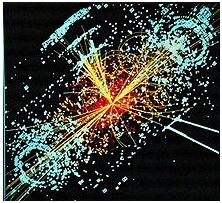
What they are looking for:
- A simulated event in the CMS detector, featuring the appearance of the Higgs boson.
- Physicists hope that the LHC will help answer the most fundamental questions in physics, questions concerning the basic laws governing the interactions and forces among the elementary objects, the deep structure of space and time, especially regarding the intersection of quantum mechanics and general relativity, where current theories and knowledge are unclear or break down altogether.
These issues include, at least:
- Is the Higgs mechanism for generating elementary particle masses via electroweak symmetry breaking indeed realized in nature? It is anticipated that the collider will either demonstrate (or rule out) the existence of the elusive Higgs boson(s), completing (or refuting) the Standard Model. The Higgs Boson is the only particle in the Standard Model which has not been detected, a prime target for the LHC, if the Tevatron doesn’t find it first. And it’s a boson, which improves CERN’s chances, and almost a guarantee that the Higgs exists, or a Higgs-like particle; there is an electroweak symmetry, and it is broken by something, and that something should be associated with particle-like excitations. There’s no guarantee that the LHC will find it. If the LHC doesn’t find the Higgs in five years, it will place very strong constraints on model building, but the Superconducting Super Collider, on the other hand, almost certainly would have found the Higgs by now.
- Is supersymmetry, an extension of the Standard Model and Poincare symmetry, realized in nature, implying that all known particles have supersymmetric partners?
These may clear up the mystery of dark matter. Supersymmetry is the most popular, and the most likely to show up at the LHC. We’ve been theorizing about it for so long that people act like it’s already been discovered — but it hasn’t. On the contrary, the allowed parameter space has been considerably whittled down by a variety of experiments. String theory predicts it, but why it shouldn’t be hidden up at the Planck scale, which is 1015 times higher in energy than what the LHC will reach. On the other hand, it can help explain why the Higgs scale is so much lower than the Planck scale — the hierarchy problem — if and only if it is broken at a low enough scale to be detectable at the LHC.
- Are there extra dimensions, as predicted by various models inspired by string theory, and can we detect them? Large Extra Dimensions the idea of extra dimensions of space was re-invigorated in the 1990’s by the discovery by Arkani-Hamed, Dimopolous and Dvali that hidden dimensions could be as large as a millimeter across, if the ordinary particles we know were confined to a three-dimensional brane. We could be making gravitons at the LHC, which would escape into the extra dimensions. The models are already quite constrained, and seem to require a good amount of fine-tuning to hold together. Warped Extra Dimensions soon after branes became popular, Randall and Sundrum put a crucial new spin on the idea: by letting the extra dimensions have a substantial spatial curvature, you could actually explain fine-tunings rather than simply converting them into different fine-tunings. This model has intriguing connections with string theory, and its own set of experimental predictions. So will some version of the Randall-Sundrum proposal turn out to be relevant at the LHC?
Other questions are:
- Are electromagnetism, the strong nuclear force and the weak nuclear force just different manifestations of a single unified force, as predicted by various Grand Unification Theories?
- Why is gravity so many orders of magnitude weaker than the other three fundamental forces?
- Are there additional sources of quark flavors, beyond those already predicted within the Standard Model?
- Why are there apparent violations of the symmetry between matter and antimatter? See also CP violation.
We detected antimatter in 1932, to be precise, so it is no longer a mystery.
- What was the nature of the quark-gluon plasma in the early universe? This will be investigated by ion collisions in ALICE.
Design.
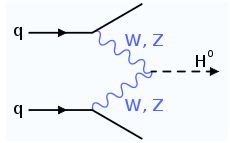 Feynman diagram of one way the Higgs boson may be produced at the LHC.
Here, two quarks each emit a W or Z boson, which combine to make a neutral Higgs.
The collider tunnel contains two adjacent parallel beam pipes that intersect at four points, each containing a proton beam, which travels in opposite directions around the ring. Some 1,232 dipole magnets keep the beams on their circular path, while an additional 392 quadrupole magnets are used to keep the beams focused, in order to maximize the chances of interaction between the particles in the four intersection points, where the two beams will cross. In total, over 1,600 superconducting magnets are installed, with most weighing over 27 tonnes. Approximately 96 tonnes of liquid helium is needed to keep the magnets at their operating temperature of 1.9 K (-271.25 °C), making the LHC the largest cryogenic facility in the world at liquid helium temperature.
Once or twice a day, as the protons are accelerated from 450 GeV to 7 TeV, the field of the superconducting dipole magnets will be increased from 0.54 to 8.3 teslas (T). The protons will each have an energy of 7 TeV, giving a total collision energy of 14 TeV. At this energy the protons have a Lorentz factor of about 7,500 and move at about 99.9999991% of the speed of light. It will take less than 90 microseconds for a proton to travel once around the main ring – a speed of about 11,000 revolutions per second. Rather than continuous beams, the protons will be bunched together, into 2,808 bunches, so that interactions between the two beams will take place at discrete intervals never shorter than 25 nanoseconds apart. However it will be operated with fewer bunches when it is first commissioned, giving it a bunch crossing interval of 75 ns.
Prior to being injected into the main accelerator, the particles are prepared by a series of systems that successively increase their energy. The first system is the linear particle accelerator LINAC 2 generating 50-MeV protons, which feeds the Proton Synchrotron Booster (PSB). There the protons are accelerated to 1.4 GeV and injected into the Proton Synchrotron (PS), where they are accelerated to 26 GeV. Finally the Super Proton Synchrotron (SPS) is used to further increase their energy to 450 GeV before they are at last injected (over a period of 20 minutes) into the main ring. Here the proton bunches are accumulated, accelerated (over a period of 20 minutes) to their peak 7-TeV energy, and finally circulated for 10 to 24 hours while collisions occur at the four intersection points.
CMS detector for LHC
The LHC physics program is mainly based on proton–proton collisions. However, shorter running periods, typically one month per year, with heavy-ion collisions are included in the program. While lighter ions are considered as well, the baseline scheme deals with lead ions. The lead ions will be first accelerated by the linear accelerator LINAC 3, and the Low-Energy Ion Ring (LEIR) will be used as an ion storage and cooler unit. The ions then will be further accelerated by the PS and SPS before being injected into LHC ring, where they will reach an energy of 2.76 TeV per nucleon (or 575 TeV per ion), higher than the energies reached by the Relativistic Heavy Ion Collider. The aim of the heavy-ion program is to investigate quark–gluon plasma, which existed in the early universe.
Detectors
Six detectors have been constructed at the LHC, located underground in large caverns excavated at the LHC's intersection points. Two of them, the ATLAS experiment and the Compact Muon Solenoid (CMS), are large, general purpose particle detectors. A Large Ion Collider Experiment (ALICE) and LHCb have more specific roles and the last two TOTEM and LHCf are very much smaller and are for very specialized research.
Summary of the main detectors is:
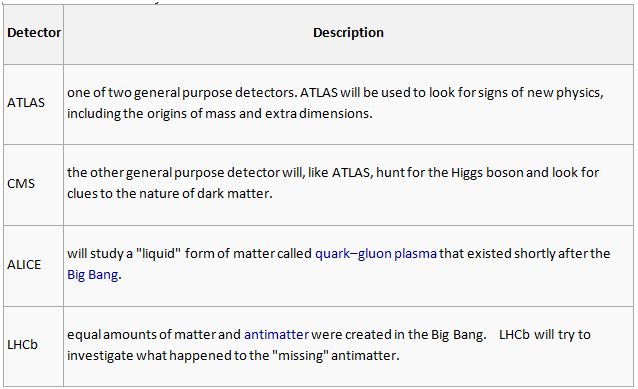
Expected results
CERN scientists estimate that if the Standard Model is correct, a single Higgs boson may be produced every few hours. At this rate, it may take about two to three years to collect enough data to discover the Higgs boson unambiguously. Similarly, it may take one year or more before sufficient results concerning supersymmetric particles have been gathered to draw meaningful conclusions.
Current Results
The first p-p collisions at energies higher than Fermilab's Tevatron p-pbar collisions have been published on arXiv, yielding greater-than-predicted charged hadron production. The CMS paper reports that the increase in the production rate of charged hadrons when the center-of-mass energy goes from 0.9 TeV to 2.36 TeV exceeds the predictions of the theoretical models used in the analysis, with the excess ranging from 10% to 14%, depending upon which model is used. The charged hadrons were primarily mesons (kaons and pions).
In Jan. 2010, Soeren Prell, an Iowa State associate professor of physics and astronomy, has been looking at the first data recorded with the ATLAS experiment's silicon pixel detector. The pixel detector is the innermost part of ATLAS, one of two giant, general purpose detectors at the collider. ATLAS will measure the paths, energies and identities of the particles created when protons or lead ions collide at unprecedented energies. The pixel detector uses 80 million pixels to make precise measurements as close to the particle collisions as possible.
Prell said the pixel detector is already sending physicists fairly clean data with very little background noise. But, he said, physicists still have to work to make sure the pixel detector is properly aligned and calibrated. It has a resolution down to 10 millionths of a meter and so it has to be just as precisely aligned.
That could include the Higgs boson, a particle predicted by the Standard Model of particle physics. The model theorizes that space is filled with a Higgs field and particles acquire their masses by interacting with the field. Detection and study of the Higgs could answer basic questions about why matter has mass and how particles acquire mass.
The Large Hadron Collider could answer big physics questions about matter and antimatter, dark matter, supersymmetry, extra dimensions, a grand unified theory or perhaps something entirely unexpected.
As reported in Sept. 8, 2008, Scientists working on the DZero particle detector experiment, including physicists from Imperial College London, have for the first time successfully observed pairs of Z bosons at the Tevatron. Pair production of these force carrying particles is extremely rare and difficult to detect, and researchers say that having observed them represents a big step towards observing the Higgs boson itself.
Then just a week after spotting the Z boson pairs, DZero scientists, along with colleagues from the CDF collaboration at the Tevatron, were able to rule out the possibility of the Higgs boson having a mass of around 170GeV/c2 – a value which lies in the mass range scientists believe the Higgs may have. This is the first time that any experiment in the world has ruled out potential values for the mass of the Higgs boson since the Large Electron -Positron Collider at CERN proved that the Higgs could not have a mass of less than 114GeV/c2 in 2000.
Dr Gavin Davies from Imperial's Department of Physics, co-leader of the Higgs hunting group on the DZero experiment, explains: "We now know that the Higgs boson does not have a mass of 170GeV/c2. If it did have this mass, then we should have seen evidence for it at the Tevatron by now. Ruling out possible masses of the Higgs is a very important part of the hunt for this elusive particle."
The Standard Model of particle physics predicts the existence of a particle, known as the Higgs boson, which gives mass to other particles. Currently, the mechanism by which particles acquire different mass values is unknown, and finding evidence for the existence of the Higgs boson would solve this fundamental mystery of nature.
The first of the Tevatron results, where pairs of Z bosons were observed, is a big step towards finding the Higgs boson because the pairs' experimental signature and characteristics are similar to those that would be seen if the Higgs was produced. In addition, the analysis methods and techniques used to find the Z bosons pairs are similar to those for finding the Higgs too.
So the Tevatron scientists have proven that their observation methods work, and that they are capable of observing very rare processes like those required to produce the Higgs.
Creating the experimental conditions in which the Higgs boson could be observed is extremely difficult. It requires very powerful particle collisions, and super-sensitive detectors to record the results of the collisions. To find the pairs of Z bosons, the DZero detector had to search through nearly 200 trillion particle collisions.
Dr Davies says that the results from the Tevatron signal the start of a new exciting phase of Higgs physics: "The observation of the very rare ZZ process is a real stepping stone to the Higgs. Following this with the first direct Higgs mass exclusion since 2000 is tremendously exciting."
"It shows that the Tevatron experiments are very much in the race for finding the Higgs," he added. DZero is an international experiment conducted by around 600 physicists from 90 institutions in 18 different countries. Currently around 10 Imperial physicists are involved with the experiment, based either full or part time at Fermilab.
This autumn the Large Hadron Collider (LHC) particle accelerator at CERN in Switzerland will be switched on to perform particle collisions at even higher energies than the Tevatron. Observing the Higgs boson is also a key goal for the detector experiments at CERN. A large cohort of Imperial physicists are working on the LHC detectors, including Professors Tejinder Virdee and Andrei Golutvin, who are lead scientists on the CMS and LHCb detectors respectively.
Scientists based at Fermilab have made important new discoveries that take them closer to finding the Higgs boson. (Credit: Image courtesy of Imperial College London). The "extra" particles may make spotting the Higgs boson harder
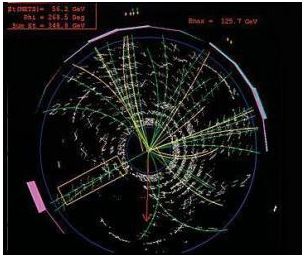
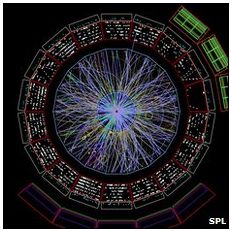
February 2010 - High-energy Large Hadron Collider results published, by Jason Palmer, Science and technology reporter, BBC News.
Particle particulars
That makes the new results a unique look at the field of high-energy physics. The experiments, smashing protons into each other, produced a few more subatomic particles known as pions and kaons than the team was expecting.
Gunther Roland, a CMS collaboration scientist from the Massachusetts Institute of Technology, said that the "extra" particles will be more of an issue when, later in 2010, the LHC dedicates itself to collisions involving ions of the element lead, a markedly heavier pair of targets resulting in an even larger array of particles on impact. We'll know much more about that in two or three months when we look at the next higher energy of 7 TeV (trillion electron volts)."
February 08, 2010 - Atom-smashing Large Hadron Collider may reveal mystery particle, from correspondents in Geneva and Reuters.
SCIENTISTS operating the "Big Bang" particle collider at CERN could solve the mystery of what gives mass to matter during a nearly two-year non-stop run lasting until late 2011, a spokesman said last week.
James Gillies said the long-sought but elusive Higgs Boson particle (named after Scots physicist Peter Higgs three decades ago) could well appear during the extended experiment after the world's biggest and most expensive scientific machine is turned on again later this month and the billions of collisions, each creating conditions that existed a minute fraction of a second after the "Big Bang" when the universe began 13.7 billion years ago. The matter spewed out by the primeval explosion eventually produced the stars, planets and life on Earth - but the Higgs theory says this was only possible if something like the Boson brought matter together, giving it mass.
The LHC has achieved energy up to 2.36 tera-electron volts (TeV), the highest ever achieved, and is planned to go up to 7 TeV gradually. Toward the end of next year, the collider will be closed down again for up to 12 months, allowing engineers to prepare the tunnel and the huge amount of equipment there for collisions at 14 TeV in the following run, probably starting in 2013.
Feb. 16, 2010 - Quark Soup - Physicists create conditions not seen since the big bang, by Sharon Begley, NEWSWEEK's science editor.
While the Large Hadron Collider rumors spread that it might create a mini black hole and swallow up the Earth, a lesser-known particle collider has been quietly making soup—quark soup. The top quark was discovered in an experiment at Fermilab in 1995, everyone knew this last of the six quarks existed, a discovery that led the way to new revelations about the creation and evolution of the universe.
Quark soup was last seen when the universe was 1 microsecond old. The Relativistic Heavy Ion Collider (RHIC) at Brookhaven National Lab on New York's Long Island, which smashes together gold ions traveling at nearly the speed of light, resulting in the collisions a tiny region of space so hot—4 trillion degrees Celsius—that protons and neutrons melt into a plasma of their constituent quarks and gluons. The soup is 250,000 times hotter than the center of the sun, 40 times hotter than a typical supernova, and the hottest temperature in the universe today. What kind of thermometer is used to measure a 4-trillion-degree soup, it is color: by analyzing the energy distribution (color) of light emitted from the soup, scientists can infer its temperature much as they infer the temperatures of stars or even of a glowing andiron.
Quark-gluon plasma existed was 13.7 billion years ago, when the universe burst into existence in the big bang. By creating it in a lab for the first time, the RHIC teams have given a chance to study how the cosmos came to evolve into the riot of galaxies and nebulae that we see today. The quark soup created at RHIC lasts not even 1 billionth of a trillionth of a second, and surprises when the quarks and gluons in the soup were expected to behave independently, instead they behave cooperatively, almost like synchronized swimmers.
The behavior that intrigued the scientists is something called broken symmetry. Within the quark soup appear "bubbles" that violate a principle of physics called mirror symmetry, or parity. This form of symmetry means the collisions of particles and the spray of subatomic debris look the same if viewed in a mirror as they do when viewed directly. But one of the detectors monitoring the collisions inside RHIC observed an asymmetry in the electric charges of particles emerging from most of the collisions. Specifically, positively charged quarks seem to prefer to fly out of the collision parallel to the magnetic field, while negatively charged quarks prefer to emerge in the opposite direction. This behavior would appear reversed if reflected in a mirror, with negative quarks traveling parallel to the magnetic field and positive quarks traveling in the opposite direction. Hence the violation of mirror symmetry.
The quark soup also seems to contain bubbles that violate another form of symmetry, called charge-parity invariance. When energy is converted to mass or vice versa as per Einstein's E=mc2, equal numbers of particles and antiparticles—matter and antimatter—are created or annihilated, respectively. That may hold the key to how structure and form emerged from the otherwise homogeneous quark soup. Such symmetry-violating bubbles in the nascent universe, cosmologists suspect, tipped balance in the equal amounts of matter and antimatter toward a preference for matter over antimatter. If the amounts of matter and antimatter had remained identical, no one would be here to notice as they go poof in an annihilating burst of energy. After almost 14 billion years after creation, every particle of matter would have been destroyed through this process, leaving a universe in radiation and nothing else, a glowing world of light without substance. By re-creating these conditions, says Steven Vigdor, Brookhaven's associate laboratory director for nuclear and particle physics, "RHIC may have a unique opportunity to test in the laboratory some crucial features of symmetry-altering bubbles speculated to have played important roles in the evolution of the infant universe."
What RHIC found Vigdor said is "consistent with predictions of symmetry-breaking domains in hot quark matter, and confirmation of this effect and understanding how these domains of broken symmetry form … may help scientists understand some of the most fundamental puzzles of the universe."
STRING THEORY for LHC
February 2007 - New particle accelerator could rule out string theory, by David Shiga.
String theory could be ruled out by experiments at the Large Hadron Collider (LHC), a particle accelerator scheduled to open by the end of 2007, a new study says. The finding offers a new approach for testing this potential "theory of everything," a goal that has so far proven elusive.
According to string theory, particles like electrons and photons are actually tiny, vibrating strings, and it accounts for all of the known forces - including gravity, which the standard model of physics does not. But its critics have complained that there is essentially no way to test it.
Strong evidence for string theory could come from the observation of short-lived, mini black holes at the LHC, a chance which is extremely small. This aspect of brane-world models is that gravity can become strong well below the Planck scale — even at LHC energies. Thus if you collide particles together in just the right way, you could make a black hole! It is unlikely that black holes will be produced, even if gravity does become strong, and if you did they will quickly evaporate away. Not a good way to test any particular theory. If they do create Stable Black Holes is there a chance that it would eat up the Earth, destroying all living organisms in the process?
In 2006, string theorist Allan Adams of MIT in Cambridge, US, and others offered a more promising check. They showed that some particle collisions could reveal whether certain fundamental assumptions underlying string theory are wrong.
Jacques Distler of the University of Texas in Austin, U.S., and his team has shown that the energies needed to reveal such effects are achievable at the LHC.
High energies
One of string theory's assumptions comes from Einstein's theory of relativity - that the speed of light is the same for all observers, a principle called Lorentz invariance.
This principle - and three others underlying string theory - determine how strongly particles called W bosons, which transmit the weak nuclear force, interact.
If these interactions are below the strength calculated by Distler's team, it would signal that one of the assumptions built into string theory is incorrect and that therefore string theory itself is wrong, the researchers say.
"They did a very important thing," Adams told New Scientist.
Quantized space
If string theory does seem to be ruled out, physicists will have to find another theory of everything that can explain the LHC observations. "If we see these violations, people will start working very feverishly on some sort of alternative that will produce these violations," Distler told New Scientist.
That alternative may turn out to be a theory called loop quantum gravity, which posits that space itself is quantized into tiny chunks. Some physicists argue that loop quantum gravity does not satisfy Lorentz invariance. "So that's one possible direction people might go," Distler says.
Although the test could in principle rule out string theory if violations are found, both Distler and Adams suspect that the results will turn out to respect the four assumptions, leaving string theory as a viable candidate for the theory of everything.
May 9, 2009 - Colliding with nature's best-kept secrets, By Elizabeth Landau.
(CNN) -- Visiting a particle accelerator is like a religious experience, at least for Nima Arkani-Hamed.
Nima Arkani-Hamed, a leading theoretical physicist, thinks the universe has at least 11 dimensions.
Immense detectors surround the areas where inconceivably small particles slam into one another at super-high energies, collisions that may confirm Arkani-Hamed's predictions about undiscovered properties of nature.
Arkani-Hamed is only in his mid-30s, but he has distinguished himself as one of the leading thinkers in the field of particle physics.
His revolutionary ideas about the way the universe works will finally be put to the test this year at Switzerland's Large Hadron Collider, which cost between $5 billion and $10 billion, could provide answers to questions physicists have had for decades. If the results confirm any of Arkani-Hamed's predictions, they would be the first extension of our notions of space-time since Albert Einstein.
Regarded as a "gem," Arkani-Hamed is "opening our minds and creating a new world of ideas that challenge deep-grained preconceptions about spacetime," said Chris Tully, professor of physics at Princeton University, who is working on the Compact Muon Solenoid experiment at the Large Hadron Collider.
Chris Tully, formerly a professor at Harvard, Arkani-Hamed currently sits on the faculty at the prestigious Institute for Advanced Study in Princeton, New Jersey, where Einstein served from 1933 until his death in 1955. "He was lured from Harvard to the IAS; I'm sure that's considered quite a coup," said Daniel Marlow, a physics professor at Princeton who is also collaborating on the CMS experiment.
Arkani-Hamed has had a hand in explaining how the world can operate according to Einstein's theory of general relativity, which describes the universe on a very large scale, and at the same time follow quantum mechanics, laws that describe the universe on a scale smaller than the eye can see.
Some of the key mysteries that stem from these clashing theories include why gravity is so weak, relative to the other fundamental physical forces such as electromagnetism and why the universe is so large. These issues come up because on an inconceivably small scale, the particles that make up our world seem to behave completely differently than one might imagine. For example, if you are driving a car, your GPS tells you where you are, and your speedometer tells you how fast you are moving. But on the scale of particles like electrons, it is impossible to know both position and speed at once; the very act of trying to find out requires incredible amounts of energy.
If it takes so much energy just to try to pin down a particle, then, in theory, all particles should have temporary energy changes around them called "quantum fluctuations." This energy translates into mass, since Einstein famously said that mass and energy are interchangeable through the equation E=mc2.
"It makes it extremely mysterious that the electron, or indeed, everything else that we know and love and are made of, isn't incredibly more massive than it is," Arkani-Hamed said. A theory that has emerged in recent decades that claims to bring some relief to physics mysteries like these is called superstring theory, or string theory for short. Previously, scientists believed that the smallest, most indivisible building blocks of our world were particles, but string theory says the world is made of extremely small vibrating loops called strings. In order for these strings to properly constitute our universe, they must vibrate in 11 dimensions. Everyone observes three spatial dimensions and one for time, but theoretical models suggest at least seven others that we do not see.
Arkani-Hamed proposed, along with physicists Savas Dimopoulos and Gia Dvali, that some of these dimensions are larger than previously thought -- specifically, as large as a millimeter. Physicists call this the ADD model, after the first initials of the authors' last names. We haven't seen these extra dimensions because gravity is the only force that can wander around them, Arkani-Hamed said.
But Arkani-Hamed says the Large Hadron Collider could lead to the direct observation of strings, or at least indirect evidence of their existence. The Large Hadron Collider may detect particles slipping in and out of the dimensions that Arkani-Hamed has worked on describing.
Data reflecting Arkani-Hamed's work on large extra dimensions "would really provide the first confirmation in this very profound way we might think about nature," Marlow said. Arkani-Hamed always had a great love of the natural world as a child. He remembers being impressed around age 14 that Newton's laws could enable him to calculate such things as the minimum speed that a space shuttle had to attain to escape the Earth's gravitational field.
What will the new Large Hadron Collider at CERN have to say about string theory, the alleged theory of everything that describes nature as composed of tiny wriggling strings?
String theorists hope that it will confirm supersymmetry, a notion that doubles the kinds of particles in the universe, and was originally invented as part of string theory, thus its discovery would not prove their case.
To test string theory directly, experimenters would have to build an accelerator to boost particles to the so-called Planck energy, at which “stringy” effects are expected to show up, roughly 10 quadrillion trillion electron volts, a quadrillion times the energy of the new hadron collider, which will accelerate protons to energies of seven trillion electron volts before smashing them together.
String theory’s hope for the new collider rests on a variant of the theory in which gravity is not weaker than the other forces but has just been diluted by extra dimensions of space. In that case, the new collider could produce black holes or bounce particles into other dimensions.
What else could LHC Find?
- Dark Matter is that you can relate the strength of its interactions to the abundance it has today — and to get the right abundance, the interaction strength should be right there at the electroweak scale, where the LHC will be looking. It might not be easy to find since dark matter is electrically neutral and doesn’t interact very much.
- Dark Energy will depend on supersymmetry or extra dimensions finds lead to our understanding of dark energy.
- Strong Dynamics or Quantum Chromodynamics (QCD), the theory that explains the strong nuclear force as arising from strongly-interacting gluons coupled to quarks, is a crucial part of the Standard Model. An underappreciated feature of QCD is that the dynamics of quarks breaks the electroweak symmetry even without the Higgs boson — unfortunately, the numbers don’t work out for it to be the primary mechanism. However, an interesting alternative to the standard idea of a Higgs boson is to imagine a new “QCD-like” force that operates at even higher energies; one venerable idea along these lines is known as technicolor, which are theories that have been struggling to remain compatible with various experimental bounds.
- New Massive Gauge Bosons another Standard-Model-like thing that could show up from a spontaneously broken symmetry (or more than one), similar to the W and Z bosons of the weak interactions — you will hear about searches for Z-prime bosons or W-prime bosons.
- New Quarks or Leptons the final Standard-Model-like thing we could find is a new “generation” of fermions (matter particles) — strongly-interacting quarks and non-strongly-interacting leptons. This is not expected since each generation includes a neutrino, and neutrinos tend to be fairly light, and the existence of new light fermions is strongly constrained both by particle physics experiments and by Big Bang Nucleosynthesis. If there are more light particles, the energy density of the universe is just a bit larger at any fixed temperature, and the universe therefore expands faster, and you therefore make a bit more Helium.
- Preons at high energies we may find even smaller particles. The possibility that quarks and leptons are made of smaller constituents.
- Mysterious Missing Energy, which are particles that are long-lived, neutral, and weakly interacting — including dark matter particles and gravitons — can only be found indirectly at a collider like the LHC. You are smashing things together, and if the total energy of the resulting particles you detect is less than that of the initial particles you smashed, you know that some invisible particles must have escaped as “missing energy.” But what? If you have a specific theory, you can match carefully to the expected dependence on the initial energy, the angle of scattering, and so forth. But if you don’t … it will be hard to figure out what is going on.
- Baryon-Number Violation, where there are more baryons than anti-baryons in the universe, and most of us think that the asymmetry must have been dynamically generated somehow. Therefore, some process must be able to change the number of baryons — but we’ve never observed such a process. And we probably won’t; in most models, violation of baryon number is far too rare to be visible at the LHC. But there is certainly no consensus about how baryogenesis happened, so we should keep an eye out.
March 24, 2010 - Atom smasher, by AP.
Geneva - Operators of the world's largest atom smasher said they will try in a week to collide proton beams at record high energy in a new bid to discover secrets of the universe. CERN says beams have been circulating in the LHC at 3.5 trillion electron volts since Friday, 3 1/2 times higher than the record set late last year. The operators will attempt to collide the beams next Tuesday.
March 30, 2010 - New era of smashing atoms eyed, by AP.
Geneva - THe LHC is ready to start a new era of science, colliding beams of protons to learn more about the makeup of the universe and its smallest particles.
March 31, 2010 - Geneva atom smasher sets high-energy collison record, by AP.
Geneva - The LHC conducted its first experiments at conditions nearing those after the Big Bang, breaking its own record for high-energy collisions. They will study the disintegrating protons after they collided at a combined energy level of 7 trillion electron volts. Scientist erupted with applause when the first successful collisions were confirmed.
Enough talk lets see some results for the $10 billion someone spent.
|| Top of page || Bottom of page ||
Other Subjects Of Physics and Cosmology.
Volume III Cosmology Images For Neutrino Study
Newtonian Cosmology - Density of matter in the Universe - The lambda term and the Einstein Universe - the Expanding Universe - The Doppler Effect - The recession of galaxies - The de Sitter universe - The Friedmann Models - Einstein-de sitter model - The radiation Universe - The Eddington-Lemaitre model - element synthesis in the hot big bang - The Steady-State theory - The perfect cosmological principle (PCP) - The continous creation of matter - The C-field - The electromagnetic field - Other Cosmological Models
Emc2 Equations Images For Neutrino Study
Lorentz-FitGerald Contraction - equivalence between mass energy - Einstein's Theory of Relativity 1905 - Mass-Energy Equivalence - mass-energy relation - Relative Time - FitzGerald ration - time dilation - clock paradox - General Theory of Relativity in 1915 - twin paradox - space-time - Fourth Dimension - Gravitation - Space-time is the four-dimensional analogy - curved space - red shift - Mossbauer effect - The General theory of 1916 - effects of gravity on space - Equation (Unified Field Theory) - Velocity of Light - Colors and wavelengths - Thermal Conductivity - Gravitational Constant - Plannck's constant
Gravitation Equations Images For Neutrino Study
What is Gravitation? - Newtonian gravitation - Negative Energy - Energy Transport - Energy transfer in Newtonian gravitation - The Tidal Phenomenon - Gravitational collapse - Newtonian gravitational collapse - Einstein's General Theory of Relativity - Theory of Gravitation - non-Euclidean geometry - The Bending of Light - Gravitational red-shift - Gravitational collapse and black holes - Schwarzschild radius - Negative Energy - Gravitational Radiation or Waves - Mach's Principle - Spinning Universe and general relativity
(Lambda-term) - The Brans-Dicke theory - The Hoyle-Narlikar theory (prinicple of least action) - Is the gravitational constant changing? - The measurement of time-variation of G
Volume III Physics Constants Images For Neutrino Study
Equations for motion - Physical Constants - Velocity of Light in a vacuum (c) - Electron charge (e) - Planck's constant (h) hbar - Avogadro's number - Atomic mass unit - Electron rest mass (Erm) - Proton rest mass (Prm) - Neutron rest mass (Nrm) - Permittivity of vacuum - Permeability of vacuum - Electron charge to mass ration (Ecm) - Ration of proton mass to electron mass (Rpem) - Neutron Compton wavelength - Muon rest mass - classical electron radius - Gyromagnetic ration of protons in water - Quantum of circulation - Molar volume of ideal gas at STP - Faraday constant - Stefan-Boltzman constant - Rydberg constant R - Gravitational constant - Mass of the earth, Sun and Moon and density - Bohr radius - Electron magnetic moment - Proton magnetic moment - Bohr magneton - Nuclear magneton - Fine structure constant - Electron Compton wavelength (Ecw) - Proton Compton wavelength - Molar gas constant - boltzmann's constant - First radiation constant - Second radiation constant - Cosmic Scale Linear Dimension - Heisenberg's Principle of Uncertainty - Schrodinger wave Equation (Matter-Waves or Wave Mechanics)
Time Theory Equations Images For Neutrino Study
The Universe and the Arrow of Time - Space and time inversions - Irreversible Phenomena (entropy) - Thermodynamics - Electrodynamics - Cosmology - Thermodynamics and Cosmology - Thermodynamics in an expanding Universe - The Electromagnetic arrow of time (Causality) - The Wheeler-Feynman theory - A relation between the thermodynamic and electromagnetic arrows of time - A relation between the cosmological and electromagnetic arrows of time - The Perfect and imperfect absorbers - steady-state model - Quantum physics - The orbital energy of the atomic electron - quantum of radiation - Why an arrow of time?
Unified Field Theory Equations Images For Neutrino Study
Unified Field Equation - Einstein's Equation - Minkowski metric - Gravitational Red-Shift - Equation of Geodesic Deviation (Riemann-Christoffel Tensor or Curvature Tensor) - Einstein's Tensor - Eintein's Theory Of Gravitation - How much non-linearity is there in the superposition of two gravitational fields? - Does the Universe have a preferred frame of reference? - Is the total Momentum conserved? - Are there galaxy induced effects? - Geodesics Riemann space - Schwarzschild solution - Gravitational collapse and black holes - schwarzschild radius - Concept of a metric and of a metric space
Science News Articles From 2011 through 2022
This will open a file as a Word Document with news articles about the latest science regarding many of the subjects above.
Last updated August 16, 2003, February 26, 2010, March 17, 2010, June 10, 2010, December 31, 2011, and January 12, 2012.
Go to the top of this page
To return to Volume III file "Dark Matter Discoveries in 2002-2003" or the Volume III - New Released Files.
Return to the Table of Contents or the Zodiac of Denderah