From The Alpha and the Omega - Volume III
by Jim A. Cornwell, Copyright © July 20, 2002, all rights reserved
"Volume III - String Theory Equations, History and Concepts"

Go to the bottom of this page

String Theory Equations, History and Concepts For Neutrino Study
    This file created on February 23, 2010 as a Volume III String Theory Equations, History and Concepts For Neutrino Study at http://www.mazzaroth.com/VolumeIII/NeutrinosAndMissingMatter.htm.

Found at http://en.wikipedia.org/wiki/String_theory
String theory, from Wikipedia, the free encyclopedia

    Main article: History of string theory

    Some of the structures reintroduced by string theory arose for the first time much earlier as part of the program of classical unification started by Albert Einstein.    The first person to add a fifth dimension to general relativity was German mathematician Theodor Kaluza in 1919, who noted that gravity in five dimensions describes both gravity and electromagnetism in four.    In 1926, the Swedish physicist Oskar Klein gave a physical interpretation of the unobservable extra dimension--- it is wrapped into a small circle.
    Einstein introduced a non-symmetric geometric tensor, while much later Brans and Dicke added a scalar component to gravity.    These ideas would be revived within string theory, where they are demanded by consistency conditions.
    String theory was originally developed during the late 1960s and early 1970s as a never completely successful theory of hadrons, the subatomic particles like the proton and neutron which feel the strong interaction.    In the 1960s, Geoffrey Chew and Steven Frautschi discovered that the mesons make families called Regge trajectories with masses related to spins in a way that was later understood by Yoichiro Nambu, Holger Bech Nielsen and Leonard Susskind to be the relationship expected from rotating strings.    Chew advocated making a theory for the interactions of these trajectories which did not presume that they were composed of any fundamental particles, but would construct their interactions from self-consistency conditions on the S-matrix.    The S-matrix approach was started by Werner Heisenberg in the 1940s as a way of constructing a theory which did not rely on the local notions of space and time, which Heisenberg believed break down at the nuclear scale.    While the scale was off by many orders of magnitude, the approach he advocated was ideally suited for a theory of quantum gravity.
    Working with experimental data, R. Dolen, D. Horn and C. Schmid [Dolen, Horn, Schmid "Finite-Energy Sum Rules and Their Application to piN Charge Exchange" http://prola.aps.org/abstract/PR/v166/i5/p1768_1] developed some sum rules for hadron exchange.    When a particle and antiparticle scatter, virtual particles can be exchanged in two qualitatively different ways.    In the s-channel, the two particles annihilate to make temporary intermediate states which fall apart into the final state particles.    In the t-channel, the particles exchange intermediate states by emission and absorption.    In field theory, the two contributions add together, one giving a continuous background contribution, the other giving peaks at certain energies.    In the data, it was clear that the peaks were stealing from the background--- the authors interpreted this as saying that the t-channel contribution was dual to the s-channel one, meaning both described the whole amplitude and included the other.
    The result was widely advertised by Murray Gell-Mann, leading Gabriele Veneziano to construct a scattering amplitude which had the property of Dolen-Horn-Schmid duality, later renamed world-sheet duality.    The amplitude needed poles where the particles appear, on straight line trajectories, and there is a special mathematical function whose poles are evenly spaced on half the real line--- the Gamma function --- which was widely used in Regge theory.    By manipulating combinations of Gamma functions, Veneziano was able to find a consistent scattering amplitude with poles on straight lines, with mostly positive residues, which obeyed duality and had the appropriate Regge scaling at high energy.    The amplitude could fit near-beam scattering data as well as other Regge type fits, and had a suggestive integral representation which could be used for generalization.
    Over the next years, hundreds of physicists worked to complete the bootstrap program for this model, with many surprises.    Veneziano himself discovered that for the scattering amplitude to describe the scattering of a particle which appears in the theory, an obvious self-consistency condition, the lightest particle must be a tachyon.    Miguel Virasoro and Joel Shapiro found a different amplitude now understood to be that of closed strings, while Ziro Koba and Holger Nielsen generalized Veneziano's integral representation to multiparticle scattering.    Veneziano and Sergio Fubini introduced an operator formalism for computing the scattering amplitudes which was a forerunner of world-sheet conformal theory, while Virasoro understood how to remove the poles with wrong-sign residues using a constraint on the states.    Claud Lovelace calculated a loop amplitude, and noted that there is an inconsistency unless the dimension of the theory is 26.    Charles Thorn, Peter Goddard and Richard Brower went on to prove that there are no wrong-sign propagating states in dimensions less than or equal to 26.    In 1969 Yoichiro Nambu, Holger Bech Nielsen and Leonard Susskind recognized that the theory could be given a description in space and time in terms of strings.    The scattering amplitudes were derived systematically from the action principle by Peter Goddard, Jeffrey Goldstone, Claudio Rebbi and Charles Thorn, giving a space-time picture to the vertex operators introduced by Veneziano and Fubini and a geometrical interpretation to the Virasoro conditions.
    In 1970, Pierre Ramond added fermions to the model, which led him to formulate a two-dimensional supersymmetry to cancel the wrong-sign states.    John Schwarz and André Neveu added another sector to the fermi theory a short time later.    In the fermion theories, the critical dimension was 10.    Stanley Mandelstam formulated a world sheet conformal theory for both the bose and fermi case, giving a two-dimensional field theoretic path-integral to generate the operator formalism.    Michio Kaku and Keiji Kikkawa gave a different formulation of the bosonic string, as a string field theory, with infinitely many particle types and with fields taking values not on points, but on loops and curves.
    In 1974, Tamiaki Yoneya discovered that all the known string theories included a massless spin-two particle which obeyed the correct Ward identities to be a graviton.    John Schwarz and Joel Scherk came to the same conclusion and made the bold leap to suggest that string theory was a theory of gravity, not a theory of hadrons.    They reintroduced Kaluza–Klein theory as a way of making sense of the extra dimensions.    At the same time, quantum chromodynamics was recognized as the correct theory of hadrons, shifting the attention of physicists and apparently leaving the bootstrap program in the dustbin of history.
    String theory eventually made it out of the dustbin, but for the following decade all work on the theory was completely ignored.    Still, the theory continued to develop at a steady pace thanks the work of a handful of devotees.    Ferdinando Gliozzi, Joel Scherk, and David Olive realized in 1976 that the original Ramond and Neveu Schwarz-strings were separately inconsistent and needed to be combined.    The resulting theory did not have a tachyon, and was proven to have space-time supersymmetry by John Schwarz and Michael Green in 1981.    The same year, Alexander Polyakov gave the theory a modern path integral formulation, and went on to develop conformal field theory extensively.    In 1979, Daniel Friedan showed that the equations of motions of string theory, which are generalizations of the Einstein equations of General Relativity, emerge from the Renormalization group equations for the two-dimensional field theory.    Schwarz and Green discovered T-duality, and constructed two different superstring theories --- IIA and IIB related by T-duality, and type I theories with open strings.    The consistency conditions had been so strong, that the entire theory was nearly uniquely determined, with only a few discrete choices.
    In the early 1980s, Edward Witten discovered that most theories of quantum gravity could not accommodate chiral fermions like the neutrino.    This led him, in collaboration with Luis Alvarez-Gaumé to study violations of the conservation laws in gravity theories with anomalies, concluding that type I string theories were inconsistent.    Green and Schwarz discovered a contribution to the anomaly that Witten and Alvarez-Gaumé had missed, which restricted the gauge group of the type I string theory to be SO(32).    In coming to understand this calculation, Edward Witten became convinced that string theory was truly a consistent theory of gravity, and he became a high-profile advocate.    Following Witten's lead, between 1984 and 1986, hundreds of physicists started to work in this field, and this is sometimes called the first superstring revolution.
    During this period, David Gross, Jeffrey Harvey, Emil Martinec, and Ryan Rohm discovered heterotic strings.    The gauge group of these closed strings was two copies of E8, and either copy could easily and naturally include the standard model.    Philip Candelas, Gary Horowitz, Andrew Strominger and Edward Witten found that the Calabi-Yau manifolds are the compactifications which preserve a realistic amount of supersymmetry, while Lance Dixon and others worked out the physical properties of orbifolds, distinctive geometrical singularities allowed in string theory.    Cumrun Vafa generalized T-duality from circles to arbitrary manifolds, creating the mathematical field of mirror symmetry.    David Gross and Vipul Periwal discovered that string perturbation theory was divergent in a way that suggested that new non-perturbative objects were missing.
    In the 1990s, Joseph Polchinski discovered that the theory requires higher-dimensional objects, called D-branes and identified these with the black-hole solutions of supergravity.    These were understood to be the new objects suggested by the perturbative divergences, and they opened up a new field with rich mathematical structure.    It quickly became clear that D-branes and other p-branes, not just strings, formed the matter content of the string theories, and the physical interpretation of the strings and branes was revealed--- they are a type of black hole.    Leonard Susskind had incorporated the holographic principle of Gerardus 't Hooft into string theory, identifying the long highly-excited string states with ordinary thermal black hole states.    As suggested by 't Hooft, the fluctuations of the black hole horizon, the world-sheet or world-volume theory, describes not only the degrees of freedom of the black hole, but all nearby objects too.
    In 1995, at the annual conference of string theorists at the University of Southern California (USC), Edward Witten gave a speech on string theory that essentially united the five string theories that existed at the time and giving birth to a new 11-dimensional theory called M-theory.    M-theory was also foreshadowed in the work of Paul Townsend at approximately the same time.    The flurry of activity which began at this time is sometimes called the second superstring revolution.
    During this period, Tom Banks, Willy Fischler, Stephen Shenker and Leonard Susskind formulated a full holographic description of M-theory on IIA D0 branes [Banks, Fischler, Shenker and Susskind "M Theory As A Matrix Model: A Conjecture" http://arxiv.org/abs/hep-th/9610043v3], the first definition of string theory that was fully non-perturbative and a concrete mathematical realization of the holographic principle.    Andrew Strominger and Cumrun Vafa calculated the entropy of certain configurations of D-branes and found agreement with the semi-classical answer for extreme charged black holes.    Petr Horava and Edward Witten found the eleven-dimensional formulation of the heterotic string theories, showing that orbifolds solve the chirality problem.    Witten noted that the effective description of the physics of D-branes at low energies is by a supersymmetric gauge theory, and found geometrical interpretations of mathematical structures in gauge theory that he and Nathan Seiberg had earlier discovered in terms of the location of the branes.
    In 1997 Juan Maldacena noted that the low energy excitations of a theory near a black hole consist of objects close to the horizon, which for extreme charged black holes looks like an anti de Sitter space.    He noted that in this limit the gauge theory describes the string excitations near the branes.    So he hypothesized that string theory on a near-horizon extreme-charged black-hole geometry, an anti-deSitter space times a sphere with flux, is equally well described by the low-energy limiting gauge theory, the N=4 supersymmetric Yang-Mills theory.    This hypothesis, complemented by converging work due to Steven Gubser, Igor Klebanov and Alexander Polyakov, is called the AdS/CFT correspondence and it is now well-accepted.    It is a concrete realization of the holographic principle, which has far-reaching implications for black holes, locality and information in physics, as well as the nature of the gravitational interaction.    Through this relationship, string theory has been shown to be related to gauge theories like quantum chromodynamics and this has led to more quantitative understanding of the behavior of hadrons, bringing string theory back to its roots.

NOW FOR THE REST OF THE STORY:

Found at http://en.wikipedia.org/wiki/String_theory
String theory, from Wikipedia, the free encyclopedia

    String theory is a developing branch of quantum mechanics and general relativity with the aim of merging and reconciling the two areas of physics into a quantum theory of gravity.[Sunil Mukhi(1999)"The Theory of Strings: A Detailed Introduction" ]    The strings of string theory are one-dimensional oscillating lines, but they are no longer considered fundamental to the theory, which can be formulated in terms of points or surfaces too.
    Since its inception as the dual resonance model which described the strongly interacting hadrons as strings, the term string theory has changed to include any of a group of related superstring theories which unite them.    One shared property of all these theories is the holographic principle.    String theory itself comes in many different formulations, each one with a different mathematical structure, and each best describing different physical circumstances.    But the principles shared by these approaches, their mutual logical consistency, and the fact that some of them easily include the standard model of particle physics, has led many physicists like Leonard Susskind and Edward Witten to believe that the theory is the correct fundamental description of nature.    In particular, string theory is the first candidate for the theory of everything (TOE), a way to describe the known fundamental forces (gravitational, electromagnetic, weak and strong interactions) and matter (quarks and leptons) in a mathematically complete system.
    Many prominent physicists, such as Sheldon Lee Glashow have criticized string theory for not providing any quantitative experimental predictions.["NOVA - The elegant Universe"]    Like any other quantum theory of gravity, it is widely believed that testing the theory directly would require prohibitively expensive feats of engineering.    Whether there are stringent indirect tests of the theory is unknown.
    String theory is of interest to many physicists because it requires new mathematical and physical ideas to mesh together its very different mathematical formulations.    One of the most inclusive of these is the 11-dimensional M-theory, which requires spacetime to have eleven dimensions,[M.J. Duff, James T. Liu and R. Minasian Eleven Dimensional Origin of String/String Duality: A One Loop Test Center for Theoretical Physics, Department of Physics, Texas A&M University] as opposed to the usual three spatial dimensions and the fourth dimension of time.    The original string theories from the 1980s describe special cases of M-theory where the eleventh dimension is a very small circle or a line, and if these formulations are considered as fundamental, then string theory requires ten dimensions.    But the theory also describes universes like ours, with four observable spacetime dimensions, as well as universes with up to 10 flat space dimensions, and also cases where the position in some of the dimensions is not described by a real number, but by a completely different type of mathematical quantity.    So the notion of spacetime dimension is not fixed in string theory: it is best thought of as different in different circumstances.[Polchinski, Joseph (1998). String Theory, Cambridge University Press.]
    String theories include objects more general than strings, called branes.    The word brane, derived from "membrane," refers to a variety of interrelated objects, such as D-branes, black p-branes and Neveu-Schwarz 5-branes.    These are extended objects that are charged sources for differential form generalizations of the vector potential electromagnetic field.    These objects are related to one-another by a variety of dualities.    Black hole-like black p-branes are identified with D-branes, which are endpoints for strings, and this identification is called Gauge-gravity duality.    Research on this equivalence has led to new insights on quantum chromodynamics, the fundamental theory of the strong nuclear force.[H. Nastase, The RHIC fireball as a dual black hole, BROWN-HET-1439, arXiv:hep-th/0501068, January 2005, and More on the RHIC fireball and dual black holes, BROWN-HET-1466, arXiv:hep-th/0603176, March 2006][H. Liu, K. Rajagopal, U. A. Wiedemann, An AdS/CFT Calculation of Screening in a Hot Wind, MIT-CTP-3757, arXiv:hep-ph/0607062 July 2006 and Calculating the Jet Quenching Parameter from AdS/CFT, Phys.Rev.Lett.97:182301,2006 arXiv:hep-ph/0605178]

Overview

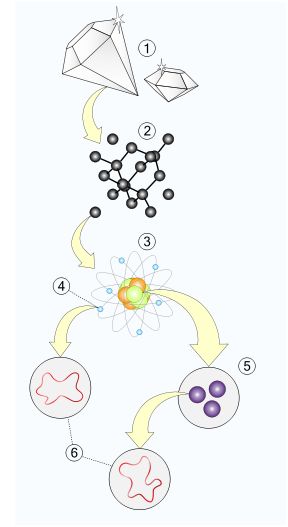
    String theory posits that the electrons and quarks within an atom are not 0-dimensional objects, but 1-dimensional strings.    These strings can move and vibrate, giving the observed particles their flavor, charge, mass and spin.    The strings make closed loops unless they encounter surfaces, called D-branes, where they can open up into 1-dimensional lines.    The endpoints of the string cannot break off the D-brane, but they can slide around on it.


    Levels of magnification:
1. Macroscopic level - Matter
2. Molecular level
3. Atomic level - Protons, neutrons, and electrons
4. Subatomic level - Electron
5. Subatomic level - Quarks
6. String level

    String theory is a theory of gravity, an extension of General Relativity, and the classical interpretation of strings and branes is that they are quantum mechanical vibrating, extended charged black holes.    The overarching physical insight behind string theory is the holographic principle, which states that the description of the oscillations of the surface of a black hole must also describe the spacetime around it.    Holography demands that a low-dimensional theory describing the fluctuations of a horizon will end up describing everything that can fall through, which can be anything at all.    So a theory of a black hole horizon is a theory of everything.
    Finding even one consistent holographic description, a priori, seems like a long shot, because it would be a disembodied nonlocal description of quantum gravity.    In string theory, not only is there one such description, there are several different ones, each describing fluctuations of horizons with different charges and dimensions, and all of them logically fit together.    So the same physical objects and interactions can be described by the fluctuations of one-dimensional black hole horizons, or by three-dimensional horizons, or by zero-dimensional horizons.    The fact that these different descriptions describe the same physics is evidence that string theory is consistent.
    An ordinary astronomical black hole does not have a convenient holographic description, because it has a Hawking temperature.    String theories are formulated on cold black holes, which are those which have as much charge as possible.    The first holographic theory described the scattering of one-dimensional strings, tiny loops of vibrating horizon charged with a two-form vector potential which makes a charged black hole a one-dimensional line.    Fluctuations of this line horizon describe all matter, so every elementary particle can be described by a mode of oscillation of a very small segment or loop of string.    The string-length is approximately the Planck length, but can be significantly bigger when the strings are weakly interacting.
    All string theories predict the existence of degrees of freedom which are usually described as extra dimensions.    Without fermions, bosonic strings can vibrate in a flat but unstable 26-dimensional space time.    In a superstring theory with fermions, the weak-coupling (no-interaction) limit describes a flat stable 10-dimensional space time.
    Interacting superstring theories are best thought of as configurations of an 11 dimensional supergravity theory called M-theory where one or more of the dimensions are curled up so that the line-extended charged black holes become long and light.
    Long, light strings can vibrate at different resonant frequencies, each such frequency describing a different elementary particle.[To compare, the size of an atom is roughly 10-10 m and the size of a proton is 10-15 m.    To imagine the Planck length: you can stretch along the diameter of an atom the same number of strings as the number of atoms you can line up to Proxima Centauri (the nearest star to Earth after the Sun).    The tension of a string (8.9×1042 newtons) is about 1040 times the tension of an average piano string (735 newtons).]
    So in string limits, any elementary particle should be thought of as a tiny vibrating line, rather than as a point.    The string can vibrate in different modes just as a guitar string can produce different notes, and every mode appears as a different particle: electron, photon, gluon, etc.
    The only way in which strings can interact is by splitting and combining in a smooth way.    It is impossible to introduce arbitrary extra matter, like point particles which interact with strings by collisions, because the particles can fall into the black hole, so holography demands that it must show up as a mode of oscillation.    The only way to introduce new matter is to find gravitational backgrounds where strings can scatter consistently, or to add boundary conditions, endpoints for the strings.    Some of the backgrounds are called NS-branes, which are extreme-charged black hole sheets of different dimensions.    Other charged black-sheet backgrounds are the D-branes, which have an alternate description as planes where strings can end and slide.    When the strings are long and light, the branes are classical and heavy.    In other limits where the strings become heavy, some of the branes can become light.
    Since the string theory is widely believed to be a consistent theory of quantum gravity, many hope that it correctly describes our universe, making it a theory of everything.
    There are known configurations which describe all the observed fundamental forces and matter but with a zero cosmological constant and some new fields.[Burt A. Ovrut (2006). "A Heterotic Standard Model".    Fortschritte der Physik 54-(2-3): 160–164.]br>     There are other configurations with different values of the cosmological constant, which are metastable but long-lived.    This leads many to believe that there is at least one metastable solution which is quantitatively identical with the standard model, with a small cosmological constant, which contains dark matter and a plausible mechanism for inflation.    It is not yet known whether string theory has such a solution, nor how much freedom the theory allows to choose the details.
    The full theory does not yet have a satisfactory definition in all circumstances, since the scattering of strings is most straightforwardly defined by a perturbation theory.
    The complete quantum mechanics of high dimensional branes is not easily defined, and the behavior of string theory in cosmological settings (time-dependent backgrounds) is not fully worked out.    It is also not clear if there is any principle by which string theory selects its vacuum state, the spacetime configuration which determines the properties of our Universe.

Basic properties

    String theory can be formulated in terms of an action principle, either the Nambu-Goto action or the Polyakov action, which describes how strings move through space and time.
    In the absence of external interactions, string dynamics are governed by tension and kinetic energy, which combine to produce oscillations.    The quantum mechanics of strings implies these oscillations take on discrete vibrational modes, the spectrum of the theory.
    On distance scales larger than the string radius, each oscillation mode behaves as a different species of particle, with its mass, spin and charge determined by the string's dynamics.    Splitting and recombination of strings correspond to particle emission and absorption, giving rise to the interactions between particles.
    An analogy for strings' modes of vibration is a guitar string's production of multiple but distinct musical notes.    In the analogy, different notes correspond to different particles.    The only difference is the guitar is only 2-dimensional, you can strum it up, and down.    In actuality the guitar strings would be every dimension, and the strings could vibrate in any direction.    Meaning that the particles could move through not only our dimension, but other dimensions as well.
    String theory includes both open strings, which have two distinct endpoints, and closed strings making a complete loop.    The two types of string behave in slightly different ways, yielding two different spectra.    For example, in most string theories, one of the closed string modes is the graviton, and one of the open string modes is the photon.
    Because the two ends of an open string can always meet and connect, forming a closed string, there are no string theories without closed strings.
    The earliest string model, the bosonic string, incorporated only bosons.    This model describes, in low enough energies, a quantum gravity theory, which also includes (if open strings are incorporated as well) gauge fields such as the photon (or, more generally, any gauge theory).    However, this model has problems.    Most importantly, the theory has a fundamental instability, believed to result in the decay (at least partially) of spacetime itself.    Additionally, as the name implies, the spectrum of particles contains only bosons, particles which, like the photon, obey particular rules of behavior.    Roughly speaking, bosons are the constituents of radiation, but not of matter, which is made of fermions.    Investigating how a string theory may include fermions in its spectrum led to the invention of supersymmetry, a mathematical relation between bosons and fermions.
    String theories which include fermionic vibrations are now known as superstring theories; several different kinds have been described, but all are now thought to be different limits of M-theory.
    Some qualitative properties of quantum strings can be understood in a fairly simple fashion.    For example, quantum strings have tension, much like regular strings made of twine; this tension is considered a fundamental parameter of the theory.    The tension of a quantum string is closely related to its size.    Consider a closed loop of string, left to move through space without external forces.    Its tension will tend to contract it into a smaller and smaller loop.    Classical intuition suggests that it might shrink to a single point, but this would violate Heisenberg's uncertainty principle.    The characteristic size of the string loop will be a balance between the tension force, acting to make it small, and the uncertainty effect, which keeps it "stretched."    Consequently, the minimum size of a string is related to the string tension.

World-sheet

    For more details on this topic, see relationship between string theory and quantum field theory.
    A point-like particle's motion may be described by drawing a graph of its position (in one or two dimensions of space) against time.    The resulting picture depicts the worldline of the particle (its 'history') in spacetime.    By analogy, a similar graph depicting the progress of a string as time passes by can be obtained; the string (a one-dimensional object — a small line — by itself) will trace out a surface (a two-dimensional manifold), known as the worldsheet.    The different string modes (representing different particles, such as photon or graviton) are surface waves on this manifold.
    A closed string looks like a small loop, so its worldsheet will look like a pipe or, more generally, a Riemann surface (a two-dimensional oriented manifold) with no boundaries (i.e. no edge).    An open string looks like a short line, so its worldsheet will look like a strip or, more generally, a Riemann surface with a boundary.


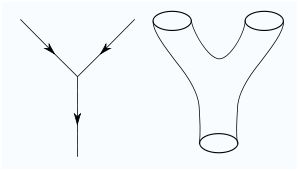
    Interaction in the subatomic world: world lines of point-like particles in the Standard Model or a world sheet swept up by closed strings in string theory Strings can split and connect.    This is reflected by the form of their worldsheet (more accurately, by its topology).    For example, if a closed string splits, its worldsheet will look like a single pipe splitting (or connected) to two pipes (often referred to as a pair of pants — see drawing above).    If a closed string splits and its two parts later reconnect, its worldsheet will look like a single pipe splitting to two and then reconnecting, which also looks like a torus connected to two pipes (one representing the ingoing string, and the other — the outgoing one).    An open string doing the same thing will have its worldsheet looking like a ring connected to two strips.
    Note that the process of a string splitting (or strings connecting) is a global process of the worldsheet, not a local one: locally, the worldsheet looks the same everywhere and it is not possible to determine a single point on the worldsheet where the splitting occurs.    Therefore these processes are an integral part of the theory, and are described by the same dynamics that controls the string modes.
    In some string theories (namely, closed strings in Type I and some versions of the bosonic string), strings can split and reconnect in an opposite orientation (as in a Möbius strip or a Klein bottle).    These theories are called unoriented.    Formally, the worldsheet in these theories is a non-orientable surface.

Dualities

    Main articles: String duality, S-duality, T-duality, and U-duality

    Before the 1990s, string theorists believed there were five distinct superstring theories: open type I, closed type I, closed type IIA, closed type IIB, and the two flavors of heterotic string theory (SO(32) and E8×E8)[S. James Gates, Jr., Ph.D., Superstring Theory: The DNA of Reality "Lecture 23 - Can I Have that Extra Dimension in the Window?"].    The thinking was that out of these five candidate theories, only one was the actual correct theory of everything, and that theory was the one whose low energy limit, with ten spacetime dimensions compactified down to four, matched the physics observed in our world today.    It is now believed that this picture was incorrect and that the five superstring theories are connected to one another as if they are each a special case of some more fundamental theory (thought to be M-theory).    These theories are related by transformations that are called dualities.    If two theories are related by a duality transformation, it means that the first theory can be transformed in some way so that it ends up looking just like the second theory.    The two theories are then said to be dual to one another under that kind of transformation.    Put differently, the two theories are mathematically different descriptions of the same phenomena.
    These dualities link quantities that were also thought to be separate.    Large and small distance scales, as well as strong and weak coupling strengths, are quantities that have always marked very distinct limits of behavior of a physical system in both classical field theory and quantum particle physics.    But strings can obscure the difference between large and small, strong and weak, and this is how these five very different theories end up being related.    T-duality relates the large and small distance scales between string theories, whereas S-duality relates strong and weak coupling strengths between string theories.    U-duality links T-duality and S-duality.


    Note that in the type IIA and type IIB string theories closed strings are allowed to move everywhere throughout the ten-dimensional spacetime (called the bulk), while open strings have their ends attached to D-branes, which are membranes of lower dimensionality (their dimension is odd — 1, 3, 5, 7 or 9 — in type IIA and even — 0, 2, 4, 6 or 8 — in type IIB, including the time direction).

Extra dimensions

Number of dimensions


    An intriguing feature of string theory is that it involves the prediction of extra dimensions.    The number of dimensions is not fixed by any consistency criterion, but flat spacetime solutions do exist in the so-called "critical dimension."    Cosmological solutions exist in a wider variety of dimensionalities, and these different dimensions—more precisely different values of the "effective central charge," a count of degrees of freedom which reduces to dimensionality in weakly curved regimes—are related by dynamical transitions.[Simeon Hellerman and Ian Swanson (2006): "Dimension-changing exact solutions of string theory"; Ofer Aharony and Eva Silverstein (2006):"[Supercritical stability, transitions and (pseudo)tachyons" http://arxiv.org/PS_cache/hep-th/pdf/0612/0612031v2.pdf].]
    Nothing in Maxwell's theory of electromagnetism or Einstein's theory of relativity makes this kind of prediction; these theories require physicists to insert the number of dimensions "by hand," and this number is fixed and independent of potential energy.    String theory allows one to relate the number of dimensions to scalar potential energy.
    Technically, this happens because a gauge anomaly exists for every separate number of predicted dimensions, and the gauge anomaly can be counteracted by including nontrivial potential energy into equations to solve motion.    Furthermore, the absence of potential energy in the "critical dimension" explains why flat spacetime solutions are possible.
    This can be better understood by noting that a photon included in a consistent theory (technically, a particle carrying a force related to an unbroken gauge symmetry) must be massless.    The mass of the photon which is predicted by string theory depends on the energy of the string mode which represents the photon.    This energy includes a contribution from the Casimir effect, namely from quantum fluctuations in the string.    The size of this contribution depends on the number of dimensions since for a larger number of dimensions, there are more possible fluctuations in the string position.
    Therefore, the photon in flat spacetime will be massless—and the theory consistent—only for a particular number of dimensions.[The calculation of the number of dimensions can be circumvented by adding a degree of freedom which compensates for the "missing" quantum fluctuations.    However, this degree of freedom behaves similar to spacetime dimensions only in some aspects, and the produced theory is not Lorentz invariant, and has other characteristics which don't appear in nature.    This is known as the linear dilaton or non-critical string.]
    When the calculation is done, the critical dimensionality is not four as one may expect (three axes of space and one of time).    The subset of X is equal to the relation of photon fluxuations in a linear dimension.    Flat space string theories are 26-dimensional in the bosonic case, while superstring and M-theories turn out to involve 10 or 11 dimensions for flat solutions.    In bosonic string theories, the 26 dimensions come from the Polyakov equation.["Quantum Geometry of Bosonic Strings – Revisited"]    Starting from any dimension greater than four, it is necessary to consider how these are reduced to four dimensional spacetime.


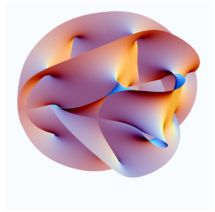
Calabi-Yau manifold (3D projection)

Compact dimensions

    Two different ways have been proposed to resolve this apparent contradiction.    The first is to compactify the extra dimensions; i.e., the 6 or 7 extra dimensions are so small as to be undetectable by present day experiments.
    To retain a high degree of supersymmetry, these compactification spaces must be very special, as reflected in their holonomy.    A 6-dimensional manifold must have SU(3) structure, a particular case (torsionless) of this being SU(3) holonomy, making it a Calabi-Yau space, and a 7-dimensional manifold must have G2 structure, with G2 holonomy again being a specific, simple, case.    Such spaces have been studied in attempts to relate string theory to the 4-dimensional Standard Model, in part due to the computational simplicity afforded by the assumption of supersymmetry.    More recently, progress has been made constructing more realistic compactifications without the degree of symmetry of Calabi-Yau or G2 manifolds.
    A standard analogy for this is to consider multidimensional space as a garden hose.    If the hose is viewed from a sufficient distance, it appears to have only one dimension, its length.    Indeed, think of a ball just small enough to enter the hose.    Throwing such a ball inside the hose, the ball would move more or less in one dimension; in any experiment we make by throwing such balls in the hose, the only important movement will be one-dimensional, that is, along the hose.    However, as one approaches the hose, one discovers that it contains a second dimension, its circumference.    Thus, an ant crawling inside it would move in two dimensions (and a fly flying in it would move in three dimensions).
    This "extra dimension" is only visible within a relatively close range to the hose, or if one "throws in" small enough objects.    Similarly, the extra compact dimensions are only "visible" at extremely small distances, or by experimenting with particles with extremely small wavelengths (of the order of the compact dimension's radius), which in quantum mechanics means very high energies (see wave-particle duality).

Further reading


Criticism of string theory

    Theory Failure: In order to make string theory work on paper our four dimensional real world had to be increased to eleven dimensions.    Since these extra dimensions can never be verified, they must be believed with religious-like faith -- not science.    Since there are an incalculable number of variations of the extra seven dimensions in string theory there are an infinite number of probable outcomes.    The only prediction ever made by string theory -- the strength of the cosmological constant -- was off by a factor of 55, which is the difference in magnitude of a baseball and our sun.    While many proponents have called string theory "elegant," this is the furthest thing from the truth.    No theory has ever proven as cumbrous and unyielding as string theory.    With all of its countless permutations it has established itself to be endless not elegant.    The final nail in the coffin of string theory is that it can never be tested.
    10/10/2009 - If the string theory can explain why the proton's mass is 938.272013(23) MeV/c2 and not something else, I would consider it a great success.    But I don't think it has reached even remotely close to that point.    The proton mass problem should be one of the land marks that the string theorists should keep in mind because what needs to be explained will eventually be explained.    I don't know if we need to throw them into the math department though.


Whats next for string theorist

    For String theory to remain as a valid form in modern physics, it will have to bring down its confusion, and prove in some way that fundamental particles that we observe are not point-like dots, but rather tiny strings that are so small that our best instruments cannot tell that they are not points.    I agree that the extra dimensions to our space-time whether curled up so tight that we can not detect them.
    Edward Witten, a leading proponents of string theory, claims it may predict our universe in time, the one that made life for us possible.
    At present string theory describes 10,500 separate universes, with different constants of nature and even different laws of physics.    Many physicists think this is a weakness of the theory, but Leonard Susskind thinks it could actually help us understand why our universe is so well suited to life.
    Can string theory accommodate inflation?    This is well accepted in physics, but it turns out that string theory has trouble producing inflation.    It could be a problem for string theory – or for inflation.
    The LHC could rule out string theory.    Particle collisions could reveal whether some of the fundamental assumptions of string theory are wrong.    Once it's working properly, the Large Hadron Collider could achieve the energies needed to reveal these effects.
    String theory is not dead yet despite capturing the popular imagination, string theory is losing its public appeal.    Sean Carroll argues that, despite the difficulties of testing it, the theory has still given us many valuable results.    Ice-bound neutrino hunter may bolster string theory in a neutrino experiment at the South Pole to detect the predicted effects of string theory.    The IceCube experiment will be able to detect up to 10 cosmic neutrinos per year.    Those neutrinos may reveal the existence of extra spatial dimensions, which is a key prediction of string theory.
    String theory facing accusations that their mathematical models cannot be tested, are retaliating with a host of thoughts on how to verify their ideas.    These include looking for gravitational waves and scrutinising the results from particle accelerators.    One of string theory's most dramatic predictions is that we should find cosmic strings.    These would be billions of light years long, thinner than a proton and spectacularly dense.    As they could reveal themselves in images of distant galaxies, the search is on.


My comment:

    In the above subject under Dualities: String duality, S-duality, T-duality, and U-duality and the five distinct superstring theories: open type I, closed type I, closed type IIA, closed type IIB, and the two flavors of heterotic string theory (SO(32) and E8×E8).
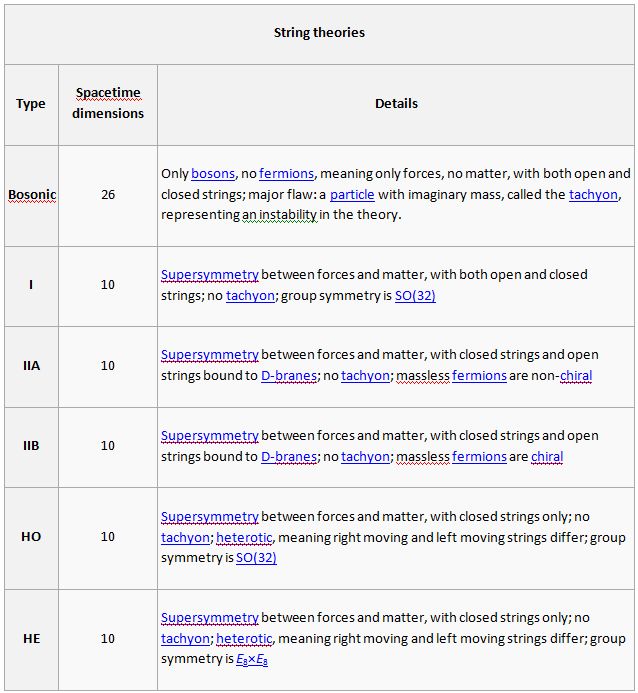
    IIA 10 Supersymmetry between forces and matter, with closed strings and open strings bound to D-branes; no tachyon; massless fermions are non-chiral.
    IIB 10 Supersymmetry between forces and matter, with closed strings and open strings bound to D-branes; no tachyon; massless fermions are chiral (means neutrinos).
    Note that in the type IIA and type IIB string theories closed strings are allowed to move everywhere throughout the ten-dimensional spacetime (called the bulk), while open strings their ends attached to D-branes, which are membranes of lower dimensionality (their dimension:
    odd  — 1, 3, 5, 7 or 9 — in type IIA
    even — 0, 2, 4, 6 or 8 — in type IIB,
    including the time direction).
    The strings make closed loops unless they encounter surfaces, called D-branes, where they can open up into 1-dimensional lines.    The endpoints of the string cannot break off the D-brane, but they can slide around on it.
    As seen in my Volume I, Chapter Four Section C page 527 on regarding the cosmology concepts in the Kabbalah.
The Ten Holy Emanations

    Before the sephiroth were emanated, there was only the Infinite Light.    When the light was restricted, a point of light issued from the Infinite Source, forming the Archetypal Man, Adam Kadmon.    This was likened to a point within a circle.    All ten sephiroth were included in this point of light or Primordial Point.    As we know a point is imperceptible and indivisible, netherless it has three dimensions.    If it were not so, we could not conceive of it.    The three dimensions are length, breadth, and depth.    Each of these dimensions is also divided into three parts, beginning, middle, and end.    We then have nine parts within this point, with the point itself making number ten.    The point and its nine dimensions are the ten sephiroth before emanation or manifestation was completed.
    (Note my comments: the above statement does not validate an actual number of nine but only six dimensions, in actuality it states that there is a three-dimensional concept (front to back, side to side, above and below), which is equal to six.    Thus the beginning, middle and end would represent the fourth-dimension of time-space or three-dimensions moving through space.    Also here is the possible concept that Einstein had that the universe might consist of a ten manifold or topological space or surface like system in its dimensioning.    Dimension is a measure of spatial extent, especially width, height, or length.    In mathematics it is one of the least number of independent coordinates required to specify uniquely a point in space or in space and time or the range of such a coordinate.    In physics a physical property, such as mass, length, time, or a combination thereof, regarded as a fundamental measure or as one of a set of fundamental measures of a physical quantity: Velocity has the dimensions of length divided by time.)

    Now for a little esoteric comparison.
    At http://www.mazzaroth.com/ChapterFour/TenSefirothAndGeometryOfHeaven.htm under Plato's Geometric progression.
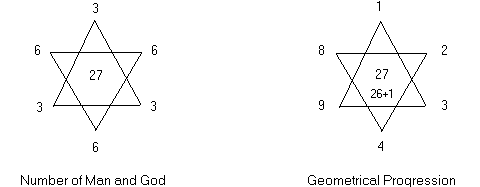
Numerical values associated with the Six Pointed Star
    Plato used mathematical symbolism to express in Greek style the kinship between his tradition and that of the Hebrew.    In Timaeus, he explains how the eternal God fashioned the world with spirit and matter bound together.
    "First of all, he took away one part of the whole [ 1 ],
    and then he separated a second part which was double the first [ 2 ],
    and then he took away a third part which was half as much again as the second and three times as much as the first [ 3 ],
    and then he took a fourth part which was twice as the second [ 4 ],
    and a fifth part which was three times the third [ 9 ],
    and a sixth part which was eight times the first [ 8 ],
    and a seventh part which was twenty-seven times the first [ 27 ]."
    Notice it was done in seven parts or octaves,
    the seven phases of clarification of the elements which inaugurate a cycle of perfect balance between spirit and matter, giving it an active and receptive double form.
    Note that the figures between brackets, form the series: 1, 2, 3, 4, 9, 8, 27 and the 9 appears before the 8.
    These figures are the first two geometrical progressions: 1, 2, 4, 8 .... and 1, 3, 9, 27 .... and both are interwoven.
    By placing Plato's numbers on the above Solomon's Seal it takes on coherence, with the
    upward pointing triangle becoming 1, 3, 9
    and the downward pointing triangle having 2, 4, 8;
    the sum of 1, 2, 3, 4, 9, 8 is 27.
    Hebrew exegetes point out that the 1 is ineffable for men and knowable only to the Elohim, the sacred name, superhuman knowledge, thus 2 marks the beginning of human initiation.
    The Hebrew numerical system has a base of 10, the base of the triangle of matter has 8 and 2 equaling 10.    Ancient astrology, has always based its number system with a base of 12.    The base of the triangle of spirit is a 9 and a 3 equaling 12.    The total of these two bases 10 and 12 equals 22.    Twenty-two is symbolic of the twenty-two different colors of light which correspond to the 22 letters of the Hebrew alphabet, having indefinite numbers of combinations according to the movement of the spirit.
    Everything is linked with another down to the very lowest link of the chain and the true essence of God, is above as well as below, in the heavens and on earth, and nothing exists outside Him.    In Isaiah 55:9 "For as the heavens are higher than the earth, so are my ways higher than your ways, and my thoughts than your thoughts."
    As to the Signs of the End after the tribulation of those days seen in Matthew 24:30 "And then shall appear the sign of the Son of man in heaven: and they shall see the Son of man coming in the clouds of heaven with power and great glory."    24:31 "And he shall send his angels with a great sound of a trumpet, and they shall gather together his elect from the four winds, from one end of heaven to the other (Mark 13:27 "from the uttermost part of the earth to the uttermost part of heaven," i.e., or simply the seven hells, seven earths, and seven heavens)."
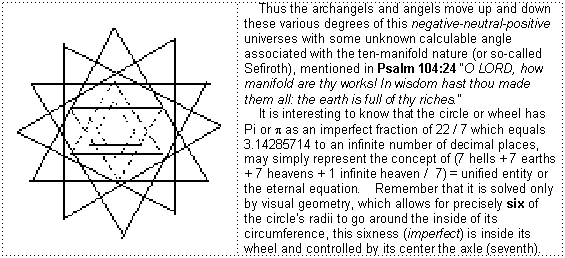
    The view is quite simple imagine the One, surrounded by four archangels, who guard over the spiritual forces flowing from the four letters YHVH, which stand watch over the four cardinal points from the (spiritual) center of the six directions of space (six-pointed star) with each of the other three looking over the other two.    If we superimpose the seven hells, seven earths, seven created heavens onto one center point, that of Araboth, the Heaven of Heavens, we get a view of the three six-pointed stars spinning on one axle, as if we were looking at wheels upon wheels.
Image of the Cosmology of the Six Pointed Star
    Note above that Psalm 104:24 states "O Lord, how manifold are thy works!..." was interesting since the string theory uses that word manifold for dimensional spaces.    Maybe the String Theorists have not yet got the odd and even numbers figured out for the dimensions correctly.
    22/7 = 3.14285714 to infinite number of decimal places, the constant they are looking for in their equations.
    For each six-pointed star there is 60 degrees between its points, if we overlay two stars in offset as above it is 30 degrees and correlates to the twelve ages of the Zodiac.    Two stars are placed inside these two, with one inside the other, and we possibly see the 24 thrones of the elders or angels and the four living beings in the center with the One noted in Revelation 4:2-11.
    We cannot see all the dimensions of the universe, modern science has allowed us to detect Radio waves which past that we do not know how far it goes.    Between that is Microwave, then Infrared, then Visible Light (Violet starts at 4100 Angstroms through Red at 6700 Angstroms) moving into Ultraviolet, then ending with X-Rays, and Gamma Rays, all with a specific frequency range from 0 up to 10 to the power of 20 and to infinity.    So there is a whole Universe of dimensions that we can not see, and can only see some by using special devices.    Animals can see in wavelengths that humans can't.    An entity living in a two-dimensional world only can experience length and width, but not height.    If I, an entity in a four dimensional world placed my finger on the two-dimensional world, I leave a tension on that dimension, which a two-D entity if notices can measure the area length and width of that tension.    The 2-D entity could make assumptions about what they discover, even though they probably may not grasp that a 3 to 4 dimensional entity is causing that tension with a finger-tip.    The point is we as 3 to 4 dimensional beings, have the same issue to understand how other dimensions affect us and how we detect them.    Most persons do not even know how to grasp the fourth-dimension, so I give them this simple analogy, "Image in your mind an acorn lying on the ground, then envision an oak tree."    Therefore, you just in mind thought experienced 4-D, in that you could see 3 spatial dimensions in the length-width-height of objects, which moved through the arrow of time.    The best analogy of the fifth-dimension, would be that as the previous analogy, you would be able to see by some method from the inside-out and from all directions outside-in of the acorn and the oak tree in its arrow of time.    I do not know anyone who can explain an analogy of the sixth to tenth dimensions, except that some push it to eternity.
    But locally, when someone says they saw an apparition appear, let it be known, that what we see may be entities from different frequencies, that have briefly intervened in our frequency range, and with our devices and eyes, we can try to make logical conclusions of what we experience from evidence, even though we may not know that what we saw may have been a finger-tip from another dimension.

    It is just food for thought for now.

More Comments: Regarding the Neutrino and String Theory extra dimensions.

    As I have pursued this study of 40 years of Physics and Cosmology and anything new on the horizon, my initial goal was to promote the neutrino as the main character in the whole of things.    As already stated in my webpages, neutrinos are a neutral subatomic particles in the lepton family, having no electrical charge and an unmeasurable mass, and can pass through ordinary matter, traveling near the speed of light, and are produced when unstable atomic nuclei or subatomic particles disintegrate, which they carry off the energy released.    They only interact with matter through a form of electromagnetic force the weak interaction, at extremely short distances.    The explosions of the stars create more neutrinos, as the weak force changes one quark into another it produced a neutrino, and has energy and spin, but has no force carrying particle, but they do react with nuclear matter.
    In time physicists proved that the weak forces were indeed the electric force in disguise, by alternating the speed of radioactive decay or break up of particles using a very powerful magnet.
    The cross section for a typical interaction involving a neutrino is 5 x 10-44 (E/[1 MeV])2 cm2 which is very small when compared to the Thomson scattering cross section of 7 x 10-25 cm2.    Thus a 1 MeV neutrino could travel through about 35 light years of water before interacting, as far as we know in the dimensions we can see or experiment in.    Even with this very small probability of interactions, neutrinos have been detected coming from nuclear reactors, the Sun, and from supernova 1987A in the Large Magellanic Cloud, all these would be masses in this universe.
    Experiments show that the neutrinos produced in muon interactions are different from the neutrinos involved in interactions with electrons.    A third kind of particle, the tau, appears to be a heavier version of the muon which is itself a heavier version of the electron.    It is assumed to have its own kind of neutrino as well.    Thus there are 3 kinds of neutrinos:
    Since it takes 40 msec for neutrinos to travel through the Earth, many cycles of the beat frequency can occur and the neutrinos become a mixture of types when traveling through the Earth and also in other dimensions.

    In the new theory of Supersymmetry, the neutralino is a key part of the theory of supersymmetry – where every elementary particle has a super-partner.    Perhaps more headline grabbing is the suggestion that neutralino could well be what is generally known as dark matter, and that it could be properly discovered outside of theory in the coming 12 months.    Some of my initial questions were:
    As we know MASS is the amount of matter in an object and defined as a measure of inertia, the tendency of a stationary object to remain motionless and of a moving object to continue moving at a constant speed and in the same direction.    Force, mass, and acceleration are related to Newton’s second law of motion F = ma.
    Mass and Weight are not the same thing.    Weight is the force on an object due to the pull of earth’s gravity.    A body weighs less the farther it gets from the surface of the earth.    But its mass remains constant, no matter where it is (weightlessness in space).    The moon's mass is 1/6th of the earth.    Thus weight can vary.
    Conservation of Mass, the loss of mass is accompanied by a release of energy in atomic bomb or nuclear reactions, gave the new concept that the total mass and energy in the universe does not change, but the quantity of each does vary.    Mass (matter) and energy are related by Albert Einstein’s famous equation E = mc2.    The formula indicates that small amounts of mass can result in large amounts of energy if the mass is completely changed into energy.
    My posit is as mass is in motion it changes to energy and creates neutrinos which permeate the space-time around the mass, and result in the creation of gravity    Some objects in motion are not affected by gravitational forces or magnetic forces.    Is this the gravitons?
    An example is the Gyroscope (a spinning wheel in a movable frame) a mechanical device that seems to defy the force of gravity.    The gyroscope holds its original position in space while the earth turns under it.    It is interesting to note that the earth holds its original position in space while the galaxy/universe turns under it.    A housefly’s top speed is 4 ½ miles per hour, but yet it can keep its position in space while enclosed in an automobile moving at 80 miles per hour, but it uses curved flight to achieve that feat.    When you ride a bicycle you must control gyroscopic forces in order to keep the bicycle standing.    The wheels must be kept spinning, and if you lean slightly to one side, you will not fall over, but only turn in the direction of the lean.    Bicycles show two gyroscopic forces: (1) gyroscopic inertia and (2) precession.
    Gyroscopic Inertia is the ability of the spinning axle of a gyroscope always to point in the same direction, no matter how the support of the gyroscope moves about.    It is gyroscopic inertia that keeps the bicycle upright as long as the wheels keep spinning.    Another example is a spinning football traveling straight to its target.
    Does the gyroscope weigh less while it is spinning?    If mass is constant, and weight can vary depending on it’s relative location to a gravitational force, is it possible that an object spinning or in motion can lose mass as energy (released as neutrinos), and thus regains that mass when it is at rest.
    Precession is the tendency of a gyroscope to move at right angles to the direction of any force applied against it and makes the bicycle turn a corner when you lean to one side.    Another example is a hula hoop which is being pushed from the side against the top, it merely will turn a corner, a precesses, or turns at right angles to the force you applied against it.
    A spinning Gyroscope is not affected by the downward pull of the earth’s gravity or by the presence of a magnetic field.    On a moving ship the gyroscope always points in the same direction regardless of the ships direction.    In a Gyrocompass it always indicates true north, and is unaffected by the earth’s magnetism or by the rolling and pitching of the ship.

    As string theory has come along, and now Quantum mechanics allows the waves to be interpreted as particles.    Bringing to light that if loops of string about 10-33 centimeter long are fundamental constituents of matter, then their vibrational energies are the masses of elementary particles such as electrons, quarks and photons.
    String theory has a super gravity entity called a bubble whose realm is in the 11th dimension, which strings wiggle through 10 dimensions, by way of a five-dimensional membrane that is wrapped around an internal curved space (like skin on a susage) and moved through a 10 dimensional space, an extreme theory.    In time other physicist simplified the string theory by topography and how objects can go from one-dimensional to three-dimensional and by shrinking them they become one-dimesnional again, as would apply to all sizes from the atomic level and up to the cosmological level.
    String theory includes both open strings, which have two distinct endpoints, and closed strings making a complete loop.    The two types of string behave in slightly different ways, yielding two different spectra.    For example, in most string theories, one of the closed string modes is the graviton, and one of the open string modes is the photon.    Most importantly, the theory has a fundamental instability, believed to result in the decay of spacetime itself.    Additionally, as the name implies, the spectrum of particles contains only bosons, particles which, like the photon, obey particular rules of behavior, bosons are the constituents of radiation, but not of matter, which is made of fermions.    Investigating how a string theory may include fermions in its spectrum led to the invention of supersymmetry, a mathematical relation between bosons and fermions.
    String theories which include fermionic vibrations are now known as superstring theories; several different kinds have been described, but all are now thought to be different limits of M-theory.
    A point-like particle's motion may be described by drawing a graph of its position (in one or two dimensions of space) against time.    The resulting picture depicts the worldline of the particle (its 'history') in spacetime.    By analogy, a similar graph depicting the progress of a string as time passes by can be obtained; the string (a one-dimensional object — a small line — by itself) will trace out a surface (a two-dimensional manifold), known as the worldsheet.    The different string modes (representing different particles, such as photon or graviton) are surface waves on this manifold.
    A closed string looks like a small loop, so its worldsheet will look like a pipe or, more generally, a Riemann surface (a two-dimensional oriented manifold) with no boundaries (i.e. no edge).    An open string worldsheet will look like a strip or, more generally, a Riemann surface with a boundary.
    String theory posits that the electrons and quarks within an atom are not 0-dimensional objects, but 1-dimensional strings.    These strings can move and vibrate, giving the observed particles their flavor, charge, mass and spin.    The strings make closed loops unless they encounter surfaces, called D-branes, where they can open up into 1-dimensional lines.    The endpoints of the string cannot break off the D-brane, but they can slide around on it.    A neutrino is an open string that could be billions of light years long just sliding around and in and out of different dimensions.
    Ice-bound neutrino hunter may bolster string theory in a neutrino experiment at the South Pole to detect the predicted effects of string theory.    The IceCube experiment will be able to detect up to 10 cosmic neutrinos per year.    Those neutrinos may reveal the existence of extra spatial dimensions, which is a key prediction of string theory.


    At the end of May of 2010 this may have occurred.    See the following article.
Subatomic particle's nature is confirmed - Neutrinos may be dark matter

    This summer, CERN gave the starting signal for the long-distance neutrino race to Italy.    The CNGS facility (CERN Neutrinos to Gran Sasso), embedded in the laboratory's accelerator complex, produced its first neutrino beam.    For the first time, billions of neutrinos were sent through the Earth's crust to the Gran Sasso laboratory, 732 kilometres away in Italy, a journey at almost the speed of light which they completed in less than 2.5 milliseconds.
    The OPERA experiment at the Gran Sasso laboratory was then commissioned, recording the first neutrino tracks.
    The CNGS project is expected to unravel some of the mysteries surrounding neutrinos, which fill the Universe but are virtually impossible to capture, as 400 billion neutrinos pass through us every second and yet only one or two will ever interact with our bodies throughout our entire lives.    The fact that they are extremely hard to intercept goes some way to explaining the mystery that surrounds them.
    We know that there are three types – or flavours – of neutrino: the electron neutrino, the muon neutrino and the tau neutrino, but physicists want to find out why the flux of neutrinos from the sun is much smaller than theory predicts.    This deficit may be due to the transformation (or oscillation) of neutrinos from one flavour into another, a process which has been observed in recent experiments.    This phenomenon, known as oscillation, is directly linked to another fundamental question that torments physicists, that of the neutrino mass.    Oscillation has shown that neutrinos have a mass, but it has yet to be determined.    The mass of neutrinos is crucial.    Even if they are infinitesimally light, these particles could contribute to the Universe’s mysterious dark matter, which is invisible to telescopes but whose gravitational effect can be observed.    A better knowledge of neutrino mass would also allow physicists to complete the puzzle that is the theory of the fundamental forces of nature and would help them to understand why matter is more prevalent in our Universe than antimatter.
    The CNGS project is to provide evidence of neutrino oscillation which is thought to occur over long distances.    To achieve this, OPERA, a first experiment nestling below 1440 metres of rock, has been commissioned at the Gran Sasso laboratory.    OPERA’s huge detector, weighing 1800 tonnes, should identify particles transformed from muon neutrinos into tau neutrinos during the journey, thus demonstrating oscillation.    OPERA is expected to intercept and detect around 25 muon neutrinos out of the one hundred billion that will reach it every day.    Around fifteen tau neutrinos produced by oscillation are expected to be detected over five years.    A second experiment, ICARUS, is expected to be built in the coming years.
    The production of a high-intensity neutrino beam at CERN requires a complex facility.    A proton beam produced and accelerated by the CERN accelerators is directed onto a graphite target to give birth to other particles called pions and kaons.    These particles are then fed into a system comprising two magnetic horns which focus them into a parallel beam that is directed towards Gran Sasso.    Next, in a 1000 metre-long tunnel, the pions and kaons decay into muons and muon neutrinos.    At the end of this decay tunnel, an 18 metre thick block of graphite and metal absorbs the protons, pions and kaons that did not decay.    The muons are stopped by the rock.    Impervious to all such obstacles, the muon neutrinos will leave the CERN tunnels and streak through the rock on their 732 kilometre journey to Italy.

    European researchers observe for the first time a transformation in neutrinos, evidence that they have mass.    It's an important step in understanding the universe's dark matter.
May 31, 2010, by Thomas H. Maugh II, Los Angeles Times.

    For the first time, physicists have confirmed that certain subatomic particles have mass and that they could account for a large proportion of matter in the universe, the so-called dark matter that astrophysicists know is there but that cannot be observed by conventional means.
    The finding concerns the behavior of neutrinos, ghost-like particles that travel at the speed of light.    In the new experiment, physicists captured a muon neutrino in the process of transforming into a tau neutrino.
    Researchers had strongly believed that such transformations occur because they have been able to observe the disappearancemuon neutrinos in a variety of experiments.
    But the research announced Monday marks the first time that the appearance of a tau neutrino has been directly observed.    Physicists from CERN (the European Organization for Nuclear Research) in Geneva and the Italian National Institute of Nuclear Physics' Gran Sasso National Laboratory were involved.    "This is an important step for neutrino physics," CERN Director-General Rolf Heuer said in a statement.    "We're all looking forward to unveiling the new physics this result presages."
    Astrophysicists have inferred the existence of dark matter from their observations that the total amount of visible matter is insufficient to account for gravitational effects.    It is estimated that dark matter accounts for 80% of the mass of the universe and visible matter only 20%.
    The new finding is important because in the theories now used to explain the behavior of fundamental particles, called the Standard Model, neutrinos have no mass.    But if they have no mass, they cannot oscillate between muon and tau forms.    The fact that they do oscillate indicates that they have mass and that the fundamentals of the Standard Model need some reworking, at the very least.
    Neutrinos interact with matter so weakly that they can travel through the entire Earth with the ease of a light beam traveling through a windowpane.    They have no electrical charge — hence the name, meaning "little neutral one."
    Physicists generally don't see neutrinos.    Instead, they observe the debris left behind on the rare occasions when a neutrino strikes an atom head on.    They now know that there are three types of neutrino: electron, muon and tau, each named for the particle that is produced in the collision.

    In Geneva, on May 31, 2010, researchers on the OPERA experiment at the INFN1’s Gran Sasso laboratory in Italy today announced the first direct observation of a tau particle in a muon neutrino beam sent through the Earth from CERN2, 730km away.    This is a significant result, providing the final missing piece of a puzzle that has been challenging science since the 1960s, and giving tantalizing hints of new physics to come.
    The neutrino puzzle began with a pioneering and ultimately Nobel Prize winning experiment conducted by US scientist Ray Davis beginning in the 1960s.    He observed far fewer neutrinos arriving at the Earth from the Sun than solar models predicted: either solar models were wrong, or something was happening to the neutrinos on their way.    A possible solution to the puzzle was provided in 1969 by the theorists Bruno Pontecorvo and Vladimir Gribov, who first suggested that chameleon-like oscillatory changes between different types of neutrinos could be responsible for the apparent neutrino deficit.
    Several experiments since have observed the disappearance of muon-neutrinos, confirming the oscillation hypothesis, but until now no observations of the appearance of a tau-neutrino in a pure muon-neutrino beam have been observed: this is the first time that the neutrino chameleon has been caught in the act of changing from muon-type to tau-type.
    Antonio Ereditato, Spokesperson of the OPERA collaboration described the development as: “an important result which rewards the entire OPERA collaboration for its years of commitment and which confirms that we have made sound experimental choices.    We are confident that this first event will be followed by others that will fully demonstrate the appearance of neutrino oscillation”.
    “The OPERA experiment has reached its first goal: the detection of a tau neutrino obtained from the transformation of a muon neutrino, which occurred during the journey from Geneva to the Gran Sasso Laboratory,” added Lucia Votano, Director Gran Sasso laboratories.    “This important result comes after a decade of intense work performed by the Collaboration, with the support of the Laboratory, and it again confirms that LNGS is a leading laboratory in Astroparticle Physics.”
    The OPERA result follows seven years of preparation and over three years of beam provided by CERN. During that time, billions of billions of muon-neutrinos have been sent from CERN to Gran Sasso, taking just 2.4 milliseconds to make the trip.    The rarity of neutrino oscillation, coupled with the fact that neutrinos interact very weakly with matter makes this kind of experiment extremely subtle to conduct.    CERN’s neutrino beam was first switched on in 2006, and since then researchers on the OPERA experiment have been carefully sifting their data for evidence of the appearance of tau particles, the telltale sign that a muon-neutrino has oscillated into a tau-neutrino.    Patience of this kind is a virtue in particle physics research, as INFN President Roberto Petronzio explained: “This success is due to the tenacity and inventiveness of the physicists of the international community, who designed a particle beam especially for this experiment,” said Petronzio.    “In this way, the original design of Gran Sasso has been crowned with success.    In fact, when constructed, the laboratories were oriented so that they could receive particle beams from CERN”.
    At CERN, neutrinos are generated from collisions of an accelerated beam of protons with a target.    When protons hit the target, particles called pions and kaons are produced.    They quickly decay, giving rise to neutrinos.    Unlike charged particles, neutrinos are not sensitive to the electromagnetic fields usually used by physicists to change the trajectories of particle beams.    Neutrinos can pass through matter without interacting with it; they keep the same direction of motion they have from their birth.    Hence, as soon as they are produced, they maintain a straight path, passing through the Earth's crust.    For this reason, it is extremely important that from the very beginning the beam points exactly towards the laboratories at Gran Sasso.
    “This is an important step for neutrino physics,” said CERN Director General Rolf Heuer.    “My congratulations go to the OPERA experiment and the Gran Sasso Laboratories, as well as the accelerator departments at CERN.    We’re all looking forward to unveiling the new physics this result presages.”
    While closing a chapter on understanding the nature of neutrinos, the observation of neutrino oscillations is strong evidence for new physics.    In the theories that physicists use to explain the behaviour of fundamental particles, which is known as the Standard Model, neutrinos have no mass.    For neutrinos to be able to oscillate, however, they must have mass: something must be missing from the Standard Model.    Despite its success in describing the particles that make up the visible Universe and their interactions, physicists have long known that there is much the Standard Model does not explain.    One possibility is the existence of other, so-far unobserved types of neutrinos that could shed light on Dark Matter, which is believed to make up about a quarter of the Universe’s mass.

    I am finally glad to hear that someone finally has proven by experiment my years of innovated thinking knowing that neutrinos were the key to the gravitational effects upon matter.    The reason they did not think they had mass, was their lack of conceiving that while they are or go into another dimensional state they effect matter which is in motion.    There would be no gravity and curvature of space without neutrinos.    If matter is not in motion then neutrinos is in a different state of dark matter, energy with no mass or form, waiting for something to put it into motion.

    In recent news, Steven Hawking has pushed for a Theory Of Everything, and has come to the conclusion that string theory may be the direction that will takes us to that discovery, as a "No Boundary Condition."    Other physicist such as Lisa Randall of Harvard University claiming they are "curled up into extra dimensions," also Bernard Carr, string theorist Michael B. Green of University of Cambridge, Edward Witten of the Institute of Advance Studies, and John Schwarz of the California Institute of Technology all pushing the 11 dimensions of M-Theory as the future solution of the Theory Of Everything.    They all have come to the conclusion that Gravity's effect is weak because it has to make its way through 11 dimensions.
    As I have stated in all of the above comments that it is also true that neutrinos have to make their way through the same 11 dimension since they permeate everything all the time just like gravity, just to enter the dimension that we can see or detect them.

    In some of the latest news on this subject the following article was provided by Discovery News.

    Superstring theory aims to plug a gaping hole where the standard model doesn't include the gravitational force.    There are the three full-sized spatial dimensions we experience every day, one dimension of time, and six extra dimensions crumpled up at the Planck scale like itty-bitty wads of paper.    As tiny as these dimensions are, strings -- the most fundamental unit in nature, vibrating down at the Planck scale -- are even smaller.

    British physicist Stephen Hawking doesn't believe in a "Heaven" or an afterlife, and he cut "God" out of the universal creation equation.    "Because there is a law such as gravity, the Universe can and will create itself from nothing.    Spontaneous creation is the reason there is something rather than nothing, why the Universe exists, why we exist," he wrote.    Stephen Green, director of lobby group Christian Voice, stated this "… shows a man who is only able to think of things in a materialistic way."
    Hawking wants to answer the question: "Why are we here?"    Hawking discussed the quantum fluctuations in the very early universe that became the seeds from which everything we see in the Universe grew.    For Hawking, no omnipresent "creator" is needed to form the Universe we live in.    From the Big Bang to present day, science can explain how we got here.    There is no "why"; we are here through chance, nothing more.
    "Science predicts that many different kinds of universe will be spontaneously created out of nothing.    It is a matter of chance which we are in," he said.
    Fundamentally, Hawking bases his argument on M-theory, an extension of string theory, where 11 dimensions are calculated to exist; our 4-dimensional space-time is therefore only part of the story.    The first step in proving the foundations of M-theory could come from the Large Hadron Collider (LHC) where supersymmetry particles may be discovered.
    Going head-to-head with religion is nothing new, and Hawking has obviously caused a kerfuffle.    However, religion and science are two very different creatures.    Faith doesn't need evidence for the existence of a God, Heaven or Hell; religion is a belief structure, no amount of mathematics can disprove a faith -- and no amount of faith can prove a god.
    If Hawking can so easily disprove Heaven using those pesky equations, can Heaven simply be shoehorned into the equations to make it exist?
    Why not!    "Hawking is happy to discuss the M-theory, in which the universe is said to have 11 dimensions, why then could the universe not have a 12th spiritual dimension?" said Green.
    As you can see, science and religion often mixes like oil and water.

    All matter (and all forces) are composed of these vibrations -- including gravity.    And one of the ways in which strings can vibrate corresponds to a particle that mediates gravity.    Therefore, general relativity has now been quantized.    And that means string theory could be used to explore the infinitely tiny point of our universe's birth (or, for that matter, the singularity that lies at the center of a black hole).
    Shattered Symmetry opens up one more wrinkle, and that is extra dimensions, versus the three we currently experience.    Physicists have a hypothetical scenario to explain this.    Before the Big Bang, the cosmos was a perfectly symmetrical nine-dimensional universe (or ten, if you add in the dimension of time) with all four fundamental forces unified at unimaginably high temperatures.    But this universe was highly unstable and cracked in two, sending an immense shock wave reverberating through the embryonic cosmos.
    The result was two separate space-times: the unfurled three-dimensional one that we inhabit, and a six-dimensional one that contracted as violently as ours expanded, shrinking into a tiny Planckian ball.    As our universe expanded and cooled, the four forces split off one by one, beginning with gravity.    Everything we see around us today is a mere shard of the original shattered nine-dimensional universe.

    The universe is not only expanding -- it's being swept along in the direction of constellations Centaurus and Hydra at a steady clip of one million miles per hour, pulled, perhaps, by the gravity of another universe.    No one knows what is tugging at us but they promote it likely dates back to the fraction of the second between the universe's explosive birth 13.7 billion years ago and its inflation a split second later.    All they can say with certainty that somewhere very far away the world is very different than what we see locally.    Whether it's 'another universe' or a we don't know," according to Alexander Kashlinsky at NASA's Goddard Space Flight Center in Greenbelt, Maryland.    Kashlinsky and colleagues have spent years building up evidence for what they call "the dark flow."    They look at how the relic radiation from the Big Bang explosion scatters as it passes through gases in galaxy clusters, a process that is something akin to looking at stars through the bubble of Earth's atmosphere.
    With data on more than 1,000 galaxy clusters, including some as distant as 3 billion light-years from Earth, the measurements show the universe's steady flow is clearly not a statistical fluke, Kashlinsky said.    "It was greatly surprising.    When we first found it, we didn't know what to do with it.    We knew how extraordinarily unexpected it was," he said.
    The force and direction of the flow holds steady across space and through time.
    "It's the same flow at a distance of a hundred million light-years as it is at 2.5 billion light-years and it points in the same direction and the same amplitude.    It looks like the entire matter of the universe is moving from one direction to the next," Kashlinsky said.
    The observation fits theoretical models of how our universe might be impacted by sibling universes, predicted by string theory that we cannot directly detect.
    It's like our universe is a box and everything that it contains is inside it like milk in a carton, physicist Laura Mersini-Houghton with University of North Carolina at Chapel Hill commented on.    "If our universe is all that's there, then the liquid in the box shouldn't be sliding.    Whatever is pulling it has to be bigger than the size of the box," she said.    "There is a structure beyond the horizon of our universe and that structure is exerting a force on our universe and creating this flow."

    The original ten-dimensional fabric of space-time was stretched tight in a supersymmetric state.    But the tension became too great, and space-time cracked in two.    One part curled up into a tight little ball, while the aftershock from the cataclysmic cosmic cracking caused the other part to expand outward rapidly, a period known as inflation.    This became our visible universe.
    What is the mechanism by which this happened?    For a ten-dimensional universe, there are millions of ways for supersymmetry to break.    So is there something special about three spatial dimensions that causes that configuration to be favored in our own universe?
    The new simulations may help shed some light on why this symmetry breaking might have unfolded the way it did.    That's what the Japanese simulation shows: the universe had nine spatial dimensions at its birth, but only three of them experienced expansion.    It's the first practical demonstration of how a three-dimensional universe emerges from nine-dimensional space, providing strong support in favor of the theory's validity.

    As to Black Holes on a String in the Fifth Dimension where last October an intriguing paper appeared on the arXiv regarding new computer simulations of what happens mathematically to black holes when you analyze them in five dimensions -- assuming that the fifth dimension is "compactified."    What do we mean by a "fifth dimension?"    The notion dates back to an early 20th century attempt to unify gravity and electromagnetism.    Albert Einstein's theory of relativity unified three-dimensional space with the fourth dimension of time, and merged gravity and acceleration, attributing the force of gravity to the warping of the fabric of space-time.
    Inspired by Einstein's work, in 1919, a Polish mathematician named Theodr Kaluza proposed that electromagnetism might be due to a similar warping of an unseen fifth spatial dimension.    By reworking Einstein’s equations in five dimensions (four spatial, one temporal), Kaluza believed that he could merge the two forces.    He envisioned light as a disturbance caused by the rippling of the higher dimension just beyond human perception, much as fish in a pond can only see the shadows of the ripples across the water’s surface caused by raindrops.
    Okay, so what is this compactification nonsense?    Well, Kaluza’s theory raised an obvious question: if there is a fifth dimension, why can't we see it?
    Enter Oskar Klein, a Swedish mathematician who argued that this hypothetical fifth dimension could simply be so tiny that not even atoms that could pass into it.    Specifically, it would have to be curled up (“compactified”) into a tiny ball much, much smaller than an atom.
    String theorists adapted these "Kaluza-Klein models" in the 1970s.    According to string theory, there are the three full-sized spatial dimensions we experience every day, one dimension of time, and six extra dimensions crumpled up at the Planck scale like itty-bitty wads of paper.
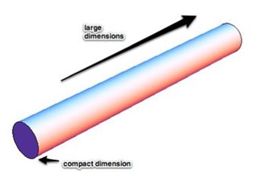
    So string theory is really complicated like that and suddenly, blacks holes in five dimensions seem quite manageable, don't they?
    So, this new paper looks at what happens to black holes in five dimensions, where the fifth dimension is compactified.    Luis Lehner and Frans Pretorius built on earlier work by Ruth Gregory and Raymond LaFlamme, who found that if you have a black hole in that particular configuration, you would get a "black string" shaped like a cylinder stretched across the extra dimension.
    That extra dimension can be larger or smaller than the black hole; the Gregory/LaFlamme model focused on the former scenario, which would give rise to an unstable configuration in the form of "wiggles" in the black string.    Those wiggles would eventually cause the string to pinch off into a series of ever smaller holes.

    Lehner and Pretorius analyzed this decay of a long black string into multiple black holes all the way to the point where the string shrinks to nothing, until it violates the so-called "cosmic censorship" conjecture that forbids a "naked singularity."    If naked singularities do exist, many believe that this innate “cosmic censorship" would shield them from direct observation.
    See, these hypothetical cylindrical black strings have singularities at their center.    And if this new analysis is correct -- and let's face it, that won't be determined experimentally any time soon, seeing as how we haven't yet observed any evidence for compactified extra dimensions -- then cosmic censorship would be violated.    As a black string gets smaller and smaller, dividing into multiple black holes, at the moment it shrinks to nothing, its singularity should become "naked" -- observable to the outside world.
    Did I mention this process is fractal to boot?    I'll let Sean Carroll over at Cosmic Variance explain:
    "The cool part is the way in which the strings decay into black holes.    They form a self-similar pattern along the way — a fractal configuration of black holes of every size, from the largest on down.    As the string shrinks in radius, it keeps beading off smaller and smaller black holes.    Eventually we would expect them all just to bump into each other and make one big black hole, but the intermediate configuration is complex and elegant.    And cosmic censorship is apparently violated when the strings finally shrink to zero radius."
    Jun Nishimura (KEK), Asato Tsuchiya (Shizuoka University), and Sang-Woo Kim (Osaka University) tackled the problem using a formulation of string theory known as the IKKT matrix model (named after the scientists who developed it in 1996, Ishibashi, Kawai, Kitazawa, and Tsuchiya).    It's designed to model the complex interactions of strings.
    For very complicated technical reasons, the connection between the original IKKT matrix model and the real world was, well, a bit vague, mostly because (a) it assumes weak interactions, when in fact the interactions between strings are quite strong; and (b) the variable of time in the calculations wasn't treated as "real" in a mathematical sense.    These new simulations assume strong interactions, and treat time as a real variable.
    So the takeaway message is that string theorists now have a useful tool for analyzing superstring theory's predictions with computer simulations, shedding light on such knotty problems as inflation, dark matter, and the accelerating expansion of the universe.    And it also explains why our universe looks the way it does.

    The following images are from Theodr Kaluza's website video for the promotion of String Theory.
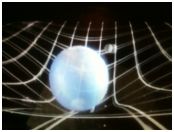
   
Space-time Curvature.
           
Space curled up tight in Space-time.
               
Quarks and Charm, then vibrating strings in their different states.


Released February 23, 2010, updated February 26, 2010, March 17, 2010, June 10, 2010, Feburary 9, 2011, May 5, 2012, and July 1, 2012.


Go to the top of this page
To return to Volume III - site for Neutrinos And Missing Matter or Volume III - M-Theory Equations, History and Concepts
or the Volume III - New Released Files.

Return to the Table of Contents or the Zodiac of Denderah