From The Alpha and the Omega - Volume III
by Jim A. Cornwell, Copyright © July 20, 2002, all rights reserved
"Volume III - Dark Matter for 2002-2010"
Go to the bottom of this page
Volume III - Dark Matter for 2002-2010
This file created on July 11, 2003 is a Volume III continuation of the original website at http://www.mazzaroth.com/Introduction/DarkMatter99.htm regarding the subject of Dark Matter for 1999-2001 ocurring in the events of 1999-2010 of the Fifth group of Twelve years.
Since my younger days I had studied and researched all the information I could on what was going on in the last fifty years in science as to cosmology and physics. For those of you that have followed these articles, my personal view regarding neutrinos from the beginning is that it is the missing matter in the universe and also their virtual interaction with mass in motion. I may never prove this before the end of my life, but I feel strongly that it will be the category that finally gives the answer to the Unified Equation. In the near future I may add an article of my research to find that answer. So stay tuned.
- 7/21/2000 - Scientists find first direct evidence of subatomic particle tau neutrino - Discovery supports standard model theorized in 1978 - by Joseph B. Verrengia, The Associated Press.
After a two-decade search, scientists have found the first direct evidence of one of the most elusive subatomic particles in nature -- the tau neutrino. The discovery announced by the scientists from the United States, Japan, Korea and Greece at the Fermi National Accelerator Laboratory outside of Chicago after searching since 1997. The tau is one of the fundamental building blocks of all matter. It is the last of the tiny particles described in the Standard Model of Particle Physics to be confirmed in experiments.
The standard model seeks to encapsulate all elementary particles and forces in a single explanation. Now the bits have been identified, though the many forces that guide their interplay remain a mystery.
"It's a tremendous milestone," said Stanford University physicist and Nobel Prize winner Martin perl, who theorized the existence of the tau neutrino in 1978. "Now it has been seen and it behaves in the way we expected."
Neutrinos are hurtling everywhere at the speed of light. Trillions pass through each of us every second. Yet they are among the hardest to detect of all subatomic particles, carrying no electrical charge and virtually no mass -- perhaps one-millionth that of an electron.
The tau neutrino is the third and perhaps final type of neutrino to be found. The first two types -- electron neutrinos and muon neutrinos -- were discovered in 1956 and 1962. In 1978, tests by Perl and others at Stanford discovered the existence of another class of subatomic particle, the tau lepton. This suggested there would be a tau neutrino, too, because neutrinos are precursors to leptons.
In 1997, scientists using the ring-shaped particle accelerator at Fermilab fired an intense neutrino beam into a 50-foot detector composed of iron plates coated with an emulsion. Then they analyzed the 6 million impressions left on the coating, and with computer assisted video camera to create 3-D images of the particle tracks. After narrowing it down they found four clear tracks of a tau lepton that were caused by tau neutrino collisions. They can never be detected directly, since they have no charge, only their signature is detected.
- 3/14/2001 - Black holes once were much more active by Paul Recer, The Associated Press.
Washington -- The early universe teemed with supermassive black holes spewing X-rays across the heavens, according to data from an orbiting telescope that picked up images from far, far away and long, long ago. The Chandra X-ray telescope, in a study focused on small sections of the sky for days-long exposures, has captured faint X-rays straming from black holes up to 12 billion light-years away, astronomers said. "The Chandra data show us that giant black holes were much more active in the past than at present," said Riccardo Giacconi, a Johns Hopkins University astronomer. "If you look at the sky with X-ray eyes, you see almost nothing but black holes," said Bruce Margon, a professor of astronomy at the University of Washington, Seattle.
Black holes are single points of extreme density forming gravitational fields so strong that nothing, not even light, can escape. Extremely powerful black holes at the center of galaxies can have a mass one million to 100 billion times that of the sun concentrated at a point not much bigger than the Earth. Stellar black holes, formed from collapsed stars, are much smaller, down to three solar masses, and can have a core only a few miles across. Since they allow no light to escape their centers, black holes are detected by the effect that they have on surrounding gas, dust and stars. Before matter is pulled into the center of a black hole, it is accelerated to near the speed of light, resulting in streams of X-rays.
- 3/19/2001 - Unusual States of Matter by Earl Lane, Times-Post News Service.
Reinhard Stock remembers the days in the late 1970s when a small band of physicists speculated that ordinary matter, if compressed enough, might transform into a new state that would mimic some of the conditions at the birth of the cosmos. Theorists argued that the protons and neutrons at the core of the atom, under extreme conditions, would "melt." That could allow the constituent building blocks, called quarks, to briefly roam free (along with particles called gluons that bind the quarks tightly together) in a state called the quark-gluon plasma. Physicists figured they might get a glimpse of it by accelerating heavy ions -- atoms stripped of their outer electrons -- to nearly the speed of light. The ions would then be sent crashing into each other or against stationary targets.
Last year, officials at CERN, the European physics research center near Geneva, Switzerland, announced that heavy ion experiments at that lab had produced circumstantial evidence for a new state of matter in which quarks had been briefly "deconfined." Many physicists were skeptical, since the current heavy ion program at CERN winds down, for the researchers to make their best case for having found a hint of the quark-gluon plasma. Evidence from other colliders may take two or three years. The goal is to explain why the universe turned out the way it looks today, physicists say. Quarks combine in trios or pairs to form the bulk of the matter we see today in the cosmos, and they are tightly bound through the strong nuclear force transmitted by uncharged particles called gluons. The experiment suggest that force gets only stronger as efforts are made to separate pairs of quarks.
- 4/2/2001 - Antarctic telescope detects neutrinos by The Washington Post.
A telescope 164 stories tall and 400 feet across, buried a mile deep in Antarctic ice, has detected some of the most exotic particles known. Neutrinos are invisible particles that have no electrical charge or mass. They are devilishly difficult to catch, but considered worth the bother, because they carry information about the most distant and violent events in the universe. The telescope has for the first time observed high-energy neutrinos, according to a team of scientists reporting in a recent issue of Nature. The ability to find high-energy neutrinos promises new insights into such phenomena as colliding black holes, gamma-ray bursters and the wreckage of exploded stars, the researchers said.
- 4/2/2001 - Dark Matter detected by its influences by Gannett News Service.
Scientists from the United States and the United Kingdom have for the first time detected the presence of dark matter in our galaxy. Scientists say that to account for the galaxy's rotation, unseen dark matter must exist. They can detect its presence by its influence on the motion of stars and other galaxies.
The researchers, who published their work in the journal Science, studied ancient white dwarf stars -- dense, cool, faded stars that no longer produce energy through nuclear fusion. They found a population of dwarf stars that may account for at least 3 percent of the halo dark matter. Since these degenerated stars are also very ancient, they could give astronomers a glimpse of the earliest history of our galaxy as well.
- 5/14/2001 - Finding Sheds Light On Spinning Black Holes by Kathy Sawyer, The Washington Post.
For the first time, astronomers have evidence that a black hole can spin like a top. In this case, a black hole 10,000 light-years from Earth appears to be whipping matter around itself at 27,000 revolutions per minute, flashing X-rays in unsteady spasms and twisting the fabric of space-time. "We can see the light emitted from matter plunging into the black hole, said Todd Strohmayer, of NASA's Goddard Space Flight Center in Greenbelt, Md. This material "whips frantically around the black hole before it is lost forever." The study of black holes is suppose to move science closer to a theory that explains how all the forces of nature work together, so called "theory of everything." This would represent the workings of gravity to fit harmoniously with the other forces of nature, said Virginia Trimble, of the University of Maryland and the University of California, Irvine. Albert Einstein's theory of gravity has passed a series of observational tests, but nobody has figured out how to make it compatible with the laws of quantum physics that govern the subatomic world. Black holes, where all these forces reach extremes, make ideal -- if difficult -- laboratories. What Strohmayer found were unique patterns in the X-ray radiation emitted around the black hole as it pulls material at almost the speed of light from a companion star orbiting around it. At the same time, the maelstrom around the hole ejects particles in jets from its north and south poles, also at incredibly high velocities. "Black holes are one of the greatest energy sources in the universe," Strohmayer noted. They surmised that the black hole inherited the rotation properties, or angular momentum, of the star that formed it.
- Scientific American, August, 2002 issue, pg. 42-52 - Does Dark Matter Really Exist? - Ninety-five percent of the universe has gone missing. Or has it? - by Mordehai Milgrom, author.
The need for extra matter arises not only in well-formed galatic systems but also through the universe at large. Long before galaxies even formed, the universe was filled with a plasma of atomic nuclei and subatomic particles. Radiation suffused the plasma and kept it extremely smooth. Fluctuations in the density of this plasma did not have a chance to grow and develop into galaxies until after the plasma had turned into a neutral gas, which does not interact with radiation as strongly.
The problem is that there just wasn't enough time for those flucuations to become galaxies we observe. Dark matter would help in that, being neutral by definition, it would not be homogenized by radiation. Therefore, it would have been contracting all along. Dark matter would have had enough time to form galaxy-mass bodies.
Common knowledge has it that part of this extra mass consists of ordinary matter that gives off too little radiation for present technology to detect: planets, dwarf stars, warm gas. Such material is more precisely called dim matter. It could represent up to 10 times as much matter as astronomers see, but even so it could account for only a small fraction of the missing mass. When researchers refer to dark matter, they usually mean an exotic breed of matter that makes up the difference. To add to the confusion, they also suspect the existence of dark energy, a distinct type of energy that would produce the observed accelerated expansion of the universe.
In sum, astronomers widely believe the current energy content of the universe to be roughly 4 percent ordinary (or "baryonic") matter, about a tenth of which is seen as stars and gas; a third dark matter in some unknown form; and two-thirds dark energy, the nature of which is even less understood.
If we accept a departure from these standard laws, we might do away with dark matter.
The formula in Newtonian physics combines two basic laws: Newton's law of gravity (which relates the force of gravity between bodies to the bodies' masses and separation) and Newtonian's second law (which relates force to acceleration). These laws accurately explain the flight of a ballistic missile and the motions of the planets. But their extrapolation to galaxies has never been directly tested.
This article suggest that if the laws break down, then modifying them might obviate dark matter. Two drastic changes to Newtonian physics have already proved necessary. The first upgraded Newtonian dynamics to the theory of relativity -- both the special theory (which changed Newton's second law) and the general theory (which altered the law of gravity). The second led to quantum theory.
Overview/Alternative to Dark Matter
- Astronomers have two ways to determine how much matter fills the universe, the total of what is seen, and the measure of how fast the visible objects move, apply the law of physics and deduce how much mass is needed to generate the gravity that restrains those objects. So the conclusion was dark matter.
- Perhaps the fault lies not in the matter but in the laws of physics. The author has proposed a modification to Newton's laws of motion or gravity to explain away the discrepancy.
- The modification, known as MOND, does a good job of reproducing observations, than dark matter does.
The author zeroed in on accleleration, propossing a modification 20 years ago to Newton's second law that changed the relation between force and acceleration when accleration is low. This was the beginning of the idea called MOND, for Modified Newtonian Dynamics. MOND introduces a new constant of nature with the dimensions of acceleration, called a0.
When the acceleration is much larger than a0, Newton's second law applies as usual: force is proportional to acceleration.
But when acceleration is small compared with a0, Newton's second law is altered: force becomes proportional to the square of the acceleration.
To account for the observed accelerations in galaxies, MOND predicts a smaller force -- hence, less gravity-producing mass--than Newtonian dynamics does, allowing for the elimination of dark matter.
In the outskirts of galaxies, the acceleration produced by gravity decreases with distance and eventually goes below a0.
Exactly where this happens depends on the value of a0 and on the mass. The higher the mass, the farther out the effects of MOND set in.
The bulk of the solar system's mass is contained in the sun, and the orbital velocity of the planets decreases with distance. Mercury has a faster orbit than Earth does, the effects of MOND falling below a0 would be 10,000 times as far from the sun as Earth is, far beyond the orbit of Pluto.
At large distances from the center of a galaxy, the orbital velocity should stop decreasing and reach a constant value. This constant velocity should be proportional to the fourth root of the galaxy's mass. So far MOND's main failure has occurred in the observations in the cores of large rich galaxy clusters, but fits well with Globular clusters, Spiral galaxies, Galaxy clusters, Dwarf spiral galaxies, Dwarf spheroidal galaxies, and small galaxy groups.
Commentary Not a Bad Idea, MOND is out of the mainstream, but it is far from wacky, by Anthony Aguirre, a theoretical cosmologist at the Institute for Advanced Study in Princeton, N.J.
As an alternative hypothesis -- a modification of Newtonian gravitational dynamics (MOND) -- has quitely endured since its proposal in 1983. As Mordehai Milgrom discusses in the above article, MOND can claim an impressive number of correct predictions regarding the dynamics of galaxies. The reactions of most astronomers fall into three categories:
- 1. MOND is a tautology, that explains only what it was designed to explain. Its few predictions have been exaggerated by its proponents.
- Since MOND has been released many have reproduced the statistics of galaxy properties at least as well as dark matter models do, even though these models describe crucial aspects of galaxy formation in an ad hoc way. MOND can predict the details of galaxy rotation using only the distribution of visible matter and assumed (fixed) ratio of mass to luminosity - a feat beyond the ability of dark matter models. This statement helps to refute the claim of it being a tautology.
- 2. MOND describes a mysterious regularity in the formation and evolution of galaxies. The standard theory of gravity still applies and dark matter still exists, but somehow the dark matter emulates MOND. When applied to unusual galaxies or systems other than galaxies, MOND will eventually be shown to fail.
- Standard dark matter theory has run into difficulty when applied to galaxies. It predicts that the dark matter cores of galaxies should be far denser than observations indicate. Some claim this is because of computational limitations. Some theorists have converted from the first view to the second view in recent years.
- 3. MOND replaces Newtonian dynamics under certain conditions. It is one aspect of a theory of gravitational dynamics that will supplant Einstein's general theory of relativity.
- Few theorists have gone to the third view yet. MOND's proponents have yet to formulate it in a way that can be applied to post-Newtonian phenomena such as gravitational lensing and cosmic expansion. Its predictions about the temperature of hot gas in clusters of galaxies disagree starkly with observations, unless clusters are dominated by -- what else? -- undetected matter. The standard dark matter theory has scored some impressive triumphs in recent years.
Released on February 3, 2005 on Scientific American's webpage at: http://www.sciam.com/article.cfm?chanID=sa003&articleID=00048DA2-5C8A-1201-947F83414B7F4945
Chunk of Universe's Missing Matter Found
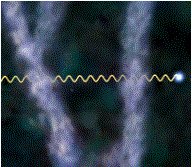
In recent years, astronomers have found themselves faced with a nagging inventory problem. Received wisdom holds that dark matter and dark energy make up 95 percent of the universe, and ordinary matter, or baryons--the subatomic particles that form planets, stars and the like--account for the remainder. The problem is, the luminous matter detected with the aid of optical telescopes has amounted to a mere 10 percent of the expected ordinary matter, and the baryons inferred by other means bring that total to only 50 percent.
New findings are helping to bridge this gap between prediction and observation. In a paper published today in the journal Nature, scientists report having identified the probable source of the rest of this missing matter. Data from the Chandra X-ray Observatory, it appears, indicate that the lost baryons may be swimming in diffuse rivers of gas in the intergalactic medium too hot to see with an optical telescope.
Previous work had suggested that baryons might be inhabiting an infernally hot intergalactic gas, but the researchers did not know enough about the density of the baryons to draw firm conclusions about how many might be there. In the new study, Fabrizio Nicastro of the Harvard-Smithsonian Center for Astrophysics and his colleagues obtained high-quality spectra of the gas while it was illuminated by the flaring of the quasarlike galaxy Markarian 421 (see image above). Based on those spectra, the team determined that the density of the baryons in the gas was sufficient to account for the missing matter.
But whether the region sampled in this study is representative of the rest of the universe is not known. "New ultraviolet and X-ray observatories are needed to complete the inventory of missing baryons," writes J. Michael Shull of the University of Colorado in an accompanying commentary. "But they will do much more, allowing astronomers to map out the cosmic web of filamentary intergalactic matter from which the first galaxies and stars were formed." --Kate Wong
July 10, 2006 - Will New Physics Answer The Big Questions?
Highlights from article by Dennis Overbye, The New York Times.
Most of us do not have a clue of what physics is. Professional physicists live for the moment when they know something nobody else has ever known, a new glimpse into the workings of what Stephen Hawking, the Cambridge University cosmologist, called "the Mind of God."
In the 1970s, particle physicists put the finishing touches on the Standard Model, a collection of theories describing all the physical forces except gravity. The model agrees with every experiment that has been performed since, but says nothing about gravity, the most familiar force of all. Nor does it explain why the universe is matter instead of antimatter, or why we believe in such things as space and time. The question. Is there physics beyond the Standard Model? Many say yes, but no one has any experimental clues as to what theory that might be.
This spring two teams of physicists at Fermilab measured a particularly odd schizophrenic particle, known as the strange neutral B meson, that flips back and forth between being itself and its own opposite antiparticle 3 trillion times a second. Weird as that behavior is, it was predicted by the Standard Model.
Meanwhile, something bizarre really has shown up. Eight years ago two teams of astronomers found that the expansion of the universe was speeding up, in defiance of cosmic gravity. The universe apparently is its own anti-gravity machine.
New studies reported last spring of relic radio waves left over from the days of the Big Bang have reinforced, but not yet proved, the idea that a violent anti-gravitational force known as "inflation" held sway in the first moments of time, stretching and bubbling the cosmos into roughly the shape we see today. Therefore whatever bubbled and stretched the cosmos is beyond the Standard Model, thus referred to as the new physics of Inflation. The question is whether it will ever be put together into a neat mathematical package. Many string theorists are looking for the answer in the world made up of tiny vibrating strings, with no experimental proof or evidence, just the beauty of their equations to work with.
August 22, 2006 - More evidence of 'dark matter' found
by Associated Press.
New York - Astronomers say they have found the best evidence to date for "dark matter," that mysterious invisible substance that is believed to account for the bulk of the universe's mass.
Using a host of telescopes, researchers focused on the collison between two galactic clusters. They found that most of the gravitational pull from the aftermath of the encounter comes from a relatively empty-looking patch of sky, a strong suggestion that there is something more there than meets the eye.
"This provides the first direct proof that dark matter must exist," said Doug Clowe, an astronomer at the University of Arizona.
The results will be published in a future issue of Astrophysical Journal Letters.
January 29, 2007 - Measuring gravity sheds light on dark matter
by C. Claibourne Ray, The New York TImes.
The telescope, a public-private project for which money is being raised by the LSST Corp (Large Synoptic Survey Telescope), plans to study time-lapse images of stars distorted by gravitational lensing, with the gravity coming from invisible dark matter.
"According to Einstein, gravity warps both space and time, explained Alan J. Friedman, consulting senior scientist for the New York Hall of Science. Small objects like Earth "produce only a modest warping of space and time."
"But massive galaxies of stars," Friedman said, "or large amounts of dark matter warp space and time around them so much that any light rays that happen to pass through these warped spaces are visibly bent, smeared around, even split up, so it might seem they came from multiple directions."
The result, he said, is that light from a distant galaxy may appear in telescopes to be coming from several galaxies, but all with exactly the same characteristics. When scientists see this, they know the light from the distant galaxy must have passed through warped space before getting to them, he said. They can measure the distortion to calculate what matter is causing it, even if that warping matter is completely dark.
February, 2007 - The Universe's Invisible Hand
by Christopher J. Conselice, Scientific American, Highlights from Feb. issue pg. 34-41
What took us so long? Only in 1998 did astronomers discover we had been missing nearly three quarters of the contents of the universe, the so-called dark energy - an unknown form of energy that surrounds each of us, tugging at us ever so slightly, holding the fate of the cosmos in its grip, but to which we are almost totally blind. Its detection ranks among the most revolutionary discoveries in the 20th-century cosmology and will require new theories of physics.
Scientists are just starting the long process of figuring out what dark energy is and what its implications are. One realization has already sunk in: although dark energy betrayed its existence through its effect on the universe as a whole, it may also shape the evolution of the universe's inhabitants - stars, galaxies, galaxy clusters. Astronomers may have been staring at its handiwork for decades without realizing it.
Dark energy, unlike matter, does not clump in some places more than others; by its very nature, it is spread smoothly everywhere, and it has the same density, about 10-26 kilogram per cubic meter. equivalent to a handful of hydrogen atoms. All the dark energy in our solar system amounts to the mass of a small asteroid, making it an utterly inconsequential player in the dance of the planets. Its effects stand out only when viewed over vast distances and spans of time.
The American astronomer Edwin Hubble, showed that all but the nearest galaxies are moving away from us at a rapid rate. This rate is proportional to distance; the more distance a galaxy is, the faster its recession. This implied that galaxies are not moving through space in the conventional sense but are being carried along as the fabric of space itself stretches. For decades, astronomers struggled to answer the question: How does the expansion rate change over time? They reasoned that it should be slowing down, as the inward gravitational attraction exerted by galaxies on one another should have counteracted the outward expansion.
The first clear observational evidence for changes in the expansion rate involved distant supernovae, massive exploding stars that can be used as markers of cosmic expansion, just as driftwood lets you measure the speed of a river. These observations made clear that the expansion was slower in the past than today and is therefore accelerating. More specifically, it had been slowing down but at some point underwent a transition and began speeding up.
One possible conclusion is that different laws of gravity apply on supergalactic scales than on lesser ones, so that galaxies' gravity does not, in fact, resist expansion. But the more generally accepted hypothesis is that the laws of gravity are universal and that some form of energy, previously unknown to science, opposes and overwhelms galaxies' mutual attraction, pushing them apart ever faster. Although dark energy is inconsequential within our galaxy, it adds up to the most powerful force in the cosmos.
Cosmic Sculptor
This new phenomenon, dark energy, which determines the overall expansion of the universe, also has long-term consequences for smaller scales. As you zoom in from the entire observable universe, the first thing you notice is that matter on cosmic scales is distributed in a cobweblike pattern - a filigree of filaments, several tens of millions of light years long, interspersed with voids of similar size. Simulations show that both matter and dark energy are needed to explain the pattern.
These patterns are features shaped by the competition between cosmic expansion and their own gravity, with neither player being overwhelming dominant. If dark energy were stronger, expansion would have won and matter would be spread out rather than concentrated in filaments. If dark energy was weaker, matter would be even more concentrated that it is.
This gets more complicated as you continue to zoom in and reach the scale of galaxies and galaxy clusters. Galaxies, including our own Milky Way, do not expand with time. Their size is controlled by an equilibrium between gravity and the angular momentum of the stars, gas and other material that make them up; they grow only be accreting new material from intergalactic space or by merging with other galaxies. Cosmic expansion has an insignificant effect on them. Thus, it is not at all obvious that dark energy should have had any say whatsoever in how galaxies formed. The same is true of galaxy clusters, the largest coherent bodies in the universe - assemblages of thousands of galaxies embedded in a vast cloud of hot gas and bound together by gravity.
Yet it now appears that dark energy may be the key link among several aspects of galaxy and cluster formation that not long ago appeared unrelated. The reason is that the formation and evolution of these systems is partially driven by interactions and mergers between galaxies, which in turn may have been driven strongly by dark energy.
To understand the influence of dark energy on the formation of galaxies, first consider how astronomers think galaxies form. Current theories are based on the idea that matter comes in two basic kinds. First, there is ordinary matter, whose particles readily interact with one another and, if electrically charged, with electromagnetic radiation. Astronomers call this type of matter "baryonic" in reference to its main constituent, baryons, such as protons and neutrons. Second, there is dark matter (which is distinct from dark energy), which makes up 85 percent of all matter and whose salient property is that it comprises particles that do not react with radiation. Gravitationally, dark matter behaves just like ordinary matter.
According to models, dark matter began to clump immediately after the big bang, forming spherical blobs referred to as "halos." The baryons, in contrast, were initially kept from clumping by their interactions with one another and with radiation. They remained in a hot, gaseous phase. As the universe expanded, this gas cooled and the baryons were able to pack themselves together. The first stars and galaxies coalesced out of this cooled gas a few hundred million years after the big bang. They did not materialize in random locations but in the centers of the dark matter halos that had already taken shape.
In the 1980's theorists at the Max Planck Institute for Astrophysics in Garching, Germany and Durham University in England did detailed computer simulations which showed that most of the first structures were small, low-mass dark matter halos. Because the early universe was so dense, these halos merged with each other to form larger-mass systems, and models are being tested by looking at distant galaxies and how they have merged over cosmic time.
Galaxy Formation Peters Out
Studies indicate that a galaxy gets bent out of shape when it merges with another galaxy. The earliest galaxies we can see existed when the universe was about a billion years old, and many of these indeed appear to be merging. As time went on, the fusion of massive galaxies became less common. Between two billion and six billion years after the big bang - the fraction of massive galaxies undergoing a merger dropped from half to nearly nothing at all. Since then, the distribution of galaxy shapes has been frozen, an indication that smashups and mergers have become relatively uncommon.
In fact, fully 98 percent of massive galaxies in today's universe are either elliptical or spiral, with shapes that would be disrupted by a merger. These galaxies are stable and comprise mostly old stars, which tells us that they must have formed early and have remained in a regular morphological form for quite some time. A few galaxies are merging in present day, but they are typically of low mass.
Star formation, too, has been waning. Another oddity is that the buildup of supermassive black holes, found at the centers of galaxies, seems to have slowed down considerably. Such holes power quasars and other types of active galaxies, which are rare in the modern universe; the black holes in our galaxy and others are quiescent. Are any of these trends in galaxy evolution related? Is it really possible that dark energy is the root cause?
The Steady Grip of Dark Energy
Some astronomers have proposed that internal processes in galaxies, such as energy released by black holes and supernovae, turned off galaxy and star formation. But dark energy has emerged as possibly a more fundamental culprit, the one that can link everything together. The central piece of evidence is the rough coincidence in timing between the end of most galaxy and cluster formation and the onset of the domination of dark energy. Both happened when the universe was about half its present age.
The idea is that up to that point in cosmic history, the density of matter was so high that gravitational forces among galaxies dominated over the effects of dark energy. Galaxies rubbed shoulders, interacted with one another, and frequently merged. New stars formed as gas clouds within galaxies collided, and black holes grew when gas was driven toward the center of these systems. As time progressed and space expanded, matter thinned out and its gravity weakened, whereas the strength of dark energy remained constant (or nearly so). The shift in balance between the two caused the expansion rate to switch from deceleration to acceleration. The structure in which galaxies reside were then pulled apart, with a gradual decrease in the galaxy merger rate as a result. Likewise, intergalactic gas was less able to fall into galaxies. Deprived of fuel, black holes became more quiescent.
This sequence could account for the downsizing of the galaxy population. The most massive dark matter halos, as well as their embedded galaxies, are also the most clustered; they reside in close proximity to other massive halos. Thus, they are likely to knock into their neighbors earlier than are lower-mass systems. When they do, they experience a burst of star formation. The newly formed stars light up and then blow up, heating the gas and preventing it from collapsing into new stars. In this way, star formation chokes itself off. The black hole at the center of such a galaxy acts as another damper on star formation. A galaxy merger feeds gas into a black hole, causing it to fire out jets that heat up gas in the system and prevent it from cooling to form new stars.
Once star formation in massive galaxies shuts down, it does not start up again. These massive galaxies can still merge with one another, but few new stars emerge for want of cold gas. As the massive galaxies stagnate, smaller galaxies continue to merge and form stars. The result is that massive galaxies take shape before smaller ones, as is observed. Dark energy perhaps modulated this process by determining the degree of galaxy clustering and the rate of merging.
Dark energy would also explain the evolution of galaxy clusters. Ancient clusters, found when the universe was less than half its present age, were already as massive as today's clusters. Galaxy clusters have not grown indicating that the infall of galaxies into clusters has been curtailed since the universe was about half its current age - a direct sign that dark energy is influencing the way galaxies are interacting on large scales. In the past it was believed to be caused by lower matter density that had been predicted, and dark energy resolved the issue.
An example of how dark energy alters the history of galaxy clusters is the fate of the galaxies in our immediate vicinity, known as the Local Group. Just a few years ago astronomers thought that the Milky Way and Andromeda, its closest large neighbor, along with their retinue satellites, would fall into the nearby Virgo cluster. But it now appears that we shall escape that fate and never become part of a large cluster of galaxies. Dark energy will cause the distance between us and Virgo to expand faster than the Local Group can cross it.
By throttling cluster development, dark energy also controls the makeup of galaxies within clusters. The cluster environment facilitates the formation of a zoo of galaxies such as the so-called lenticulars, giant ellipticals and dwarf ellipticals. By regulating the ability of galaxies to join clusters, dark energy dictates the relative abundance of these galaxy types.
Striking a Balance
An accelerating universe dominated by dark energy is a natural way to produce all the observed changes in the galaxy population - namely, the cessation of mergers and its many corollaries, such as loss of vigorous star formation and the end of galactic metamorphosis. If dark energy did not exist, galaxy mergers would have continued for longer than they did, and galaxies like ours would be rare. Large-scale structures of galaxies would have been more tightly bound, and more mergers of structures and accretion would have occurred.
If dark energy were even stronger than it is, the universe would have had fewer mergers and thus fewer massive galaxies and glalaxy clusters. Spiral and low-mass dwarf irregular galaxies would be more common, because fewer galaxy mergers would have occurred throughout time, and galaxy clusters would be much less massive or perhaps not exist at all. It is likely that fewer stars would have formed, and a higher fraction of our universe's baryonic mass would still be in a gaseous state.
Stars are needed to produce elements heavier than lithium, which are used to build terrestrial planets and life. If lower star formation rates meant that these elements did not form in great abundance, the universe would not have many planets, and life itself might never arisen.
Although dark energy will benefit life: the acceleration will prevent the eventual collapse of our galaxy. It will pull apart distant galaxies, making them recede so fast that we lose sight of them for good. Space is emptying out, leaving our galaxy and its immediate neighbors an increasingly isolated island.
Dark energy might be evolving. Some models predict that if dark energy becomes ever more dominant over time, it will rip apart gravitationally bound objects, such as galaxy clusters and galaxies. Ultimately, planet Earth will be stripped from the sun and shredded, along with all objects on it. Even atoms will be destroyed. Dark energy, once cast in the shadows of matter, will have exacted its final revenge.
August 1, 2007 - Dimensional Shortcuts - Is there evidence for string theory in a neutrino experiment?
by Mark Alpert, Scientific American, Highlights from August issue pg. 26
The neutrino is the oddball of particle physics. It has no charge and rarely interacts with other particles, but it comes in three flavors -- electron, muon and tau -- and madly oscillates from one flavor to the next as it travels along. For the past five years, researchers at the Fermi National Accelerator Laboratory in Batavia, Ill., have been firing beams of muon neutrinos at the MiniBooNE detector, a huge spherical tank filled with 800 tons of mineral oil, to see how many of the particles changed in flight to electron neutrinos. The first results, announced in April, mostly vindicated the Standard Model -- the conventional theory of particle physics -- but an unexplained anomaly in the data leaves open a more exotic possibility. Some scientists speculate that the cause of the anomaly is a new kind of neutrino that can take shortcuts through the extra dimensions predicted by string theory.
The impetus behind MiniBooNE was to follow up a previous experiment, conducted at Los Alamos National Laboratory in the 1990s, which had shown evidence for a fourth type of neutrino. Called the sterile neutrino, this putative particle would be even more elusive than the three ordinary flavors because it would not be subject to the weak nuclear force as the other particles are but would interact only through gravity. Because the existence of sterile neutrinos would challenge the Standard Model, researchers were eager to run a similar experiment to confirm or refute the findings. The results from MiniBooNE, however, were a mixed bag. For neutrinos with energies ranging from 475 million to three billion electron volts, the number of flavor oscillations nicely matched the Standard Model predictions, but at lower energies investigators found a significant excess of electron neutrinos.
Even stranger, three physicists had anticipated this result. Their work is an outgrowth of string theory, which stipulates the existence of at least 10 dimensions to create a framework that incorporates both gravity and quantum mechanics. To explain why we do not perceive the extra dimensions, string theorists have posited that all ordinary particles in our universe may be confined to a four-dimensional "brane," floating within an extra-dimensional "bulk." like an enormous sheet of flypaper suspended in the air. But certain special particles can travel in and out of the brane, notably the graviton (which conveys the gravitational force) and the sterile neutrino. In 2005 Heinrich Päs, now at the University of Alabama, Sandip Pakvasa of the University of Hawaii and Thomas J. Weiler of Vanderbilt University proposed that if the brane is curved or microscopically deformed, then sterile neutrinos could take shortcuts through the bulk. These shortcuts would influence the flavor oscillations, increasing the probability of a transition at certain energies.
As it turned out, MiniBooNE's results closely tracked the predictions made by Päs, Pakvasa and Weiler. The remarkable thing is that before this no scientists have found experimental evidence for string theory, and confirming the existence of extra dimensions would indeed be a major breakthrough.
August 13, 2007 - In the dark about matter - Technology probes mystery of physics
by Alicia Chang, Associated Press
Los Angeles - In deep underground laboratories around the globe, a high-tech race is on to spot dark matter, the invisible cosmic glue that's believed to keep galaxies from spinning apart.
Whoever discovers the nature of dark matter would solve one of modern science's greatest mysteries and be a shoo-in for the Nobel Prize. Yet it's more than just a brainy exercise. Deciphering dark matter -- along with a better understanding of another mysterious force called dark energy -- could help reveal the fate of the universe.
Previous hunts for the hypothetical matter have turned up nothing, but that has not deterred some two dozen research teams from plumbing the darkness of idled mines and tunnel shafts for a fleeting glimpse.
Dark-matter detecting machines today are more powerful than previous generations, but even the best have failed so far to catch a whiff of the stuff. Many teams are now building bigger detectors or toying with novel technologies to aid in the hunt.
"Were in the golden age of dark matter research," said Sean Carroll, a California Institute of Technology theoretical physicist who has no role in the experiments. "It's looking good for some breakthroughs to happen."
The prevailing theory is that dark matter is made up of tiny, exotic particles left over from the Big Bang some 13.7 billion years ago. Dark matter, thought to make up a quarter of the universe's mass, gets its name because it doesn't give off light or heat. Astronomers know it exists because of its gravitational tug-of-war with stars and galaxies.
Knowing that dark matter exists is a far cry from knowing what it is. Most experiments are searching for theoretical particles called WIMPS -- or weakly interacting massive particles -- the leading dark-matter candidate.
The underground custom-built machines are all waiting for the rare moment when a WIMP hits the atomic nucleus and causes an elastic recoil. Experiments have to run below ground to prevent cosmic rays from interfering with the results.
Dark matter researcher Neil Spooner of Sheffield University in England sums it up this way: "You have a needle in a haystack and you're trying to remove the hay. You need better technology to pull out the event you're looking for and reject the rubbish."
Not all dark matter searches are betting their money on WIMP's.
The Axion Dark Matter Experiment at Lawrence Livermore National Laboratory has been searching for another particle called axions. The first phase of the project ended in 2003 with no signal. It recently got the green light from the Energy Department to upgrade the experiment.
Just how long the dark matter hunt will go on is anybody's guess.
"The crystall ball is fuzzy," said physicist Leslie Rosenberg, a cospokeswoman of the axion project, adding that, "the nature of dark matter will be revealed."
Last updated April 1, 2005, August 30, 2006, February 3, 2007, August 1, 2007, August 17, 2007, and January 12, 2012.
Go to the top of this page
To return to Volume I file "Dark Matter Discoveries in 1999-2001" or go to Volume III - Neutrinos and the Missing Matter or the Volume III - New Released Files.
Return to the Table of Contents or the Zodiac of Denderah