From The Alpha and the Omega - Volume III
by Jim A. Cornwell, Copyright © July 20, 2002, all rights reserved
"Volume III - The Fourth Month - Constellation Names for Ursa Minor"
In the Fourth Month of Cancer
Ursa Minor, Little or Lesser Bear, The Lesser Sheepfold, Little Dipper
The constellation name for Ursa Minor:
- Sumerian MAR.GÍD.DA.AN.NA, "The Wagon of Heaven," Ursa Minor.
This would read as Sumerian (mar, wagon, chariot + gíd, long + da, nominative + an, heaven + na, nominative), thus "The Long Wagon of Heaven."
- See notes in Ursa Major for Sumerian MAR.GID.DA.
- Sumerian an: n., sky, heaven; the god An; grain ear/date cluster; v., to be high; adj., high.
- Sumerian an-ki: universe ('sky' + 'earth').
- Sumerian an-na: tin ('sky' + 'stone').
- Sumerian an-pa: zenith ('sky' + 'branch' of sun dial ?).
- Sumerian an-ta: above ('heaven' + 'from').
- Sumerian an-ta...gi4: to meet ('heaven' + 'from' + 'to return').
- Sumerian an-ta-sur-ra: a stone ('heaven' + 'from' + 'boundary marker' + a,'the').
- Sumerian an-úr: horizon ('sky' + 'base, floor').
- Sumerian an-za-kàr: tower ('heaven' + 'stone' + 'round, high thing').
- Sumerian ni; na: he, she; that one.
- In the "Gospel of the Stars, by Joseph Seiss, page 126, "Dane, Islander, the Chair, Chariot of Thor."
- Richard H. Allen claims: The early Danes and Icelanders knew it as the Smaller Chariot, or Throne, of Thor; and their descendants still call it Litli Vagn, the Little Wagon; as also, but very differently, Fiosakonur a lopti, the Milkmaids of the Sky. But the Finns, apparently alone among the northern nations of Europe in this conception, have Vaha Otawa, the Little Bear.
- See the word Wagon in the star name a Polaris
.
Richard H. Allen states: Similarly it was Kunosouris, but solely Kunosoura; this early and universal title, usually translated the "Dog's Tail," (from Greek kuon, dog, and oura, tail) continuing as Cynosura down to the time of the Rudolphine Tables; although with us "Cynosure" is applied only to Polaris. The origin of this word is uncertain, for the star group does not answer to its name unless the dog himself be attached; still some, recalling a variant legend of Kallisto and her Dog instead of Arcas, have thought that here lay the explanation. Others have drawn this title from that of the Attican promontory east of Marathon, because sailors, on their approach to it from the sea, saw these stars shining above it and beyond; but if there be any connection at all here, the reversed derivation is more probable; while Bournouf asserted that it is in no way associated with the Greek word for "dog."
Cox identified the word with Aukosoura, which he renders Tail, or Train, of Light. Yet this does not seem appropriate to a comparatively faint constellation, and would rather recall the city of that title in Arcadia, the country so intimately connected with the Bears. But the stellar name probably long antedated the geographical, old as this was; Pausanias considering Lycosura the most ancient city in the world, having been founded by Lycaon (Lupus) some time before the Deluge of Deucalion. Indeed the Arcadians asserted that they and their country antedated the creation of the moon, an assertion which gave occasion to Aristotle's term for them, — Proselenoi and the Latins' Proselenes.
Very recently, however, Brown has suggested that the word is not Hellenic in origin, but Euphratean; -and, in confirmation of this, mentions a constellation title from that valley, transcribed by Sayce as An-ta-sur-ra, the Upper Sphere. Brown reads this An-nas-sur-ra, High in Rising, certainly very appropriate to Ursa Minor; and he compares it with K-uv-os, or, the initial consonant being omitted, Unosoura. This, singularly like the Euphratean original, "might easily become Kunosoura under the influence of a popular etymology, aided by the appearance of the tail stars of the constellation.
One source claims that the Little Bear is not mentioned neither in Euphratean tablets, nor by Homer in 800 B.C., it was originally a Phoenician figure, later adopted by the Greeks about 600 B.C.
- In "The Witness of the Stars," by E.W. Bullinger, page 150, "It is sufficient to point to the fact that no Bear is found in any Chaldean, Egyptian, Persian, or Indian Zodiacs, and that no bear was ever seen with such a tail."
Egyptian/Coptic:
- See Denderah Zodiac, Ursa Minor for more information on this constellation.
- In his work “BABYLONIAN STAR-LORE: An Illustrated Guide to the Star-lore and Constellations of Ancient Babylonia,” by Gavin White in his exerts claims, "And just the other side of the Hippo, in the circumpolar regions of heaven, is a particularly interesting image of a wolf-like creature set upon a plough. They are, doubtless, an image of the Babylonian constellations known as the Wolf and Plough, which have proved difficult to locate from Babylonian sources alone, so having a clear presentation of their forms is an additional bonus."
White's image of Wolf and Plough is seen on page 50 shown here 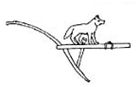 compared to the Round Denderah image
  and on the Square Denderah image
 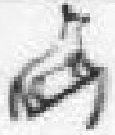 which White claims, "The Plough seems to play a central role in the cosmology of the heavens. Its specific symbolism is derived from farming traditions where the seed-plough was suspended from the rafters of a barn when not in use. In this analogy, the barn's rafters represent the highest reaches of the heavens and the 'peg' from which the plough was hung marked the pole of the ecliptic, the eternal center point of the heavens, around which the celestial north pole revoloves over the course of nearly 26,000 years. The Wolf is probably placed here to gnaw on the rope-work suspending the plough from its peg. Like the other celestial ropes already seen among the circumpolar stars we may suspect that this ties together the different levels of the cosmos, and when the Wolf finally gnaws through it, the end of a world-age will come to pass.
An equally significant aspect of the Plough is revealed when we realize that it is in fact a seed-plough, a technological development of the typical soil-breaking plough that was used to plant seeds directly into the furrow. Its sexual symbolism, implanting seed into the feminine furrow, is perfectly obvious and is made explicit in some of the Plough's astrology omens where it is used to represent the overly masculine planet Mars."
Other names associated to the constellation Ursa Minor:
- Banat' Na'ash al Sughi'a, Al Fass, Elrucca'bah, Geidi, Al Dubb al As'ghar, Dub Alasgar, Dhub Elez'guar, Dou'be, Dob'her, Al Kau'kabal Shamali'yy, Al Kib'lah, Al Kutb al Shamali'yy, Al Raka'bah, Reicchab'ba (Beta), Al Rukkabah.
- The Orsa Minore of Italy, Petite Ourse of France, and Kleine Bar of Germany.
- Alrucaba, or Alruccaba, which probably should be Al Rukkabah, is first found in the Alfonsine Tables, although the edition of 1521 applied it only to the lucida (alpha, Polaris). While this generally is supposed to be from the Arabic Al Rakabah, the Riders, Grotius asserted that it is from the Chaldee Rukub, a Vehicle, the Hebrew Rekhubh; and, if so, would seem to be equivalent to the Wain and from the Hebrew editor of Alfonso. Others have thought it from Rukbah, the Knee, as beta always has marked the forearm of the Bear, and Alrucaba, in a varied orthography, was current for that star some centuries ago, as it is now for Polaris. Riccioli gave a queerly combined name for the constellation, Dubherukabah; and Bayer had Eruccabah, ending his list of titles with Ezra, a blunder in some connection with the commentator Aben Ezra, whom he often cited as an authority; still Riccioli followed him in this.
- The Arabs also likened the constellation to a Fish, while with all that nation, heathen or Muhammadan, it was Al Fass, the Hole in which the earth's axle found its bearing.
- The Arabians knew Ursa Minor as Al Dubb al Asghar, the Lesser Bear, — Bayer's Dhub Elezguar, and Chilmead's Dub Alasgar, — although earlier it was even more familiar to them as another Bier; and they called the three stars in the tail of our figure Banat al Na’ash al Sughra, the Daughters of the Lesser Bier.
- Plutarch said that with the Phoenicians it was Doube or Dobher (?), similar to the Arabian title, but defined by Flammarion as the "Speaking Constellation," — better, I think, the "Guiding One," indicating to their sailors the course to steer at sea.
- to the Chinese it was Peih Sing.
See Star Names for Ursa Minor
This file last updated on July 15, 2008, and March 30, 2010.
Return to the Table of Contents or the Zodiac of Denderah