From The Alpha and the Omega - Volume III
by Jim A. Cornwell, Copyright © July 20, 2002, all rights reserved
"Volume III - The Tenth Month - Constellation Names for Aquila"
In the Tenth Month - Capricornus.
Aquila, the Eagle
The constellation name for Aquila:
- Sumerian Á.MUSHEN, Akkadian Erû, "The Eagle," in Aquila; which is seen in the Sumerian as (á, arm, wing, strength + mušen, bird), "The Strong Bird," not specifically an eagle.
- Sumerian á, áhi, ah5: arm; wing; horn; side; strength; work performance; wages; moment.
- Sumerian mušen: bird (muš, 'reptile', + an, 'sky').
- Sumerian mušen-dù: fowler ('bird' + 'to mould').
- Sumerian hu: bird (earlier word than mušen).
- Sumerian nam-RI-HU: bird breeder (?) (abstract prefix + 'to tend' + 'bird').
- Sumerian RI-HU: bird breeder (?) ('to tend' + 'birds').
- Sumerian hu-luh, ha-luh: to scare; to become scared, frightened ('birds/fish' + 'to sweep away').
- Sumerian anzud(2), anzu(2)-(d)[dIM.MI/DUGUDmušen]: a mythical giant bird; vulture, eagle.
- In his work “BABYLONIAN STAR-LORE: An Illustrated Guide to the Star-lore and Constellations of Ancient Babylonia,” by Gavin White gives this image of a Anzu Bird seen on page 59-61 shown here as
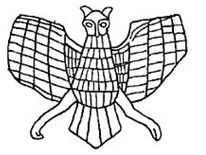 from a Sumerian mace-head where he comments "The Anzu-bird was envisioned as a giantic lion-headed eagle, whose enormous wings were thought to create the winds, stir up storms and cover lands in rolling fog. As a seasonal symbol the Anzu Bird represents the storms of winter; he is the Mesopotamian thunderbird whose spirit pervades the winds.
But the wind represents much more than just weather to the archaic mind. The wind is also breath, and breath is of the nature of the soul. So the winds are full of souls, ghosts and spirits of the dead. Thought of in this manner the Anzu Bird symbolizes the host of discarnate souls ascending into the heavens at the end of the stellar calendar.
By the 3rd millennium the constellation of the Anzu Bird was so ancient that it no longer rose in its correct season. His star was therefore 'killed off', removed from the star-map, and replaced with the newly created figure of the Horse. Even though his constellation image disappeared from the skies his symbolism has passed onto newer constellations further west. His spirit has quite evidently been reborn in the form of the Eagle who carries away the Dead Man. Less obviously his symbolism has passed onto the Panther, who guards the entrance to the underworld; ... and thus in the Greek star-map the Swan, Cygnus, whose outstretched wings and trailing feet are suspiciously similar to those of the Anzu Bird.
In conclusion we can state that the Anzu Bird was probably an ancient Sumerian constellation, probably created in the 5th or even 6th millennium B.C.E., that had gone out of fashion by the time the classical star catalogue Mul-Apin came to be composed. It continued to be used in omens and astrology texts the constellation does not occur in later star-lists, where it appears to have been replaced by the Horse constellation, thus it would have been originally located in the region around Pegasus legs.
The Anzu Bird is written as Mul Dingir Im-Dugud-musen.
In astrology texts Anzu is sometimes identified with Kingu and the Asakku-demon. Kingu was a primeval deity who led the forces of Tiamat against the gods in the Epic of Creation. The Asakku-demon was another primeval creature, the offspring of Heaven and Earth ... described as a hideous monster, a disease-bringing demon that lived in the mountains, and was defeated by Ninurta."
- Sumerian urin, ùri: eagle; standard, emblem, banner; blood.
- Sumerian u5: n., male bird, cock; totality; v., to mount (in intercourse); to be on top of; to ride; to steer, conduct; adj., (raised) high.
- Some sources claim that the Akkadian isu, phonetic syllable of gish; Akkadian is-su-ru, bird, derived from the syllable is.
- One source claims the Sumero-Akkadian Aquila is called Alula, meaning "The-Great-Spirit," a figure found on uranographic stones known as:
- Idkhu Zamama the Eagle, which means "The-Living-Eye," a bird figured on a Euphratean uranographic stone of about 1,200 B.C.
- and/or Erigu, "The-Powerful-Bird."
- Arabs called it Al Tair
, the Great Bird, which is its alpha star.
- Allen stated that while their Al Nasr al Tair, the Flying Eagle, was confined to alpha, beta, and gamma; although this was contrary to their custom of using only one star for a sky figure.
- Grotius called the whole Altair and Alcair.
- Bayer said Alcar and Atair.
In Kish, there is a Babylonian myth where the eagle and the serpent swore an oath to Shamash.
From www.lexiline.com it claims a connection between Sagitta and Aquila, "d.ZA.BA4.BA4, the Eagle TI8.(MUSHEN) and the Corpse, Sumerian (LU).USH, means 'corpse, dead body'."
- Aquila and d.ZA.BA4.BA4, maybe associated with a note that Sargon became the cupbearer to Ur-Zababa, king of Kish or Zababa the warrior of Kish.
In the "Gospel of the Stars," by Joseph Seiss, page 68, Aquila "Some claim the eagle to be Merops, king of Cos, husband of Ethemea, who lamented for his condemned wife and transformed into an eagle and was placed among the stars."
- Joseph Seiss also calls "Aquila, the pierced, wounded, and falling eagle."
- Rolleston calls this, "the Eagle falling."
Job 39:26 "Doth the hawk fly, by thy wisdom."
- Fly.
- Hebrew 'abar, aw-bar', a prim. root, to soar, fly.
Egyptian/Coptic:
- To see more on the Denderah Zodiac for Aquila.
- In his work “BABYLONIAN STAR-LORE: An Illustrated Guide to the Star-lore and Constellations of Ancient Babylonia,” by Gavin White in his reference to Aquila he gives this image of the Eagle which is seen on page 30 shown here as
 compared to the Round Denderah image
  and the Square Denderah image
  , which White claims, "The Greek Eagle (Aquila) is probably derived from the Babylonian Eagle. In their respective traditions both stars are often associated or confused with a vulture; and both birds are carrying another object represented in the stars - the Greek Eagle carries an Arrow (Sagitta) while the Babylonia Eagle probably carried the constellation known as the Dead Man."
White continues on page 48 with this image  and comment, "The Eagle continues the same vein of symbolism as it is seen flying off with the constellation known as the Dead Man. The Eagle could function as a guide to the dead, transporting the Dead Man to the underworld as the Greek Harpies were sometimes thought to do. Alternatively, it may be carrying off the soul of an evildoer for some special punishment - effectively denying him a place in the ancestral realms."
The occasional early title Aquilaris was from the fact that the instrument (Lyre of Lyra) was often shown hanging from the claws of the Eagle (Aquila) also imagined in its stars.
Other names for Aquila: Al Ghurab (Achsasi), Al Mizan, Al 'Okab, Al 'Ukab.
- Persian titles were Alub, Gherges, and Shahin tarazed, the Star-striking Falcon of Al Nasr al Din, but now divided for beta (Alshain) and gamma (Tarazed).
- In the Ilkhanian Tables it was Gups Petomenos, the Flying Vulture.
- The Turks call it Taushaugjil, their Hunting Eagle.
- The Hebrews knew it as Neshr, an Eagle, Falcon, or Vulture; and the Chaldee Paraphrase asserted that it was figured on the banners of Dan; but as these tribal symbols properly were for the zodiac, Scorpio usually was ascribed to Dan.
- To the Arabians the classical figure became Al ‘Okab, probably their Black Eagle, Chilmead citing this as Alhhakhab.
- Al Achsasi, however, mentioned it as Al Ghurab, the Crow, or Raven, probably a late Arabian name.
- Under Libra, Allen states: Arabian astronomers, following Ptolemy, ... but later on, when influenced by Rome, they became Al Kiffatan, the Trays of the Balance, and Al Mizan, the Scale-beam, Bayer attributing the latter to the Hebrews. This appeared in the Alfonsine Tables and elsewhere as Almisan, Almizen, Mizin; Schickard writing it Midsanon.
- French Aigle.
- German Adler (They have a combined title der Adier mit dem Antinous) its southern stars once constituted the now discarded Antinous, and added an arrow held in the Eagle's talons; and Hevelius included a bow and arrow in his description; but on the Heis map the Youth is held by Aquila.
- Italian Aquila.
See Star Names of Aquila.
This file was updated on July 15, 2008, and March 30, 2010.
Return to the Table of Contents or the Zodiac of Denderah