From The Alpha and the Omega - Volume III
by Jim A. Cornwell, Copyright © July 20, 2002, all rights reserved
"Volume III - The First Month - Constellation Names for Perseus"
In the First Month of Aries
Perseus, the Hero, or Rescuer, or the Breaker
The constellation name for Perseus:
- Sumerian SHU.GI, Akkadian shibu, "The Old Man," in Perseus. Note: SHU, is sometimes seen as the island sign.
- Sumerian šu-gi4: old ('hand' + 'to return' ?, 'to lock up' ?).
- Sumerian šu: n., hand; share, portion, bundle; strength; v., to pour.
- Sumerian šú: (cf., šuš(2)).
- Sumerian šu12: (cf., šùde).
- Sumerian gi(4): to surround, besiege; to lock up.
- Sumerian gi4, ge4: to return, come back; to send (back) (with -ši-); to restore; to answer (person to whom answer is given resumed by dative prefix, and with -ni-).
- Sumerian gi: reed; length measure.
- Sumerian gí, gé: reed mat.
- Sumerian gi(n), ge(n): v., to act justly; to stabilize, strengthen; to confirm; to establish something as the property of someone (dative); adj., just; firm; fixed; reliable.
- Sumerian gi(17): n., young man; adj., small.
- Sumerian gi7: (cf., gir15).
- In the Scorpius Introduction we mention the Sumerian dShulgi, which may be associated with the calendar that was reformed in the Ur III period by Shulgi, king of Sumer from 2094-2047 B.C., and seen as (dšul, young man, warrior + gi(n), justice), for "A Divine Young Man/Warrior of Justice."
- Sumerian šul: n., young man; warrior; adj., strong, heroic.
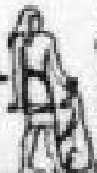
- In his work “BABYLONIAN STAR-LORE: An Illustrated Guide to the Star-lore and Constellations of Ancient Babylonia,” by Gavin White in his reference to the Old Man he gives this image of the Perseus which is seen on page 39 shown here as
 and comments, "I believe that the final group of springtime constellations have a strong calendrical significance as they seem to be purposefully located at the juncture of the old and new years. The constellation of the Old Man depicts an ancestral god that very appropriately rises in month 12, at the very end of the calendrical cycle. At this time of natural abundance the earth was to 'open up' in order to yield her bounty, but to the archaic mind this opening up was accompanied by a host of dangers, chief of which was the potential pollution from the dead who could gain easy access to the upper worlds at this pivotal time. In light of this belief, I would suggest that the Old Man, with his wand and prophylactic head, is banishing the ghosts of the old year and driving them back to the underworld."
A comment from myself about the image of the Old Man is that he is holding the head of Medusa in his hand, therefore the image of the Old Man is definitely connected to Perseus and correlates with the Round Denderah image
and comments, "I believe that the final group of springtime constellations have a strong calendrical significance as they seem to be purposefully located at the juncture of the old and new years. The constellation of the Old Man depicts an ancestral god that very appropriately rises in month 12, at the very end of the calendrical cycle. At this time of natural abundance the earth was to 'open up' in order to yield her bounty, but to the archaic mind this opening up was accompanied by a host of dangers, chief of which was the potential pollution from the dead who could gain easy access to the upper worlds at this pivotal time. In light of this belief, I would suggest that the Old Man, with his wand and prophylactic head, is banishing the ghosts of the old year and driving them back to the underworld."
A comment from myself about the image of the Old Man is that he is holding the head of Medusa in his hand, therefore the image of the Old Man is definitely connected to Perseus and correlates with the Round Denderah image  and the Square Denderah image
  , where we can see that an entity is about to be sacrificed, which White shows on page 31 as
  and claims, "And although Perseus is widely regarded as a purely Greek figure, in the section on the Old Man I argue that the principle elements of his iconography closely relates him to Enmesarra, an ancient Babylonian god associated with the dead and the underworld."
- Sumerian names for stars can be seen with this name associated:
, "The Feet of the Old Man," probably b star named in Arabic Algol, head of the demon).
Sumerian GISH.KAK dEN.ME.SHÁR.RA, "The Cart Pole of EN.ME.SHÁR.RA," (seen also in the Taurus constellation information) probably g Persei (no name).
Sumerian GABA SHU.GI, "The Chest of the Old Man," probably d Persei (no name).
From www.lexiline.com, "The Man, Old One (SHU.GI), d.Enmesharra. SUGI 'member(s) (of a clan), people' distinguished from Sumerian LU.CHUN.GA (Aries) the simple farmworker. One source believes this is the constellation Auriga - [(a)Shu.gi is equal to Auri.ga]."
Perseus was probably from Phoenician origin and not in the early Euphratean lists:
- Perseus carried a severed demonic head with the star Algol.
- Perseus holds the head of the Gorgon in one hand, the star Algol marks the eye of Medusa [head of Medusa] and he has an uplifted sword in the other hand.
- In the oldest texts this head or eye was Sibi, "Double-eye."
- Note the Akkadian shibu, which is the translation of the Sumerian name for Perseus.
- Perseus' name may have derived from Bar-Sav "Son of Hair", "The Hairy."
- This name was found in Homer's Iliad, xiv 320, from 800 B.C.
- He was the founder of Mykenai.
- Hair.
- Hebrew se'ar, say-awr', or sa'ar (Isa. 7:20), sah'-ar, from Heb. sa'ar, saw-ar', to storm, thus in the sense of disleveling hair (as if tossed or bristling).
- Perseus was armed with a sickle-shaped scimitar for the powers of darkness against Cetus.
Egyptian/Coptic:
- On Denderah Zodiac seen above Pisces, Perseus is seen as a male figure with his left hand on the head or behind the head of an animal, which some say is a ram (with a long tail), but looks much like a dog or wolf. Whether it is held by its ears ready for slaughter is unknown. It is also claimed that it is known as Kar Knem, he who fights and subdues.
- One source claims of Perseus, "Beyond the fish's mouth (east fish of Pisces) is a man holding a ram (Gr. Gorgon) by its ears, as if preparing to sacrifice it." See notes in Pegasus for more about the animal.
- In "The Witness of the Stars," by E.W. Bullinger, page 116 "In the Denderah Zodiac His (Perseus) name is Kar Knem, he who fights and subdues."
- Richard H. Allen states: La Lande identified the figure with the Egyptian Khem, and with Mithras of Persia, Herodotus having asserted that Perseus, through his and Andromeda's son Perses, gave name to that country and her people, who previously were the Chephenes, as descended from Chepheus, the son of Belus, identified by some with the Cepheus of the sky. The kings of Cappadocia and of Pontus, similarly descended, represented the Hero on their coins.
Greek myth Perses was the son of Danae and Zeus. He rescued Andromeda, whom he took for a bride.
- In "The Witness of the Stars," by E.W. Bullinger, page 115 "Perseus was known in Hebrew as Peretz, Breaker of Micah 2:13. In the Greek Perses, in Romans 16:13 Perseus."
In the "Gospel of the Stars," by Joseph Seiss, page 98 "Peretz, is the Persian Bershuash."
- As another name for the constellation Bersha'wish.
- Allen claims: Alove probably came, by some error in transcription, from Al Ghul, more correctly applied to the star beta (Algol); while Bershawish, Fersaus, and Siaush are plainly the Arabians' orthography of the Greek title, the letter P not being found in their alphabet.
Hebrew Perets, means "The Breaker," which is the constellation Perseus. As reference to an unknown constellation called Caput Medusa, the head of Medusa in Hebrew means the "The Trodden Underfoot."
- Micah 2:13 The breaker is come up before them: they [the returning Israelites and Jews.] have broken up, and have passed through the gate [i.e. through the gate of the foe's city in which they had been captives. So the image of the resurrection (Hos. 13:14) represents Israel's restoration.], and are gone out by it: and their king ["the Breaker," peculiarly "their king" (Hosea 3:5, Matt. 27:37).] shall pass before them [as did when they went up out of Egypt (Exo. 13:21, Deut. 1:30, 33).], and the LORD on the head of them [Jehovah at their head (Isa. 52:12). Messiah, the second person, is meant (c.f. Exo. 23:20; 33:14; Isa. 63:9).].
- Break.
- Hebrew parats, paw-rats', a primary root, to break out (in may applications, direct and indirect, lit. and fig.) abroad, (make a) breach, break (away, down, forth, up), burst out, come (spread) abroad, compel, disperse, grow, increase, open, press, scatter, urge. This is Jehovah Messiah, who breaks through every obstacle in the way to their restoration: not as formerly breaking forth to destroy them for transgression (Exo. 19:22, Judg. 21:15), but breaking away for them through their enemies.
- Another source claims that Perseus, The Breaker. Micah 2:13 "The breaker is come up before them." The King leads forth before them. Perseus is shown with an uplifted sword in one hand and the head of Medusa in the other. Perseus clearly depicts Christ, born by a miraculous shower of gold, causing his conception: lived his whole life in persecution, but undertook to destroy the dangerous works or the Gorgons, rescued the Church (Andromeda) from her bonds and set her free. He carried her up on High and married her.
- Richard H. Allen comments: His story probably was well known in Greece anterior to the 5th century B.C., for Euripides and Sophocles each wrote a drama based on Andromeda's history; and with them, as with the subsequent Greeks, he was Perseus, a word that may be derived from the Hebrew Parash, a Horseman, although Ctesias, in his Persika of about 400 B.C., had Parsondas as a stellar name from Babylonia that may be this. Parasiea, current in late Indian astronomy, is only another form of the Greek original.
Ippotes (Hippotes), the Horseman, and Profugus, the Flying One, also are titles for these stars.
Hero.
- Sumerian ur-sag: hero, warrior ('young man' + 'first, in front').
- Sumerian šul: n., young man; warrior. adj., strong, heroic.
Other names for Perseus: Almirazgual (Moorish), Alove', Bersha'wish, Algem'o, Cele'ub, Chel'eub, Chel'ub, Fersaus, Hamil Ra's al Ghul, Al Kalb, Sia'ush.
- Allen states the following: Alove probably came, by some error in transcription, from Al Ghul, more correctly applied to the star beta (Algol); while Bershawish, Fersaus, and Siaush are plainly the Arabians' orthography of the Greek title, the letter P not being found in their alphabet. They, however, commonly called it Hamil Ras al Ghul, the Bearer of the Demon's Head, which became Almirazgual in Moorish Spain, and was translated from Ulug Beg as Portans caput larvae, the same being still seen in the German Trager des Medusen Kopf.
- Classical poets called it Pinnipes, referring to the talaria; Cyllenius, the Hero having been aided by Mercury; Abantiades and Acrisioniades, from his grandfather and father; Inachides, from a still earlier ancestor, the first king of Argos; and Deferens caput Algol, Victor Gorgonei monstri, Gorgonifer, Gorgonisue, and Deferens cathenam, from the association of Perseus with Medusa and the chain of Andromeda.
- Seen as the French Persee, the Italian Perseo, and the German Perseus, formerly was catalogued as Perseus et Caput Medusae.
See Star Names of Perseus.
This file updated on July 15, 2008, and March 30, 2010.
Return to the Table of Contents or the Zodiac of Denderah