From The Alpha and the Omega - Volume III
by Jim A. Cornwell, Copyright © July 20, 2002, all rights reserved
"Volume III - Sumerian and Patriarch Ages After the Flood"
Go to the bottom of this page
Sumerian and Patriarch Ages After the Flood
This file is an offshoot of The city of Kish, in the Early Dynastic-I, to make references to information about the ages of individuals.
As can be seen in the following information from my online publishing 1998 - original copyright 1995 - The Alpha and the Omega, Volume I -- by Jim A. Cornwell - Chapter Three page 165.
Noah and the Giants (Anakim or Anunnaki) after the Flood.
Noah's three sons may have brought with them wives, who were not pure descendants of Adam but those of the Anakim (Heb. 'anaqim, sons of Anak, Heb. 'anaq, long-necked) or possibly the Canaanites. Or else after Ham and Japheth eventually became the ancestors of the "goyim," where they combined with the Anakim who survived the Flood. The early Sumerian texts called them Anunnaki, "those who came from heaven to earth." The Anakim as in Genesis 6:4 they are the sons of the sons of God, they are called the Nephilim (uncertain etymology) or giants (Heb. rapha, raphah, Heb. gibbor, mighty, Rephaim of Canaan ancestor of Og, king of Bashan, Emims of the Moabites, Zamzummims of Ammonites, Heb. murmurers, Zuzites (Zuzim) in Gen. 14:5) who were of old, men of renown. This crossbreeding may be the reason why the ancestors believe that sexual relations could affect one's health. One might even suspect that the Anakim were possibly the Greek Gods of mythology "fallen angels" or the original Hebrew "B'nai Elohim" some who did not survive the Flood.
'a n a q -- h a n o kh
Some Talmudic commentaries stated that the Anakim were the sons of Enoch. Enoch (Heb. hanokh, consecrated, Gr. Henoch). Genesis and the Talmud both suggest that the Giants, who resented God for destroying their ancestors, meddled in the affairs of mankind.
Eventually Nimrod seen in Genesis 10:8-10 "And Cush begat Nimrod: he began to be a mighty one (first king) in the earth. He was a mighty hunter (his royal character) before the LORD (Jehovah, Yahweh): wherefore it is said, Even as Nimrod the mighty hunter before the LORD." "And the beginning of his kingdom was Babel, Erech, and Accad, and Calneh, in the land of Shinar." A true king behaves like that of a shepherd. Religiously Genesis 10:8-10 portrays the character in which earthly imperial power first appears in human history.
The name Nimrod (Heb. nimrodh, assumed "rebel"), a descendent of Ham, was responsible for building the city of Babel (Babylon) and the name Nimrod has been plausibly explained as Sumerian (early non-Semitic Babylonian) Nin-Maradda, "Lord of Marad," a town southwest of Kish. If the Babylonian Cush is to be traced to the city of Kish, founded about 3200-3000 B.C. from where the Babylonian emperors of the third millennium B.C. took their royal titles as kings of the world.
The Sumerian King List names the dynasty of Kish with twenty-three kings first in the enumeration of Mesopotamian dynasties, which reigned after the Flood. This individual was the beginning of the kingdom in Babylonia, and he became the founder of Nineveh and other cities in Assyria. He became distinguished as a hunter, ruler, and builder. He lived for an undetermined amount of centuries after the Flood, and was the grandson of Ham. He was a bold man, and of great strength of hand. He persuaded men not to ascribe to God, in order to bring them into a constant dependence upon his own power. He swore to build a tower too high for the waters to be able to reach! Thus avenging himself on God for destroying their forefathers!
Even if we add the 1,656 years to 6,000 B.C. it would equal 7,656 B.C. for Adam's Fall.
Notice that there is a two-thousand year variation in these figures.
If the 365 years, from the first descendants of Shem to the time when Abram left the land of Ur of Chaldees, at which point he was 75 years of age, is subtracted from 6,000 B.C. it only moves us to the year 5,635 B.C. for Abram's entry into the days of Nimrod.
As can be seen in the following information from my online publishing 1998 - original copyright 1995 - The Alpha and the Omega, Volume I -- by Jim A. Cornwell - Chapter Three page 194.
(From Chapter Two)
Noah was the last known man of the Tradition to live close to a thousand years and he saw many generations of men before his death at 950 years old. Noah's youngest son Shem, lived for 600 years. Then in the following generations the life span of men diminished.
In Genesis 6:3, God said, "My life-giving spirit shall not remain in man for ever: he for his part is mortal flesh, he shall live for a hundred and twenty years." Adam's descendants, who were almost immortal, gradually took on a life span within present earthly norm according to Genesis 11.
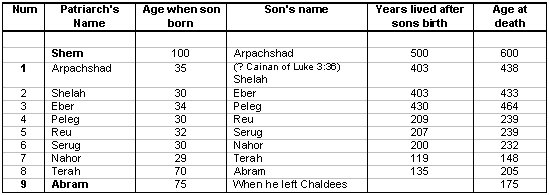
(This starts at Genesis 11:27 and ends at Genesis 25:8)
Eventually, not Abram, but Abraham died at the age of 175 years old in Genesis 25:7-8.
Notice that there were Nine persons involved in this genealogy.
Thus we total 365 years from the Deluge to the time that Abram left the Ur of Chaldees. It is still a mystery to me how the decrease in longevity could occur so rapidly in 365 years. This was a drop from 950 years to an average of 317 years, a 3 to 1 ratio. Think of the effect that Ozone depletion may be causing in our time.
So this implies that the 23 Sumerian Kings of Kish were of another race developing along side of the Biblical patriarchs. Also in my work is the proposal that Abram was a tribe of people who endured from 5,000 B.C. to 2,000 B.C. where Abraham came into the picture.
Other sources such as the Septuagint, equate to 1,093 years from the Flood till Terah begat Abram (Abraham). If one assumes that the Flood occurred in 6,000 B.C. and they deduct 1,093 years this would set Abram's birth at the end of the Age of Gemini around 4,907 B.C.
I would presume that Abram of 3,024 B.C. and Abraham of 2,070 B.C. were two different persons, or tribe, or the same individual at different times, or his genealogy from Arpachshad to Nahor ages at their sons birth are longer than those reported as the 365 years implies or even as Josephus proposes.

This file was created on November 20, 2004.
Go to the top of this page
To return to Volume III - Introduction to the Sumerian Kings List
or the Volume III - New Released Files.
Return to the Table of Contents or the Zodiac of Denderah