From The Alpha and the Omega - Volume III
by Jim A. Cornwell, Copyright © July 20, 2002, all rights reserved
"Volume III - The Twelfth Month - Constellation Names for Andromeda"
In the Twelfth Month - Pisces.
Andromeda, the Princess, or Chained Maiden.
The constellation name for Andromeda:
- Phoenician in origin as Andromeda.
- Babylonian-Assyrian (Semitic) Kakkab Eritu.
- Akkadian Ama or Eme, "The-Constellation-of-the-Pregnant-Woman."
- An epithet of Ishtar-Aphrodite was Mulitta, Babylonian Mulidtu, "The Bearer," probably the original female figure called Adamath, "The Female Earth," "The Ruddy (or Rosy) One," Phoenician Andromeda.
- Greek Andromeda is a figure of a beautiful woman appearing in a seated position, bound with chains upon her hands and feet.
- One source claims it means "the set free from death."
- Another sources claims the Greek means "Man-Ruler."
- In Greek myth Andromeda is the daughter of Cepheus and Cassiopeia (see Triangulum), and became the wife of Perseus, who rescued her from a sea monster (Cetus).
- Princess.
- Hebrew Sarah, saw-raw', the same as Heb. sarah, saw-raw', fem. of Heb. sar, sar, a mistress, i.e. female noble, princess, queen, thus Sarah, Abraham's wife, Sarah.
- Of interest as seen:
- Under Pisces in Andromeda is the Arabic star name a Alpheratz, Alpher'atz "horse's shoulder" or Sir'rah "horse's navel," confirming that this star was once considered part of Pegasus.
- In "The Witness of the Stars," by E.W. Bullinger, page 101 "In the Denderah Zodiac her (Andromeda) name is Set, which means set, set up as a queen. In Hebrew it is Sirra, the chained, and Persea, the stretched out."
- Rolleston claims the "Hebrew Sirra, means the chained."
- Hebrew Saray, saw-rah'ee, from Heb. sar, sar, thus dominative, Sarai, the wife of Abram.
- Sumerian egir2,3, egi(2): princess.
- Chain. (See Pisces and Cetus also)
- Hebrew rabiyd, raw-beed', from Heb. rabad, raw-bad', to spread, a collar, chain.
- Hebrew 'anaq, aw-nawk', chain.
- Hebrew 'aboth, ab-oth', to intertwine, band, cord, chain.
- Greek the word halysis, found in Mark 5:3-4, Luke 8:29 chains are used to bind a demoniac. And also used as an angel binds Satan with a chain.
- In "The Witness of the Stars," by E.W. Bullinger, page 101 "In the Denderah Zodiac her (Andromeda) name is Set, which means set, set up as a queen. In Hebrew it is Sirra, the chained, and Persea, the stretched out."
- Bound.
- Hebrew 'asar, aw-sar', to yoke, or put in bonds, tie.
- Hebrew 'aqad, aw-kad', to tie with thongs, bind.
- Sumerian ulul(2): binding; harness; leash, chain (u, 'ten, many', + lal, 'to strap, harness').
- Bride.
- Hebrew kallah, kal-law', from Heb. kalal, kaw-lal', a primary root to complete, (make) perfect, thus a bride (as if perfect), hence a son's wife, bride, daughter-in-law, spouse.
- Greek numphe, noom-fay', from a primary but obsolete verb Gr. nupto (to veil as a bride, comp. Lat. "nupto," to marry), a young married woman (as veiled), included a bethrothed girl, by implication a son's wife, bride, daughter-in-law.
- Sumerian mí-ús-sá: bride ('woman' + 'to come near to' + 'to equal in value').
- Sumerian munus; nunus(Emesal): female; woman (mí, 'woman', + nuz/nus, 'egg') (cf., mí, nunuz, and nitah).
- Sumerian mí: n., woman; female (cf. also, munus). adj., feminine.
- Sumerian LU.LIM, Akkadian lulimu, "The Stag," Andromeda, Sumerian lu, man. The connection to Andromeda is not easily determined, and may even be in error.
- Sumerian lulim: stag, hart.
- Under Aries we find the note that an adaptation extended the original, or solitary "Horn-Star" (Hamal, alpha Arietis) into Kakkab Lulim
, the constellation of the Ram.
In his work “BABYLONIAN STAR-LORE: An Illustrated Guide to the Star-lore and Constellations of Ancient Babylonia,” by Gavin White in his reference to The Stag he gives this image seen on page 36-37 shown here as 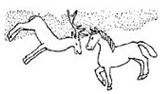 , which White claims, "As mythical symbols the Horse and Stag both represent the rebirth of the sun. This is most clearly seen in the mythology of the horse, whose principle mythic duty is to pull the chariot of the sun. The solar chariot ultimately governs the three major cycles of time recognized in myth - in terms of a day the chariot announces the dawn, in terms of the year it heralds the New Year, and in terms if the whole of creation it celebrates the birth of the sun from the primordial waters of chaos. The Horse was probably chosen for this exalted role because of its speed and its shimmering mane, which was thought to represent radiating beams of sunlight.
The Stag is in many respects a very similar symbol to the Horse; it too has an age-old association to the sun and fire, and like the horse's mane the stag's horns also represent rays of sunlight. The annual renewal of its horns further predisposes it to be a symbol of rebirth, and in the form of the reindeer sledge of Father Christmas, the stag is still honored to this day as the symbol of the sun's wintertime passage. As symbols of solar rebirth the Horse and the Stag are thus very appropriate symbols to find at the very start of the stellar calendar."
Egyptian/Coptic:
- On the Denderah Zodiac above Aries are three connected figures representing (Triangulum) Cassiopeia and Andromeda under Pisces. See Cassiopeia under Aries for more information on it.
- Some claim these to be seen as a goat, baboon and hawk.
- The first figure to the lower left is a goat-like animal with its back against the figure to the right, which some claim is a baboon with a long tail, but it has the appearance of a dog, the same which is seen in Denderah Decan 8 and Grand Temple Decan 13, in the same sitting position with hands on its thighs. Perched on top of both of them we see a hawk figure wearing the white crown of Egypt.
- One-source claims, Triangulum "Above the Ram and Fishes is a complex trinity composed of a goat, a baboon, and a hawk with the white crown on its head. These three represent material, physical and spiritual consciousness." "They are bonded to Aries and Pisces at the east fish with the Utchat."
- Others claim that its name is Set, seated as queen.
- In "The Witness of the Stars," by E.W. Bullinger, page 101 "In the Denderah Zodiac her (Andromeda) name is Set, which means set, set up as a queen. In Hebrew it is Sirra, the chained, and Persea, the stretched out."
- In "The Witness of the Stars," by E.W. Bullinger, page 107 "In the Denderah Zodiac Her (Cassiopeia) name is Set, which means set, set up as Queen. ALBUMAZER says this constellation was anciently called 'the daughter of splendor.'"
- One-source states this about Andromeda, "Above the wall ('Wall of the Ruler') Andromeda is bound to a stone and a Tree of Life. Below the wall in the stars, the material soul of the past life is placed at the roots of the same tree. That message is an essential message behind the Osiris-Seker neter and the constellation of the Sculptor at the bottom of the Cosmos."
- Under Pisces we find the following as a reference to the 'Wall of the Ruler':
- O'Neil has the Sumerian as Zi-me (similar to the above sim-mah), which is associated with the Akkadian Zibbati, "Tails," which derives from (zi, life, wall, went out, rise up + me, function, area of power), as if "Deity of Life," or possibly "(Deity) Ruler - of the Wall/Went out or Rose Up from."
- Sculptor is below Cetus and Aquarius to the left of Fomalhaut in Piscis Austrinus. It is a modern constellation.
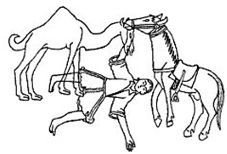
- In his work “BABYLONIAN STAR-LORE: An Illustrated Guide to the Star-lore and Constellations of Ancient Babylonia,” by Gavin White in his reference to Andromeda he gives this image of the Andromeda which is seen on page 31 shown here as
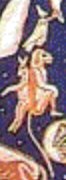
 compared to the Round Denderah image
  and the Square Denderah image
  , which White claims, "The figure of Andromeda may be a misunderstood depiction of Anunitum, 'the goddess of heaven', who is conventionally thought of as the northern fish of Pisces. But she may also have been represented as a mermaid and I believe that the Greeks may have mistakenly reprocessed the mermaid's human element into the wholly human form of Andromeda."
Other names for Andromeda: Ansna'de, Asna'de, Al Arma'lah, Al Mar'ah al Mus'alsalah.
- Richard H. Allen states: Arabian astronomers knew these stars as Al Mar’ah al Musalsalah, their equivalent of the classical descriptive title, — Chilmead's Almara Almasulsala, — for Western mythological names had no place in their science, although they were familiar with the ideas. But they represented a Sea Calf, or Seal, Vitulus marinus catenatus [The common seal is Phoca vitulina], as Bayer Latinized it, with a chain around its neck that united it to one of the Fishes; their religious scruples deterring them from figuring the human form.
See Star Names of Andromeda.
This file was updated on July 15, 2008, and March 30, 2010.
Return to the Table of Contents or the Zodiac of Denderah